1 free read left. Create a free account for unlimited reading + AI research.
Create free account
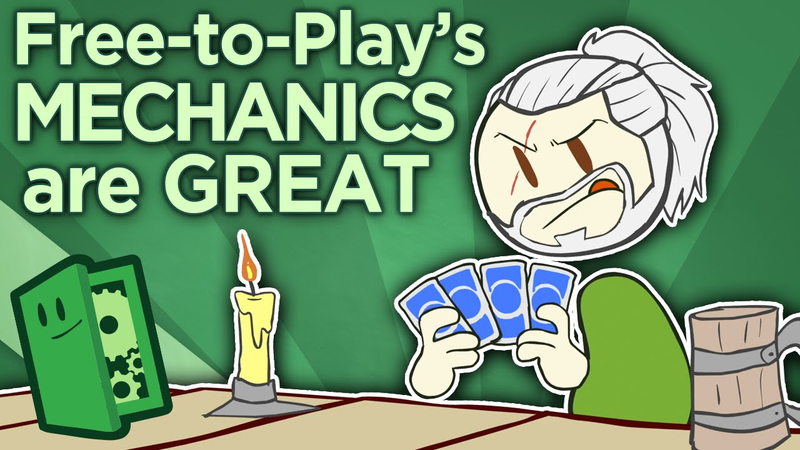
Free-to-Play's MECHANICS are Great - The Mini-Game Revolution - Extra Credits
Key insights
6 takeaways- 01Free-to-play mechanics can be repurposed as engaging mini-game systems by replacing real-world microtransactions with in-game resources earned through standard gameplay.
- 02These systems function as effective resource sinks, offering players meaningful ways to utilize accumulated in-game wealth through optional, self-contained experiences.
- 03Decoupling collection-based loops and strategic progression from financial barriers eliminates the exploitative nature of traditional Skinner box designs while maintaining player engagement.
- 04Integrating acquisition mechanics and armory-style progression into mini-games provides players with a sense of long-term investment, preventing side content from feeling shallow or forgettable.
- 05Successful implementations like Gwent in The Witcher 3 and Blitzball in Final Fantasy X demonstrate that persistent, reward-based mini-games significantly enhance the depth of the broader game world.
- 06Transitioning these mechanics into single-player environments shifts the focus of success from external financial power to player effort, strategy, and choice.
Ask AI about this video
Transcript
All right, so technically the actual title for today's topic should be free-to-play mechanics actually work brilliantly as mini-games so long as you don't actually have to spend money and the game's microtransactions are paid for with currency you earn by playing the game. But, that sure ain't fitting on a thumbnail, so here we are. And yes, by free-to-play mechanics I am talking about those horrible pay-to-win mechanics that have become a blight on the free-to-play model. So, what am I getting at when I say that they function great as mini-games? Well, take Gwent as an example case. Gwent was a fantastic card mini-game in The Witcher 3, one that people loved so much they demanded that CD Projekt Red turn it into a full game. But, if you think about it, Gwent follows all the basic design patterns of a pay-to-win game. There's a fair amount of strategy, but fundamentally if you haven't got a deck of cards with high enough numbers, you just aren't going to win. And of course, the way to get cards with higher numbers is to invest time and money into Gwent. But, this is actually genius because your money
investment is all in-game money, money that The Witcher earns by doing witchery things like slaying monsters and selling loot. And the time investment is mostly time spent running around this big beautiful world getting sidetracked by the million other things to do. This all turns out to be great because fundamentally what they've done is put another RPG style treadmill into their game, but one that's way better than the classic grind for experience system. Because when pay-to-win is all done with fake currency, that's what it becomes, another kind of RPG treadmill. Better still, because this type of treadmill is highly self-guided and a small completely non-integral part of a much larger experience, it doesn't turn into the same Skinner box trap that so many RPG treadmilling systems do. On top of that, serves as a sink for in-game resources, which is something every RPG generally ends up needing. And it's a way for the player to get a massive difference in kind whenever they're looking for one. And it allows the designers to do two powerful things with their mini-game. First, it lets them
create an opportunity for players to play with the strategy that these sort of pay-to-win games provide. Often, any strategy or enjoyment there is to be found in these games gets lost in the fact that you've got to spend a thousand dollars to even meaningfully play them. But as a mini-game, it lets players enjoy searching for the best way to acquire things and continuously get to rethink the best way to apply whatever limited resources they have every time they unlock a new piece of that mini-game's content. It actually creates interesting design possibilities that we don't often get to see fully realized in games without the free-to-play model. But it also means that designers get to put something very important back into their mini-game, persistence. A lot of mini-games end up feeling shallow and like a waste of time because once you finish the mini-game, that's it. You're done. You've unlocked that lock or gotten that bonus or played that song and now it's time to move on. But much of the history of video game design is actually the history of us adding persistence where there was none. Whether it be adding level-up mechanics to multiplayer games or adding player
armories to shooters, designers have found that people like to feel like they got something for their time, even if it's something they might never use and will eventually abandon. Players like to feel that because they fought hard and got that win, that next time around they'll be better or at the very least cooler-looking than they were last time. Tragically, our main go-to approach for this has been just adding experience bars to everything. But the collection and acquisition mechanics taught to us by free-to-play games offer an interesting alternative. Those of you who played a lot of Final Fantasy X, what mini-game do you remember most? I bet it's Blitzball. But depending on how you count it, there were like five other mini-games to play in Final Fantasy X. Do you even remember any of them? I mean, other than those miserable side quests for the ultimate weapons? Screw those things. My point is, an element of a game that you don't even remember, or worse, despise, isn't worth your time and isn't worth the time it took to create. And sure, you can argue that Blitzball had all sorts of flaws with it. It did. But I think it shows us the power of persistence even for mini games, and serves as a serviceable
example because it integrated some of these aspects way before we really even thought of them as associated with a free-to-play world. It shows us where we might go with our mini games, and Gwent shows us that in the modern world, such mini games might eventually even turn into something profitable to create. A good test bed for smaller game ideas. It'll be interesting to see how Gwent does outside of the world of Witcher 3. I'm very curious to see what changes they have to make to keep it from falling into the pay-to-win trap of so many other games of this nature. But if nothing else, it's shown us the value of persistence even in our mini games. Without it, so many of them just become the most forgettable differences in kind. Because the problem with pay-to-win games are threefold. One, there's always somebody with more money out there. Two, there's always better things to spend your money on. And three, getting money is often not that fun in the first place. But in a single-player experience, where the money is earned by playing the game, all of those difficulties disappear. And suddenly, all the mechanics we use for pay-to-win can actually be rewarding and
different. So, let's hope that we can take all the interesting design that we found was possible within the horrible pay-to-win games, and relocate that to the single-player world where it can be enjoyed and used positively. And hey, maybe we'll even manage to sate all consumer desire for those games, and tank the current free-to-play market so that we can get back to doing free-to-play right. Unlikely, I know, but it's a lovely dream. See you all next week.
Summary
Free-to-play mechanics, often criticized for their predatory pay-to-win structures, can serve as highly effective foundations for engaging mini-games when decoupled from real-world currency. By replacing microtransactions with in-game resources earned through standard gameplay, developers can transform repetitive grinding into a rewarding progression system. This approach allows players to enjoy the strategic depth and collection-based loops inherent in free-to-play models without the frustration of financial barriers or the exploitative nature of traditional Skinner box designs.
The primary benefit of this integration is the introduction of persistence into mini-games, which often suffer from feeling shallow or forgettable. By incorporating acquisition mechanics and armory-style progression, developers provide players with a sense of growth and long-term investment. Examples such as Gwent in The Witcher 3 and Blitzball in Final Fantasy X demonstrate that when mini-games offer meaningful, persistent rewards, they become memorable experiences that enhance the broader game world. These systems also function as effective resource sinks, providing players with diverse ways to utilize their accumulated in-game wealth.
Ultimately, the transition of these mechanics into single-player environments resolves the core issues of pay-to-win models, where success is dictated by external financial power rather than player effort. By utilizing these systems as self-contained, optional experiences, designers can foster player engagement through choice and strategy. This shift not only improves the quality of side content but also offers a potential blueprint for re-evaluating how progression and monetization are balanced across the broader gaming industry, suggesting that the most compelling elements of free-to-play design can be reclaimed for more player-centric experiences.
















Comments