1 free read left. Create a free account for unlimited reading + AI research.
Create free accountWhitepaper International Journal of Serious Games
1 free read left. Create a free account for unlimited reading + AI research.
Create free accountWhitepaperInternational Journal of Serious Games
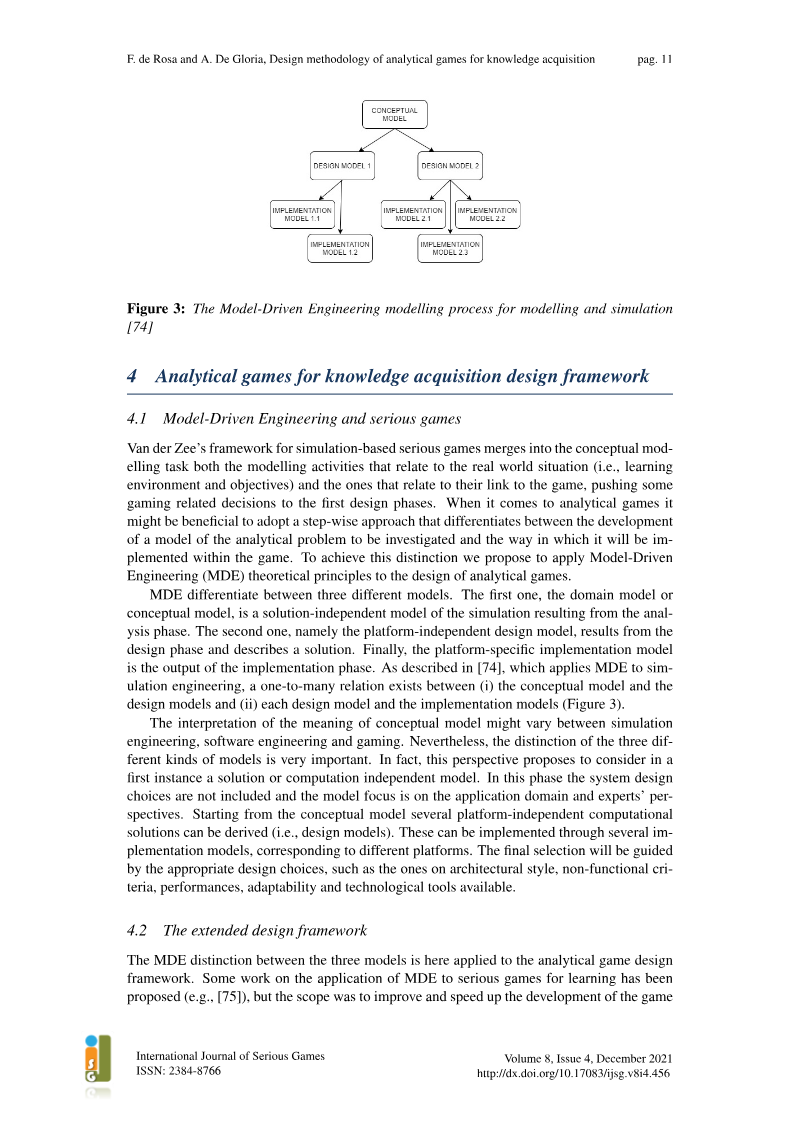
This framework ensures scientific rigor and data integrity by decoupling conceptual problem modeling from platform-specific implementation.
Think of it like designing a building's blueprint before choosing the construction materials.
Distilling the key insights…
Analytical games serve as critical instruments for knowledge acquisition and expert elicitation, yet their development often suffers from an over-reliance on technical platform selection at the expense of rigorous design methodology. To address this, a comprehensive framework integrates Model-Driven Engineering to decouple conceptual problem modeling from platform-specific implementation. This structured approach ensures that games function as cohesive human-system ecosystems, where design choices are systematically mapped across conceptual, design, and implementation layers to maintain scientific rigor and data integrity throughout the development lifecycle.
A central challenge in modern analytical game design is the integration of automation and autonomy. As these technologies fundamentally alter human-system interaction, designers must balance technical feasibility with human-centric factors such as situational awareness, cognitive engagement, and trust. The framework mandates a rigorous assessment of the levels of automation, ensuring that autonomous systems do not inadvertently erode the human-in-the-loop requirements necessary for effective research. By employing iterative feedback loops, developers can evaluate how these technologies influence decision-making processes and overall data quality.
Practical application of this methodology, demonstrated through the transition of the Reliability Game from a physical to a digital environment, highlights the trade-offs inherent in modernizing analytical tools. While automation enhances efficiency and data collection capabilities, it necessitates careful management to compensate for the potential loss of human facilitation. Ultimately, the methodology provides a robust foundation for creating serious games that effectively bridge the gap between complex human cognition and advanced autonomous systems, ensuring that game-based research remains both technologically sophisticated and scientifically valid.



International Journal of Serious Games · 2026

International Journal of Serious Games · 2026

International Journal of Serious Games · 2026
International Journal of Serious Games · 2026
International Journal of Serious Games · 2026



International Journal of Serious Games · 2026
International Journal of Serious Games · 2026

International Journal of Serious Games · 2025
International Journal of Serious Games · 2025
International Journal of Serious Games · 2025

Serious Games Society · 2025


International Journal of Serious Games · 2025



European Conference on Games Based Learning (ECGBL) · 2026

International Journal of Games and Social Impact · 2026
Serious Games Society · 2026