1 free read left. Create a free account for unlimited reading + AI research.
Create free accountWhitepaper DiGRA
1 free read left. Create a free account for unlimited reading + AI research.
Create free accountWhitepaperDiGRA
The authors frame private servers as community co-creation and a lens on keeping games playable once official support ends. This concern grows with internet-dependent Games as a Service models.
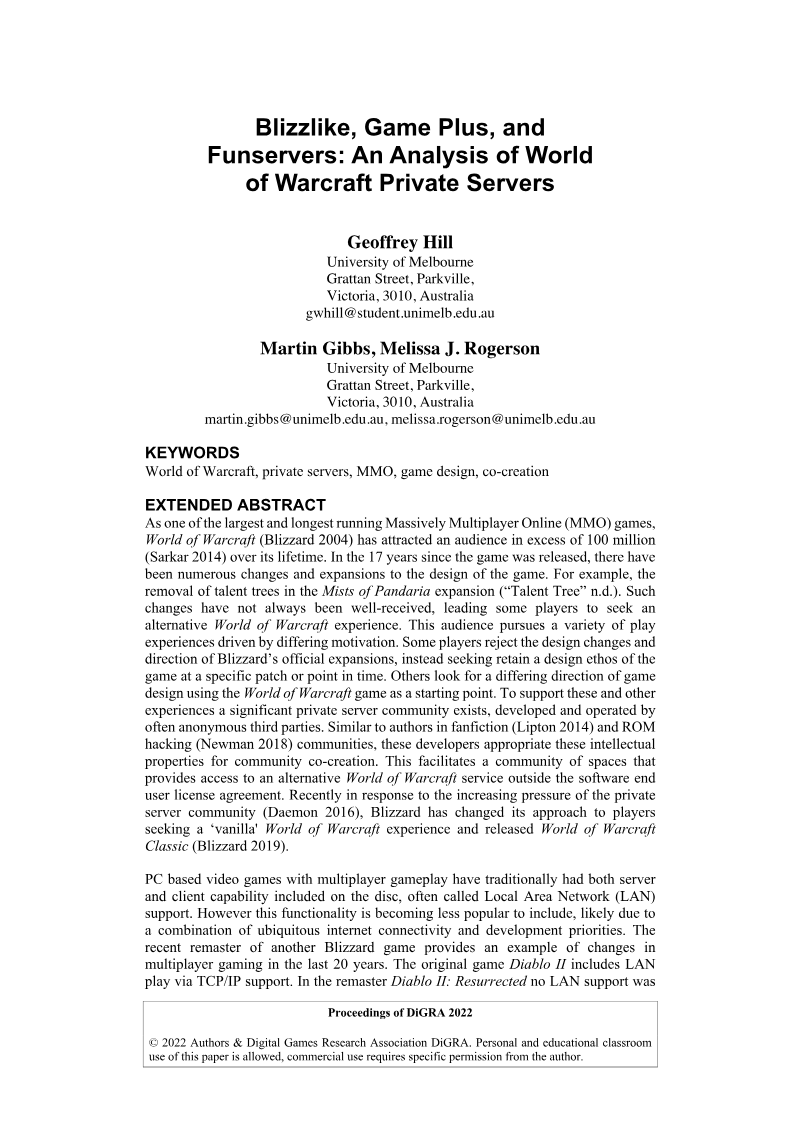
This paper, by researchers at the University of Melbourne, examines the World of Warcraft private server ecosystem, a community of unofficial servers operated by often anonymous third parties that offer alternative versions of Blizzard's MMO outside its licensing terms. The authors frame these servers as a form of community co-creation and use them as a lens on the broader question of how games might remain playable once official support ends, a concern made pressing by the growing dominance of internet-dependent, Games as a Service models. The stated aim is to map the scale of the private server space, identify its components such as server cores, hosting, administration, and marketing, and classify its practices.
The authors divide private servers into three broad types. "Blizzlike" servers attempt to replicate a specific historical version of the game, sometimes following a progressive content-release schedule that mirrors Blizzard's original timeline. "Game Plus" servers keep a base version but extend it with new story, classes, races, and dungeons in the style of the original. "Funservers," the largest departure, take an existing client and rebuild its classes, systems, and environments into substantially different games, in some cases total conversions that draw on Warcraft assets while creating new genres. Examples include Turtle WoW, Ascension, and Shinobi Story, respectively.
The scope of the study is limited by the difficulty of measuring a space that is legally ambiguous, frequently temporary, and often hidden from casual observers. The authors therefore draw their sample from the reddit community r/wowservers, selecting popular servers from that list over the preceding two years, and treat the hundreds of existing servers as a larger, undercounted population. The approach is qualitative and descriptive, relying on case-study examination rather than survey data or quantified user numbers.
The paper's central conclusion is that private server practices are far more diverse and labour-intensive than the common view of them as free-to-play imitations of the official game. The authors argue that this variety remains largely unexplored by researchers and that the phenomenon offers insight into the future of video game preservation and emulation as online dependence increases.
Each row is a game or company this document names, each column a document, oldest first. A mark means that document names it. Select a row to see those documents.



DiGRA · 2023

DiGRA · 2023



DiGRA · 2023

DiGRA · 2023



DiGRA · 2023



DiGRA · 2023



DiGRA · 2023



DiGRA · 2023



DiGRA · 2023



DiGRA · 2023



DiGRA · 2023

DiGRA · 2023
The Game Business · 2026