Updated Jun 1, 2026 by InvestGame
Report
Published by InvestGame
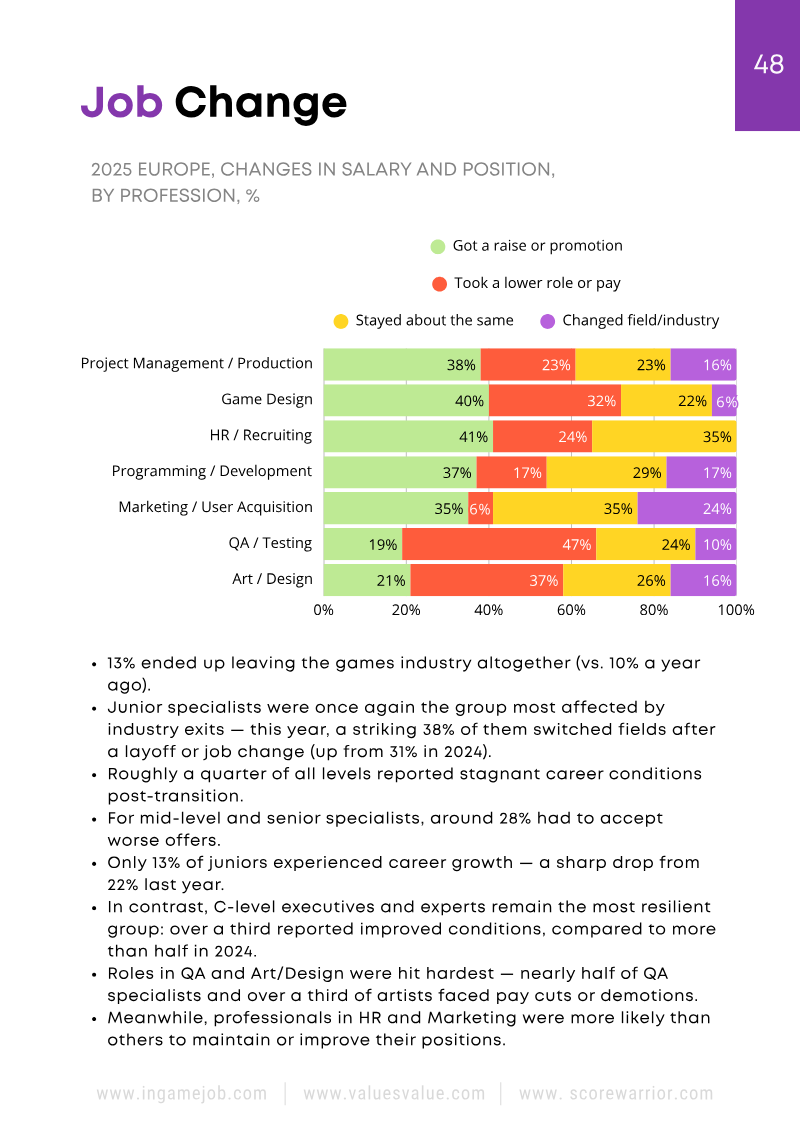
SALARIES, COMPENSATION TRENDS AND STATE OF THE GA w w w. i n g a m e j o b. c o m w w w. v a l u e s v a l u e. c o m w w w. s c o r e w a r r i o r. c o m 26% experienc ed layoffs in the past year, with game designers, artists, and QA spec ialists hit the hardest. 13% left the games industry entirely in the past year. M arketing professionals lead the trend, with 24% switc hing to other industries — the highest rate ac ross all roles.
VALOLS VALUL Big GᴬᴹES INᴰUSTRY EMPLOYMENT SURVEY 2025 SALARIES, COMPENSATION TRENDS AND STATE OF THE GA w w w. i n g a m e j o b. c o m w w w. v a l u e s v a l u e. c o m w w w. s c o r e w a r r i o r. c o m MES SECTOR IN EUROPE D Exclusive sponsor: Exclusive sponsor:
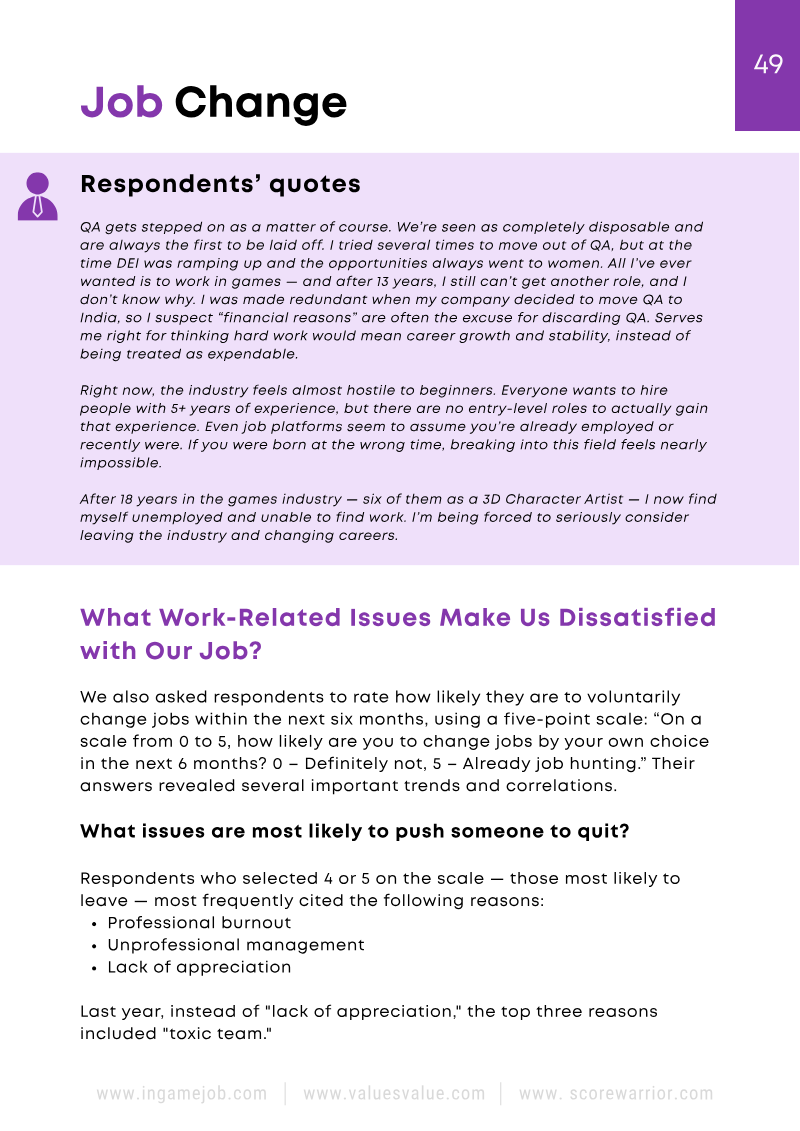
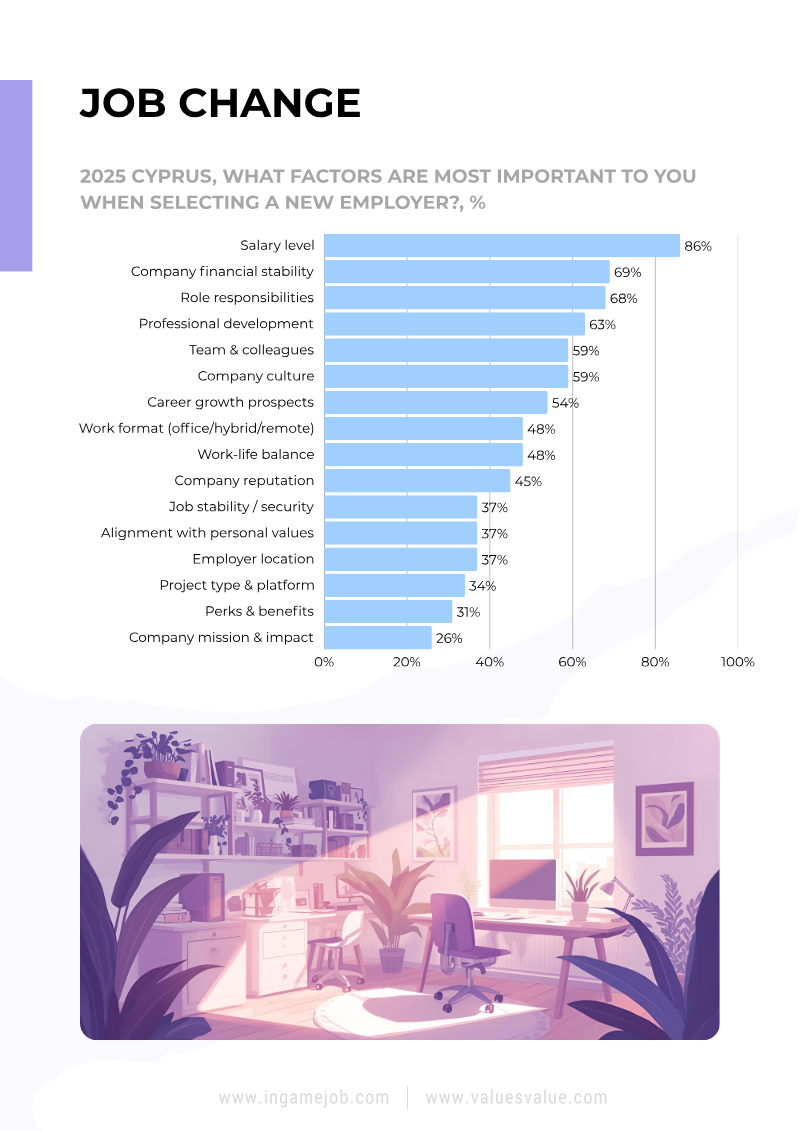
Highlights of 2025 26% experienc ed layoffs in the past year, with game designers, artists, and QA spec ialists hit the hardest. 13% left the games industry entirely in the past year. M arketing professionals lead the trend, with 24% switc hing to other industries — the highest rate ac ross all roles. At the junior level, 39% exited the industry in 20 24 –20 25. 15% have been job hunting for over a year — or are still searc hing. Among programmers, 18% say it takes a year or more to land a new role. When c hanging jobs last year, 28% ac c epted worse terms — either a lower salary or a lower position. Only 1% of respondents are interested in developing hyper- c asual games. Salary remains the top priority when c hoosing an employer for 87% of professionals. Half of all respondents report experienc ing professional burnout. 41% have a personal projec t on the side, most often programmers, game designers, and artists. game designers, and artists. QA spec ialists are the most skeptic al about AI: 24% neither use it for work nor plan to — the highest rate of any role. for work nor plan to - the highest rate of any role.
Introduction & Research Methodology Who c ond u c te d the s tu d y? This study was c onduc ted for the ninth time and the third at the international level. It provides an in- depth look into the European video games industry. A c ollaboration between Values Value and InGame Job, the researc h explores key trends in salaries, job satisfac tion, job sec urity, and c areer development ac ross different roles and regions. Values Value is a rec ruitment expert in hiring top game development talent. InGame Job is an online platform for finding c areer opportunities in the gaming industry. Last year's results were presented exc lusively at devc om Developer Conferenc e 20 24 . You c an watc h the full talk by Tanja Loktionova, founder of Values Value and c o-founder of InGame Job, on YouTube here. Wha t i s thi s s tu d y a b ou t? We’re looking into how sec ure industry professionals feel, foc using on their views on the likelihood of layoffs, their thoughts on switc hing jobs in 20 25, and how many have left the industry due to job c uts. We’re also identifying the groups most vulnerable to these c hanges. Alongside inc ome and job satisfac tion, our researc h explores the ec onomic effec ts of mass layoffs. Respondents also shared whic h c ompanies they’d like to work for and their preferred genres and platforms. As always, a large sec tion of the report is dedic ated to eNPS, broken down by various c riteria.
nc ome and job satisfac tion, our researc h explores the ec onomic effec ts of mass layoffs. Respondents also shared whic h c ompanies they’d like to work for and their preferred genres and platforms. As always, a large sec tion of the report is dedic ated to eNPS, broken down by various c riteria. This helps us understand how fac tors like c ompany type, size, projec t genre, and even the presenc e of a pet projec t impac t employee engagement and loyalty.
Introduction & Research Methodology How wa s the s tu d y c ond u c te d ? The researc h was c onduc ted anonymously from M arc h to June 20 25. A total of 1,650 respondents from 85 c ountries worldwide partic ipated in the study. The data was c leansed of invalid and anomalous salary responses. We analyze only the European region in order to represent valid data for this report. We divide Europe into two regions (European Uni on and Non-European Uni on) bec ause there are signific ant differenc es in the c ost of living, inc ome, expenses, and taxes. This way, we present more ac c urate figures in the salary c harts. For the sake of c larity, the following c ountries were grouped together as the region "Europe (EU+UK+S wi tzerl and)": Austria, Belgium, Bulgaria, Croatia, Cyprus, Czec h Republic , Denmark, Estonia, Finland, Franc e, Germany, Greec e, Hungary, Ireland, Italy, Latvia, Lithuania, M alta, Netherlands, Poland, Portugal, Romania, Slovakia, Slovenia, Spain, Sweden, Switzerland, and the United Kingdom. The size of the sample – 70 9 people. The following c ountries were grouped together as the region "Europe (Non-EU)": Armenia, Belarus, Georgia, M oldova, Bosnia and Herzegovina, M ontenegro, North M ac edonia, Serbia and Ukraine. The size of the sample – 54 3 respondents. size of the sample - 543 respondents.
Introduction & Research Methodology Who p a r ti c i p a te d i n the s tu d y? 56% male, 25% female, 19% other 8% Junior, 24% M iddle, 35% Senior, 29% Lead/Top 21% have over 10 years of experienc e in games 82% have a bac helor's or master's degree, 8% did not finish university, 6% have only a high sc hool educ ation, and 3% have a PhD. Th a n k yo u ! This year, we would like to thank the partners and sponsors of this researc h who supported our initiative: the gaming c ompanies TAP CLAP, Hypercel l, HyperV R, Joyteracti ve, and the rec ruitment agency Tri be. A spec ial thank you goes to our main sponsor, the gaming c ompany S corewarri or. iovtergctiv HYPER CELL Exclusive Partner Lxoiurovoortol
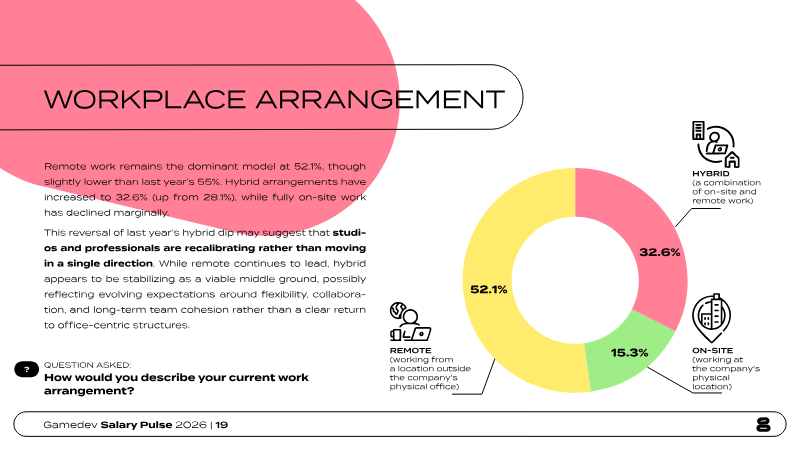
The game development industry is currently navigating a period of profound structural instability, characterized by widespread workforce reductions and a pervasive sense of professional anxiety. Despite the rapid integration of artificial intelligence, the primary driver of current career displacement remains studio restructuring rather than technological replacement. While the majority of the workforce remains employed in hybrid or remote roles, a significant portion of professionals are actively reassessing their career trajectories. This climate of cautious realism is reflected in market sentiment, where nearly 40 percent of industry participants anticipate further decline, leading to increased emotional fatigue and a shift in priorities toward time-based benefits, such as the four-day workweek, over traditional office perks. Geographically, the industry maintains a clear hierarchy in compensation, with North America consistently commanding the highest salary tiers across all seniority levels. In contrast, Central and Eastern Europe continue to function as the most cost-effective hubs for talent acquisition. This regional disparity underscores a broader trend of geographic diversification, as studios balance the need for specialized expertise with the economic realities of global operations. Although the workforce remains mobile, the prevalence of remote work has effectively anchored many professionals, creating a distinct divide where on-site employees demonstrate a significantly higher propensity for international relocation compared to their remote counterparts. The current landscape is defined by a maturing workforce dominated by mid-to-senior level professionals, accompanied by a concerning decline in new entrants. This demographic shift, coupled with the ongoing volatility in employment, has necessitated more flexible recruitment strategies. Studios are increasingly moving away from traditional hiring models, favoring diverse solutions that range from subscription-based flat-fee packages to comprehensive recruitment process outsourcing. As the industry continues to evolve, these data-driven benchmarks serve as a critical framework for both studios and professionals attempting to navigate the complexities of global compensation and shifting labor market dynamics.
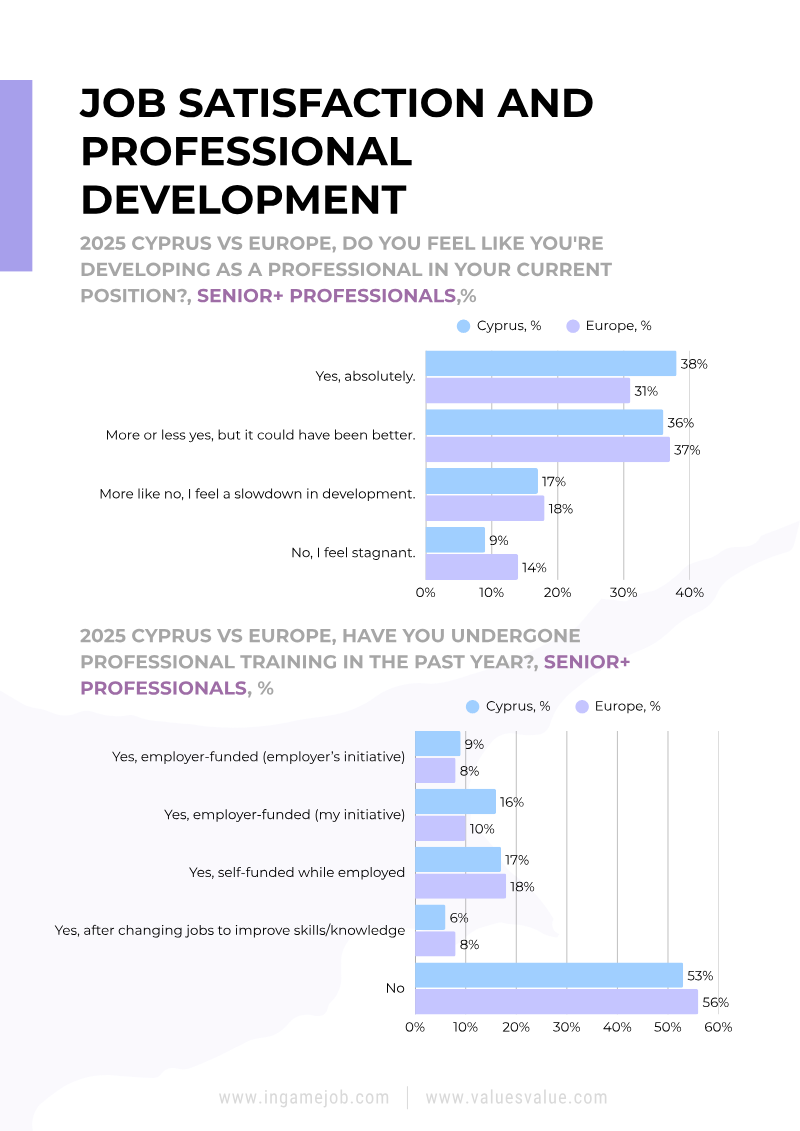
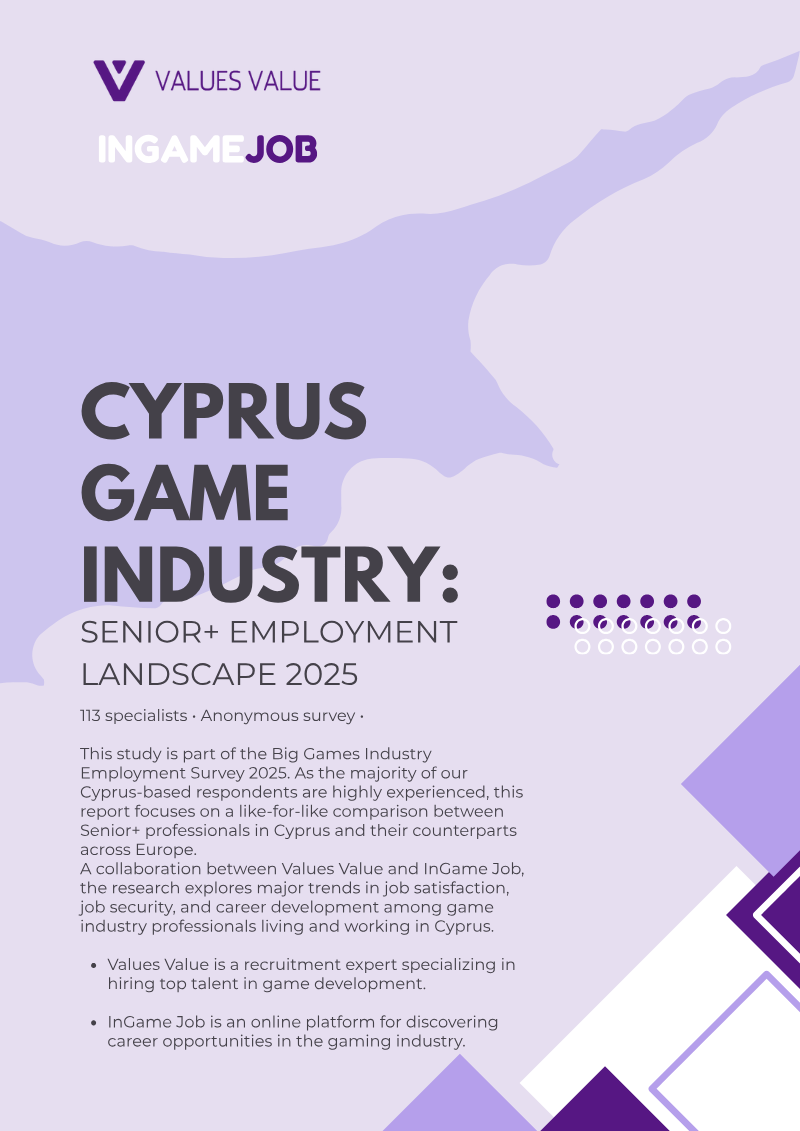
SENIOR+ EMPLO Y: 113 specialists • Anonymous survey • This study is part of the Big Games Industry Employment Survey 2025. As the majority of our Cyprus-based respondents are highly experienced, this report focuses on a like-for-like comparison between Senior+ professionals in Cyprus and their counterparts across Europe.
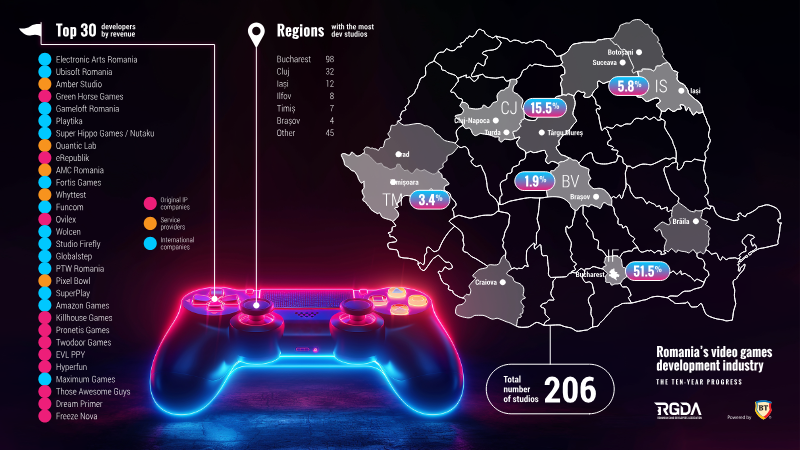
The analysis presents a comprehensive overview of Romania’s video‑game development sector, focusing on revenue performance, geographic concentration, and workforce trends over the past decade. Its central thesis is that the industry has experienced rapid expansion, with total turnover rising from roughly €119 million in 2015 to more than €340 million in 2024, while the number of active studios grew by 70 % within the same period. Revenue concentration is illustrated by a ranking of the top thirty developers, highlighting that multinational publishers such as Electronic Arts Romania (Bucharest) and Ubisoft Romania (Cluj‑Napoca) dominate the market, together accounting for a substantial share of the €340 million total. Mid‑size studios—including Amber Studio (Iași), Green Horse Games (Ilfov), and Playtika (Brașov)—contribute notable percentages, ranging from 5 % to 15 % of overall earnings. The data also maps studio locations, revealing a strong clustering in Bucharest, Cluj‑Napoca, Iași, and Brașov, with emerging hubs in Timișoara, Turda, and Arad. Workforce figures show headcount increasing from 279,986 employees in 2015 to a projected 343,160 in 2024, reflecting a 12 % annual growth rate in personnel. Productivity, measured as turnover per employee, rose by 7.4 % over the ten‑year span, indicating that revenue gains are not solely driven by hiring but also by higher efficiency. Service‑oriented companies and international providers together represent 51.5 % of the sector, underscoring the importance of outsourcing and cross‑border collaborations. The scope encompasses the entire Romanian market, covering all development, publishing, and service activities from 2015 through 2024. Figures appear to be compiled from company‑reported revenues, employee registers, and regional studio counts, suggesting a mixed methodology of financial reporting and industry surveys. Overall, the evidence points to a robust, diversifying ecosystem that is increasingly integrated with the global video‑game supply chain.
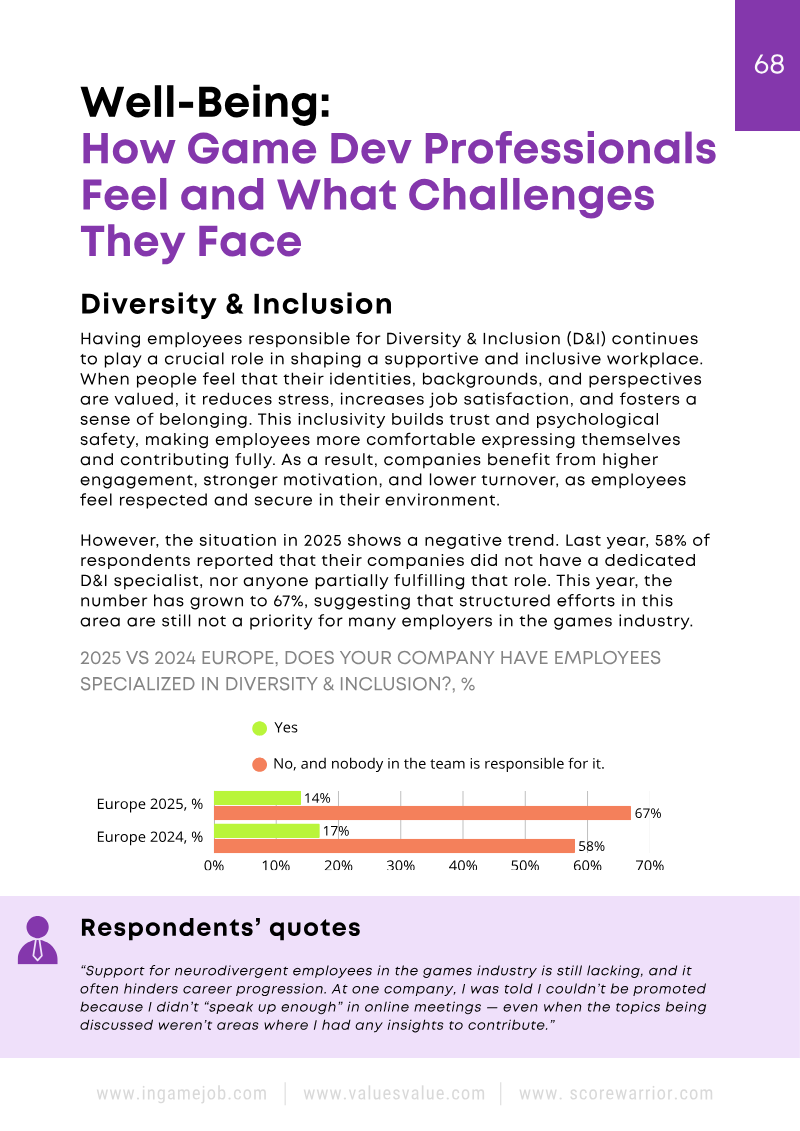
The European games industry entered 2025 in a state of significant distress, characterized by widespread layoffs, stagnant wages, and a sharp decline in employee well-being. Approximately 26% of professionals across the continent experienced layoffs, with junior-level talent bearing the brunt of the instability as 39% exited the sector entirely. This contraction has shifted the labor market from a growth-oriented environment to one focused on cost optimization. Consequently, employee engagement scores have plummeted, and over half of the workforce reports suffering from professional burnout. Financial stability has replaced company mission as the primary motivator for 87% of workers, many of whom are now accepting inferior contract terms or pay cuts to remain employed. Compensation trends reveal a deepening divide based on geography, seniority, and specialization. While median salaries remain highest in the Fighting and MMO genres, reaching up to €90,000 in the EU and UK, a persistent gender pay gap continues to affect technical and C-level roles. Programmers have seen a downward trend in compensation due to increased competition and the rapid integration of artificial intelligence. AI adoption has surged, with over 60% of professionals now using these tools regularly, particularly in analytics and management. However, creative fields like art and quality assurance remain more resistant to AI integration, even as these specific roles face the highest risks of unemployment and long-term job searches. Workplace culture is currently defined by a regression in structured support and a rise in management inefficiency. The number of companies lacking dedicated diversity and inclusion specialists has increased to 67%, while nearly one-third of developers report stagnant professional growth. Although remote flexibility remains a high priority, the shift toward pragmatic relocation suggests that workers are increasingly making career decisions based on cost-of-living calculations rather than traditional ambition. This environment of instability has doubled the rate of long-term unemployment, leaving the European games industry with a workforce that is increasingly disillusioned and prioritized toward survival over innovation.