1 free read left. Create a free account for unlimited reading + AI research.
Create free accountWhitepaper European Conference on Games Based Learning (ECGBL)
1 free read left. Create a free account for unlimited reading + AI research.
Create free accountWhitepaperEuropean Conference on Games Based Learning (ECGBL)
The authors frame the core problem as a tension between games' rigid rule systems and the player agency that convivial tools require. They draw on Illich's concept of conviviality.
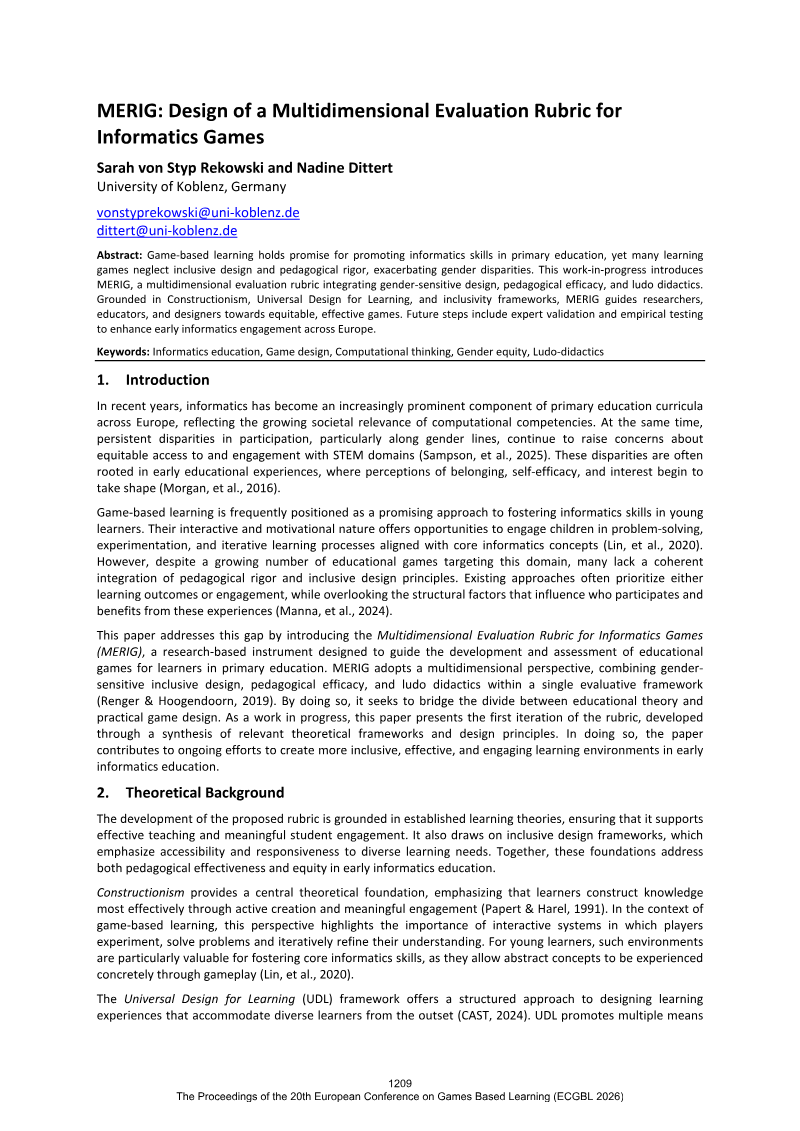
This paper by Meshcheryakova and Hemmert explores whether games can serve as "convivial" tools for civic learning and collaborative thinking about shared futures, drawing on Illich's concept of conviviality, which emphasizes collaboration, self-determination, and joyful interaction. The authors frame the central problem as a tension between games' rigid rule systems and the agency that convivial tools require. To investigate it, they use research-through-design, creating two analogue games that take different approaches to player influence: Narrate, a collaborative storytelling game in which players co-create a story about their town's future, and Remix, a card game in which players can invent and manipulate rules while working toward future-oriented goals.
Each game was tested with two groups, totaling 17 participants aged 17 to 74, recruited through local civic and refugee-support organizations. Sessions lasted two to three hours and combined gameplay with semi-structured focus group interviews. Audio recordings were transcribed and analyzed using deductive thematic analysis, with the two design strategies serving as overarching themes. The sample is small and drawn from a single German city, which limits generalizability, though the mixed backgrounds of participants add some diversity to the findings.
The key result is that narrative-focused design was more effective than mechanics-focused design. Narrate generated engaging discussions, meaningful exchange across age groups, and a strong personal connection to the future being imagined, although participants criticized the decision mechanics for lacking real risk. Remix drew players' attention toward optimization rather than experimentation: participants rarely invented new rules, and the content on future goals faded into the background, leaving many feeling their individual contributions were unimportant. The authors conclude that engaging with the story produced a stronger sense of agency than manipulating tactical rules, and they recommend building in more dialogue and extending sessions into game-making workshops.



European Conference on Games Based Learning (ECGBL) · 2026



European Conference on Games Based Learning (ECGBL) · 2026



European Conference on Games Based Learning (ECGBL) · 2026



European Conference on Games Based Learning (ECGBL) · 2026



European Conference on Games Based Learning (ECGBL) · 2026



European Conference on Games Based Learning (ECGBL) · 2026



European Conference on Games Based Learning (ECGBL) · 2026



European Conference on Games Based Learning (ECGBL) · 2026



European Conference on Games Based Learning (ECGBL) · 2026



European Conference on Games Based Learning (ECGBL) · 2026



European Conference on Games Based Learning (ECGBL) · 2026



European Conference on Games Based Learning (ECGBL) · 2026
European Conference on Games Based Learning (ECGBL) · 2026
European Conference on Games Based Learning (ECGBL) · 2026
European Conference on Games Based Learning (ECGBL) · 2026