1 free read left. Create a free account for unlimited reading + AI research.
Create free accountWhitepaper DiGRA
1 free read left. Create a free account for unlimited reading + AI research.
Create free accountWhitepaperDiGRA
The paper frames digital play as an ontological principle rather than mere entertainment. It treats gameplay as structured by rhythmic attunement, sensory engagement, imagination, and non-linear lived temporality.
This paper proposes a cosmo-phenomenological framework for understanding digital play, utilizing the metaphor of Aiōn from Heraclitus and Fink. The central thesis is that gameplay constitutes a distinct mode of being-in-the-world, characterized by rhythmic attunement, sensory engagement, imagination, and a non-linear, lived temporality. The framework aims to clarify how players inhabit, perceive, and co-create game worlds, expanding existing theoretical models in game studies.
The analysis draws on philosophical concepts from Huizinga, Heidegger, and Fink, who characterize play as an ontological principle and a cosmological symbol mirroring human existence. This perspective positions gameplay as a mode of world-making rather than merely a representational or rule-bound activity. Aiōn, representing continuous creation and dissolution, is applied to digital games to explain how gameplay suspends everyday temporal constraints, generating an experiential world governed by possibility and rhythmic emergence.
Key findings highlight "ludic attunement" as the affective and perceptual adjustment through which players resonate with the game world, involving a coupling of body, sensation, and imagination. Digital play is described as a "sensory-rhythmic field" formed by audiovisual cues, mechanical timing, spatial patterns, and haptic feedback, which structure player perception and action. This field is sustained by the player's continuous adjustment to evolving patterns, indicating a spatiotemporal dimension and a "ludic body" grounding the experience.
The paper distinguishes Aiōn from Chronos, arguing that digital play embodies a non-linear temporality of lived intensities and perceptual condensations, rather than chronological time. This temporal structure is presented as an existential mode that defines play, fostering a free, open-ended spirit. The methodology integrates philosophical hermeneutics with contemporary game studies, drawing on a range of scholars in aesthetics, imagination, spatiality, and sensory flow in games. The scope is theoretical, focusing on the conceptual understanding of digital play without specific geographic or time period limitations, and does not include empirical data or survey results.

DiGRA · 2026

DiGRA · 2026



DiGRA · 2026



DiGRA · 2026



DiGRA · 2026



DiGRA · 2026



DiGRA · 2026



DiGRA · 2026



DiGRA · 2026

DiGRA · 2026



DiGRA · 2026



DiGRA · 2026
European Conference on Games Based Learning (ECGBL) · 2026
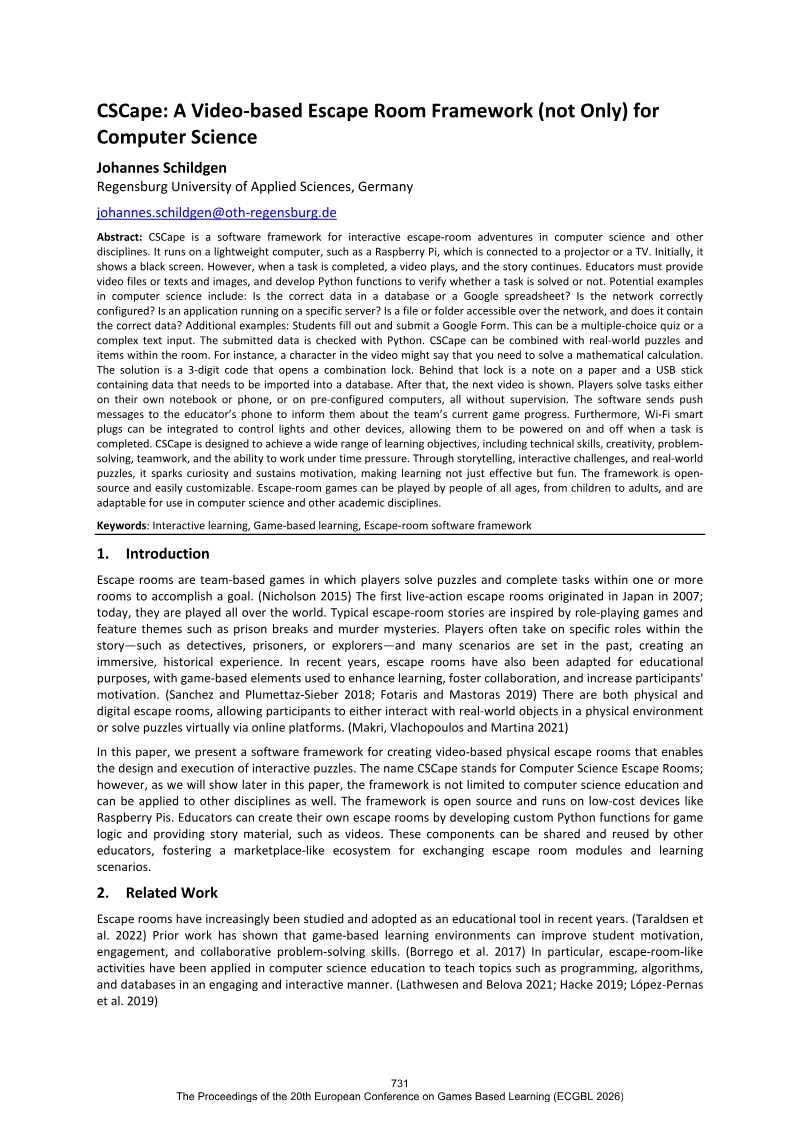
European Conference on Games Based Learning (ECGBL) · 2026

Jason Schreier · 2026







Comments