Key insights
9 slides
The shock
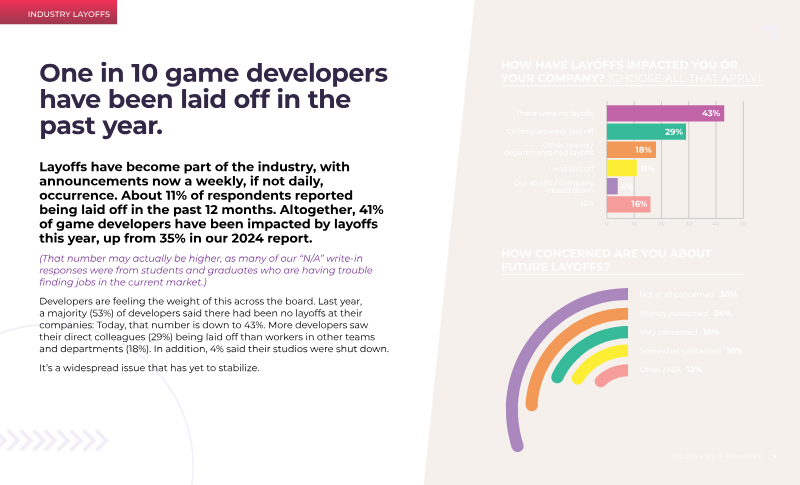
41% of developers were affected by layoffs or studio closures.
The industry entered 2025 with significant workforce volatility. This instability triggered a shift in studio composition.
Page 10 of the reportThere were no layoffs43
Colleagues were laid off29
Other teams / departments had layoffs18
I was laid off11
Our studio / company closed down4
N/A16
Studio shift
AAA representation drops to 15% while solo developers rise to 21%.
The industry is shifting toward smaller teams. Solo developers now constitute 21% of the workforce.
Funding squeeze
56% of all developers now rely on self-funding.
Financial access is tightening as traditional venture capital and publishing deals become scarce.
Self-funding. 56% of all developers and 82% of independent creators rely on self-funding.
Page 31 of the reportSelf-funding56
Publishing deal / Project-based funding28
Government funding / Grants15
Venture capital15
Co-development contract15
Friends or family14
Private investment13
Seed funding11
AI cooling
51% of developers cite ethical concerns about generative AI.
Generative AI adoption is cooling despite 52% of developers using the technology. Concerns center on intellectual property theft and job displacement.
Page 17 of the reportI use them36
No, we have no interest27
Some of my colleagues do16
No, but we're interested9
Don't know7
Other5
Live-service pivot
42% of developers express no interest in live-service games.
The market is pivoting away from the live-service model. Saturation and burnout drive this strategic shift.
Page 26 of the reportNo42
Don't know / N/A29
I already develop live-service games16
Yes13
Crunch returns
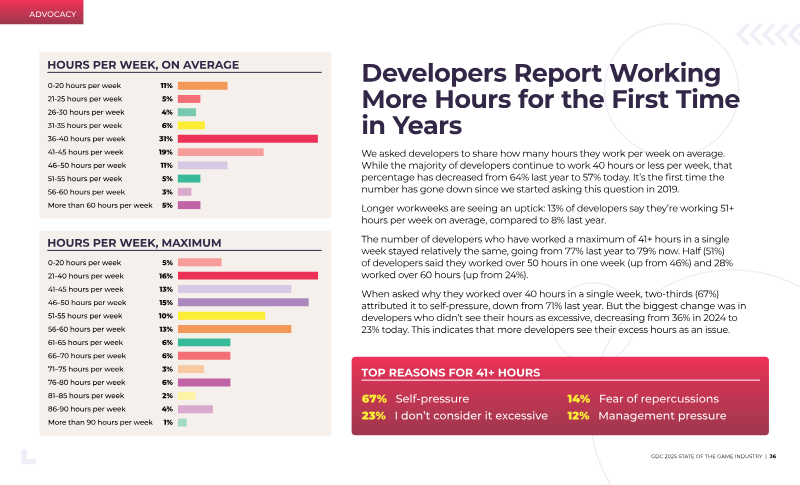
57% of developers work 40 hours or less.
Labor conditions have tightened for the first time in several years. The average workweek is lengthening, and 58% of the workforce supports unionization.
Workweek length. The percentage of developers working 40 hours or less has dropped to 57%.
Environmental risk
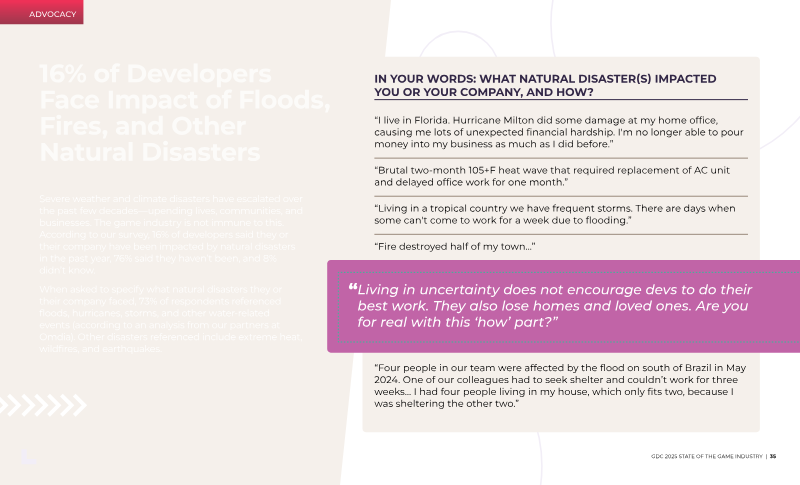
16% of developers report natural disasters impacting productivity.
External environmental factors are becoming a tangible operational risk. Wildfires and floods have directly affected some teams.
Diversifying talent
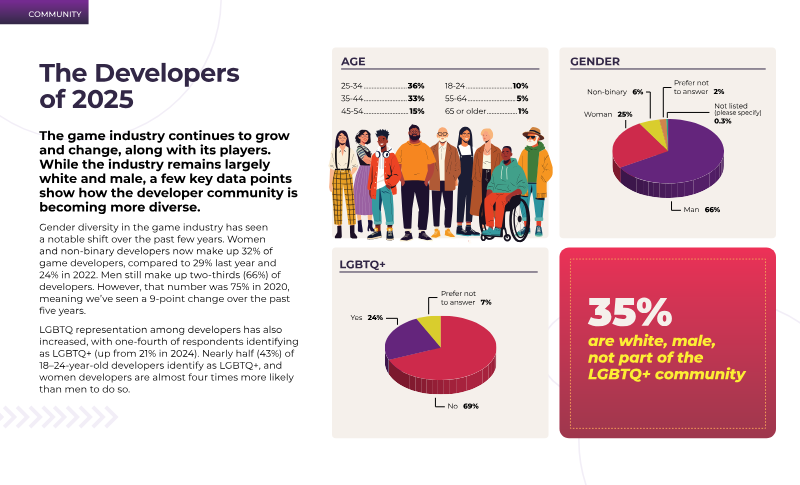
Women and non-binary individuals comprise 32% of the workforce.
The industry continues to diversify despite structural pressures. LGBTQ+ representation reaches 25% of the workforce.
Platform dominance
PC remains the dominant platform for 80% of projects.
PC leads platform usage for current projects. The industry entered 2025 defined by a paradox of technological advancement and structural instability.
PC80
PlayStation 5 (or 5 Pro)38
Xbox Series X/S34
Android29
iOS28
Mac23
Nintendo Switch20
Web browser16
1 / 9
Ask AI about this report