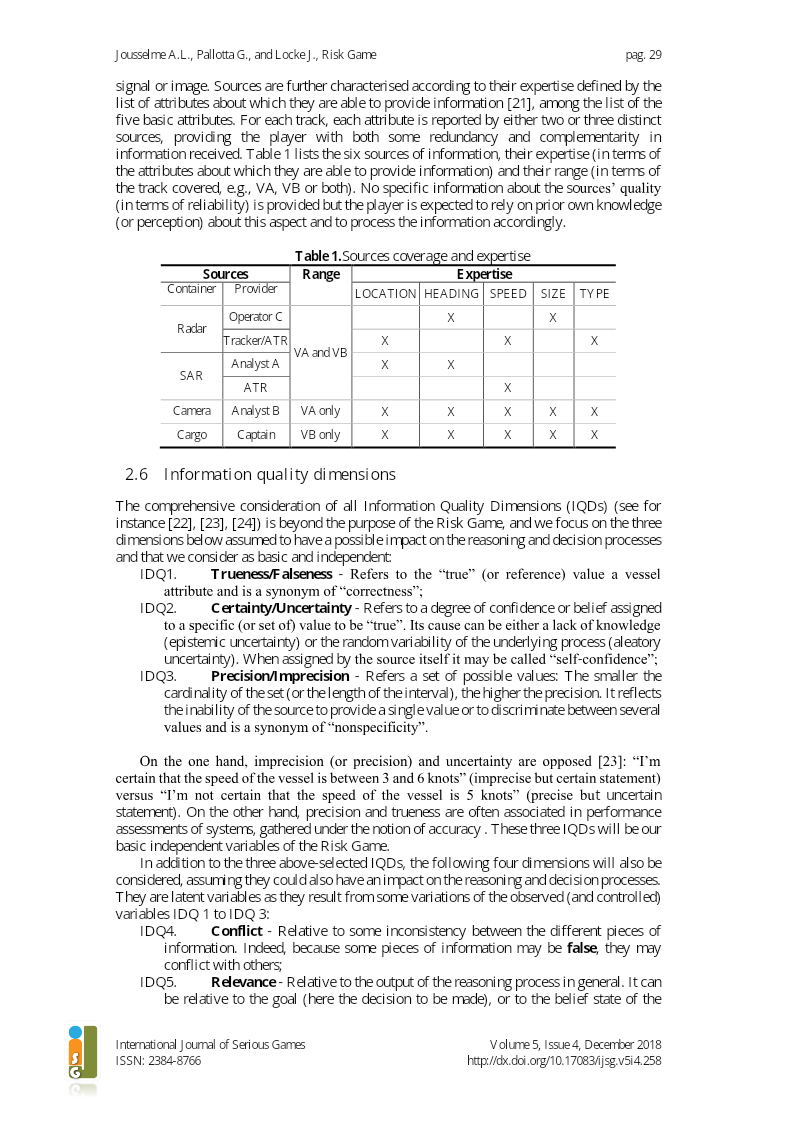
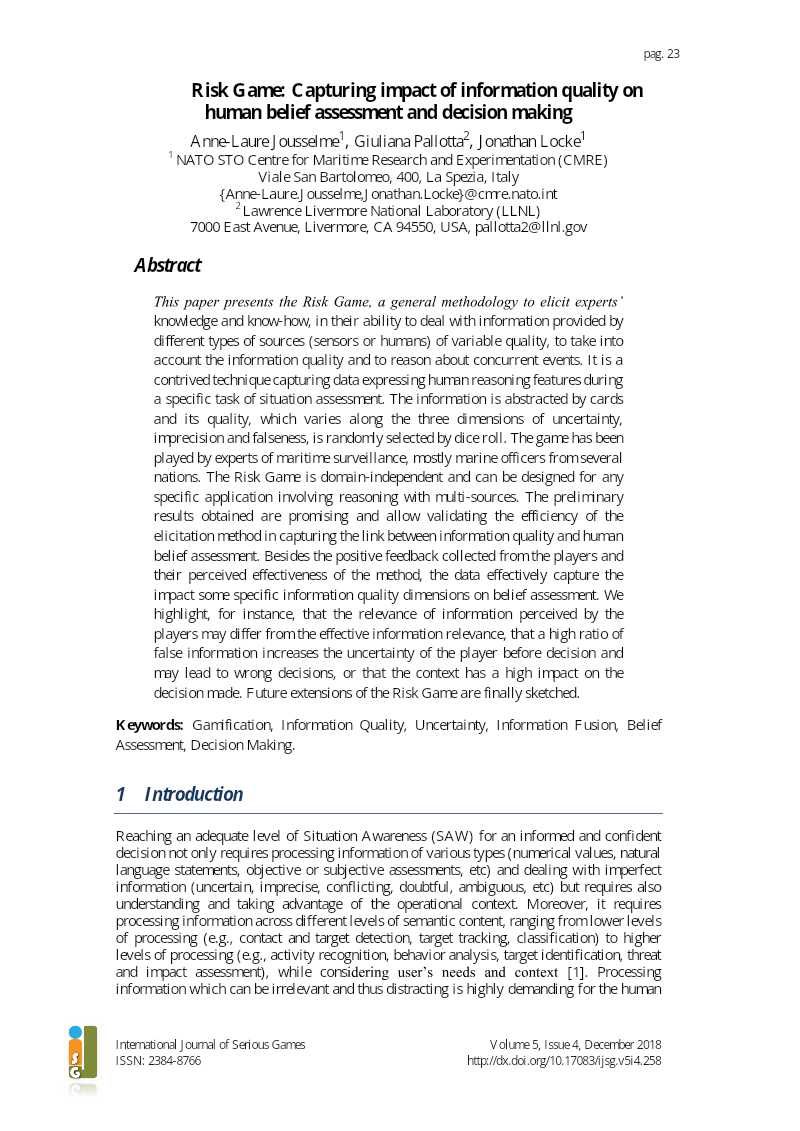
The Reliability Game serves as a specialized serious game designed to investigate the cognitive mechanisms behind situational awareness and belief formation under conditions of uncertainty. By placing maritime subject matter experts within a simulated scenario involving a missing vessel, the research examines how varying source types and information quality influence human judgment. The primary thesis posits that structured, mechanic-driven experimentation can effectively quantify how individuals weigh evidence against competing hypotheses, ultimately providing critical data to inform the development of more robust automated information fusion systems.
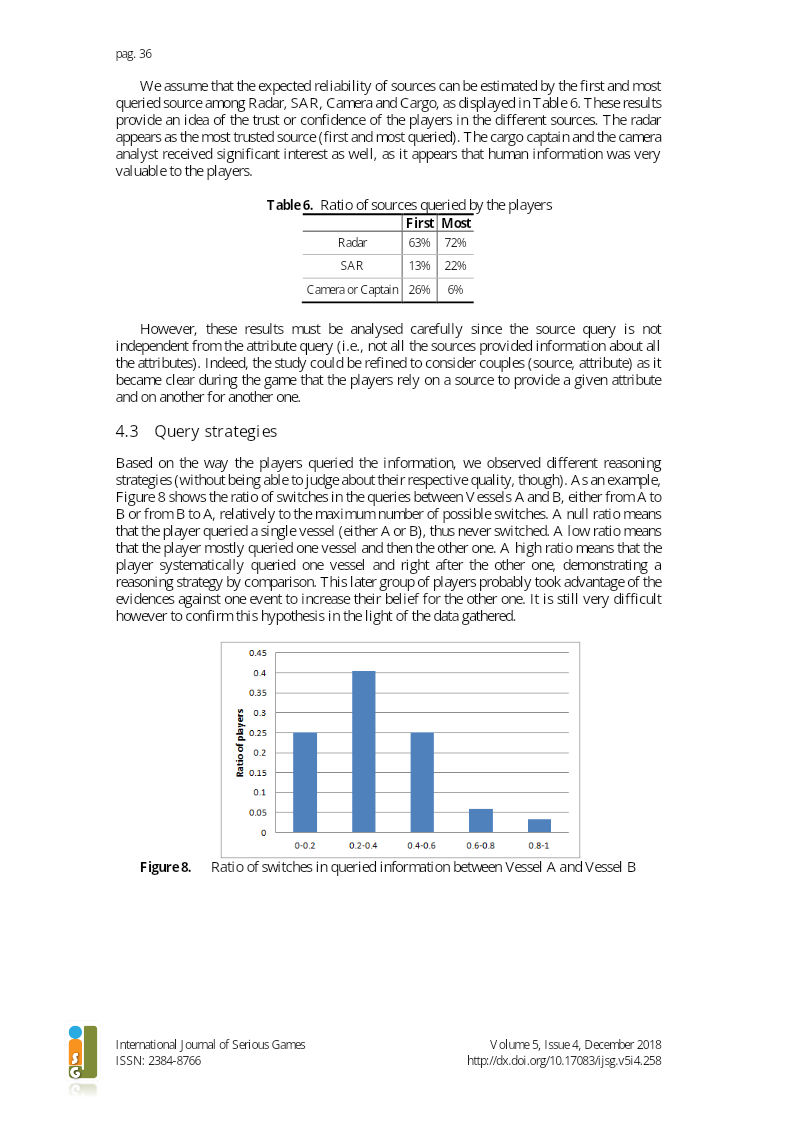
The experimental framework requires participants to evaluate eleven distinct information cards across four rounds, forcing them to categorize evidence against three potential outcomes: no incident, a safety issue, or a security issue. To ensure cognitive rigor and prevent memory-based carryover effects, the game design limits the information set while requiring players to provide explicit confidence ratings for their assessments. Findings indicate that participants generally prefer to exclude specific hypotheses rather than confirm them, and they exhibit a notable reluctance to utilize an unknown rating, preferring instead to commit to a definitive, albeit uncertain, stance.
While the current methodology relies on physical interaction to capture nuanced qualitative insights from experts, the research is transitioning toward a digital format to increase statistical power and scalability. This shift aims to formalize the observed decision-making patterns through evidence theory, bridging the gap between human cognitive behavior and computational logic. Ultimately, the study confirms that the game’s intuitive mechanics successfully capture the complexities of human belief revision, offering a viable pathway for refining how automated systems interpret and process information from diverse, unreliable sources.