1 free read left. Create a free account for unlimited reading + AI research.
Create free accountArticle European Conference on Games Based Learning (ECGBL)
1 free read left. Create a free account for unlimited reading + AI research.
Create free accountArticleEuropean Conference on Games Based Learning (ECGBL)
They tend to underestimate the new relational roles serious games demand of them.
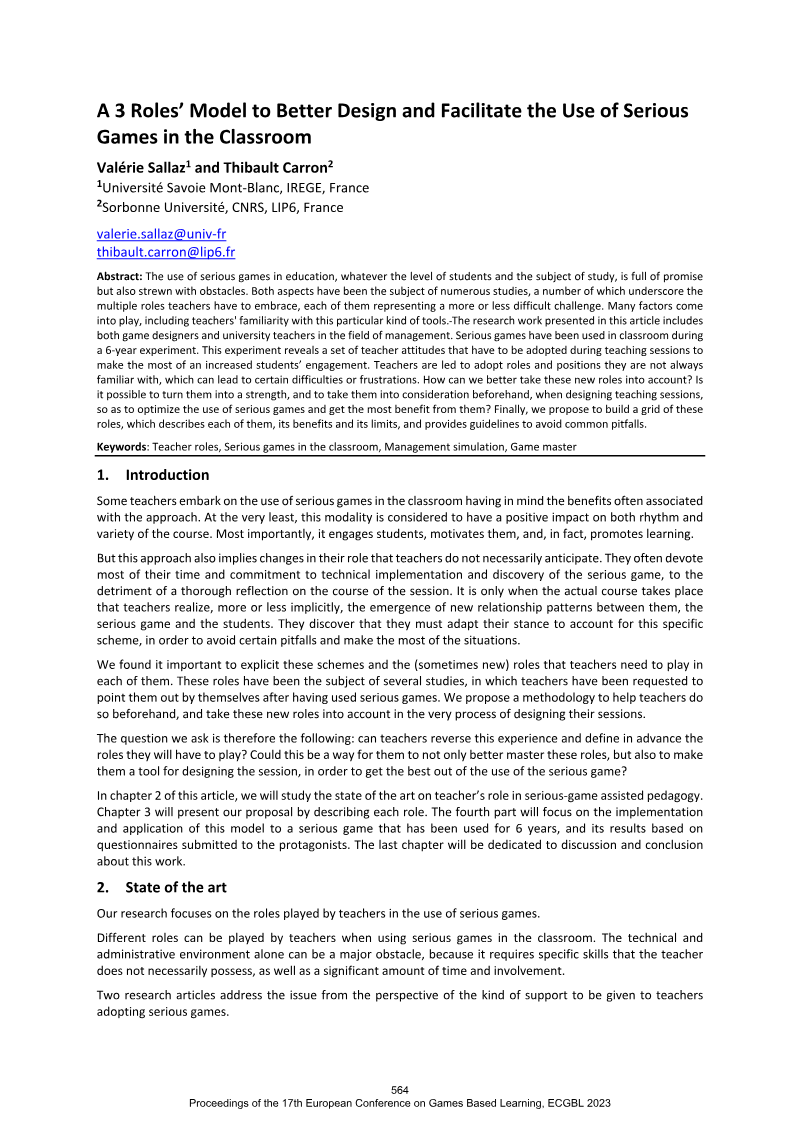
The paper proposes a three-role model to help teachers plan and run serious-game sessions in the classroom: Pilot, who structures the session and keeps it running smoothly; Expert, who connects the game experience to learning objectives; and Game Master, who delivers a genuinely engaging playful experience. The authors argue that teachers typically focus on technical setup and discovery of the game while underestimating the new relational roles the game demands, and that anticipating these roles during design can turn them into a design tool rather than a source of frustration. The model is built on a review of prior taxonomies of teacher roles, which the authors consolidate into a deliberately simplified framework accompanied by guiding questions and best practices for each role.
The model was tested through a six-year classroom experiment in management education, involving three serious games on remote management, conflict management, and feedback, used across roughly 150 students per year in two tutorial sessions. The sessions combined collective play, paired play with instructions, free play, collective debriefs, and theoretical lectures, with scores deliberately disconnected from assessment. Observations reported high levels of interaction and engagement, and the authors note that students tend to focus solely on winning unless given explicit learning instructions.
Survey results from two questionnaires support the approach to a degree. Over four years, more than 80% of students agreed that the serious game made the course more pleasant, lively, and modern. A second questionnaire found that 92% perceived knowledge transmission during the collective simulation as linked to the game, and 81% said a subsequent lecture was clarified by the game. Students' rankings of the sequences they learned most from largely matched those they enjoyed most, which the authors interpret as evidence that students equate pleasure with learning. The study is limited to a single discipline and institution, relies on self-reported perceptions, and is not evaluated against a control condition.



European Conference on Games Based Learning (ECGBL) · 2026



European Conference on Games Based Learning (ECGBL) · 2026



European Conference on Games Based Learning (ECGBL) · 2026



European Conference on Games Based Learning (ECGBL) · 2026



European Conference on Games Based Learning (ECGBL) · 2026



European Conference on Games Based Learning (ECGBL) · 2026



European Conference on Games Based Learning (ECGBL) · 2026



European Conference on Games Based Learning (ECGBL) · 2026



European Conference on Games Based Learning (ECGBL) · 2026



European Conference on Games Based Learning (ECGBL) · 2026



European Conference on Games Based Learning (ECGBL) · 2026



European Conference on Games Based Learning (ECGBL) · 2026



European Conference on Games Based Learning (ECGBL) · 2026
European Conference on Games Based Learning (ECGBL) · 2026



European Conference on Games Based Learning (ECGBL) · 2026