Monetization & Live Ops
Revenue models, in-game economies, retention and live operations.
260 documents
Apptica · 2023
ReportMobile Games: State of the Market & Playtime Benchmarks Q3 2023
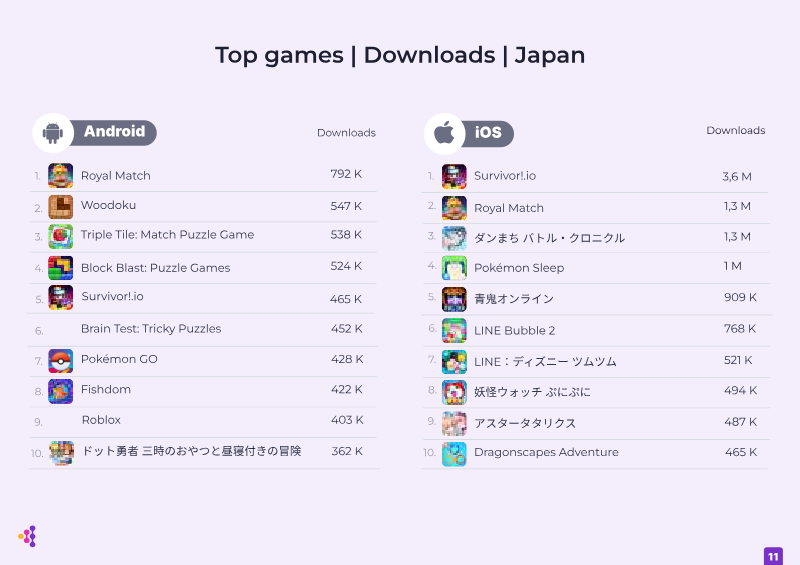
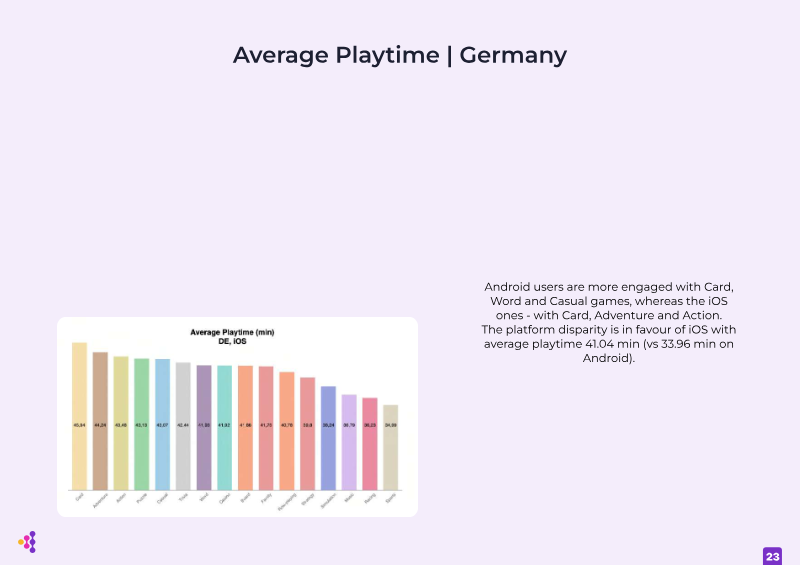
The analysis evaluates the current performance of the mobile‑games ecosystem, concentrating on download popularity, revenue generation, and user‑engagement metrics across key Western and Asian markets. By comparing platform‑specific behavior and regional preferences, it seeks to identify the titles and genres that drive the strongest financial returns and the longest play sessions, thereby informing strategic decisions for developers, publishers, and marketers. Casual‑puzzle and social titles dominate download charts in France, Germany, and the United Kingdom, with Monopoly Go!, Roblox and Subway Surfers leading the rankings. Revenue concentration is even more pronounced: Coin Master repeatedly tops earnings tables, delivering €5.3 million on Android in France and €6.7 million on Android in Germany. Across the surveyed territories, iOS users exhibit markedly longer sessions than Android users, with average iOS playtime ranging from 35 minutes in the United States to 51 minutes in Japan, compared with 29–44 minutes on Android. Japan records the longest sessions overall, while France shows the smallest platform gap of roughly 3.6 minutes. The titles that capture the most playtime vary by region but are largely anchored by the same franchises, such as Candy Crush and other established puzzle series. The study covers major European markets (France, Germany, UK), North America (US) and Japan, reflecting data from the most recent full‑year cycle. It spans the casual, puzzle, and social segments of the mobile‑games industry, highlighting a persistent dominance of a limited set of high‑engagement franchises and a clear platform‑based divergence in user behavior. These patterns suggest that future monetization strategies should prioritize iOS‑centric engagement tactics in markets with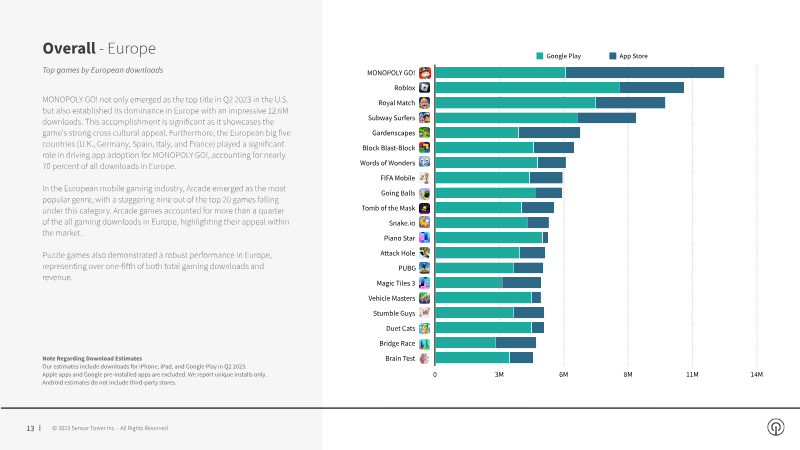

Sensor Tower · 2023
ReportStore Intelligence Data Digest: Q2 2023
Global mobile app performance in the second quarter of 2023 reflects a stabilizing market, with total downloads reaching 34.3 billion despite a marginal 1.5% year-over-year decline. While TikTok maintained its long-standing position as the most downloaded app globally, the quarter was defined by the rapid expansion of the shopping platform Temu, which achieved 74 million downloads and secured a top-ten global ranking. In the gaming sector, established titles like Subway Surfers and Ludo King continued to lead worldwide, though new entries such as MONOPOLY GO! and Honkai: Star Rail demonstrated significant momentum by dominating Western markets and leveraging existing brand equity. Geographic trends highlight a shift in growth centers, as traditional markets like the United States, China, and the United Kingdom experienced download contractions. In contrast, India solidified its status as the world’s largest mobile market, accounting for 24% of global Google Play downloads. Emerging markets also showed resilience, with the App Store seeing double-digit growth in Brazil and Indonesia. While Meta and Google remain the preeminent global publishers, Meta faced regional headwinds in Asia due to regulatory shifts in India that impacted Instagram and Facebook adoption. Sector-specific analysis reveals a transition toward gamification and retention-focused strategies. Education apps, led by Duolingo, successfully utilized streak features to drive high user engagement, whereas the food delivery and streaming sectors faced saturation. Food delivery downloads fell below pre-pandemic levels, and streaming services pivoted toward aggressive monetization and advertising strategies to combat slowing acquisition. Although Netflix maintains a superior 79% retention rate, its low new-user acquisition rate of 3% underscores the broader challenge of maintaining growth in a mature digital landscape.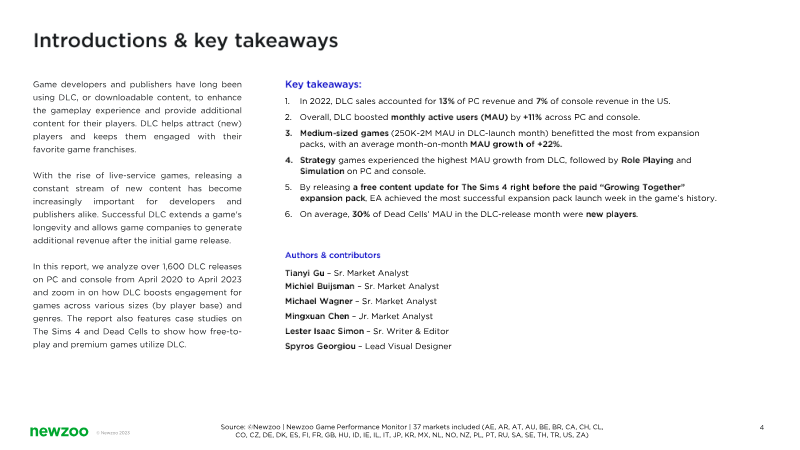
Newzoo · 2023
ReportNewzoo DLC Content Report 2023
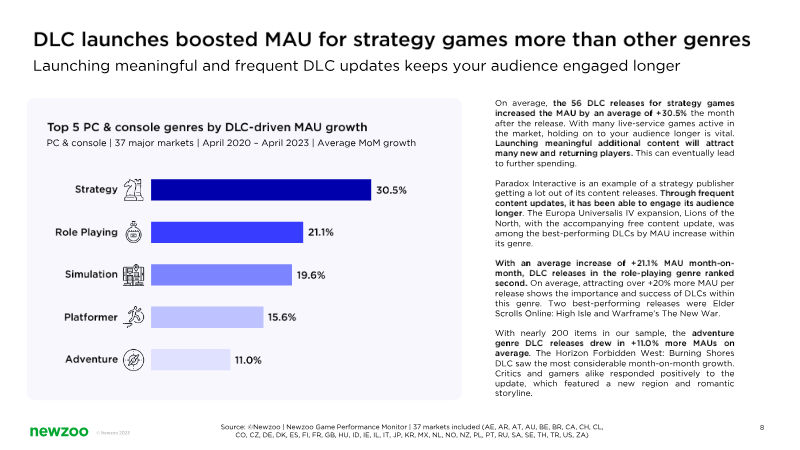
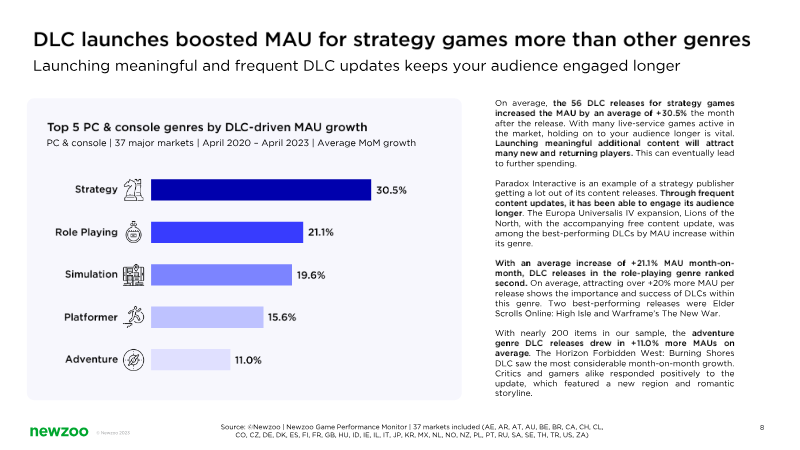
This analysis examines the impact of downloadable content (DLC) on player engagement and revenue across the PC and console markets. Covering the period from April 2020 to April 2023, the study evaluates over 1,600 DLC releases across 37 major global markets. The findings demonstrate that DLC serves as a critical tool for extending game longevity and driving monetization, particularly within the live-service model. In 2022, DLC sales accounted for 13% of total PC revenue and 7% of console revenue in the United States, highlighting a stronger reliance on add-on content among PC audiences. The research indicates that DLC launches provide a significant boost to player activity, with an average increase of 11% in Monthly Active Users (MAU) during the launch month. Medium-sized games, defined as those with 250,000 to 2 million MAU, saw the most substantial benefit, averaging a 22% growth rate. From a genre perspective, strategy games experienced the highest engagement spikes at 30.5%, followed by role-playing games at 21.1%. However, the data also reveals a trend of declining engagement in the months following a release, suggesting that players often churn or move to other titles once they have consumed the new content. Case studies of The Sims 4 and Dead Cells illustrate diverse strategic approaches to content delivery. Electronic Arts successfully utilized a "free-to-play" funnel by releasing a free update immediately before a paid expansion, resulting in the most successful launch week in the franchise's recent history. Conversely, Dead Cells demonstrated the power of crossovers, with its Return to Castlevania DLC driving a 225% increase in MAU. Despite these spikes, the analysis notes that retention remains a challenge, as a significant majority of players do not return for subsequent updates, emphasizing the constant need for fresh content to maintain a stable player base.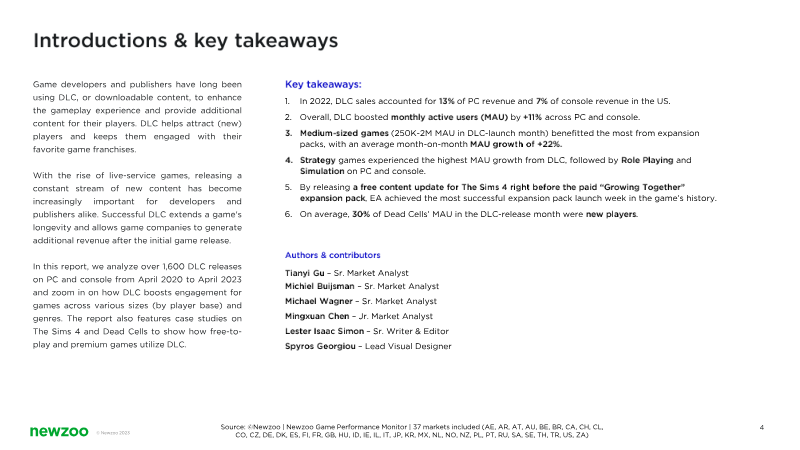
Newzoo · 2023
ReportHow DLC boosts engagement for PC and console games
Downloadable content (DLC) serves as a critical driver for player engagement and long-term monetization in the PC and console gaming sectors. Analyzing over 1,600 content releases between April 2020 and April 2023 across 37 major markets, data indicates that DLC launches provide an average monthly active user (MAU) boost of 11%. This impact is most pronounced for medium-sized games with 250,000 to 2 million MAU, which experienced a 22% growth during launch months. While these releases successfully spike interest, engagement typically declines in the months following the initial release, highlighting the necessity of a consistent content pipeline to maintain player interest. Monetization trends in the United States further underscore the importance of post-launch content. In 2022, DLC accounted for 13% of PC revenue and 7% of console revenue, contributing to a landscape where in-game spending represents nearly half of total industry earnings. Strategy games emerged as the top-performing genre for DLC-driven growth, seeing a 30.5% average increase in MAU, followed by role-playing and adventure titles. These findings suggest that genres requiring deep mechanical updates or narrative expansions benefit most from the DLC model. Case studies of The Sims 4 and Dead Cells illustrate diverse strategic approaches to content delivery. Electronic Arts successfully utilized a "free-to-play" transition combined with a free base-game update to prime the audience for the "Growing Together" expansion, resulting in its most successful launch week since 2015. Conversely, Dead Cells demonstrated the power of high-profile collaborations, such as the Castlevania DLC, which drove a 225% MAU increase. However, the data also reveals a retention challenge, as a significant majority of players who engage with new DLC do not remain active in subsequent non-update months. This emphasizes that while DLC is a potent tool for re-acquisition and revenue, sustaining a permanent player base remains a complex hurdle for live-service titles.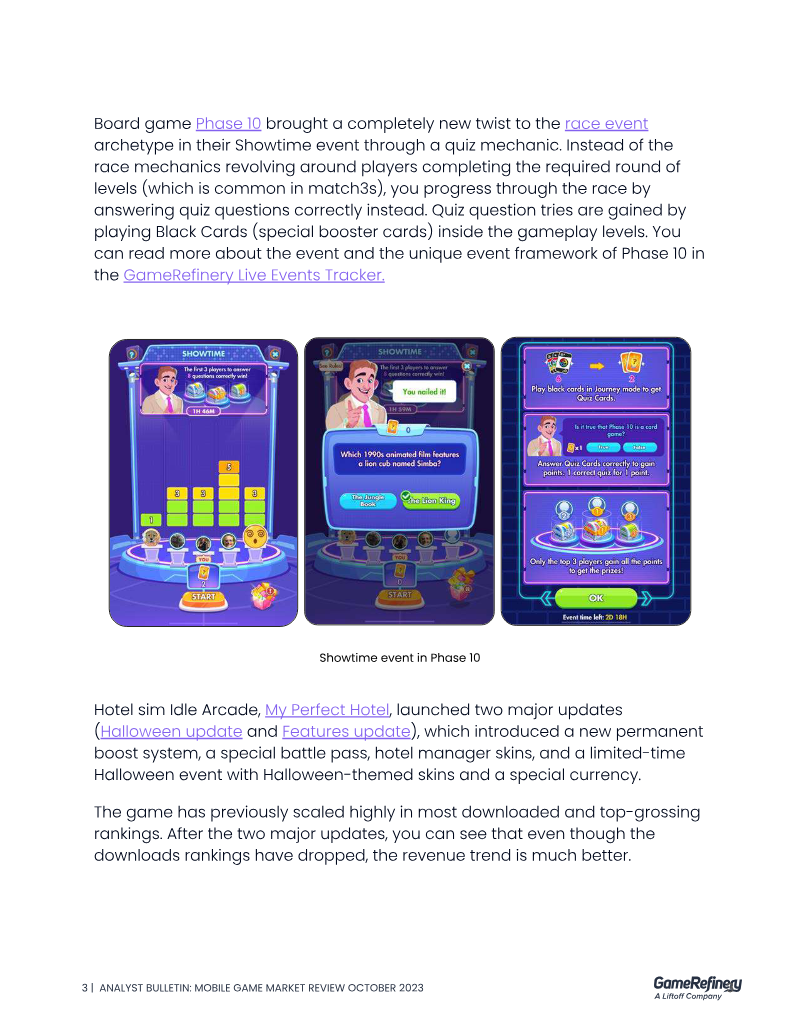
GameRefinery · 2023
ReportMobile Game Market Review October 2023
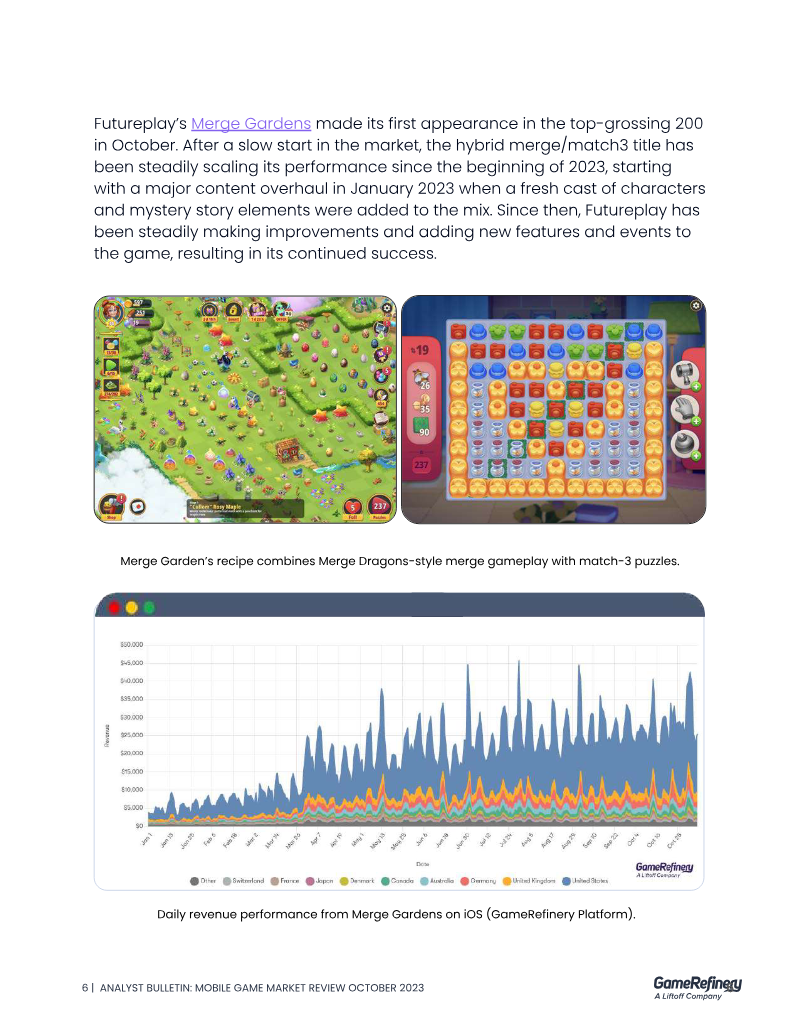
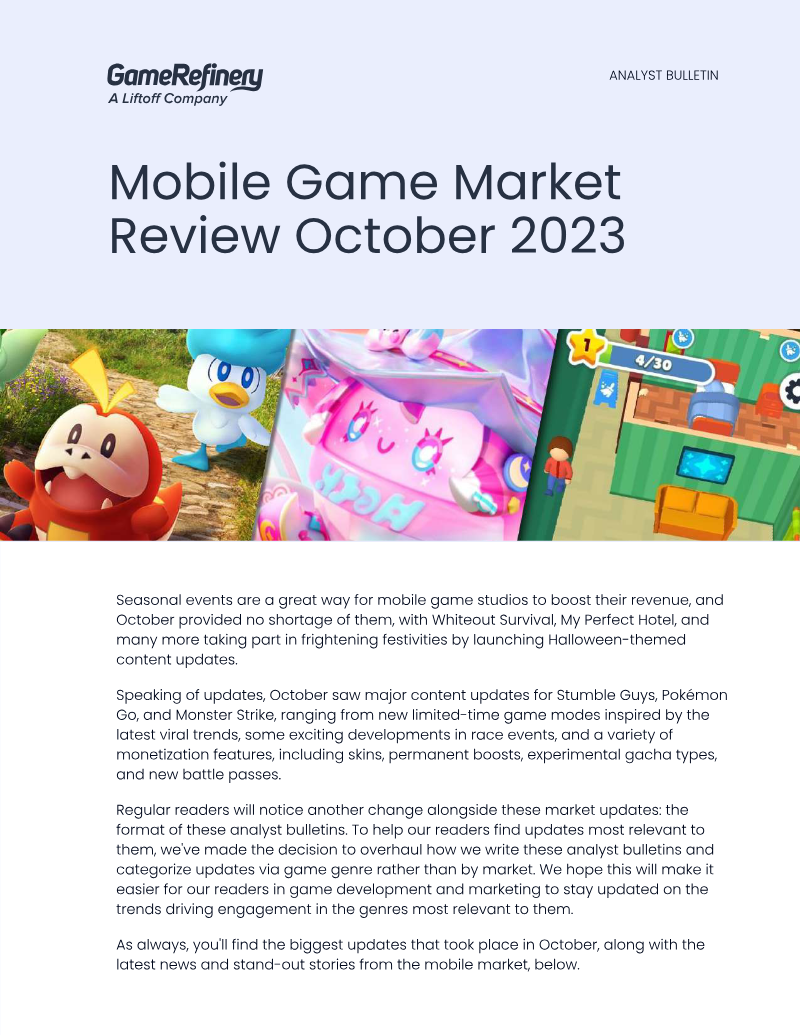
The mobile gaming market in October 2023 was characterized by a heavy reliance on seasonal Halloween content and innovative social features to drive monetization and engagement. Analysis of the period reveals that major titles across the casual and midcore segments utilized limited-time events, crossover collaborations, and experimental gacha mechanics to bolster revenue. Geographically, the review focuses on major global markets, specifically the United States, Japan, and China, highlighting how regional preferences dictate event structures, such as the prevalence of social multi-gachas and location-based business discounts in the Japanese market. In the casual segment, developers increasingly integrated social and competitive mechanics to maintain player interest. Notable examples include Pokémon Go’s introduction of a four-player party system and Eggy Party’s "Pedestrian Street" mode, which emphasizes social hangouts over core gameplay. Data indicates that titles like My Perfect Hotel successfully improved revenue trends by balancing download fluctuations with permanent boost systems and specialized battle passes. Furthermore, the market saw the rise of "challenging" platforming content in the party royale genre, drawing inspiration from viral PC trends to test player perseverance. The midcore sector demonstrated the power of long-term live operations and high-profile collaborations. Monster Strike’s 10th-anniversary celebrations in Japan utilized celebrity partnerships and anime crossovers to maintain its top-tier status. Simultaneously, new entries such as Dungeon Hunter 6 and Reverse: 1999 achieved significant chart positions shortly after launch, with the latter reaching the top 100 in both the US and Japan. The findings suggest a market shift toward hybrid gameplay—such as combining merge mechanics with match-3 puzzles—and the successful localization of high-performing Chinese extraction shooters for Western audiences. Overall, the data underscores that consistent content overhauls and the strategic timing of feature updates remain the primary drivers for scaling performance in a competitive mobile landscape.

Video Games Europe · 2023
WhitepaperPosition Paper: Public Consultation for the Fitness Check of EU Consumer Law on Digital Fairness
The analysis contends that the existing EU consumer‑protection framework is already adequate for ensuring digital fairness in the video‑game sector and should be fully deployed before any new legislation is considered. It calls for a coordinated, holistic approach that aligns the 2021 Guidance on digital services and the enforcement powers granted by the Omnibus Directive, and urges the European Commission to publish clear, ex‑ante guidelines on fair commercial practices. The industry’s self‑regulatory PEGI system, which enjoys roughly three‑quarters consumer awareness and provides age‑appropriate ratings, is presented as a cornerstone of this coordinated framework. Evidence is offered that the current acquis effectively bans manipulative tactics such as bait‑and‑switch and false testimonials, with notable success in the gaming market. Coordinated actions by national consumer protection authorities on in‑app purchases during 2013‑14 and the Italian competition authority’s 2020 commitments on loot‑box transparency illustrate the system’s capacity to curb unfair practices. The analysis warns that forthcoming rules could duplicate or undermine these established mechanisms. A specific argument is made regarding in‑game currencies, which are characterised as non‑convertible digital content lacking real‑world monetary value. Accordingly, they should be exempt from “monetary equivalence” regulations, provided that transparency is achieved by displaying the real‑currency price at the point of purchase and clearly informing players of the transaction details. The overall recommendation is to rely on the existing EU consumer‑protection instruments, reinforced by industry self‑regulation, to safeguard digital fairness across the European video‑game market.
Newzoo · 2023
PresentationPC & Console Gaming: 2023
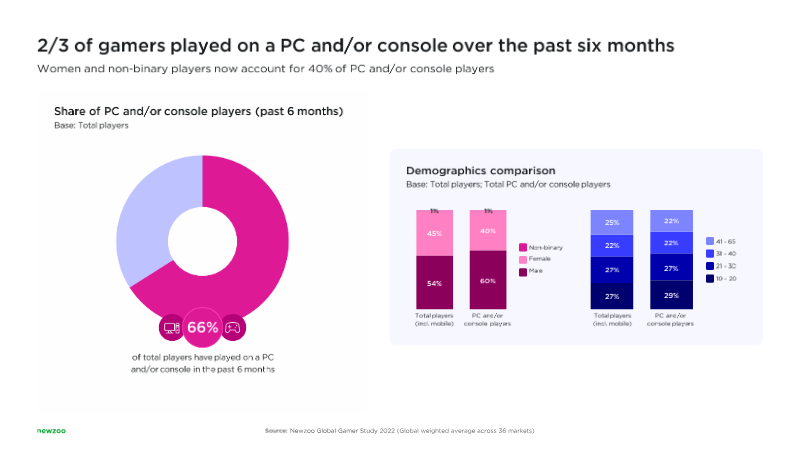
The global PC and console gaming market in 2023 is navigating a period of post-pandemic stabilization, marked by a contraction in total playtime as the industry adjusts from the unprecedented surges observed between 2020 and 2022. Despite this correction, the sector remains significantly larger than pre-COVID projections, outperforming historical expectations by over $32 billion. The current landscape is defined by intense competition for user attention, where established franchises and long-standing titles maintain dominance over new market entrants. To sustain growth in this saturated environment, developers and publishers are increasingly prioritizing engagement-focused strategies, including cross-platform functionality, subscription-based models, and persistent microtransaction ecosystems. A pivotal driver of modern industry performance is the integration of transmedia strategies, as film and television adaptations of gaming intellectual property have proven highly effective at revitalizing engagement and driving revenue for legacy titles. The ecosystem is evolving into a multifaceted social environment where the boundaries between playing, viewing, and social interaction continue to blur. This shift toward a more interconnected, cross-platform experience is supported by improved console hardware availability and a substantial pipeline of delayed software releases, both of which are expected to catalyze growth throughout the remainder of the year. Comprehensive market intelligence, derived from title-level performance metrics, global consumer research, and brand health tracking, remains essential for stakeholders to navigate these shifting dynamics. By synthesizing data on player behavior and market trends, industry participants can better forecast growth trajectories and refine monetization strategies. As the sector matures, the ability to leverage these analytical tools to monitor consumer engagement across both PC and console platforms will be the primary determinant of success in an increasingly competitive global landscape.
Sensor Tower · 2023
ReportThe State of Puzzle Games: 2023
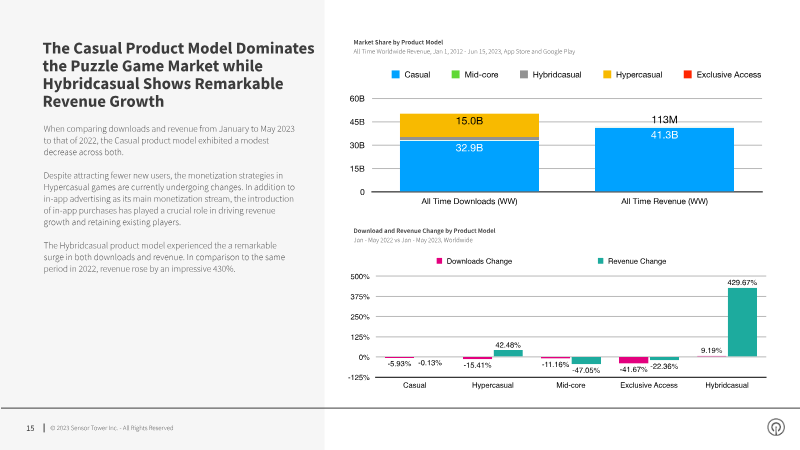
The puzzle game sector is undergoing a significant structural evolution, characterized by a shift in product models and monetization strategies. This analysis, covering global mobile market data from January 2018 through mid-2023, examines the performance of various sub-genres, including Swap, Blast, Merge, and Pair. The primary objective is to evaluate how developers are leveraging meta-features and hybrid monetization to sustain growth in a maturing market. Key findings indicate that while traditional casual puzzle games continue to dominate total revenue, the hybridcasual model has emerged as a primary growth driver. Between early 2022 and early 2023, hybridcasual revenue surged by approximately 430%, signaling a departure from purely hypercasual, ad-supported frameworks. This transition is particularly evident in the Pair sub-genre, where hybridcasual revenue grew from 14.8% to 58.7% of the total within a single year. Conversely, many established sub-genres, such as Real-Time, Chain, and Bubble Shooter, experienced double-digit declines in both downloads and revenue during the same period. Methodologically, the findings rely on consumer spending and download estimates from the Apple App Store and Google Play Store, excluding third-party Android marketplaces. The data highlights that successful titles increasingly integrate complex meta-features—such as narrative storytelling, decoration, and social clans—alongside diversified monetization tools like season passes and loot boxes. While casual games maintain the largest market share, the data suggests that future industry success depends on the ability to blend accessible gameplay with the deeper retention mechanics and hybrid revenue streams characteristic of the hybridcasual model.


Tenjin · 2023
ReportFrom Hyper to Hybrid in 2023
The report examines mobile advertising and in‑app purchase (IAP) trends across Android and iOS platforms from January 2022 through June 2023, focusing on the shift toward hybrid marketing strategies. Key findings show a 23 % rise in Android IAPs and a 24 % increase on Apple, indicating robust revenue growth for both ecosystems. Geographic analysis reveals that India, Brazil, the United States, Indonesia, and Mexico remain the top five Android install markets in both 2022 and H1 2023, while iOS installs shift from China and Japan in 2022 to Canada and Germany in H1 2023, underscoring changing regional appetites. Ad network performance also evolved: Google Ads ascended to the top Android spot in H1 2023, overtaking AppLovin, while Meta entered the top five on both platforms. On iOS, AppLovin moved from second to first place, and Google Ads entered the top five for the first time. These shifts suggest advertisers are reallocating spend toward networks with stronger cross‑platform reach and data capabilities. The methodology relies on anonymized Tenjin data collected between 1 January 2022 and 30 June 2023, with rankings limited to networks and countries exceeding 25 million installs. Tenjin positions itself beyond attribution, offering a data‑science platform, SKAdNetwork reporting, LTV analytics, automation APIs, and cost aggregation to support hyper‑growth for small and medium publishers. The report thus provides actionable insights into platform performance, regional dynamics, and network effectiveness for mobile marketers navigating the hybrid advertising landscape.


Tenjin · 2023
ReportFrom Hyper to Hybrid in 2023 (2023)
The report examines the evolving landscape of mobile gaming in 2023, focusing on the decline of pure hyper‑casual profitability and the rise of hybrid models that blend ad revenue with in‑app purchases. It attributes the downturn to factors such as iOS App Tracking Transparency, post‑COVID user behavior shifts, and stricter publisher gatekeeping that now demands “absolute hit” metrics. Consequently, developers increasingly self‑publish and diversify monetization strategies, incorporating IAPs and meta gameplay elements. Key findings highlight that India leads in ad impressions and IAP volume, while the United States dominates eCPM earnings across both Android and iOS platforms. Apple Search Ads remains the top iOS ad network, securing three of the highest positions, whereas Applovin dominates Android advertising. In monetization channels, ironSource and Meta networks top the rankings for revenue generation on both operating systems. The data set spans global markets, covering major regions such as North America and Asia, and includes both Android and iOS ecosystems. The methodology relies on Tenjin’s comprehensive data warehouse, aggregating millions of installs and ad impressions to produce rankings and predictive insights. The analysis integrates LTV prediction models, attribution visualization, and advanced metrics to provide actionable guidance for publishers transitioning from hyper‑casual to hybrid monetization strategies.


AppsFlyer · 2023
ReportThe State of Mobile Gaming in India: 2023
India’s mobile‑gaming ecosystem is experiencing rapid expansion, with a projected market value of $8.6 billion by 2027 and more than 600 million active users. Growth is fueled by affordable smartphones, low data costs, and a pandemic‑accelerated surge in casual, hyper‑casual, and real‑money titles. Install rates spiked up to 90 % during lockdowns, while in‑app purchase revenue is expected to reach $284 billion by 2026. To sustain this momentum, brands must deploy comprehensive customer‑engagement platforms that provide real‑time analytics, segmentation, and personalized push campaigns to enhance retention and monetization. Push notifications and in‑app messaging prove critical for user engagement. Data shows a 3.34 % click‑through rate and up to 91 % delivery success for push alerts, while in‑app campaigns achieve 15–44 % conversion rates and a 38 % average on one million impressions. Segmentation techniques such as RFM, affinity profiling, and predictive AI models (e.g., Sherpa) enable targeted, omnichannel flows that reduce churn and lower acquisition costs—new customers cost five times more than retaining existing ones. App Store Optimization tools like AppTweak further amplify visibility; for instance, RummyCircle’s keyword strategy increased visibility by 14.2 % and drove a 200,000‑download spike after A/B testing. Despite the market’s growth, brands face declining installs, stickiness, and revenue. The solution lies in data‑driven engagement: hyper‑personalized messaging powered by AI unlocks deeper customer insights, improves retention, and provides a competitive advantage. Platforms such as MoEngage, already trusted by Fortune 500 and internet‑first brands worldwide, offer the scalability required for publishers to thrive in India’s dynamic mobile‑gaming landscape.


Sensor Tower · 2023
Report