Video Games Europe
Association39 documents
Documents
Legal3 pages
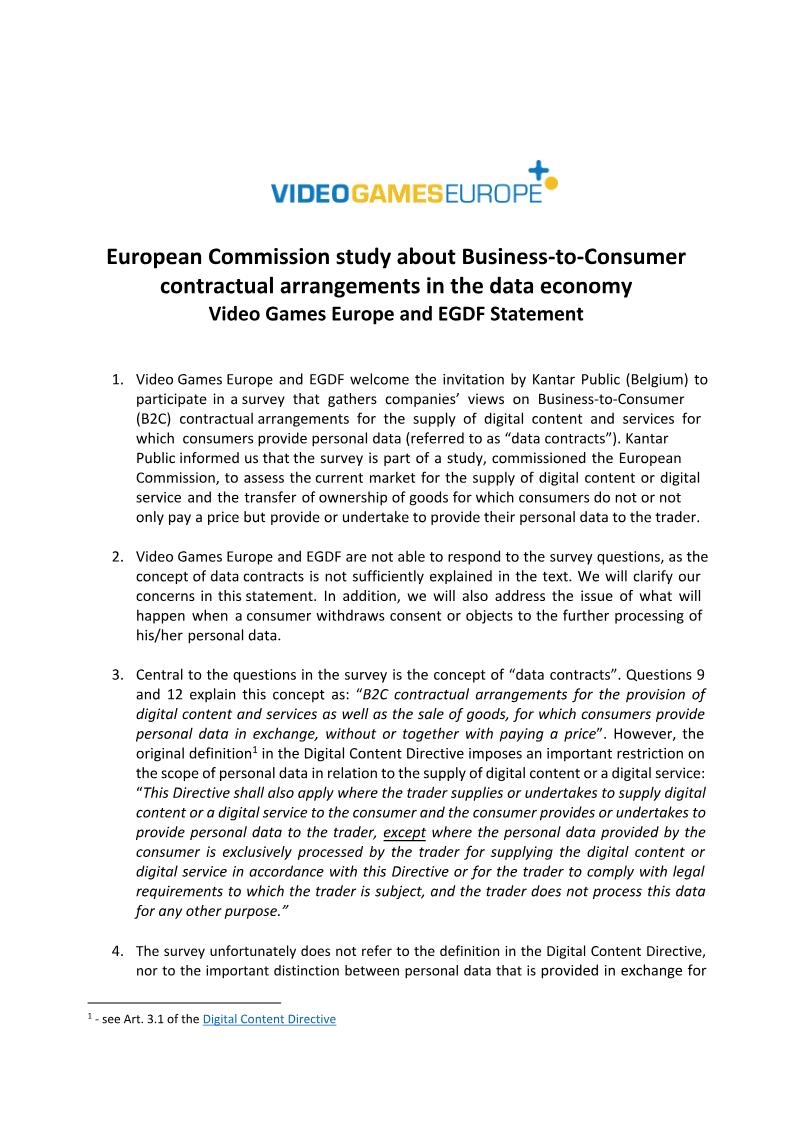
European Commission Study About Business-to-Consumer Contractual Arrangements in the Data Economy
The statement submitted by Video Games Europe and the European Games Developer Federation (EGDF) seeks to clarify the interpretation of “data contracts” within the European Commission’s study on Business‑to‑Consumer (B2C) contractual arrangements in the data economy. It argues that the survey’s definition of data contracts—where consumers provide personal data in exchange for digital content or services, with or without payment—fails to reflect the Digital Content Directive’s narrower scope, which excludes personal data processed solely for the performance of the contract or legal compliance. Consequently, routine data processing required to deliver video‑game content, such as technical device information and account registration details, should not be treated as a separate means of access or a distinct contractual element.
The response highlights that most data‑processing activities in video games are performed on the basis of contractual necessity, legal obligations, or legitimate interests rather than consumer consent, rendering questions about consent withdrawal largely irrelevant. It stresses that treating essential processing as a “data contract” could distort market analysis and policy formulation. The statement also provides a snapshot of the European video‑games sector: roughly 5,000 developer studios and publishers, employing about 98,000 people, generating €23.3 billion in 2021, and representing the third‑largest global market for video games.
By situating its concerns within the broader regulatory framework, the statement calls for the survey to adopt the Digital Content Directive’s definition and to distinguish between data required for service delivery and data exchanged as a commercial consideration. This clarification aims to ensure that any forthcoming policy measures accurately reflect the realities of the European video‑games ecosystem.
- Video Games Europe and the EGDF argue that the European Commission’s survey incorrectly classifies routine data processing—such as account registration and technical device information—as a 'data contract' exchange.
- The industry groups contend that most video game data processing is driven by contractual necessity, legal obligations, or legitimate interests, rather than consumer consent.
- The European video game sector generated €23.3 billion in 2021, positioning it as the third-largest global market for the industry.
- The European gaming ecosystem consists of approximately 5,000 developer studios and publishers, supporting a workforce of about 98,000 employees.
- Industry stakeholders are calling for the Commission to align its survey definitions with the Digital Content Directive, which excludes data processed solely for contract performance or legal compliance.
+1
Video Games EuropeJan 2023
Report15 pages
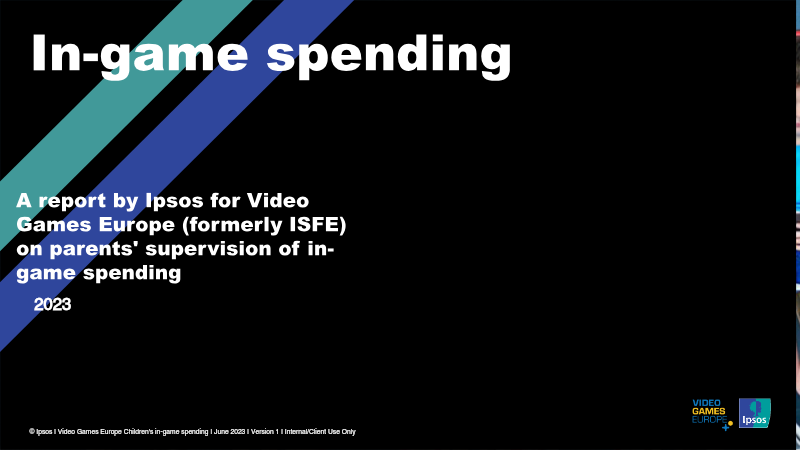
In-Game Spending: Parents' Supervision of In-Game Spending 2023
The research investigates how parents supervise and manage their children’s in‑game purchases, tracking trends across five European markets—United Kingdom, France, Germany, Spain and Italy—over four survey waves (2018, 2019, 2020 and 2023). Each wave surveyed adult parents or guardians of children who play video games, with sample sizes ranging from 962 in 2018 to 2,808 in 2023, providing a broad cross‑section of the region’s gaming households.
Findings show that three‑quarters of parents consistently report that their children do not spend on in‑game extras, a proportion that has remained stable since 2020. Among the minority who do spend, the average monthly outlay rose from €33 in 2020 to €39 in 2023, reflecting a €6 increase that aligns with inflation. Most spending (64 %) falls within the €1‑20 range, with the most popular items being gameplay‑impacting content (34 %) and decorative or cosmetic items (just under one third). Loot boxes and other unknown‑reward items remain relatively unpopular.
Parental oversight is high: nine‑in‑ten parents of spending children have some form of agreement, half of which are explicit—either seeking permission (38 %) or setting limits (23 %). Preferred monitoring tools include credit‑card bill checks, parental‑control settings, and two‑factor authentication, though 44 % of parents who avoid controls deem them unnecessary and 32 % find them difficult to activate. Awareness of in‑game currency and loot boxes among all players (ages 11‑64) is also limited, with only 9 % having purchased in‑game currency and 4 % having bought loot boxes. The study’s methodology relies on standardized questionnaires administered to representative adult panels in each country, ensuring comparability within each survey year while noting that cross‑year comparisons are constrained by methodological changes.
- Three-quarters of children do not engage in in-game spending, a figure that has remained stable since 2020.
- Average monthly in-game spending among children who do spend increased from €33 in 2020 to €39 in 2023, a rise consistent with inflation.
- The majority of in-game spending (64%) is concentrated in the €1–20 monthly range, with gameplay-impacting content (34%) and cosmetic items (33%) being the most popular purchases.
- Parental oversight is high, with 90% of parents of spending children maintaining some form of agreement, including explicit permission requirements (38%) or spending limits (23%).
- While 44% of parents who do not use parental controls consider them unnecessary, 32% report that they find these tools difficult to activate.
+1
Video Games EuropeJan 2023
Legal2 pages
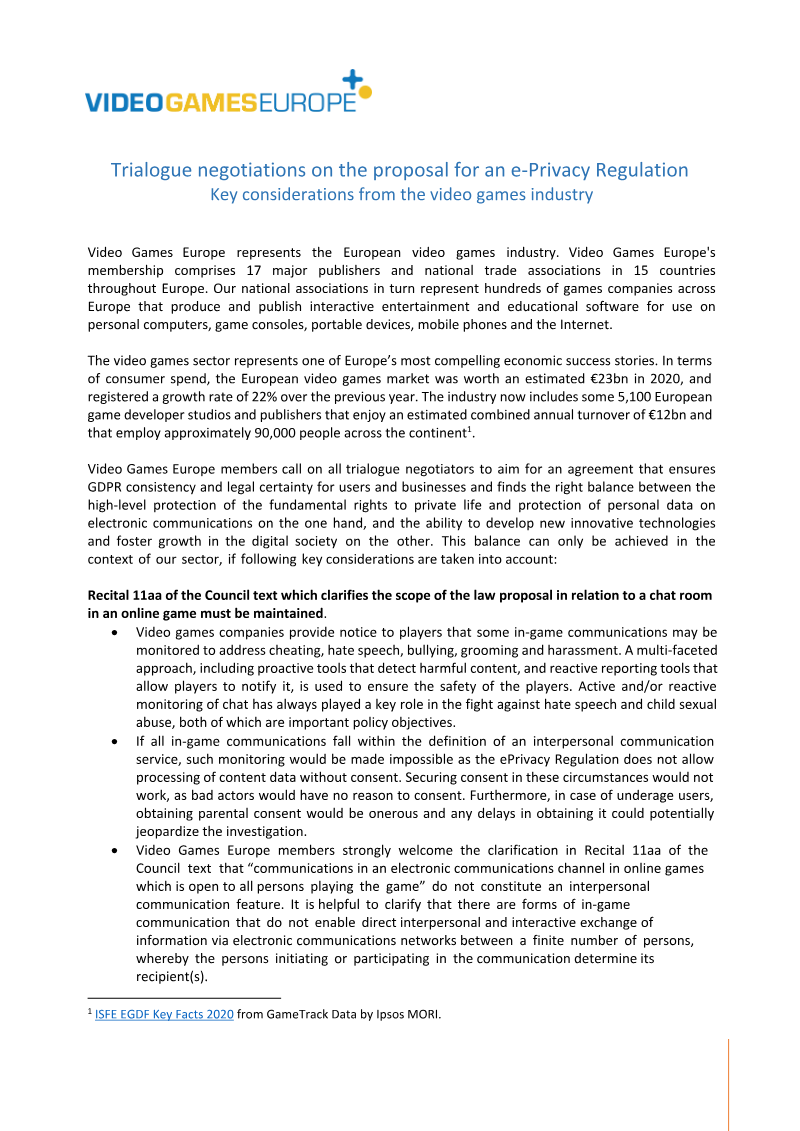
Trialogue Negotiations on the Proposal for an e-Privacy Regulation: Key Considerations from the Video Games Industry
Video Games Europe, representing 17 major publishers and national trade associations across 15 European countries, urges trialogue negotiators to craft an e‑Privacy Regulation that aligns with GDPR consistency while preserving the sector’s capacity to innovate and protect users. The industry, valued at €23 billion in consumer spend in 2020 and growing 22 percent year‑on‑year, comprises roughly 5,100 developer studios and publishers with combined annual turnover of €12 billion and a workforce of about 90 000 employees.
Key positions stress that in‑game communications, particularly chat rooms open to all players, must remain outside the definition of an interpersonal communication service, as clarified in Recital 11aa, to enable monitoring for cheating, hate speech, bullying, grooming and child sexual abuse. Requiring consent for such monitoring would be ineffective, especially for under‑age users, and could impede investigations. The industry also seeks broad adoption of the Council’s provisions in Article 8, allowing processing of terminal equipment information for performance optimisation, audience measurement, security, fraud prevention and software updates without individual consent, thereby avoiding consent fatigue and cumbersome parental authorisation.
Video Games Europe opposes the introduction of mandatory privacy‑setting requirements in Article 10, arguing that they would stifle competition, concentrate power among a few software providers, and impose costly technical burdens on consoles. Finally, the association calls for Article 11 to be aligned with GDPR Article 23, expanding public‑interest exemptions to include protection of data subjects, enforcement of civil claims and IP enforcement, ensuring law‑enforcement access while safeguarding fundamental rights.
- The European video game industry, comprising 5,100 studios and 90,000 employees, generated €12 billion in annual turnover and saw 22 percent year-on-year growth as of 2020.
- Video Games Europe argues that in-game chat rooms must be excluded from the definition of interpersonal communication services to allow for essential monitoring of cheating, hate speech, and child safety risks.
- The industry advocates for Article 8 provisions that permit processing terminal equipment data for security, fraud prevention, and performance updates without requiring individual consent.
- Mandatory privacy-setting requirements under Article 10 are opposed on the grounds that they would impose technical burdens on consoles and consolidate market power among a few software providers.
- The industry calls for Article 11 to align with GDPR Article 23, expanding public-interest exemptions to cover IP enforcement, civil claims, and the protection of data subjects.
+1
Video Games EuropeJan 2021