Take-Two Interactive
Game Co.57 documents
Major US game publisher (Rockstar Games, 2K, Zynga). IR includes investor presentations with Net Bookings breakdowns and franchise data.
Documents
Financial1 pages
Take-Two 10-Q — Q3 FY2024 (February 2024)
Take‑Two Interactive’s third‑quarter 2024 filing presents a mixed financial picture amid aggressive expansion through the Zynga and Popcore acquisitions. Net revenue for the nine‑month period fell to $1.37 billion, a 3% decline from the prior year’s $1.41 billion, largely driven by a 5% drop in core game sales and a 10% decline in advertising revenue. Gross profit slipped to $678 million, reflecting higher development costs and a significant goodwill impairment related to Zynga. Operating expenses rose to $2.65 billion, with marketing and headcount costs increasing sharply; this pushed the company into a $129.5 million operating loss and an overall net loss of $841 million for the period.
Revenue remains heavily weighted toward digital channels, with 95.6% of sales coming from online platforms and 40.5% from console releases, while mobile gaming—bolstered by Zynga titles such as Empires & Puzzles and Toon Blast—contributed a $212 million lift. Geographic revenue is concentrated in the United States ($417.8 million) and international markets ($1.53 billion), with deferred revenue balances exceeding $1.14 billion, indicating substantial advance payments for future content.
Liquidity is robust; cash and short‑term investments total $1.19 billion, supported by a net debt reduction of nearly $989 million during the quarter. The company retains a sizable revolving credit facility and has largely repaid its 2026 convertible notes, leaving only $21.4 million outstanding. Foreign‑currency hedges mitigate exposure to volatile currencies, though the Turkish lira devaluation remains a noted risk. Overall, Take‑Two continues to pursue high‑margin digital content while managing the financial impact of recent acquisitions and market headwinds.
- Take-Two reported a net loss of $841 million for the nine-month period ending Q3 FY2024, driven by an operating loss of $129.5 million and significant goodwill impairment charges related to the Zynga acquisition.
- Net revenue for the nine-month period declined 3% year-over-year to $1.37 billion, impacted by a 5% drop in core game sales and a 10% decrease in advertising revenue.
- Operating expenses surged to $2.65 billion, reflecting increased costs associated with marketing and headcount expansion following the acquisitions of Zynga and Popcore.
- Digital channels dominate the company's revenue model, accounting for 95.6% of total sales, with mobile titles like 'Empires & Puzzles' and 'Toon Blast' contributing $212 million.
- The company maintains a strong liquidity position with $1.19 billion in cash and short-term investments, having successfully reduced net debt by $989 million during the quarter.
Take-Two InteractiveFeb 2024
Financial1 pages
Take-Two 10-Q — Q3 FY2023 (November 2023)
The filing presents Take‑Two Interactive Software’s consolidated financial results for the quarter ended September 30, 2023, detailing performance trends, asset impairments, and liquidity management. Net revenue fell 7 % to $1.30 billion, largely due to weaker sales of key mobile franchises such as Empires & Puzzles and Tiny Tina’s Wonderlands, while the Grand Theft Auto and Red Dead Redemption titles helped offset some decline. Digital online sales dominated revenue, accounting for 95–96 % of total and rising $122.7 million year‑over‑year, yet gross profit margin contracted sharply from 48.8 % to 32 %, driven by a $165 million goodwill impairment related to Zynga and higher cost of revenue.
Operating expenses surged, with marketing and personnel costs rising 2.9 % of revenue and total operating loss widening to $543 million, a result of the Zynga acquisition’s integration costs and ongoing investment in live‑service monetization. Goodwill declined from $6,767 million to $6,600 million and intangible assets amortized $427 million over the nine‑month period, reflecting reduced forecasted performance of certain game assets.
Liquidity remains robust: cash and short‑term investments totaled $1.29 billion, supported by a $500 million revolving credit facility largely unused. Debt restructuring efforts reduced convertible notes to $21–29 million outstanding, while cash balances were bolstered by a $999 million debt issuance. The company’s share repurchase program remains largely intact, with 11.7 million shares repurchased to date and 10 million shares available for future buybacks. Overall, the quarter illustrates a challenging revenue environment tempered by strong digital sales and disciplined capital management.
- Take-Two reported a 7% decline in net revenue to $1.30 billion for the quarter ended September 30, 2023, driven by underperformance in mobile franchises like Empires & Puzzles and Tiny Tina’s Wonderlands.
- Gross profit margin contracted significantly from 48.8% to 32%, primarily due to a $165 million goodwill impairment related to the Zynga acquisition and increased costs of revenue.
- Operating losses widened to $543 million, reflecting the financial impact of integrating Zynga and ongoing investments in live-service monetization, alongside a 2.9% increase in marketing and personnel costs relative to revenue.
- Digital online sales remain the company's core revenue driver, accounting for 95–96% of total revenue and growing by $122.7 million year-over-year.
- Goodwill decreased from $6,767 million to $6,600 million, while intangible assets saw $427 million in amortization over the nine-month period, signaling downward revisions in the forecasted performance of certain game assets.
Take-Two InteractiveNov 2023
Financial1 pages
Take-Two 10-Q — Q2 FY2023 (August 2023)
Take‑Two Interactive reported a mixed financial performance for the three months ended June 30, 2023. Net revenue increased to $1.28 billion, driven primarily by a $1.10 billion rise in game revenue and a $105 million boost from advertising, yet operating expenses climbed 25.5% to $883.5 million, producing a $204 million loss from operations and an overall net loss of $206 million. Total assets stood at $15.53 billion, with long‑term debt rising to $2.70 billion and cash and equivalents at $775.9 million.
Revenue recognition details show a 17% year‑over‑year growth, largely from recurrent consumer spending ($1.07 billion), while full‑game sales fell $60 million. Deferred revenue of $1.03 billion is expected to be recognized over the next 12 months, and a new management agreement with ZelnickMedia provides an annual fee of $3.3 billion and a higher bonus potential than the prior contract.
The company’s fair‑value framework places all financial assets and liabilities within Levels 1 or 2, with no level transfers during the period. Fair‑value assets totaled $831.8 million and liabilities $45.7 million, while contingent earn‑out obligations from recent acquisitions increased by $14.1 million.
Debt and liquidity remain robust: senior notes were issued with associated issuance costs, $650 million of 2024 notes were retired for a $7 million gain, and a new five‑year unsecured credit facility of $500 million remains largely unused. Cash balances rose to $1,260.7 million, and convertible note obligations were largely satisfied, leaving only $21.4 million (2024) and $29.4 million (2026) outstanding.
Tax benefits surged to $22.9 million, lowering the effective tax rate to 10.0%, while the company anticipates no impact from the Inflation Reduction Act’s corporate alternative minimum tax for FY 2024. Overall, Take‑Two continues to focus on digital online sales—now 96.5% of net revenue—with Zynga’s free‑to‑play mobile catalog as a key growth engine, while maintaining effective internal controls and sufficient liquidity for future operations.
- Take-Two reported a net loss of $206 million for the quarter ending June 30, 2023, driven by a 25.5% increase in operating expenses to $883.5 million despite net revenue reaching $1.28 billion.
- Recurrent consumer spending remains the primary revenue driver at $1.07 billion, while full-game sales experienced a $60 million decline year-over-year.
- Digital online sales now account for 96.5% of total net revenue, with the company positioning Zynga’s free-to-play mobile catalog as its primary growth engine.
- The company maintains a strong liquidity position with $1.26 billion in cash and a largely unused $500 million five-year unsecured credit facility.
- Deferred revenue stands at $1.03 billion, which is expected to be recognized over the next 12 months.
Take-Two InteractiveAug 2023
Financial1 pages
Take-Two 10-K — FY2022 (May 2023)
Take‑Two Interactive’s FY 2022 10‑K documents a strategic pivot toward mobile and live‑service gaming, anchored by the $9.52 billion acquisition of Zynga. The deal added 6 billion downloads and $2.16 billion in net revenue, but also introduced significant amortization, platform fees and debt obligations that pushed the company into a $1.12 billion operating loss for FY 2023. Gross‑profit margins contracted from 56.2% to 42.7%, reflecting higher product‑costs and lease expenses, while operating costs more than doubled to support the Zynga integration.
Revenue concentration remains a core risk: 52.9% of FY 2023 sales came from the top five franchises, and 79.6% of revenue was tied to five major customers. Market dynamics—rapid shifts in consumer preference, platform fee changes from Apple, Google and console makers, and regulatory scrutiny over data privacy, loot‑box mechanics and gambling laws—could materially erode sales or increase compliance costs. Cybersecurity incidents, such as the 2022 breach of Rockstar development footage, illustrate operational vulnerabilities that could damage reputation and incur additional expenses.
Geographically, Take‑Two’s expansion into Asia, Latin America and post‑Brexit Europe exposes it to trade, cultural and regulatory uncertainties that may limit market access or raise costs. The company’s debt profile includes $2.7 billion in senior notes and a $500 million revolving credit facility, with ongoing covenant monitoring under its 2022 Credit Agreement. Equity‑based compensation surged to $317 million in FY 2023, reflecting a broader strategy of growth through M&A and talent retention.
Overall, Take‑Two’s financial trajectory is shaped by the Zynga acquisition’s revenue upside and debt‑heavy balance sheet, while concentration risk, platform dependency, regulatory exposure and cyber threats present ongoing challenges to sustaining profitability and shareholder value.
- The $9.52 billion acquisition of Zynga caused a $1.12 billion operating loss in FY 2023, driven by debt obligations, amortization, and a contraction in gross-profit margins from 56.2% to 42.7%.
- Take-Two faces significant revenue concentration risk, with 52.9% of FY 2023 sales derived from only five franchises and 79.6% of revenue tied to five major customers.
- Operating costs more than doubled in FY 2023 as the company integrated Zynga's operations, which contributed $2.16 billion in net revenue and 6 billion downloads.
- The company’s debt profile includes $2.7 billion in senior notes and a $500 million revolving credit facility, requiring ongoing monitoring under the 2022 Credit Agreement.
- Equity-based compensation reached $317 million in FY 2023, reflecting a strategic focus on talent retention and growth through M&A.
Take-Two InteractiveMay 2023

Legal22 pages
Global Code of Business Conduct and Ethics
Take-Two Interactive maintains a comprehensive framework of mandatory ethical standards designed to ensure integrity, legal compliance, and the protection of human rights across its global operations. These standards apply to all employees, directors, and third-party partners, covering a broad geographic scope that includes specific restrictions regarding sanctioned territories such as Iran and North Korea. By establishing strict protocols for non-discrimination, the protection of corporate assets, and the disclosure of potential conflicts of interest—including outside employment and romantic relationships—the organization fosters a culture of accountability. Compliance is reinforced through biennial training and a rigorous enforcement mechanism where violations may lead to termination.
Corporate integrity is further supported by mandates for financial transparency and fair competition. All financial records must accurately reflect transactions, and the unauthorized disclosure of sensitive information to shareholders or the media is strictly prohibited. To prevent market manipulation, the framework forbids insider trading and establishes clear antitrust guidelines that prevent the exchange of commercial data with competitors or interference with the pricing rights of distributors. Furthermore, the organization enforces a zero-tolerance policy toward bribery, corruption, money laundering, and tax evasion. This extends to third-party agents, who must undergo due diligence to ensure all business dealings, particularly those involving public officials, remain ethical and legal.
To facilitate the reporting of misconduct, a 24/7 anonymous hotline is provided, allowing for the confidential disclosure of grievances to the Chief Legal Officer or Audit Committee. Strong anti-retaliation protections ensure that individuals reporting concerns in good faith are shielded from adverse actions, though disciplinary measures apply to those who provide knowingly false information. Waivers of these ethical requirements are exceptionally rare, requiring formal approval from the Board of Directors or the Chief Legal Officer, with any executive-level exceptions disclosed publicly to shareholders to maintain institutional transparency.
- Take-Two Interactive enforces a mandatory global code of conduct for all employees, directors, and third-party partners, with violations subject to termination.
- The policy mandates strict financial transparency and prohibits market manipulation, including insider trading, antitrust violations, and the unauthorized disclosure of sensitive corporate information.
- A zero-tolerance policy applies to bribery, corruption, money laundering, and tax evasion, requiring rigorous due diligence for all third-party agents interacting with public officials.
- Employees are required to disclose potential conflicts of interest, including outside employment and romantic relationships, to maintain organizational accountability.
- The company provides a 24/7 anonymous reporting hotline managed by the Chief Legal Officer or Audit Committee, supported by formal anti-retaliation protections for whistleblowers.
Take-Two InteractiveApr 2023
Legal2 pages
Policy for Reporting Misconduct
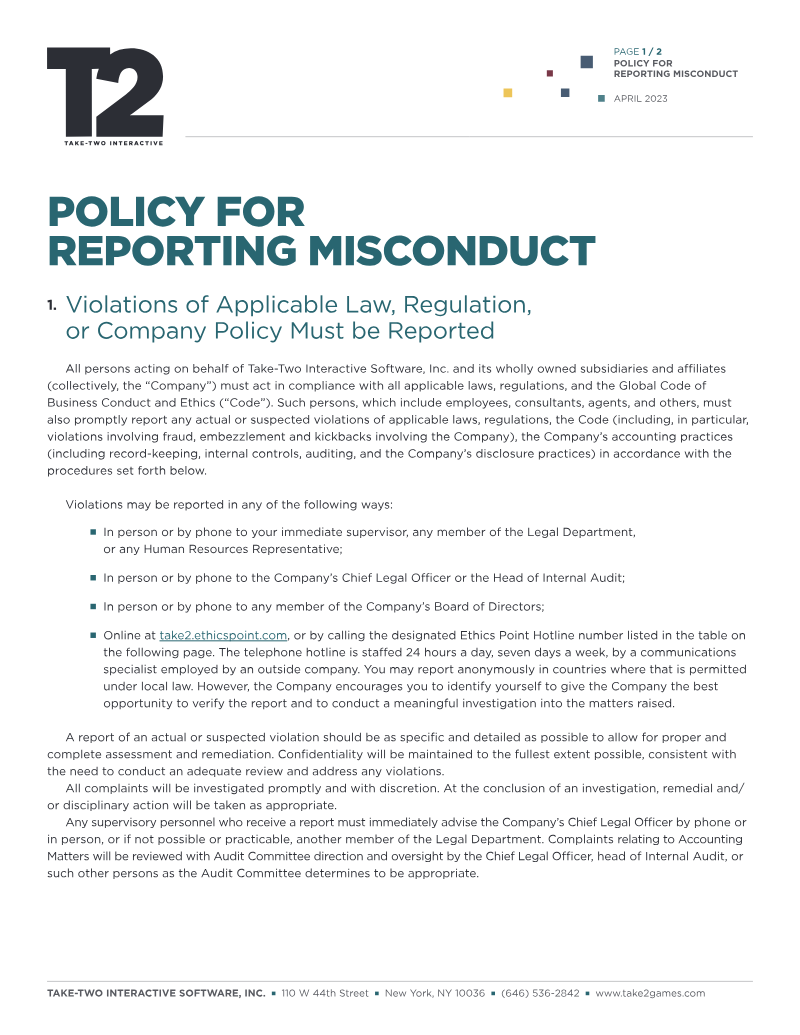
The April 2023 misconduct reporting policy for Take-Two Interactive Software establishes a mandatory framework for identifying and addressing violations of law, regulation, and the Global Code of Business Conduct and Ethics. The policy applies to all employees, consultants, and agents acting on behalf of the company and its global subsidiaries. It emphasizes the necessity of reporting financial irregularities, including fraud, embezzlement, kickbacks, and accounting or auditing discrepancies. By mandating transparency, the company aims to maintain internal controls and ensure compliance with international business standards.
The scope of the policy is global, providing specific toll-free hotline numbers for twenty-four countries across North America, Europe, Asia, and Oceania. Reporting mechanisms are designed for accessibility and include in-person or telephonic communication with supervisors, legal counsel, human resources, or the Board of Directors. Additionally, a third-party ethics hotline operates twenty-four hours a day, allowing for anonymous reporting where permitted by local law. The company commits to prompt, discrete investigations and appropriate remedial actions while maintaining confidentiality to the fullest extent possible.
A central tenet of the policy is the strict prohibition of retaliation against individuals who report suspected misconduct in good faith. It explicitly forbids interference with the reporting process, aligning with statutory protections such as Section 806 of the Sarbanes-Oxley Act and Section 922 of the Dodd-Frank Act. Furthermore, the policy clarifies that internal procedures do not preclude individuals from reporting violations directly to governmental agencies or whistleblowing entities without prior company clearance. This dual approach ensures that the organization remains accountable to both internal ethical standards and external regulatory requirements.
- Take-Two Interactive’s April 2023 misconduct policy mandates that all employees, consultants, and agents report violations of law, regulations, and the company's Global Code of Business Conduct and Ethics.
- The policy explicitly prohibits retaliation against individuals who report suspected misconduct in good faith, citing protections under Section 806 of the Sarbanes-Oxley Act and Section 922 of the Dodd-Frank Act.
- Employees are permitted to report violations directly to governmental agencies or whistleblowing entities without requiring prior company clearance.
- The company provides a global reporting infrastructure featuring toll-free hotlines in twenty-four countries across North America, Europe, Asia, and Oceania.
- Reporting channels include direct communication with supervisors, legal counsel, HR, the Board of Directors, or a 24/7 third-party ethics hotline that supports anonymous reporting where legally permitted.
Take-Two InteractiveApr 2023
Financial1 pages
Take-Two Interactive 10-Q – Q3 FY2023
Take‑Two Interactive’s Q3 FY2023 filing documents a dramatic shift in its financial profile following the acquisition of Zynga. Net revenue surged 51–56 % to $3.9 billion, largely driven by Zynga’s mobile portfolio and new releases such as PGA Tour 2K23. However, gross‑profit margins contracted to the low 50 % range due to higher amortization of intangible assets, platform fees on mobile sales and increased marketing costs. Operating expenses rose 130–123 % to $2.5 billion, reflecting integration costs and expanded R&D, while interest expense ballooned from $7.2 million to over $108 million as debt financing for the acquisition was drawn down. The company reported a net loss of $153 million (loss per share $0.91) for the nine‑month period, reversing a prior year profit of $307 million.
Capital structure adjustments are evident: senior notes and convertible debt were largely repaid or converted, leaving $21.4 billion of 2024 notes and $29.4 billion of 2026 notes outstanding, with significant debt‑issuance and credit‑agreement fees amortized over the life of the notes. A $500 bn revolving line and a $350 bn term loan were used to fund these repayments. Fair‑value measurements for contingent earn‑outs from acquisitions rely on Level 3 inputs and Monte‑Carlo simulations, impacting accrued expenses.
Risk disclosures highlight exposure to foreign‑currency translation, interest‑rate fluctuations and commodity price movements; hedging instruments are employed to mitigate these. Cybersecurity incidents were contained with minimal cost, and no operational disruption was reported for core studios.
Geographically, international revenue accounts for 37–41 % of earnings, underscoring currency and trade risk. The report covers the United States market with a nine‑month horizon (January–December 2022) and includes detailed ASC 606 revenue recognition policies, fair‑value frameworks, and post‑acquisition accounting for Zynga and Popcore. Overall, the filing presents a company in transition, balancing significant growth opportunities against elevated costs and debt‑related risks.
- Take-Two Interactive reported a net loss of $153 million for the nine-month period ending December 2022, a significant reversal from the $307 million profit recorded in the prior year.
- Net revenue increased by 51–56% to $3.9 billion, primarily fueled by the acquisition of Zynga and new releases like PGA Tour 2K23.
- Operating expenses surged 123–130% to $2.5 billion, driven by Zynga integration costs, increased R&D investment, and higher marketing expenditures.
- Gross profit margins contracted to the low 50% range due to the impact of platform fees on mobile sales, increased marketing costs, and the amortization of intangible assets.
- Interest expenses rose sharply from $7.2 million to over $108 million as the company drew down debt financing to fund the Zynga acquisition.
Take-Two InteractiveFeb 2023
Financial1 pages
Take-Two 10-Q — Q3 FY2022 (November 2022)
Take‑Two Interactive’s Q3 FY2022 filing documents a sharp transition from modest profitability to a substantial net loss, largely attributable to the May 2022 acquisition of Zynga. Net revenue for the quarter rose 62 % to $1.394 billion, driven by a 52 % jump in mobile revenue and the addition of Zynga’s high‑download titles. Digital‑online sales dominated, accounting for 95 % of total revenue, while console and PC revenues declined. Operating expenses surged 144 % to $932 million, with selling‑and‑marketing and research & development costs inflating as the company integrated Zynga’s operations. The result was an operating loss of $257 million (18 % of revenue) and a net loss of $361 million for the quarter, reversing last year’s modest profit.
Financially, Take‑Two financed the acquisition through a $2.7 billion senior‑note issuance and a new $500 million revolving credit facility, generating interest expense of $28.9 million for the six months ended September 30. Cash and cash equivalents fell to $1.66 billion, reflecting large outflows for the Zynga purchase and related earn‑outs. Fair‑value measurements remained largely Level 2, with a $61.1 million contingent earn‑out liability for the Nordeus acquisition and significant Level 3 inputs for Zynga’s convertible notes.
Revenue recognition follows ASC 606, allocating transaction prices to distinct performance obligations and recognizing revenue over time for virtual‑currency and in‑game purchases. The company’s portfolio remains concentrated, with five franchises contributing nearly 80 % of net revenue; however, mobile and digital channels now provide the bulk of growth. Foreign‑currency exposure is modest (≈40 % of revenue outside the U.S.), and interest‑rate risk is managed through short‑term debt at 3.60 % and forward contracts. Overall, the filing illustrates a company in transition, leveraging acquisitions to expand its digital footprint while managing significant integration costs and financing obligations.
- Take-Two reported a net loss of $361 million for Q3 FY2022, a sharp reversal from the previous year's profitability, primarily driven by a 144% surge in operating expenses following the acquisition of Zynga.
- Net revenue grew 62% to $1.394 billion, fueled by a 52% increase in mobile revenue and the integration of Zynga’s high-download titles.
- Digital-online sales now account for 95% of total revenue, while traditional console and PC revenue streams experienced a decline.
- The company financed the Zynga acquisition through a $2.7 billion senior-note issuance and a $500 million revolving credit facility, resulting in $28.9 million in interest expenses for the first half of the fiscal year.
- Cash and cash equivalents decreased to $1.66 billion as the company utilized capital for the Zynga purchase and associated earn-out obligations.
+2
Take-Two InteractiveNov 2022
Financial1 pages
Take-Two 10-Q — Q2 FY2022 (August 2022)
Take‑Two Interactive’s Q2 FY2022 filing documents a sharp reversal from the prior year, reporting a $104 million net loss versus a $152 million profit in Q2 FY2021. The loss is largely attributable to the May 2022 acquisition of Zynga, which added $276.7 million in net revenue but also introduced a $177.5 million operating loss, higher amortization of software development costs, and significant marketing, G&A and R&D expenses. Operating expenses rose to $704 million from $313 million year‑ago, while gross profit margin improved modestly to 60.5% from 59.5%, reflecting lower internal royalties but higher amortization and product costs.
Revenue for the quarter reached $1.10 billion, with 73% recognized over time from recurrent consumer spending such as virtual currency and in‑game purchases, and 27% at point of sale. Digital online sales accounted for 94 % of net revenue, and the United States contributed roughly $683 million. Deferred revenue climbed to $1.10 billion, largely due to Zynga integration, and contract assets of $1.25 billion are projected to generate about $1.18 billion over the next 12 months.
Liquidity remains solid, with cash balances of $847 million and a strong $1.49 billion cash position after the acquisition outflow of $2.8 billion in investing activities. Take‑Two financed Zynga through $2.7 billion of senior notes (3.3%–4.0%) and new credit facilities, resulting in a $2.94 billion long‑term debt load that raises leverage concerns. Interest expense on these facilities was $20 million for the quarter, and convertible notes tied to Zynga were largely tendered or converted.
Geographically, 38 % of net revenue originates outside the United States, exposing the company to foreign‑exchange and geopolitical risks. Capital expenditures for FY 2023 are projected at $135 million, with $42.5 million spent in Q1 FY2022. Forward contracts mitigate but do not fully hedge currency exposure, and interest‑rate risk is limited to short‑term investments and variable‑rate debt. Overall, the filing underscores Take‑Two’s strategy of high‑quality, cross‑platform releases and incremental monetization through virtual goods while navigating the financial implications of a large acquisition and associated debt.
- Take-Two reported a $104 million net loss for Q2 FY2022, a significant decline from the $152 million profit recorded in the same period last year.
- The $2.8 billion acquisition of Zynga was the primary driver of financial volatility, contributing $276.7 million in revenue but incurring $177.5 million in operating losses and significantly higher R&D and marketing expenses.
- Operating expenses more than doubled year-over-year, rising from $313 million to $704 million due to the Zynga integration and increased amortization of software development costs.
- The company’s long-term debt load reached $2.94 billion, financed primarily through $2.7 billion in senior notes and new credit facilities to fund the Zynga purchase.
- Recurrent consumer spending remains the core revenue driver, accounting for 73% of the $1.10 billion total revenue, while digital online sales represented 94% of the total.
Take-Two InteractiveAug 2022
Legal8 pages
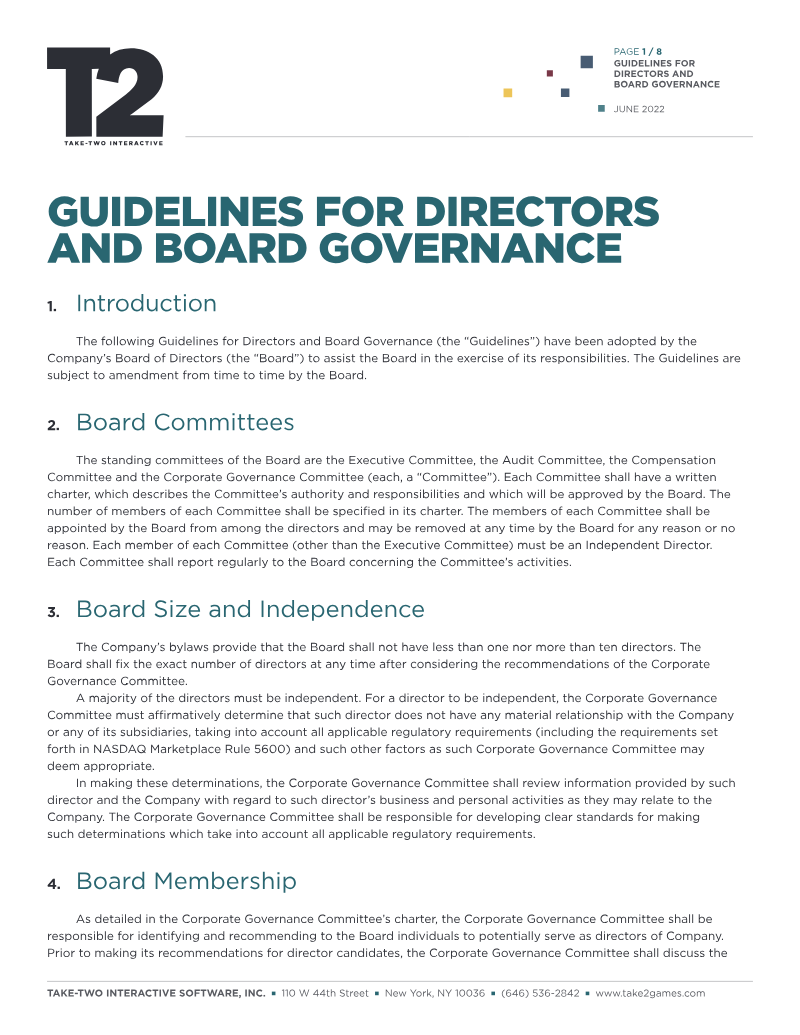
Guidelines for Directors and Board Governance June 2022
These corporate governance guidelines, adopted in June 2022, establish the structural and operational framework for a company’s Board of Directors. The primary purpose of the document is to define the responsibilities, qualifications, and ethical standards required of directors to ensure effective oversight and alignment with shareholder interests. The scope covers board composition, committee structures, and specific policies regarding executive compensation and strategic planning, adhering to regulatory standards such as the NASDAQ Marketplace Rules and the Securities Exchange Act of 1934.
Key findings and mandates include a board size limited to between one and ten members, with a requirement that at least two-thirds of directors be independent. The governance structure relies on four standing committees—Executive, Audit, Compensation, and Corporate Governance—each governed by written charters. The guidelines emphasize rigorous independence standards, requiring that the Corporate Governance Committee affirmatively determine the absence of material relationships between independent directors and the company. Furthermore, the board must conduct annual self-evaluations and dedicate specific sessions each year to strategic planning and senior management succession.
The document also outlines strict financial and ethical accountability measures. A clawback policy allows the board to recover improperly awarded incentive compensation from executives if payments were based on erroneously reported financial results due to fraudulent or illegal conduct. Additionally, director qualifications are explicitly defined in an annex, prioritizing integrity, diversity, and financial literacy. To align interests with stockholders, the guidelines mandate that a portion of director compensation be provided in company equity. The board maintains the authority to limit outside directorships held by its members to prevent conflicts of interest or time commitment issues.
- The board must consist of between one and ten members, with a mandate that at least two-thirds of the directors maintain independent status.
- Four standing committees—Executive, Audit, Compensation, and Corporate Governance—are required, each operating under its own written charter.
- A mandatory clawback policy empowers the board to recover executive incentive compensation if payments were based on financial results linked to fraudulent or illegal conduct.
- To align director interests with shareholders, a portion of all director compensation must be paid in company equity.
- The Corporate Governance Committee is responsible for conducting annual board self-evaluations and affirmatively verifying the absence of material relationships between independent directors and the company.
Take-Two InteractiveJun 2022
Legal4 pages
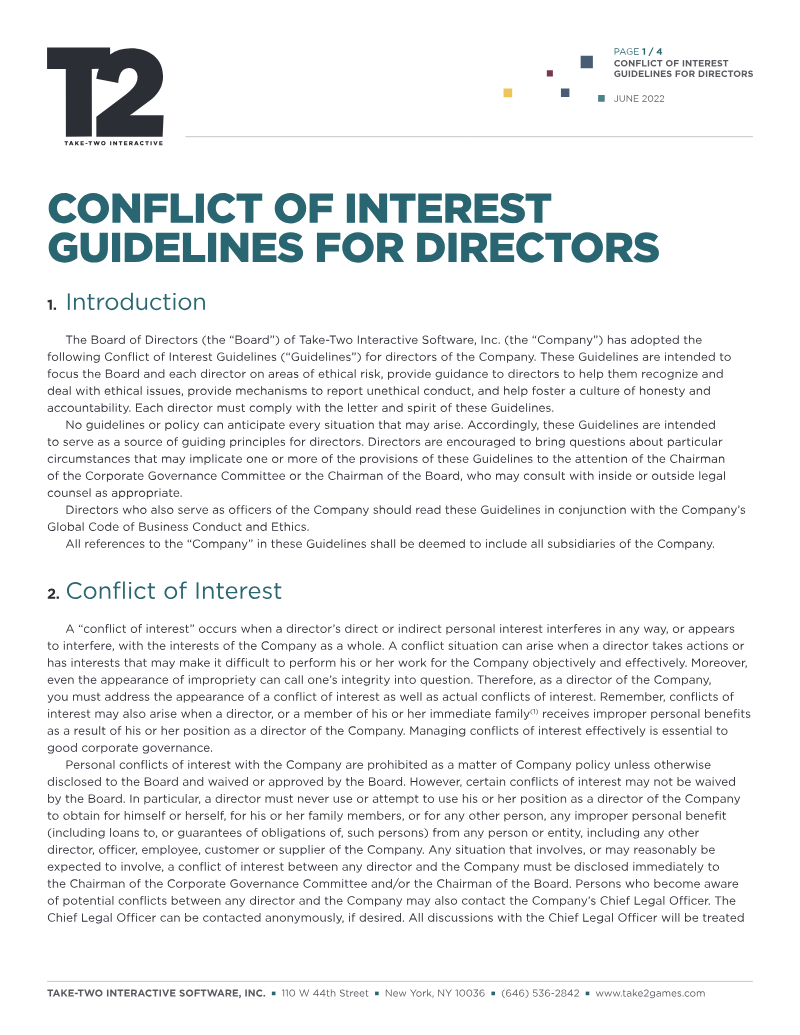
Conflict of Interest Guidelines for Directors: June 2022
The Conflict of Interest Guidelines for Directors, adopted by Take-Two Interactive Software, Inc. in June 2022, establish a formal framework for ethical conduct and accountability among the members of the Board of Directors. The primary purpose of these guidelines is to help directors recognize and navigate ethical risks, particularly situations where personal interests might interfere—or appear to interfere—with the interests of the company and its subsidiaries. The scope of the policy covers all directors, including those who also serve as officers, and extends to their immediate family members as defined by NASDAQ regulations.
Key provisions prohibit directors from exploiting corporate opportunities for personal gain, competing with the company, or using company property and information for non-business purposes. The guidelines set specific thresholds for gifts, generally limiting acceptable items to those with a de minimis value of $150 or less, provided they are customary and related to unique life events. Furthermore, directors are required to maintain strict confidentiality regarding non-public information and must provide annual disclosures of all material outside business interests, including positions held in other public or private companies.
The policy emphasizes transparency and reporting, mandating that potential conflicts be disclosed immediately to the Chairman of the Board or the Corporate Governance Committee. While the Board may waive certain conflicts through a majority vote of disinterested directors, such waivers must be publicly disclosed in compliance with SEC and NASDAQ rules. To foster a culture of honesty, the guidelines include non-retaliation protections for those reporting questionable behavior in good faith and empower the Board to take disciplinary actions to deter wrongdoing and ensure adherence to these standards.
- Take-Two Interactive Software, Inc. adopted formal conflict of interest guidelines in June 2022 to mandate ethical conduct and accountability for all members of the Board of Directors.
- Directors must provide annual disclosures of all material outside business interests, including any positions held in other public or private companies.
- The policy prohibits directors from exploiting corporate opportunities for personal gain, competing with the company, or using company property and information for non-business purposes.
- Acceptable gifts are generally limited to a de minimis value of $150 or less, provided they are customary and related to unique life events.
- Potential conflicts must be disclosed immediately to the Chairman of the Board or the Corporate Governance Committee, and any waivers granted by the Board must be publicly disclosed per SEC and NASDAQ rules.
Take-Two InteractiveJun 2022
Financial1 pages
Take-Two Interactive Annual Report: Fiscal Year 2021
Take‑Two Interactive Software, Inc. reports a fiscal year 2021 in which it maintained robust revenue growth and solid liquidity while pursuing aggressive expansion through acquisitions. Net revenue reached $3.50 billion, driven primarily by digital‑online sales and a strong U.S. market share; full‑game revenue remained the core driver, with virtual currency and downloadable content contributing a growing share of recurring consumer spending. Operating expenses rose 23.8 % to $1.50 billion, largely due to higher selling/marketing, general & administrative, and research‑and‑development costs, offset by a modest increase in interest expense linked to the Zynga bridge loan.
The company’s balance sheet remained healthy, with $2.195 billion in cash and equivalents and a $247.5 million credit line, while no borrowings were outstanding at year‑end. Capitalized software and third‑party development costs were amortized over 12–30 months, and ASC 606 revenue recognition policies required significant judgment in estimating service periods for full‑game sales. Take‑Two’s risk profile highlighted concentration on a few flagship franchises (e.g., Grand Theft Auto and NBA 2K), dependence on major platform partners (Sony, Microsoft, digital storefronts), and exposure to regulatory, cyber‑security, and supply‑chain risks. The pending acquisition of Zynga, valued at $12.7 billion enterprise value and financed with $2.7 billion of senior notes, represented a strategic pivot toward mobile and online gaming, while the earlier purchase of Nordeus added €51.7 million in net revenue.
Geographically, international sales accounted for roughly 40 % of total revenue, with significant growth in Asia through mobile and cloud platforms. The company’s financial strategy included foreign‑currency forward contracts to hedge earnings volatility, a growing goodwill balance from acquisitions, and disciplined product‑investment reviews. Overall, Take‑Two’s FY2021 performance demonstrated strong operating cash flow, a diversified revenue mix, and a clear focus on expanding its high‑quality, internally owned franchises while mitigating concentration risks through strategic acquisitions and digital distribution.
- Take-Two Interactive reported $3.50 billion in net revenue for fiscal year 2021, driven primarily by full-game sales and an increasing contribution from recurring consumer spending via virtual currency and downloadable content.
- The company initiated a strategic pivot toward mobile and online gaming through the $12.7 billion acquisition of Zynga, financed in part by $2.7 billion in senior notes.
- Operating expenses increased by 23.8% to $1.50 billion, attributed to higher costs in marketing, general and administrative functions, and research and development.
- The company maintains a strong liquidity position with $2.195 billion in cash and equivalents and no outstanding borrowings at year-end.
- Revenue remains heavily concentrated in flagship franchises like Grand Theft Auto and NBA 2K, while international markets, particularly in Asia, accounted for approximately 40% of total revenue.
+3
Take-Two InteractiveMay 2022