Sega Sammy Holdings
Game Co.26 documents
Documents
Financial5 pages
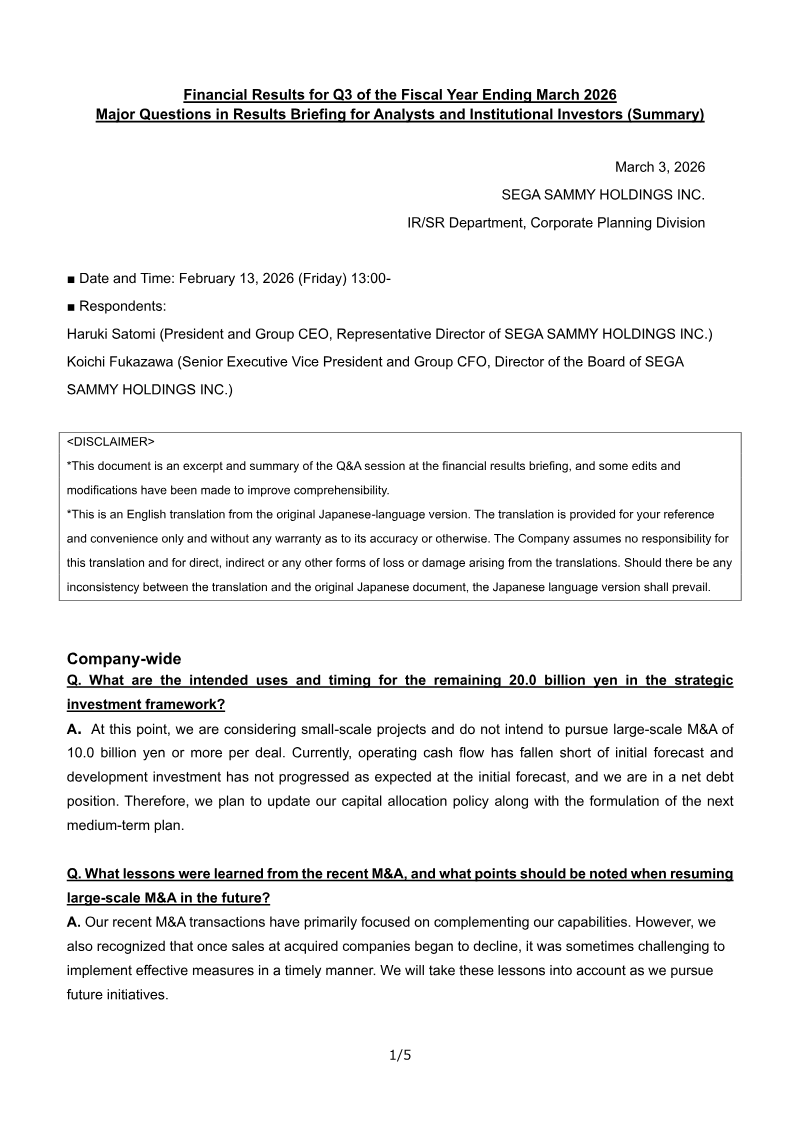
Financial Results for Q3 of the Fiscal Year Ending March 2026: Major Questions in Results Briefing
Sega Sammy Holdings’ third-quarter financial results briefing for the fiscal year ending March 2026 outlines a strategic shift toward improved capital efficiency and a more unified global marketing structure. Facing a net debt position and performance shortfalls in certain segments, management is prioritizing the optimization of existing assets over large-scale mergers and acquisitions. The company intends to refine its capital allocation policy in the upcoming medium-term plan, focusing on businesses where it can leverage core strengths to ensure sustainable growth.
In the Entertainment Contents segment, the company is addressing challenges in its consumer business by transitioning from a region-specific publishing model to a centralized, data-driven global strategy. While the acquisition of Rovio’s "Beacon" system has not yet yielded the expected results due to operational differences between casual and core mobile titles, the company remains committed to maximizing the value of its intellectual property. Future growth is anchored by a robust pipeline of major titles scheduled for the fiscal year ending March 2027, alongside a transmedia strategy that leverages the Sonic the Hedgehog film franchise to drive licensing and merchandise revenue.
The Pachislot and Pachinko business continues to serve as a stable earnings pillar, with the company maintaining flexible pricing strategies to navigate competitive pressures. Despite a downward revision in unit sales volume, high demand for mainstay titles has allowed the company to remain on track with its profit forecasts. Meanwhile, the Gaming business is focused on integrating recent acquisitions, such as GAN and Stakelogic, to expand recurring revenue through platform migration and content development. Management has clarified that it will not pursue large-scale investments in domestic integrated resorts, preferring instead to offer operational expertise and equipment supply if opportunities arise.
- Sega Sammy is shifting its capital allocation strategy to prioritize the optimization of existing assets over large-scale mergers and acquisitions due to its current net debt position.
- The Entertainment Contents segment is transitioning from a region-specific publishing model to a centralized, data-driven global strategy to improve performance in its consumer business.
- The company is banking on a robust pipeline of major titles scheduled for the fiscal year ending March 2027 and a transmedia strategy centered on the Sonic the Hedgehog film franchise to drive future growth.
- The Pachislot and Pachinko division remains a stable earnings pillar, maintaining profit forecasts despite a downward revision in unit sales volume by leveraging high demand for mainstay titles.
- Integration of recent acquisitions GAN and Stakelogic is the primary focus for the Gaming business, aimed at expanding recurring revenue through platform migration and content development.
+1
Sega Sammy Holdings
Report80 pages
Integrated Report 2025
SEGA SAMMY HOLDINGS INTEGRATED REPORT 2025 SEGA SAMMY HOLDINGS INTEGRATED REPORT 2025 Key Visual from Sonic the Hedgehog 3 movie Group Value Introduction Strengthening of Non-Financial Capital Creativity is Mindset and DNA SEGA SAMMY Group Core Businesses 02 Materiality 56 Creativity is Alway...
- SEGA SAMMY Holdings aims for Adjusted EBITDA over ¥230.0 billion and ROE over 10% cumulatively for the three-year period from FY2025/3 to FY2027/3.
- The company is expanding its Gaming Business through the acquisition of Stakelogic B.V. by its subsidiary SEGA SAMMY CREATION INC., completed on April 28, 2025.
- The Entertainment Contents Business expects revenue to increase compared to FY2025/3, with strong sales of new and repeat full games in the Consumer area and continued growth in licensing income, despite an anticipated reactionary decline in Animation areas.
- The Pachislot & Pachinko Machines Business aims to reclaim the No. 1 total utilization share, having fallen one position in the fiscal year ended March 2024 due to differences between product specifications and market needs.
- SEGA SAMMY Holdings is reinforcing "culturally diverse human resources" aligned with its global business expansion strategy and has increased external directors to four to enhance transparency and governance.
+2
Sega Sammy Holdings
Report53 pages
Results Presentation: Q3 for the Fiscal Year Ending March 2026
Q3 for the Fiscal Year Ending March 2026 The market forecasts, performance outlooks, plans, strategies, and other forward-looking statements contained in this document are based on information available to the Company and the judgment of its management at the time this material was created. They do not constitute a guarantee of future performance.
- The company recognized impairment losses of approximately 229 million euros (31.3 billion yen) on Rovio's goodwill and other intangible assets, primarily due to reduced sales forecasts for existing and new game titles.
- Q3 FY2026/3 operating income was 19.8 billion yen, a significant decrease from 43.7 billion yen in Q3 FY2025/3. The full-year operating income forecast for FY2026/3 was revised down to 40.0 billion yen from 53.0 billion yen.
- Rovio's performance significantly underperformed initial forecasts, with existing key titles declining more than expected and new titles failing to meet target KPIs or experiencing development delays/cancellations.
- The Entertainment Contents segment's operating income for Q3 FY2026/3 was 23.7 billion yen, down from 34.6 billion yen in Q3 FY2025/3, and its full-year forecast was revised down to 30.5 billion yen from 39.5 billion yen.
- The company plans to improve Rovio's profit margins by actively increasing external payment usage to 30% for Rovio titles within five years, and by optimizing UA costs through marketing strategy updates and AI in development.
+1
Sega Sammy Holdings
Report13 pages
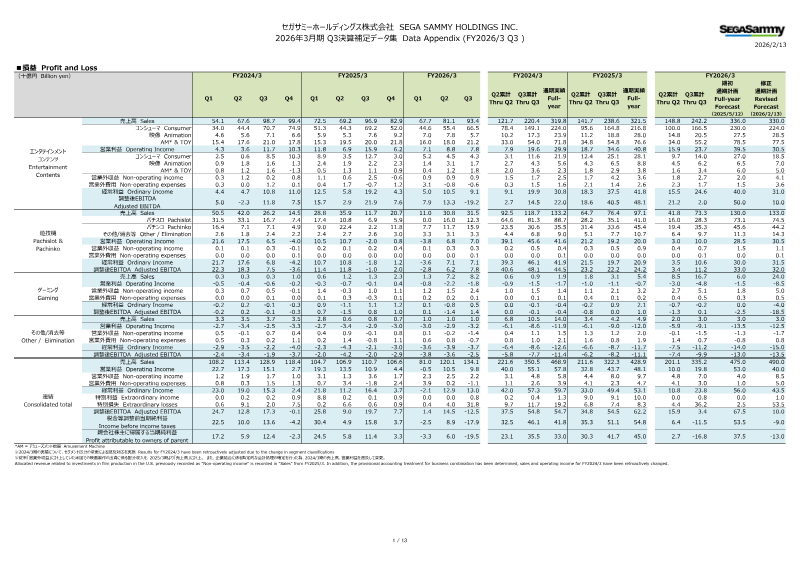
FY2026/3 Q3 Data Appendix
2026年3⽉期 Q3決算補⾜データ集 Data Appendix (FY2026/3 Q3 ) (⼗億円 Billion yen) FY2024/3 FY2025/3 FY2026/3 FY2024/3 FY2025/3 FY2026/3 Q1 Q2 Q3 Q4 Q1 Q2 Q3 Q4 ...
- For FY2026/3 Q3, Sales reached 242.2 billion yen, with a full-year forecast of 330.0 billion yen (revised from 336.0 billion yen). Operating Income for Q3 was 23.7 billion yen, with a full-year forecast of 30.5 billion yen (revised from 39.5 billion yen).
- The Entertainment Contents segment is the largest contributor to sales and operating income, with Q3 sales of 166.5 billion yen and operating income of 14.0 billion yen. Consumer games within this segment generated 66.5 billion yen in Q3 sales.
- R&D and Content Production expenses for Entertainment Contents were 23.1 billion yen through Q3 FY2026/3, with a full-year forecast of 29.7 billion yen. This is a significant increase from 20.3 billion yen in FY2025/3 Q3.
- Unit sales of major IPs for FY2026/3 Q3 include Sonic series at 4,000 thousand units, Total War series at 3,160 thousand units, Persona series at 2,410 thousand units, and Like a Dragon series at 2,500 thousand units.
- The Gaming segment saw a substantial increase in employees, from 104 in FY2025/3 Q4 to 930 in FY2026/3 Q3, reflecting the incorporation of Rovio into the group.
Sega Sammy Holdings
Financial16 pages
Consolidated Financial Results: FY2026/3 Q3
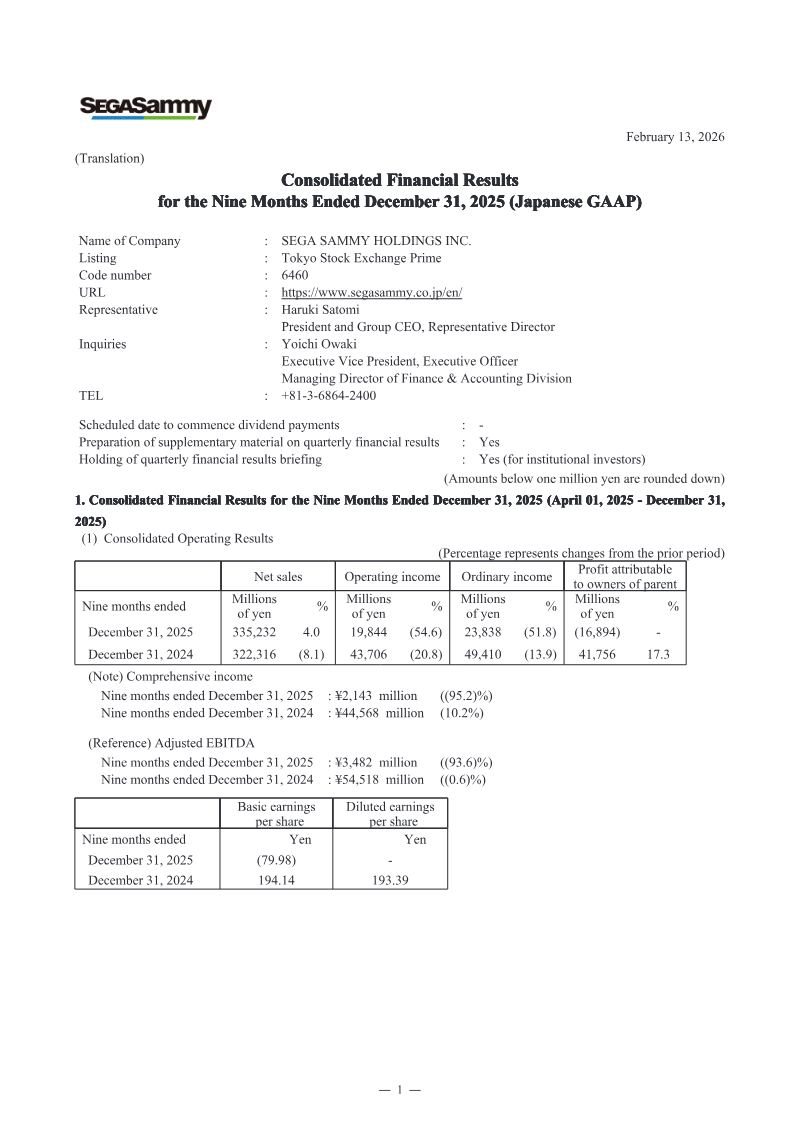
The quarterly consolidated financial results for SEGA SAMMY HOLDINGS INC. cover the nine‑month period ending December 31, 2025, within a fiscal year that ends March 31, 2026. Net sales rose 4 % to ¥335,232 million from ¥322,316 million in the prior year. Operating income fell sharply by 54.6 % to ¥19,844 million, driven largely by a ¥31,380 million impairment loss on goodwill and other intangible assets related to the Rovio subsidiary. Ordinary income declined 51.8 % to ¥23,838 million, and profit attributable to owners of parent turned a loss of ¥16,894 million. Adjusted EBITDA contracted 93.6 % to ¥3,482 million from ¥54,518 million, reflecting the extraordinary impairment and restructuring costs. Basic earnings per share shifted from a profit of ¥194.14 to a loss of ¥79.98.
Segment performance varied: Entertainment Contents sales increased modestly (1.5 %) but ordinary income fell 34.3 % to ¥24,676 million; Pachislot & Pachinko sales declined 4.0 % with ordinary income dropping 46.0 %; Gaming revenue surged 438.5 % to ¥16,795 million but incurred a loss of ¥247 million due to consolidation of newly acquired GAN and Stakelogic. The Group’s balance sheet shows total assets at ¥640,474 million and net equity of ¥360,618 million, with the equity ratio at 56.2 %. Current liabilities rose to ¥109,254 million, lowering the current ratio to 35.1 %. Treasury stock increased from ¥54,866 million to ¥26,459 million as the company retired 20 million shares and subsequently acquired up to 12 million shares at a maximum cost of ¥20 billion. The results reflect significant impairment impacts, a shift in capital allocation policy toward shareholder returns, and ongoing adjustments to the Gaming and Entertainment segments amid new acquisitions.
- Sega Sammy reported a net loss of ¥16,894 million for the nine months ending December 31, 2025, primarily driven by a ¥31,380 million impairment loss related to the Rovio subsidiary.
- Operating income plummeted 54.6% to ¥19,844 million, while adjusted EBITDA contracted 93.6% to ¥3,482 million due to the significant impairment and restructuring costs.
- Despite a 4% increase in net sales to ¥335,232 million, profitability suffered across core segments, with Entertainment Contents ordinary income falling 34.3% and Pachislot & Pachinko ordinary income dropping 46.0%.
- Gaming segment revenue surged 438.5% to ¥16,795 million following the acquisitions of GAN and Stakelogic, though the segment recorded a ¥247 million loss during the integration phase.
- The company shifted its capital allocation strategy by retiring 20 million shares and authorizing the acquisition of up to 12 million additional shares at a maximum cost of ¥20 billion.
+1
Sega Sammy Holdings
Financial13 pages
Q3 2026 Financial Supplementary Data Collection Data Appendix (FY2026/3 Q3)
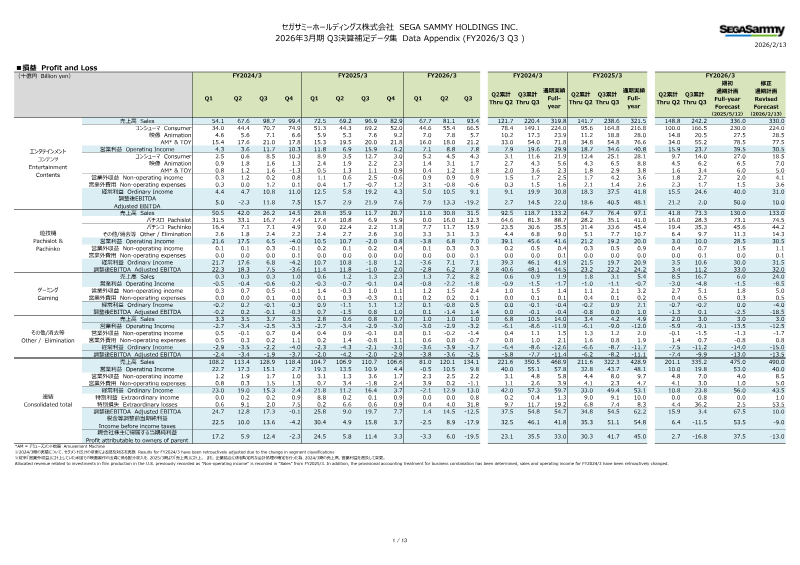
Financial results for the third quarter of the fiscal year ending March 2026 reveal a complex performance landscape characterized by robust revenue generation offset by substantial extraordinary losses. Consolidated sales reached 134.1 billion yen for the quarter, driven primarily by the Entertainment Contents segment. However, the company recorded a net loss of 19.5 billion yen due to 31.8 billion yen in extraordinary charges. These financial pressures necessitated a revision of the full-year forecast, which now anticipates higher overall sales of 490.0 billion yen but a projected net loss of 13.0 billion yen for the fiscal year.
The consumer games division remains a cornerstone of the business, though it faces tempered expectations for the remainder of the year. While third-quarter sales were strong at 66.5 billion yen and full-game unit sales reached 8.69 million, the annual unit sales target was lowered from 30.0 million to 26.5 million. This adjustment stems largely from a decline in anticipated repeat sales of older titles. Key intellectual properties continue to demonstrate market resonance, with the Sonic series leading performance at 4.0 million units year-to-date, followed by the Total War, Like a Dragon, and Persona franchises, which each contributed between 2.4 million and 3.2 million units.
In the amusement and resort sectors, the Pachislot and Pachinko segments show signs of recovery despite regulatory and competitive challenges. While Pachislot approval rates remain low and utilization shares have dipped to 14.5%, the Pachinko segment saw an improved utilization share of 10.0%, ranking the company third in the market. Simultaneously, the Paradise Segasammy casino resort reported growth, hosting 321,000 users year-to-date and generating a cumulative operating profit of 86.2 billion KRW. These diverse results highlight a period of strategic recalibration as the company manages high-performing legacy IPs against broader structural financial headwinds.
- The company reported a Q3 net loss of 19.5 billion yen, driven by 31.8 billion yen in extraordinary charges, leading to a revised full-year net loss forecast of 13.0 billion yen.
- Full-year sales forecasts were increased to 490.0 billion yen, despite the company lowering its annual consumer game unit sales target from 30.0 million to 26.5 million units.
- Consumer game performance in Q3 reached 66.5 billion yen in sales and 8.69 million units, with the downward revision in annual targets attributed to weaker-than-expected repeat sales of older titles.
- The Sonic franchise remains the top performer with 4.0 million units sold year-to-date, followed by the Total War, Like a Dragon, and Persona franchises, which each moved between 2.4 million and 3.2 million units.
- The Paradise Segasammy casino resort reported growth with 321,000 year-to-date users and a cumulative operating profit of 86.2 billion KRW.
+2
Sega Sammy HoldingsFeb 2026
Financial53 pages
Results Presentation: Q3 Fiscal Year Ending March 2026
The company’s Q3 fiscal year ending March 2026 fell short of its initial forecast, primarily due to weaker entertainment‑content sales and a substantial goodwill impairment of approximately 31.3 billion yen following the Rovio acquisition. Operating income reached 43.7 billion yen versus a forecast of 48.1 billion yen, while adjusted EBITDA for the full year was revised upward to 62.2 billion yen after accounting for M&A effects and impairment losses. The balance sheet reflected a 6.6 billion‑yen increase in goodwill and a 39.9 billion‑yen decline in shareholders’ equity, driven by the impairment and a treasury‑stock buyback.
Entertainment‑content sales underperformed across most segments, with the Consumer area’s full‑game and new free‑to‑play titles falling short of expectations. Animation sales, however, exceeded forecasts, and licensing revenue alongside subscription services in the Consumer segment are projected to grow year‑over‑year. The company highlighted strong character licensing and a steady animation business but noted sluggish results for Rovio and the need to boost holiday‑period sales.
The Gaming Business continued to build a foundation for growth, launching new titles such as “Railroad RICHES Link™” and “Super Burst Boosted Cartin’ Gold™.” Casino sales hit a record high, driven by Japanese VIP and mass‑market customers, yet the group anticipates roughly 15 billion yen in impairment losses from Stakelogic and is restructuring management and product development to improve profitability. Focus remains on B2B omnichannel expansion in online gaming and social casino markets while tightening capital allocation for new IP development.
Looking ahead, the next fiscal year will concentrate on expanding SEGA Sammy’s core entertainment portfolio with four major IP releases, enhancing sales capabilities for content titles, and launching a full‑scale B2B online gaming platform. In the pachislot/pachinko segment, new cabinet models featuring flagship IPs will roll out through Q3‑Q4 2026. The animation arm plans several high‑profile releases, including new “Detective Conan” and “Lupin the Third” projects, with a mix of global launches and Netflix exclusives to diversify revenue streams.
- Q3 operating income reached 43.7 billion yen, missing the 48.1 billion yen forecast due to weak entertainment-content sales and a 31.3 billion yen goodwill impairment related to the Rovio acquisition.
- The company recorded a 39.9 billion yen decline in shareholders' equity, resulting from the Rovio impairment and a treasury-stock buyback.
- Casino sales reached a record high driven by Japanese VIP and mass-market customers, though the group expects a 15 billion yen impairment loss from Stakelogic and is restructuring to improve profitability.
- Entertainment-content sales underperformed in the Consumer segment for full-game and free-to-play titles, though animation sales exceeded forecasts and licensing revenue is projected to grow year-over-year.
- Full-year adjusted EBITDA guidance was revised upward to 62.2 billion yen, accounting for M&A effects and impairment losses.
Sega Sammy HoldingsFeb 2026
Presentation53 pages
Q3 for the Fiscal Year Ending March 2026 Results Presentation
Sega Sammy’s performance through the third quarter of the fiscal year ending March 2026 is characterized by a significant divergence between robust domestic gaming machine operations and substantial financial setbacks in the global consumer and mobile segments. While the Pachislot and Pachinko division exceeded expectations—driven by high-volume unit sales of titles like Smart Pachislot Tokyo Revengers—the broader group faces a projected net loss of 13.0 billion yen for the fiscal year. This downturn is primarily the result of 46.3 billion yen in extraordinary impairment losses related to the acquisitions of Rovio and Stakelogic, the latter of which was impacted by regulatory shifts in the Netherlands.
The Entertainment Contents Business struggled with underperforming new full game launches and a deteriorating user acquisition environment for mobile titles, most notably Sonic Rumble. Consequently, management has pivoted from aggressive expansion to a period of consolidation, suspending large-scale M&A activities in favor of a 20.0 billion yen share buyback program. To restore profitability within the mobile sector, the strategy now emphasizes a "regrowth phase" for Rovio, leveraging AI-driven marketing efficiencies and a transmedia approach that includes major theatrical releases for the Angry Birds and Sonic franchises scheduled through 2027.
Despite current headwinds, the medium-term outlook relies on a robust multi-platform pipeline and the expansion of the Gaming Business, which includes record-high performance at Paradise SegaSammy fueled by Japanese VIP demand. Upcoming releases for the Nintendo Switch 2 and the continued rollout of high-profile intellectual properties like Yakuza and Persona are intended to stabilize the consumer area. Geographically, the company remains focused on global markets while maintaining strict compliance with international gaming regulations in jurisdictions such as Nevada, which govern both corporate operations and shareholder requirements.
- Sega Sammy projects a 13.0 billion yen net loss for the fiscal year ending March 2026, driven by 46.3 billion yen in impairment losses from the acquisitions of Rovio and Stakelogic.
- The Pachislot and Pachinko division is the company's primary financial driver, significantly exceeding expectations through high-volume sales of titles like Smart Pachislot Tokyo Revengers.
- Management has shifted from aggressive M&A to a consolidation strategy, marked by the suspension of large-scale acquisitions and the initiation of a 20.0 billion yen share buyback program.
- The Entertainment Contents Business is underperforming due to weak new full game launches and poor user acquisition for mobile titles, specifically Sonic Rumble.
- The company is pivoting to a 'regrowth phase' for Rovio, utilizing AI-driven marketing and transmedia support from Angry Birds and Sonic theatrical releases scheduled through 2027.
Sega Sammy HoldingsFeb 2026
Financial16 pages
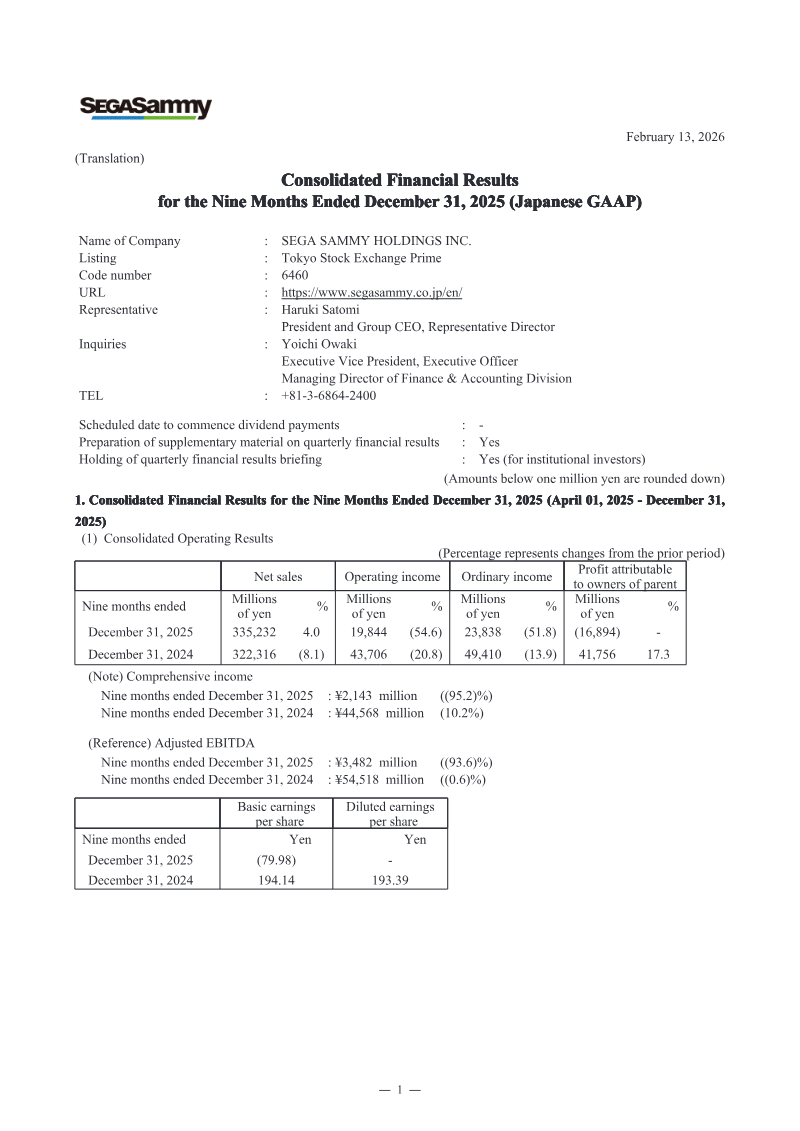
Consolidated Financial Results for the Nine Months Ended December 31, 2025
Sega Sammy Holdings experienced a period of financial transition during the first nine months of the fiscal year ending March 31, 2026, characterized by modest revenue growth alongside significant bottom-line volatility. Net sales increased by 4.0% to ¥335.2 billion, supported by the successful execution of the Sonic the Hedgehog transmedia strategy and record profits from the Paradise City integrated resort in South Korea. However, the company recorded a net loss of ¥16.9 billion, a sharp reversal from the prior year’s profitability. This downturn was primarily driven by a ¥31.4 billion impairment loss on goodwill and intangible assets associated with the acquisition of Rovio Entertainment, which contributed to a 54.6% decline in operating income.
Performance across core business segments remained mixed as the company integrated recent acquisitions. While the Gaming segment saw a 441.6% surge in third-party sales following the consolidation of Stakelogic and GAN, it ultimately recorded an ordinary loss. Meanwhile, ordinary income fell by 34.3% in the Entertainment Contents division and 46% in the Pachislot and Pachinko segment. These operational headwinds, combined with dividend payments and treasury stock acquisitions, led to a reduction in total net assets to ¥360.6 billion.
In response to these financial pressures and the impact of the Rovio impairment, a strategic shift in capital allocation has been implemented. The company has formally suspended large-scale M&A activities to prioritize shareholder returns and balance sheet stability. This pivot includes a ¥20 billion treasury stock buyback program scheduled between February and July 2026, intended to acquire and retire up to 5.71% of outstanding shares. By reallocating capital previously reserved for aggressive growth investments, the focus has moved toward optimizing existing assets and enhancing shareholder value through disciplined financial management.
- Sega Sammy reported a net loss of ¥16.9 billion for the nine months ending December 31, 2025, driven primarily by a ¥31.4 billion impairment loss related to the acquisition of Rovio Entertainment.
- Operating income declined by 54.6% year-over-year, despite a 4.0% increase in net sales to ¥335.2 billion supported by Sonic the Hedgehog transmedia performance and Paradise City resort profits.
- The company is suspending large-scale M&A activities to prioritize balance sheet stability and has initiated a ¥20 billion treasury stock buyback program to retire up to 5.71% of outstanding shares between February and July 2026.
- Ordinary income fell significantly across core divisions, with a 34.3% decline in the Entertainment Contents segment and a 46% drop in the Pachislot and Pachinko segment.
- While the Gaming segment experienced a 441.6% surge in third-party sales following the consolidation of Stakelogic and GAN, the division ultimately recorded an ordinary loss.
+1
Sega Sammy HoldingsFeb 2026
Report80 pages
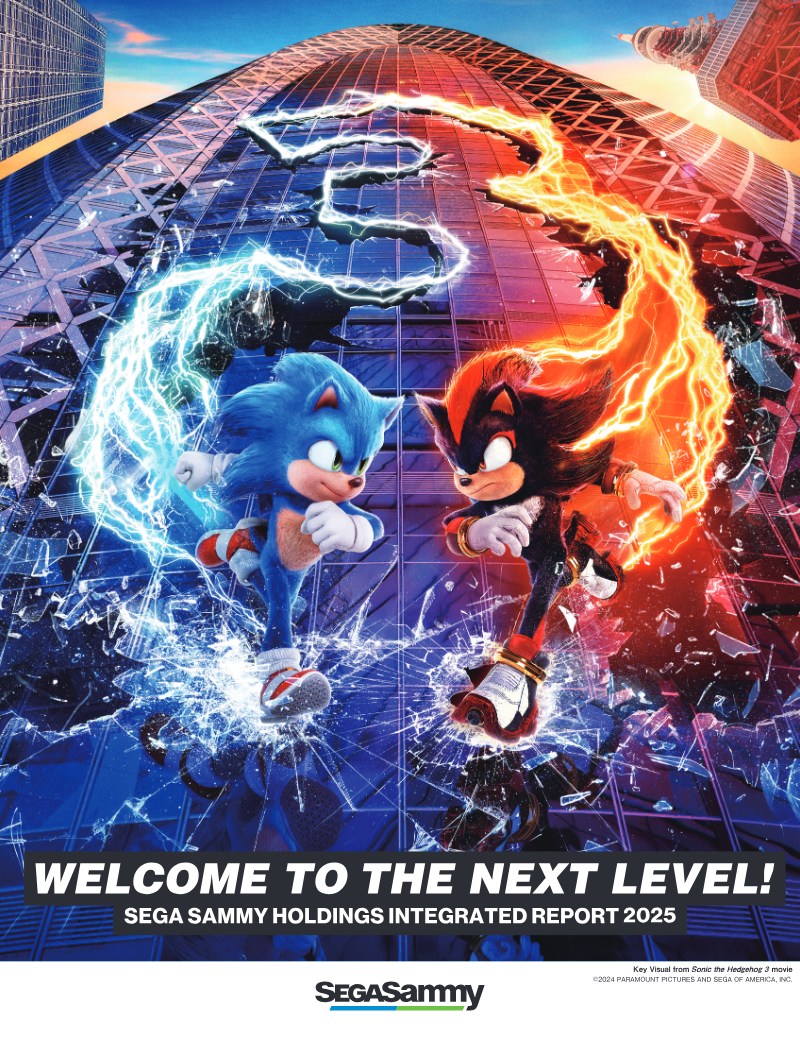
Sega Sammy Holdings Integrated Report 2025
Sega Sammy Holdings’ 2025 Integrated Report details a transformative strategic shift aimed at establishing a more balanced and resilient business portfolio. Historically reliant on the volatile Pachislot & Pachinko market, the Group is transitioning to a three-pillar structure: Entertainment Contents, Pachislot & Pachinko, and a newly formed Gaming Business. This "Welcome to the Next Level!" plan focuses on global expansion and transmedia integration to drive long-term growth through 2030.
The Entertainment Contents segment remains the primary revenue driver, contributing ¥321.5 billion of the Group’s ¥428.9 billion in FY2025 net sales. This growth is fueled by a "mille-feuille" revenue model that leverages major intellectual properties like Sonic the Hedgehog, Persona, and Like a Dragon across games, film, and licensing. Meanwhile, the Pachislot & Pachinko segment is being repositioned as a stable cash generator. To combat a shrinking domestic market, the Group is introducing innovative modular cabinet systems to reduce costs for operators and improve player engagement.
The most significant strategic development is the establishment of the Gaming Business as a third pillar, targeting the North American iGaming and B2B casino solutions markets. This expansion is underpinned by the major acquisitions of Rovio, GAN, and Stakelogic, totaling over ¥130 billion, alongside the divestment of non-core assets like the Phoenix Seagaia Resort. Financially, the Group reported a robust FY2025 performance with a profit of ¥45.1 billion and an ROE of 12.2%. Looking ahead, the Group targets a cumulative adjusted EBITDA of over ¥230 billion by FY2027, supported by a commitment to shareholder returns including a 50% total return ratio and a 3% dividend on equity. Sustainability and governance also remain central, with goals for carbon neutrality by 2050 and enhanced diversity within its global workforce.
- Sega Sammy is restructuring into a three-pillar business model comprising Entertainment Contents, Pachislot & Pachinko, and a new Gaming Business to reduce reliance on volatile domestic markets.
- The Entertainment Contents segment generated ¥321.5 billion of the Group's ¥428.9 billion total FY2025 net sales, driven by a transmedia strategy utilizing IPs like Sonic, Persona, and Like a Dragon.
- The company is aggressively entering the North American iGaming and B2B casino markets through over ¥130 billion in acquisitions, including Rovio, GAN, and Stakelogic.
- The Group reported a robust FY2025 financial performance with a profit of ¥45.1 billion and an ROE of 12.2%.
- Management has set a target of over ¥230 billion in cumulative adjusted EBITDA by FY2027, supported by a 50% total return ratio and a 3% dividend on equity.
Sega Sammy HoldingsOct 2025
Financial71 pages
Fiscal Year Ended March 2025 Results Presentation
Sega Sammy’s financial performance for the fiscal year ended March 2025 reflects a transitional period characterized by strategic restructuring and the expansion of global intellectual property. While net sales and operating income saw a decline to 428.9 billion yen and 48.1 billion yen respectively, net profit rose to 45.0 billion yen following the divestment of Phoenix Resort. The Entertainment Contents division remained a primary growth engine, bolstered by high-margin repeat game sales and the successful integration of Rovio. Despite a temporary downturn in the Pachislot and Pachinko segment due to a lack of major releases, the Gaming division achieved profitability through record-breaking casino performance at Paradise SegaSammy and robust slot machine sales in the United States.
The medium-term strategy centers on a transmedia approach designed to maximize the lifecycle value of core franchises. This is exemplified by the Sonic the Hedgehog brand, which saw significant licensing growth and substantial box office success, paving the way for a multi-year pipeline of films and animation through 2027. To sustain this momentum, the company is reviving legacy titles such as Virtua Fighter and Shinobi while investing 20.93 billion yen to acquire Stakelogic, targeting the North American online gaming market. These initiatives are supported by structural reforms in European operations and a commitment to human capital, including specific targets for cultural diversity and female leadership by 2031.
Looking toward the fiscal year ending March 2026, a recovery in sales to 475.0 billion yen is projected, driven by a strong pipeline of new titles and the revitalization of the Pachislot business through innovative cabinet systems. The company maintains a disciplined capital policy, targeting a 50% total return ratio for shareholders and a cumulative adjusted EBITDA of over 230 billion yen by 2027. Furthermore, Sega Sammy continues to prioritize ESG benchmarks, maintaining high ratings for gender diversity and climate change management while navigating the complex regulatory requirements of international gaming jurisdictions.
- Sega Sammy reported fiscal year 2025 net sales of 428.9 billion yen and operating income of 48.1 billion yen, with net profit rising to 45.0 billion yen following the divestment of Phoenix Resort.
- The company is executing a transmedia strategy for core franchises like Sonic the Hedgehog, supported by a film and animation pipeline extending through 2027.
- Sega Sammy acquired Stakelogic for 20.93 billion yen to expand its presence in the North American online gaming market.
- Management projects a recovery to 475.0 billion yen in sales for fiscal year 2026, driven by a new game pipeline and the revitalization of the Pachislot business.
- The company has set a medium-term financial target of a cumulative adjusted EBITDA exceeding 230 billion yen by 2027 while maintaining a 50% total shareholder return ratio.
+1
Sega Sammy HoldingsMay 2025
Financial29 pages
Results Presentation: Q3 for the Fiscal Year Ending March 2025
This financial presentation details the consolidated results for Sega Sammy Holdings for the third quarter of the fiscal year ending March 2025. The findings indicate a strong overall performance, particularly within the Entertainment Contents segment, which includes consumer games and animation. While the company reported a year-to-date net sales decrease to 322.3 billion yen compared to the previous year, it revised its full-year ordinary income forecast upward to 51.5 billion yen, driven by robust performance in its core intellectual properties.
The scope of the report covers global operations across three primary segments: Entertainment Contents, Pachislot and Pachinko Machines, and Gaming. In the consumer area, the successful launches of Metaphor: ReFantazio and Sonic X Shadow Generations contributed to strong sales, though the company recorded an inventory write-down following the cancellation of Football Manager 25. The animation division saw significant gains from the Sonic the Hedgehog cinematic franchise. Conversely, the Pachislot and Pachinko segment faced a downward revision in sales forecasts due to the postponement of mainstay titles to the next fiscal year to ensure product quality.
The Gaming business, centered on North American slot machine sales and the Paradise City resort in South Korea, showed steady growth. The company announced an organizational restructuring of this segment to integrate recent acquisitions like GAN and Stakelogic, aiming to establish gaming as a third major business pillar. Methodologically, the report utilizes consolidated financial data, exchange rate impact analysis, and unit sales tracking. The company maintains a shareholder return policy targeting a total return ratio of 50% or a 3% dividend on equity, supported by a medium-term plan to invest over 100 billion yen in research, development, and strategic growth.
- Sega Sammy revised its full-year ordinary income forecast upward to 51.5 billion yen, despite a year-to-date net sales decrease to 322.3 billion yen for the fiscal year ending March 2025.
- The Entertainment Contents segment drove performance through successful launches of Metaphor: ReFantazio and Sonic X Shadow Generations, alongside strong results from the Sonic the Hedgehog cinematic franchise.
- The company recorded an inventory write-down following the cancellation of Football Manager 25, impacting the consumer games division.
- The Pachislot and Pachinko segment sales forecasts were revised downward due to the postponement of mainstay titles to the next fiscal year to prioritize product quality.
- Sega Sammy is restructuring its Gaming segment to integrate recent acquisitions GAN and Stakelogic, aiming to establish the division as a third major business pillar alongside Entertainment Contents and Pachislot/Pachinko.
+1
Sega Sammy HoldingsFeb 2025