Kadokawa Corporation
Game Co.27 documents
Media company, parent of FromSoftware (Elden Ring, Dark Souls, Sekiro, Armored Core). Also anime, manga, publishing.
Documents

Legal3 pages
Notice Regarding a Candidate for Member of the Board and Changes in Chief Officer and Corporate Officer Positions
Kadokawa Corporation announced that its Nomination Committee will nominate a new board member, Kouji Okura, for the 12th Annual General Meeting on June 24 2026. The board slate totals twelve candidates, of which 58.3 % are independent directors, 25 % are women, and 8.3 % are non‑Japanese. The only retiring board member is Ayumi Uzawa, an independent director.
Okura, 69, brings extensive experience from Mitsubishi Heavy Industries, where he held senior accounting and audit roles before becoming president and CEO of Mitsubishi Shipbuilding. His background in finance, governance, risk management, and structural reform positions him to strengthen Kadokawa’s corporate governance and strategic oversight.
The company also confirmed changes in its chief officer and corporate officer structure effective June 24. Chief Human Resource Officer Naohisa Yamashita, Chief Literature & Film Officer, and Chief Manga & Light Novels Officer remain in place. New appointments include Sho Tanaka as Chief Anime Officer, tasked with leading animation and production initiatives, and Masayuki Aoyagi as President and CEO of Arclight Inc. Corporate officers were also reorganized, with new roles for Takashi Sensui (Chief Global Officer) and Hidetaka Miyazaki (Corporate Officer, Game Business), among others.
These appointments reflect Kadokawa’s focus on strengthening governance, diversifying its leadership, and aligning executive roles with its core media and entertainment business segments across Japan.
- Kadokawa Corporation will nominate Kouji Okura, former CEO of Mitsubishi Shipbuilding, to its board of directors at the 12th Annual General Meeting on June 24, 2026.
- The proposed board slate consists of 12 candidates, with 58.3% independent directors, 25% women, and 8.3% non-Japanese representation.
- Sho Tanaka has been appointed as the new Chief Anime Officer to lead the company's animation and production initiatives effective June 24, 2026.
- Hidetaka Miyazaki has been appointed as Corporate Officer for the Game Business, while Takashi Sensui takes on the role of Chief Global Officer.
- Masayuki Aoyagi will assume the position of President and CEO of Arclight Inc. as part of the broader corporate officer reorganization.
Kadokawa Corporation

Legal32 pages
Supplementary Document of the Company’s Initiatives to Enhance Corporate Value and the Shareholder Proposal: Japan
The supplementary document presents KADOKAWA’s strategic response to a shareholder proposal, outlining a six‑year Mid‑term Management Plan that replaces the previous five‑year framework. The core objective is to restore profitability and build a resilient, IP‑driven revenue base by restructuring domestic publishing and animation operations, tightening fixed costs, and investing in high‑growth intellectual property. The plan targets a 12 % return on equity (ROE) by fiscal year 2031, with an emphasis on portfolio and price‑strategy optimization in publishing, cost control in animation production, and a strategic early‑retirement program to free resources for growth.
The transformation strategy is divided into three phases: structural reform (FY2026‑27), profit growth (FY2028‑29), and expansion (FY2030‑31). During the reform phase, KADOKAWA will consolidate business units under new executive leaders and establish a cross‑business steering committee, while pruning unprofitable lines. Net sales are projected to rise from ¥325 bn in FY2026 to ¥400 bn by FY2031, and operating margins are expected to improve from 4.0 % to 9.5 %. A disciplined capital policy will aim for a 30 % payout ratio and maintain share‑buyback flexibility.
Governance measures reinforce the plan’s execution. CEO Takeshi Natsuno maintains 100 % attendance at key board, executive council, and investor meetings, while conducting regular “direct‑meeting” sessions with employees and final interviews for new hires. The board will continuously monitor KPIs—sales returns, in‑house animation production, overseas revenue, ROE, and EPS—and will adjust management structure or investment allocation if progress lags. These initiatives collectively aim to accelerate revenue restructuring, enhance capital efficiency, and sustain leadership continuity across Japan’s media‑mix industry.
- KADOKAWA has launched a six-year Mid-term Management Plan targeting a 12% return on equity (ROE) by fiscal year 2031.
- The company aims to increase net sales from ¥325 billion in FY2026 to ¥400 billion by FY2031, while expanding operating margins from 4.0% to 9.5%.
- The strategic transformation is divided into three phases: structural reform (FY2026–27), profit growth (FY2028–29), and expansion (FY2030–31).
- Core operational changes include restructuring domestic publishing and animation, implementing a strategic early-retirement program, and consolidating business units under new executive leadership.
- Capital policy will focus on a 30% dividend payout ratio while maintaining flexibility for share buybacks.
Kadokawa Corporation
Legal92 pages
Notice of the 12th General Meeting of Shareholders: Japan
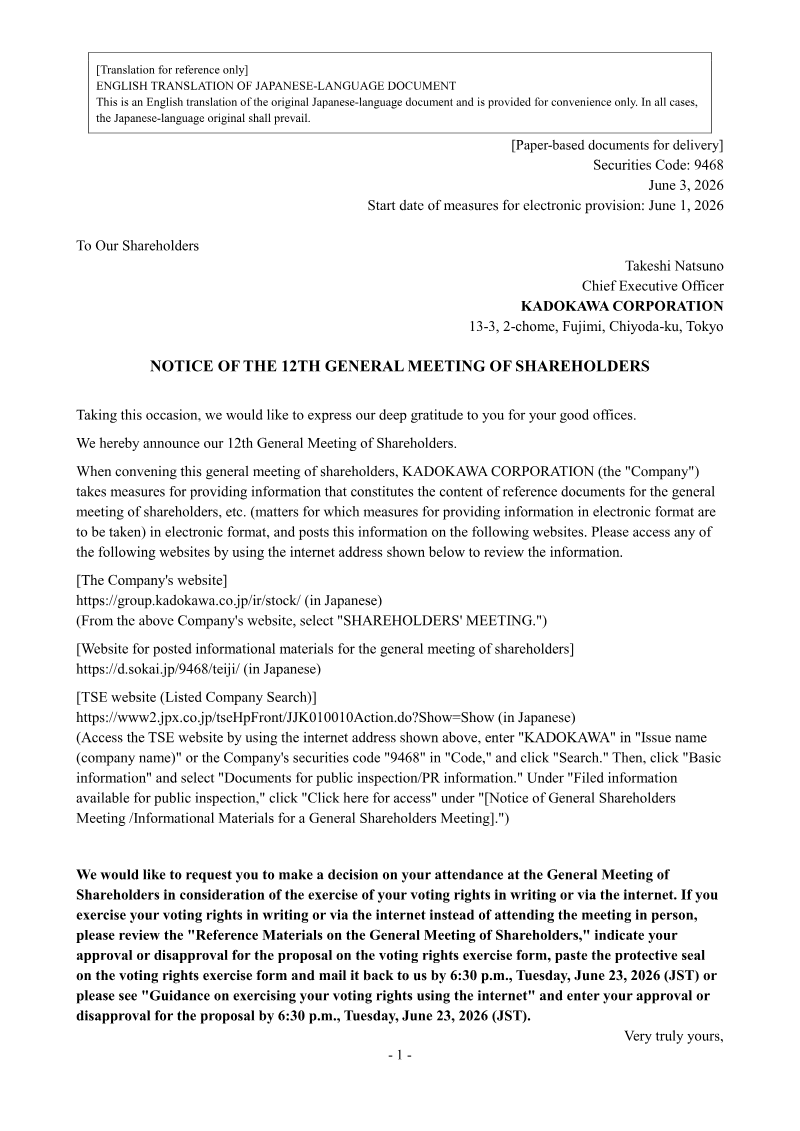
Kadokawa Corporation’s 12th annual shareholders’ meeting, scheduled for June 24 2026, serves to present FY 2025‑26 financial results, audit findings and a mid‑term management plan that frames the next two fiscal years as a “structural reform period.” The board proposes twelve directors, including two newly nominated outside directors—Koichi Kusano and Koji Okura—whose legal, governance, finance and restructuring expertise are expected to reinforce audit oversight and risk management. A motion to dismiss one director is opposed by the board, underscoring its commitment to continuity.
Financially, the Group recorded a ¥17.0 billion net sales decline of 4.7 % YoY, with operating losses of ¥3.97 billion driven by weaker recreation and MD segments amid rising anime production costs and a shrinking domestic print market. Capital expenditures of ¥9.98 billion focused on e‑book technology, studio expansion and gaming development, reflecting the CEO’s “Global Media Mix with Technology” strategy. The company targets ¥400 billion sales, ¥38 billion operating profit and 9.4 % ROE for FY2026‑27, with a projected ¥180 EPS by FY2031. Recent acquisitions of Edizioni BD S.r.l. and SOZO Pte. Ltd., each adding significant goodwill, signal a strategic push into global media and event hosting.
Governance structures remain robust: all outside directors attended every committee meeting, contributed constructively to oversight and compensation reform, and the independent auditor received ¥107 million with no indemnity agreements. Internal audit processes are reported to an Audit Committee Office, and compliance measures have been tightened following a Fair Trade Commission recommendation. The Group’s financial base includes ¥10,153 million in long‑term borrowings and a fair‑value classification that keeps investment securities at Level 1. Overall, Kadokawa’s disclosures portray a company actively restructuring its operations, reinforcing governance, and pursuing growth through technology‑enabled media expansion.
- Kadokawa Corporation reported a 4.7% year-over-year decline in net sales to ¥17.0 billion and an operating loss of ¥3.97 billion, attributed to rising anime production costs and a shrinking domestic print market.
- The company has designated the next two fiscal years as a 'structural reform period,' targeting ¥400 billion in sales, ¥38 billion in operating profit, and a 9.4% ROE by FY2026-27.
- Management is prioritizing a 'Global Media Mix with Technology' strategy, supported by ¥9.98 billion in capital expenditures focused on e-book technology, studio expansion, and gaming development.
- To strengthen governance and risk management, the board has nominated two new outside directors, Koichi Kusano and Koji Okura, while formally opposing a motion to dismiss an existing director.
- International expansion efforts include the recent acquisitions of Edizioni BD S.r.l. and SOZO Pte. Ltd. to bolster the company's global media and event-hosting capabilities.
Kadokawa Corporation

Financial69 pages
Consolidated Earnings Results: Fiscal Year Ended March 31, 2025
KADOKAWA’s fiscal year ending March 31, 2025 recorded a 7.7 % increase in consolidated net sales to ¥12,900 million, yet operating profit fell 9.8 % and net profit plunged 35.1 %. The sharp decline was largely attributable to a ¥2.4 billion cyber‑attack loss that hit the Web Services and Publication/IP Creation segments, coupled with a contraction in domestic paper‑book sales. Despite these setbacks, the Animation/Film and Gaming divisions achieved record sales—Animation/Film grew 10.9 % in net sales, while Gaming posted a 32.5 % rise driven by Elden Ring and its DLC—though Q4 profitability was eroded by higher impairment charges.
Education and EdTech emerged as the primary growth engine, with sales up 12.9 % and operating profit surging 37.9 %. New school partnerships, rising enrollment, and expanded digital publishing contributed to this performance, offsetting losses in other areas. E‑book sales reached ¥26.9 billion and international paper‑based book sales rose 18 %, reflecting a successful diversification of revenue streams.
Strategically, KADOKAWA is consolidating its animation studios, investing in talent development and digital logistics, and strengthening governance to accelerate cross‑segment media‑mix initiatives. The company’s board maintains a high proportion of independent directors (58.3 %) and a 25 % female director ratio, underscoring its commitment to robust corporate governance.
Overall, the FY2025 results demonstrate resilience through diversified content and education offerings, while highlighting the vulnerability of digital platforms to cyber threats. The company’s focus on expanding its IP ecosystem and improving operational efficiencies positions it for sustained growth across domestic and international markets.
- KADOKAWA’s net profit fell 35.1% and operating profit dropped 9.8% for the fiscal year ending March 31, 2025, primarily due to a ¥2.4 billion loss from a cyber-attack and declining domestic paper-book sales.
- The Gaming division achieved a 32.5% increase in net sales, driven by the strong performance of Elden Ring and its associated DLC.
- Education and EdTech became the company's primary growth engine, recording a 12.9% increase in sales and a 37.9% surge in operating profit.
- Consolidated net sales rose 7.7% to ¥12,900 million, bolstered by record-setting performances in the Animation/Film division, which grew 10.9%, and the Gaming division.
- Revenue diversification efforts showed success as e-book sales reached ¥26.9 billion and international paper-based book sales grew by 18%.
Kadokawa Corporation

Financial39 pages
Earnings Results for the 2nd Quarter Ended September 30, 2025: Kadokawa
Kadokawa’s second‑quarter earnings for FY 2026 reveal a modest decline in consolidated performance, with net sales falling 1.9 % to ¥136,320 million and operating profit contracting 29.7 % to ¥4,597 million. The downturn is largely attributable to weaker Animation/Film and Gaming units, while Publication/IP Creation and Web Services have partially recovered from last year’s cyber‑attack losses. Consequently, the company has lowered its full‑year outlook to ¥278.2 bn in net sales and trimmed operating profit guidance by roughly 38 % to ¥10.3 bn, reflecting a cautious stance amid shifting market dynamics.
Within Publication/IP Creation, first‑half sales dipped 0.2 % as domestic paper book revenue fell 6.7 % and e‑book income dropped 15.2 %, though international paper sales grew 20.1 %. Operating profit suffered a sharp 94.1 % decline, driven by timing adjustments in sales recognition and higher variable costs from new titles, despite a 9.6 % increase in newly launched IPs. The segment plans to reorganize its domestic publishing structure, concentrate on comics and light novels, and trim costs in lower‑volume genres to restore profitability.
Other business segments experienced an 11.0 % YoY sales decline and a 21.3 % drop in operating profit, largely due to reduced MD sales; however, recreation sales rose 22.1 % thanks to strong IP‑event performance. Management intends to reinforce MD product lines, expand global merchandise and event hosting, and rationalize SAKURA TOWN operations to recover earnings in the second half.
The Education/EdTech unit shows modest growth, with high‑school enrollments up 11 % and Vantan enrollment rising 6 %. International Animation/Film and Gaming continue to dominate revenue, accounting for roughly 58 % of sales. Capital investment reached ¥14.1 bn, mainly in intangible assets and property/plant/equipment. After a ¥15 bn loan repayment, the equity ratio stands at 64.3 % and net cash balances ¥101.4 bn as of September 30, 2025, underscoring a solid balance sheet amid earnings volatility.
- Kadokawa lowered its full-year operating profit guidance by approximately 38% to ¥10.3 billion, following a 29.7% decline in operating profit to ¥4,597 million for the second quarter ended September 30, 2025.
- Consolidated net sales for the second quarter fell 1.9% to ¥136,320 million, driven by underperformance in the Animation/Film and Gaming units, which together account for roughly 58% of total revenue.
- The Publication/IP Creation segment saw a 94.1% collapse in operating profit due to timing adjustments and higher variable costs, despite a 9.6% increase in new IP launches.
- Domestic publishing revenue struggled with a 6.7% decline in paper books and a 15.2% drop in e-book income, though international paper book sales grew by 20.1%.
- The company maintains a strong financial position with a 64.3% equity ratio and ¥101.4 billion in net cash, even after a ¥15 billion debt repayment.
Kadokawa Corporation
Financial37 pages
Earnings Results: 3rd Quarter Ended December 31, 2025
KADOKAWA’s financial performance for the nine-month period ending December 31, 2025, reflects a period of significant contraction, characterized by a 1.7% decline in net sales and a 59.7% collapse in operating profit. This downturn stems from difficult year-over-year comparisons against previous major title successes, rising operational costs, and the lingering impact of past cyberattacks. The Publication/IP Creation segment experienced the most acute pressure, with operating profit falling by 90.2% as the company increased investments in digital manufacturing, logistics, and human capital while facing a decrease in sales scale per individual title.
The company’s diversified business model provided some stability, as the Web Services and Education/EdTech segments emerged as key growth drivers. Specifically, the N High School Group reported a 10% increase in student enrollment, highlighting the resilience of the education division. Conversely, the Animation/Film and Gaming segments struggled, with international net sales declining by 16.6% due to a shift in the release slate toward new adaptations rather than established, high-performing franchises.
To address these systemic challenges, KADOKAWA is currently executing comprehensive business reforms, including organizational streamlining and aggressive cost-optimization strategies. Management remains focused on long-term recovery, prioritizing the secondary utilization of intellectual property and leveraging a robust pipeline of animation sequels and major titles to bolster performance in the final quarter and the upcoming fiscal year. By balancing immediate fiscal discipline with continued investment in core IP development, the company aims to stabilize its margins and restore profitability across its global operations.
- KADOKAWA reported a 59.7% collapse in operating profit and a 1.7% decline in net sales for the nine-month period ending December 31, 2025.
- The Publication/IP Creation segment saw operating profit plummet by 90.2% due to increased investments in digital manufacturing and logistics alongside lower sales per title.
- International net sales for the Animation/Film and Gaming segments declined by 16.6% as the company shifted its release slate toward new adaptations rather than established franchises.
- The Education/EdTech segment provided a growth buffer, with the N High School Group achieving a 10% increase in student enrollment.
- Management is responding to the downturn with organizational streamlining and cost-optimization strategies to stabilize margins.
Kadokawa Corporation
Financial15 pages
Summary of Consolidated Earnings Results for the Nine Months Ended December 31, 2025
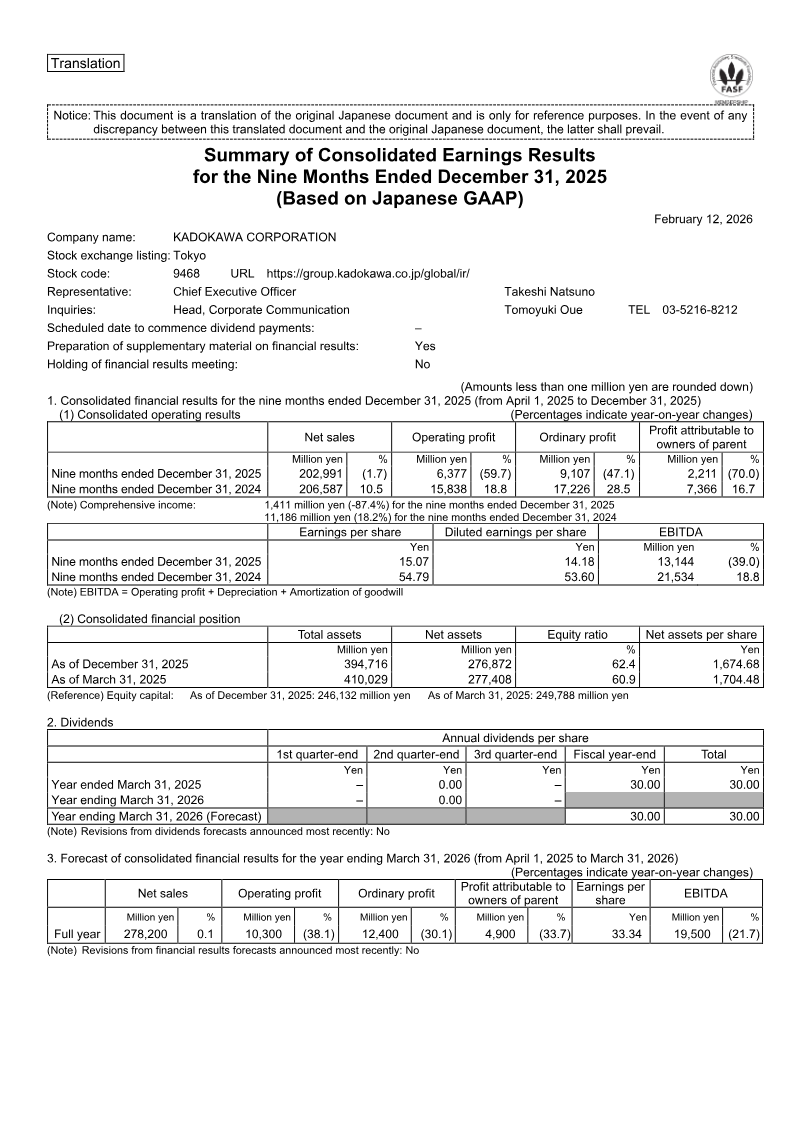
KADOKAWA CORPORATION experienced a difficult fiscal period for the nine months ending December 31, 2025, characterized by a 1.7 percent decline in net sales to 202,991 million yen and a substantial 59.7 percent drop in operating profit to 6,377 million yen. This contraction in profitability, which resulted in a 70.0 percent decrease in net income attributable to owners of the parent, stems from a lack of major hit titles across the Publication, Animation, and Gaming segments. While the Web Services and Education sectors demonstrated resilience through growth, these gains were insufficient to offset rising operational expenses and a 2,700 million yen impairment loss recorded within the Animation and Film division.
The company’s balance sheet reflects these pressures, with total assets contracting to 394,716 million yen as a result of debt repayment and reduced cash reserves. Despite these headwinds, management has opted to maintain its existing consolidated earnings forecasts for the full fiscal year ending March 31, 2026. This outlook suggests an expectation of stabilization or recovery in the final quarter, supported by ongoing strategic initiatives rather than immediate short-term gains.
Strategic expansion remains a priority, evidenced by the acquisition of an 80 percent stake in the Singapore-based firm SOZO Pte. Ltd. for 2,299 million yen. This move is designed to bolster the company’s global media mix and secure a stronger foothold in the Southeast Asian entertainment market. Although the financial contributions of this new subsidiary were not reflected in the current nine-month results, the acquisition highlights a long-term commitment to international growth. Furthermore, the company is utilizing a performance-based stock compensation plan, involving the disposal of over 900,000 treasury shares in early 2026, to align internal incentives with future recovery efforts.
- KADOKAWA CORPORATION reported a 59.7% drop in operating profit to 6,377 million yen and a 70.0% decline in net income for the nine months ending December 31, 2025.
- Net sales fell 1.7% to 202,991 million yen, primarily driven by a lack of major hit titles across the Publication, Animation, and Gaming segments.
- The company recorded a 2,700 million yen impairment loss in the Animation and Film division, contributing to the overall contraction in profitability.
- Management maintained its full-year earnings forecast for the fiscal year ending March 31, 2026, anticipating a recovery in the final quarter.
- KADOKAWA acquired an 80% stake in Singapore-based SOZO Pte. Ltd. for 2,299 million yen to expand its presence in the Southeast Asian entertainment market.
Kadokawa Corporation
Legal2 pages
Notice Concerning Change of Major and Principal Shareholder
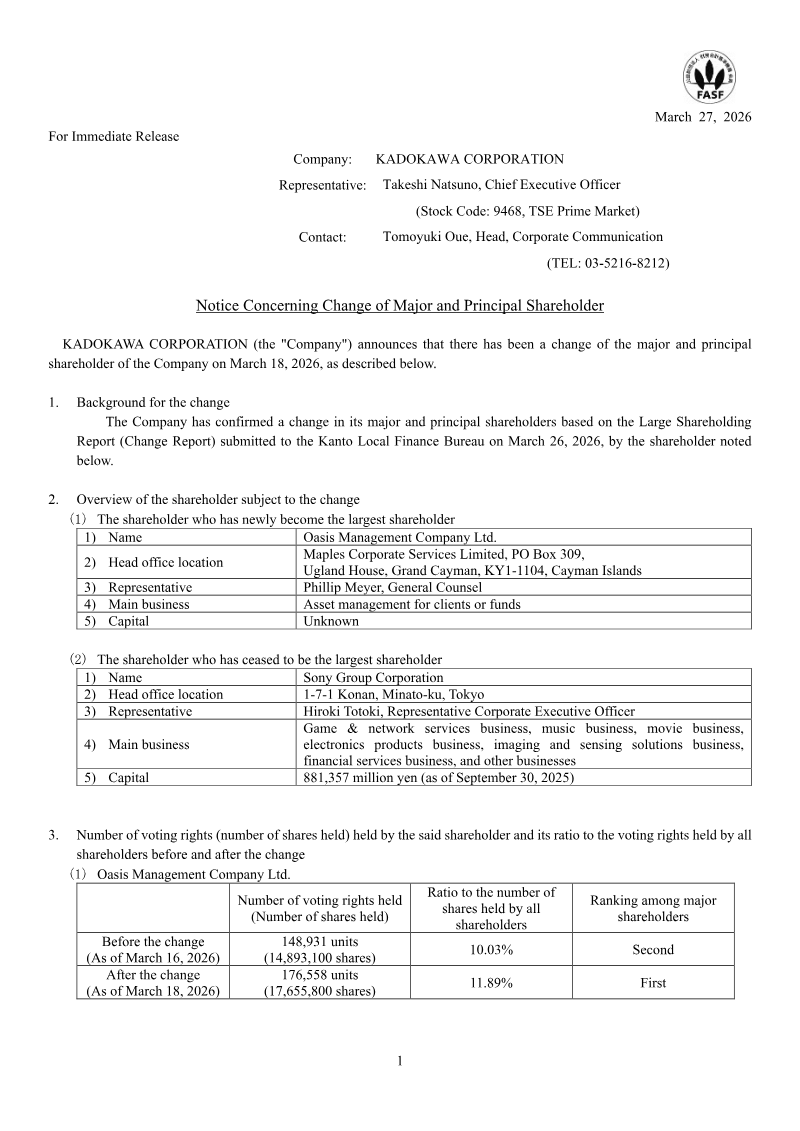
KADOKAWA CORPORATION has officially confirmed a shift in its primary shareholder structure, effective March 18, 2026. Oasis Management Company Ltd., a Cayman Islands-based asset management firm, has ascended to the position of the company’s largest shareholder, surpassing the Sony Group Corporation. This transition follows the submission of a Large Shareholding Report to the Kanto Local Finance Bureau, which detailed the acquisition of additional voting rights by the investment firm.
Data indicates that Oasis Management increased its holdings from 148,931 voting units to 176,558 units, raising its ownership stake from 10.03% to 11.89%. Conversely, the Sony Group Corporation, which previously held the top position with a 10.10% stake, now holds 10.04% of the voting rights, moving into the second position among major shareholders. These figures are calculated against a total of 1,484,474 voting rights, a total that accounts for recent treasury share disposals related to performance-based stock compensation plans.
The findings are derived from official regulatory filings and internal shareholder register assessments conducted by KADOKAWA CORPORATION as of March 2026. While the company has acknowledged this change in its ownership hierarchy, it has issued no specific commentary regarding the future strategic implications of this shift in its shareholder base. The disclosure serves as a formal notification to the Tokyo Stock Exchange and the public regarding the change in the company's principal investor.
- As of March 18, 2026, Oasis Management Company Ltd. has replaced Sony Group Corporation as the largest shareholder of KADOKAWA CORPORATION.
- Oasis Management increased its stake from 10.03% to 11.89%, growing its holdings from 148,931 to 176,558 voting units.
- Sony Group Corporation now holds the second-largest position with 10.04% of voting rights, a slight decrease from its previous 10.10% stake.
- The ownership calculations are based on a total of 1,484,474 voting rights, which reflects recent treasury share disposals for performance-based stock compensation.
- KADOKAWA CORPORATION has provided no official commentary regarding the strategic implications of this shift in its shareholder hierarchy.
Kadokawa Corporation
Legal2 pages
Notice Concerning Change of Major Shareholder
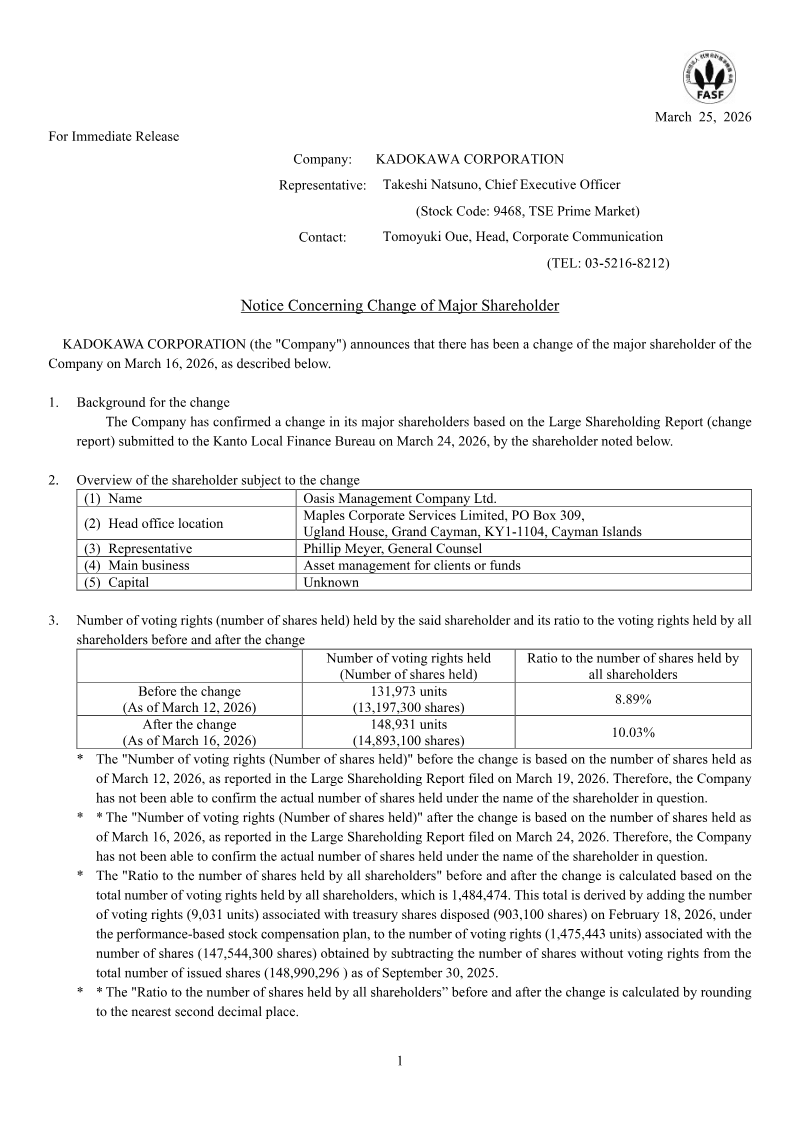
KADOKAWA CORPORATION has officially confirmed a shift in its major shareholder composition following a regulatory filing submitted to the Kanto Local Finance Bureau. The disclosure identifies Oasis Management Company Ltd., a Cayman Islands-based asset management firm, as the entity responsible for the change. This update reflects the company’s commitment to transparency regarding its equity structure and institutional investor activity within the Japanese market.
The data indicates that Oasis Management increased its stake in KADOKAWA CORPORATION between March 12 and March 16, 2026. Specifically, the firm’s holdings rose from 131,973 voting rights to 148,931 voting rights. This acquisition increased the firm’s total ownership ratio from 8.89% to 10.03% of the company’s total voting rights. These figures were calculated against a total of 1,484,474 voting rights, which accounts for recent treasury share dispositions related to performance-based stock compensation plans.
The methodology for these findings relies on the Large Shareholding Report submitted by the investor, as the company does not independently verify the actual share certificates held under the shareholder's name. As this development is purely a matter of equity ownership reporting, KADOKAWA CORPORATION has indicated that there is no immediate impact on its corporate strategy or future outlook. The announcement serves as a formal notification to stakeholders and the Tokyo Stock Exchange regarding the change in significant ownership status.
- Oasis Management Company Ltd. has increased its stake in KADOKAWA CORPORATION to 10.03% of total voting rights, up from 8.89%.
- The asset management firm acquired an additional 16,958 voting rights between March 12 and March 16, 2026, bringing their total holdings to 148,931.
- The ownership percentage was calculated against a total of 1,484,474 voting rights, a figure that accounts for recent treasury share dispositions.
- KADOKAWA CORPORATION stated that this change in major shareholder composition will have no immediate impact on the company's corporate strategy or future outlook.
- The disclosure was triggered by a regulatory filing submitted to the Kanto Local Finance Bureau and serves as formal notification to the Tokyo Stock Exchange.
Kadokawa Corporation

Report37 pages
Earnings Results: Q3 Fiscal Year Ending March 2026
1. 2026 年3 月期第 3四半期連結実績サマリ P3 2. 2026 年3 月期第 3四半期連結実績(セグメント別) P10 3. Appendix P19 Q12 20263ThDuloos①#H3-A? A 2025年3月期 2026年3月期 前年同期比 2025年3月期 2026年3月期 前年同期比 (単位:百万円) 4-12月実績 4-12月実績 (増減額) 10-12月実績 10-12月実績 (増減額) 売上高 206,587 202,991 ▲1.7% 70,267 69,058 ▲1.7% Q12 (▲3,595) (▲1,208) ③ ▲59.7% ...
- For the first three quarters of fiscal year ending March 2026 (April-December), overall sales decreased by 1.7%, operating profit by 59.7%, ordinary profit by 47.1%, and net profit by 70.0% compared to the previous year, largely due to declines in publishing/IP creation, anime/live-action, and games.
- The Publishing/IP Creation segment's operating profit decreased by 90.2% year-over-year, primarily due to a change in revenue recognition timing for electronic books (approx. -2 billion JPY), reduced marginal profit from smaller per-title sales despite increased new IP, and higher personnel and investment costs.
- The Anime/Live-Action segment experienced a 16.6% decrease in sales and a significant drop in operating profit year-over-year, mainly because the previous year benefited from major anime titles and extensive secondary usage of live-action films, which were not replicated this period.
- The Education/EdTech segment saw strong growth, with sales increasing by 13.4% and operating profit by 10.9% year-over-year, driven by increased student numbers at Vantan and N High School Group/ZEN University.
- Despite overall declines, the Game segment saw strong sales from "ELDEN RING NIGHTREIGN" and its DLC, though it still experienced a year-over-year decrease compared to the previous period's significant contributions from "ELDEN RING" DLC and the main game.
+1
Kadokawa Corporation
Financial15 pages
Consolidated Financial Results: Q3 Fiscal Year Ending March 2026
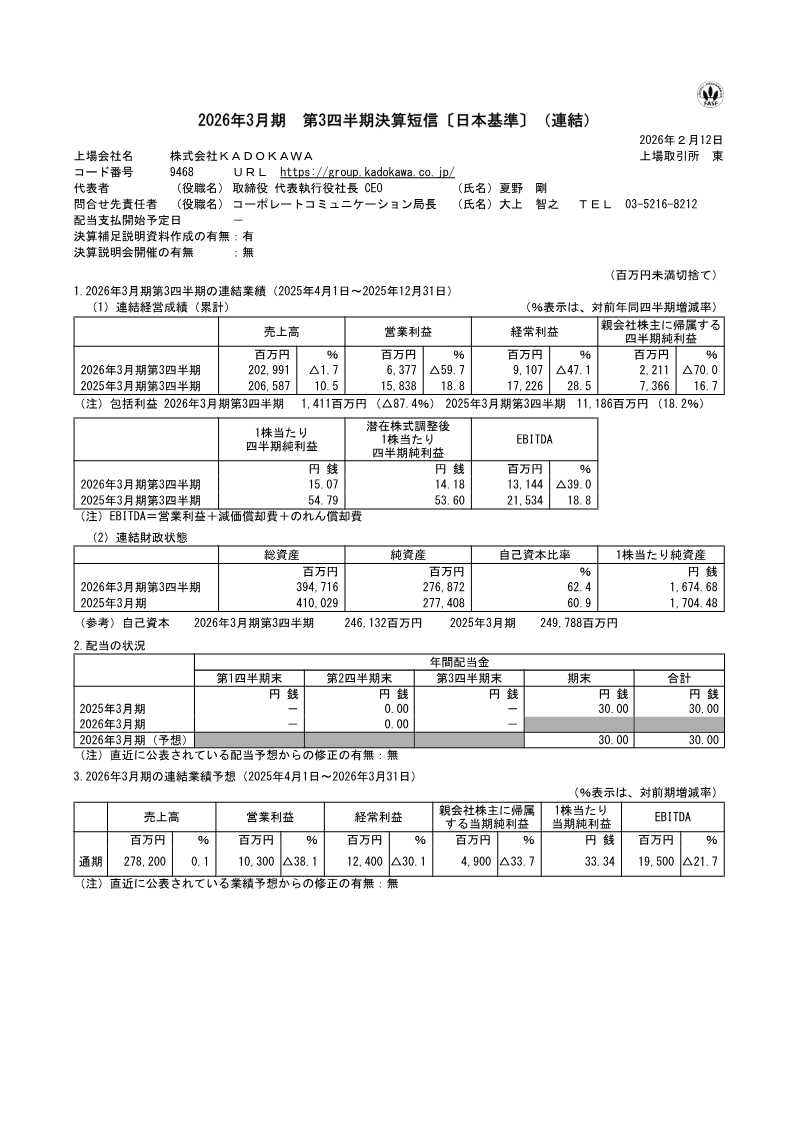
Kadokawa Corporation reported a decline in its third‑quarter consolidated results for the fiscal year ending March 2026. Total sales fell 1.7 % to ¥20,299 billion, while operating profit dropped 59.7 % to ¥637 million and ordinary profit fell 47.1 % to ¥910 million, leading to a parent‑shareholder net loss of ¥221 million. EBITDA contracted 39.0 % to ¥1,314 million, and the diluted earnings per share fell from ¥54.79 to ¥15.07. Net assets decreased modestly, with total assets at ¥394 billion and equity at ¥277 billion; the equity ratio remained healthy at 62.4 %. Cash and cash equivalents ended the quarter at ¥73 billion after significant outflows from investment activities (¥5.2 billion) and financing (¥5.0 billion).
Segment performance varied: the publishing/IP creation unit posted a 90.2 % drop in operating profit to ¥623 million despite flat sales, whereas the web services segment achieved a 21.5 % revenue increase and an operating profit of ¥2187 million. The animation/film segment recorded a loss of ¥940 million, and the game unit saw an 11.6 % revenue decline with a modest operating profit of ¥8050 million. Education and other segments delivered modest gains.
The company added two subsidiaries—Edizioni BD S.r.l. in Italy and SOZO Pte. Ltd. in Singapore—to its consolidation, increasing goodwill by ¥2,427 million and ¥1,846 million respectively. A significant system‑failure expense of ¥2,338 million related to a cyberattack on the Niconico service was recorded as a special loss. Dividend policy remained unchanged, with no dividends declared for the current year and a forecast of ¥30 million per quarter. The report covers Japan, the United States, Asia and other regions for the period April 1 2025 to March 31 2026, using Japanese GAAP and a survey of consolidated financial statements.
- Kadokawa Corporation reported a net loss of ¥221 million for Q3 of the fiscal year ending March 2026, driven by a 59.7% decline in operating profit to ¥637 million.
- A cyberattack on the Niconico service resulted in a ¥2,338 million special loss, significantly impacting the company's bottom line.
- The publishing/IP creation segment saw operating profit plummet 90.2% to ¥623 million, while the animation/film segment recorded a loss of ¥940 million.
- The game unit experienced an 11.6% revenue decline, though it remained profitable with an operating profit of ¥8,050 million.
- The web services segment was a primary growth driver, achieving a 21.5% revenue increase and generating ¥2,187 million in operating profit.
Kadokawa Corporation

Financial37 pages
Earnings Results: FY2026 Q3
KADOKAWA’s financial performance through the third quarter of fiscal year 2026 reflects a period of transition characterized by a slight consolidated revenue decline to 202.9 billion yen and a sharp 59.7% drop in operating profit. This contraction stems primarily from profit margin compression in the publishing sector due to rising labor costs and smaller title scales, alongside difficult year-on-year comparisons in the gaming and anime divisions. While the previous fiscal year benefited from the massive global success of Elden Ring, current results show a normalization of earnings despite steady contributions from downloadable content and repeat sales totaling 2.5 million units.
The gaming segment remains a focal point for future growth, with a strategic shift toward next-generation hardware. Development is currently underway for multiple titles for the successor to the Nintendo Switch, including Elden Ring Tarnished Edition and a platform-exclusive title, The Duskbloods, co-published with Nintendo. Although specific release dates and financial guidance for these projects remain undisclosed, they represent a core pillar of the long-term recovery strategy. Meanwhile, the anime segment continues to leverage a robust slate of 52 titles, including popular franchises like Re:Zero and Oshi no Ko, even as licensing income saw a temporary 22% decline.
Geographically, international markets continue to play a vital role, with overseas revenue reaching 12.5 billion yen for the quarter. The United States and Asia remain the dominant territories, accounting for 45.6% and 39.3% of international sales, respectively. Positive momentum in the Education and EdTech divisions, which achieved 13.4% revenue growth through record student enrollment, provides a stabilizing counterweight to the volatility in entertainment software. Moving into the final quarter, recovery efforts will focus on strategic price revisions in publishing and a strong lineup of anime sequels to offset earlier margin pressures.
- Kadokawa reported a 59.7% drop in operating profit and a decline in consolidated revenue to 202.9 billion yen for Q3 FY2026, driven by publishing margin compression and difficult year-on-year comparisons in gaming.
- The gaming division is pivoting toward next-generation hardware, with development underway for 'Elden Ring Tarnished Edition' and a Nintendo-exclusive title, 'The Duskbloods', for the successor to the Nintendo Switch.
- Gaming earnings have normalized following the massive success of 'Elden Ring' in the prior year, though the segment still generated 2.5 million units in repeat sales and DLC volume.
- The Education and EdTech divisions provided a financial buffer with 13.4% revenue growth, supported by record student enrollment.
- International revenue reached 12.5 billion yen for the quarter, with the United States and Asia accounting for 45.6% and 39.3% of those sales, respectively.
+1
Kadokawa CorporationFeb 2026