Updated Jun 10, 2026 by Kadokawa Corporation
Legal
Published by Kadokawa Corporation
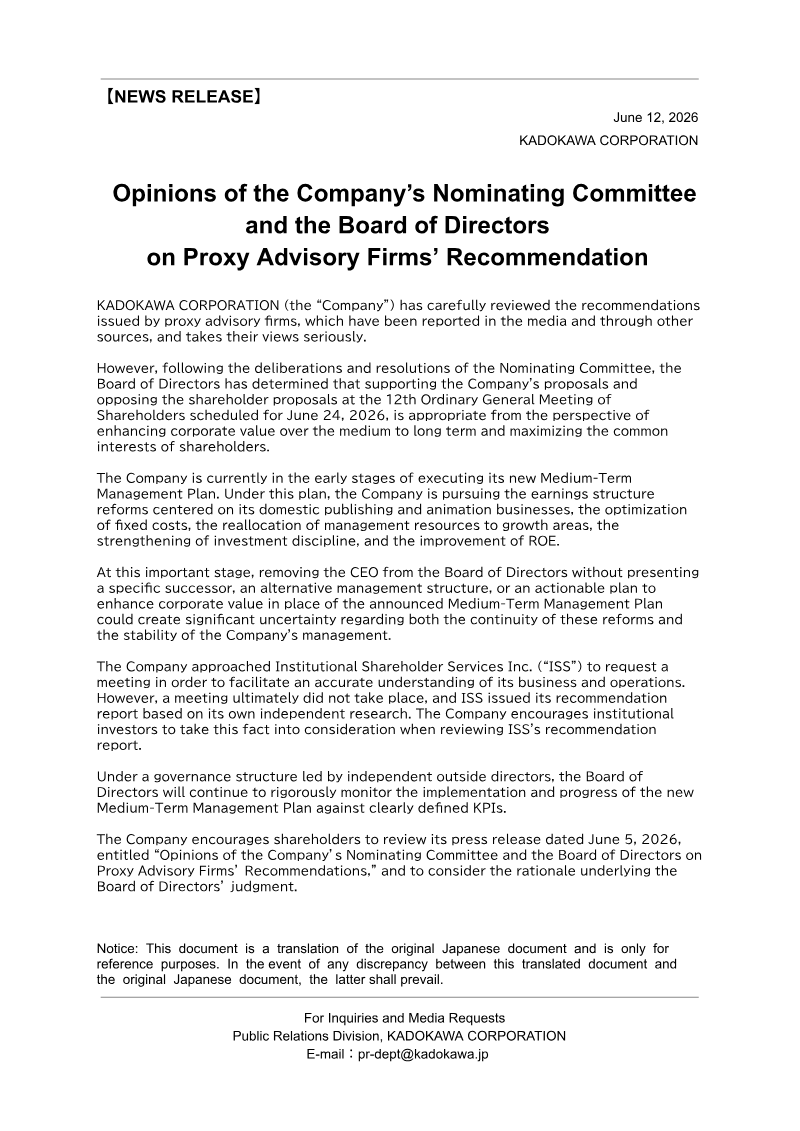
The supplementary document presents KADOKAWA’s strategic response to a shareholder proposal, outlining a six‑year Mid‑term Management Plan that replaces the previous five‑year framework. The core objective is to restore profitability and build a resilient, IP‑driven revenue base by restructuring domestic publishing and animation operations, tightening fixed costs, and investing in high‑growth intellectual property. The plan targets a 12 % return on equity (ROE) by fiscal year 2031, with an emphasis on portfolio and price‑strategy optimization in publishing, cost control in animation production, and a strategic early‑retirement program to free resources for growth. The transformation strategy is divided into three phases: structural reform (FY2026‑27), profit growth (FY2028‑29), and expansion (FY2030‑31). During the reform phase, KADOKAWA will consolidate business units under new executive leaders and establish a cross‑business steering committee, while pruning unprofitable lines. Net sales are projected to rise from ¥325 bn in FY2026 to ¥400 bn by FY2031, and operating margins are expected to improve from 4.0 % to 9.5 %. A disciplined capital policy will aim for a 30 % payout ratio and maintain share‑buyback flexibility. Governance measures reinforce the plan’s execution. CEO Takeshi Natsuno maintains 100 % attendance at key board, executive council, and investor meetings, while conducting regular “direct‑meeting” sessions with employees and final interviews for new hires. The board will continuously monitor KPIs—sales returns, in‑house animation production, overseas revenue, ROE, and EPS—and will adjust management structure or investment allocation if progress lags. These initiatives collectively aim to accelerate revenue restructuring, enhance capital efficiency, and sustain leadership continuity across Japan’s media‑mix industry.
Supplementary Document of the Company’s Initiatives to Enhance Corporate Value and the Shareholder Proposal - For the Ordinary General Shareholders Meeting (May 28, 2026) - KADOKAWA
⚫ The Company believes that the website, “A Better KADOKAWA” pertaining to the shareholder proposal created by Oasis Management Company Ltd. (“Oasis”) contains statements that differ from the Company’s understanding and do not fully reflect the Company’s initiatives. ⚫ The Company is receiving from its institutional investors’ questions about Oasis’ assertions and the new Mid-term Management Plan that the Company announced on May 14, 2026. ⚫ The purpose of this Document is to communicate the Company’s view once again in light of the above situations. (This Document summarizes existing disclosed information including the new Mid-term Management Plan.) 1. Course of Events Leading to Revision of the Mid-term Management Plan P.3 2. Specific Measures and Roadmap to Achieve the New Mid-term Management Plan (ROE Target, etc.) P.7 3. Finance Policy and Capital Allocation P.17 4. Outline of Opinions of the Company’s Nominating Committee and Board of Directors on the Shareholder Proposal (Proposal for Dismissal of CEO Natsuno) P.21
Former Mid-term Management Plan: Five-year plan (announced on November 2, 2023) 【Initial goal for FY2027 plan (vs most recent forecast)】 FY2023 FY2024 FY2025 FY2026 FY2027 Consolidated sales: 340 billion yen (vs 325 billion yen) Consolidated operating profit: 34 billion yen (vs 13 billion Seeding period Harvesting period yen) FY2023-FY2025 (three years) FY2026-FY2027 (two years) Publication is the source of the In the wake of unexpected downturn in profitability in the domestic publication Company’s IP business and the animation business (consolidated sales and overseas sales Origin of all of the Company’s businesses were steadily growing, operating profit significantly decreased) , leading to animation, films, games, and the Board of Directors decided to revise the former Mid-term Management Plan overseas rollout and formulate a new one. New Mid-term Management Plan: Six-year plan (announced on May 14, 2026) FY2026 FY2027 FY2028 FY2029 FY2030 FY2031 -Reform period Profit growth period Profit expansion period Transformation -Growth -Expansion FY2026-FY2027 FY2028-FY2029 FY2030-FY2031 (two years) (two years) (two years) ROE 12% in the medium
> **[Chart page]** This page contains visual data — view in PDF for the best experience. ⚫ While sales grew both domestically and internationally, we determined that achieving our operating profit target would be difficult due to declining profitability in domestic publication and animation. Consolidated net sales FY2027 Consolidated operating profit FY2027 (Unit: 100 Million JPY) Forecast vs mid (Unit: 100 Million JPY) Forecast vs mid term management 500 Publication/IP term management 出版・IP創出 アニメ・実写映像 出版・IP創出 アニメ・実写映像 Webサービス Publication/IP Creation Animation/Film plan target Creation Animation/Film Web Services plan target 教育・EdTech その他 ゲーム Webサービス 教育・EdTech Education/ EdTech Others Gaming Web Services Education/ EdTech 全社・消去 営業利益率 10% Others Gaming Corporate Operating margin その他 ゲーム 3,400 / Eliminations Publication/ 10.0% Corporate / Eliminations Overseas net sales 全社・消去 海外売上高 3,250 400 7.1% IP Creation + 340 Animation/Film 2,581 2,779 2,829 3,003 420 495 6.0% 3.9% 70 336 298 312 203 274 3.4% 5.0% 254 170 172 226 252 300 185 167 2.9% 38 203 179 172 196 208 238 18 134 151 205 204 130 214 180 483 586 605 565 200 80 95 81 101 60 461 511 17 43 0.0% 1,593 1,653 1,684 4 24 75 45 40 1,420 1,514 1,556 100 46 47 32 24 184 28 20 0 104 84 21 5 86 602 560 606 640 700 41 68 -5.0% 408 0 -10 -5 -28 -20 -17
170 172 226 252 300 185 167 2.9% 38 203 179 172 196 208 238 18 134 151 205 204 130 214 180 483 586 605 565 200 80 95 81 101 60 461 511 17 43 0.0% 1,593 1,653 1,684 4 24 75 45 40 1,420 1,514 1,556 100 46 47 32 24 184 28 20 0 104 84 21 5 86 602 560 606 640 700 41 68 -5.0% 408 0 -10 -5 -28 -20 -17 -55 -60 -65 -108 -44 -42 -40 -41 -43 -13 -104 -92 -21 -32 -40 FY2023 FY2024 FY2025 FY2026 FY2027 FY2027 -100 FY2023 FY2024 FY2025 FY2026 FY2027 FY2027 -10.0% (Results) (Results) (Results) (Forecast) (Forecast) (Current mid-term 24/3期 25/3期 26/3期 27/3期 28/3期 28/3期 24/3期 25/3期 26/3期 27/3期 28/3期 28/3期 (Results) (Results) (Results) (Forecast) (Forecast) (Current mid-term
With the awareness of challenges, the Company has already begun executing the reform. The Company’s management team takes seriously the results for FY2025, underachievement of the former Mid-term Management Plan, and decreased profitability. Based on such acknowledgement, the Company announced the new Mid-term Management Plan on May 14, 2026, explicitly setting forth a policy of revising the revenue structure, investment distribution, execution system, and KIP management. The Company will advance a revenue structure reform, fixed costs optimization, and investments in growing areas with a focus on the domestic publication business and the animation business.
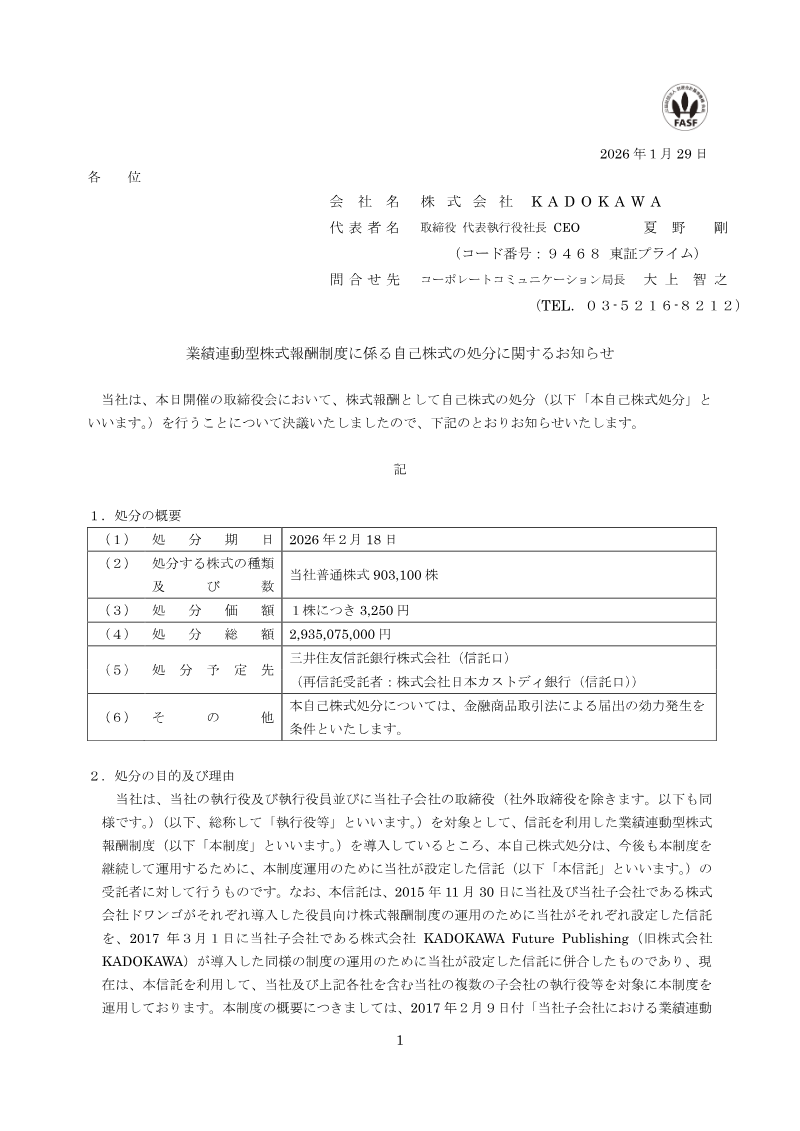
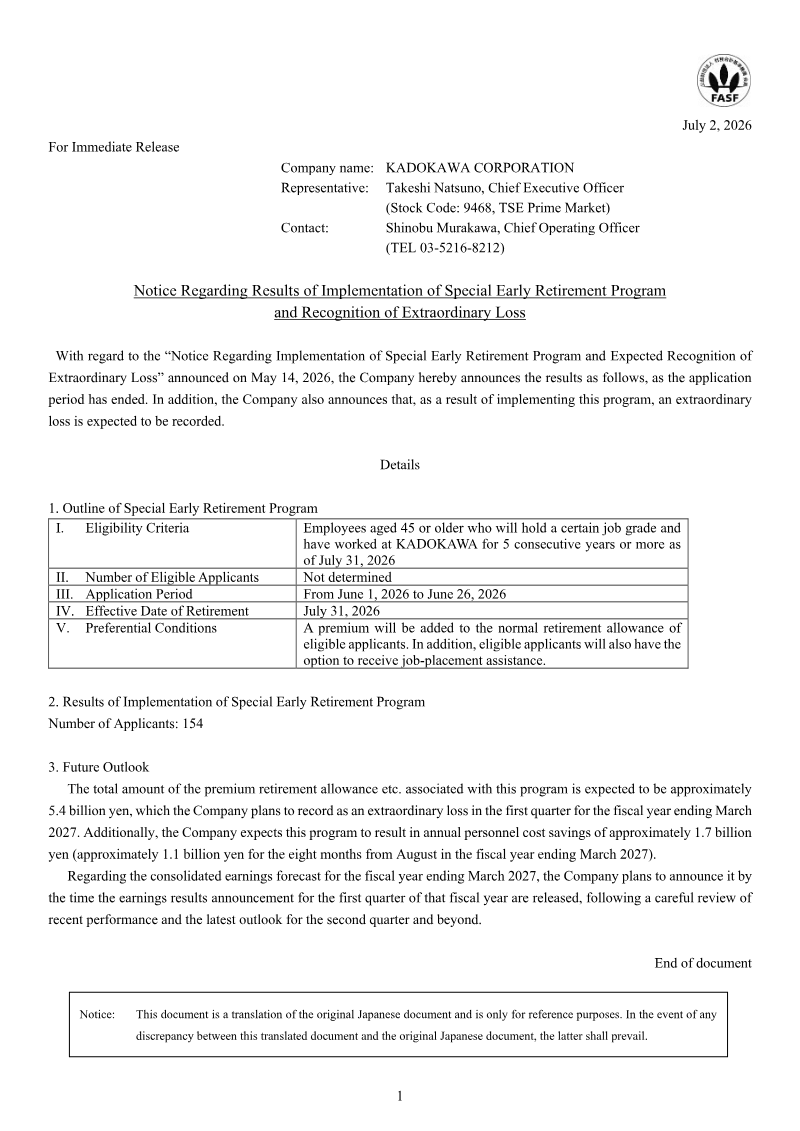
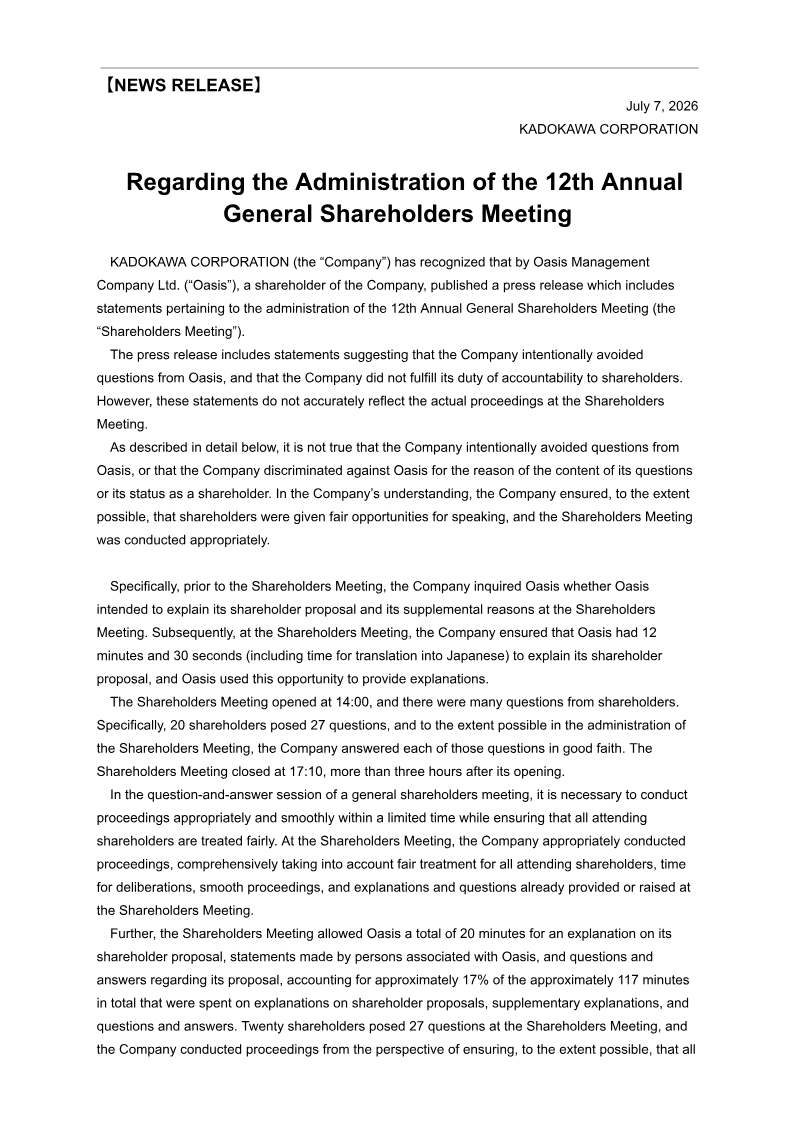
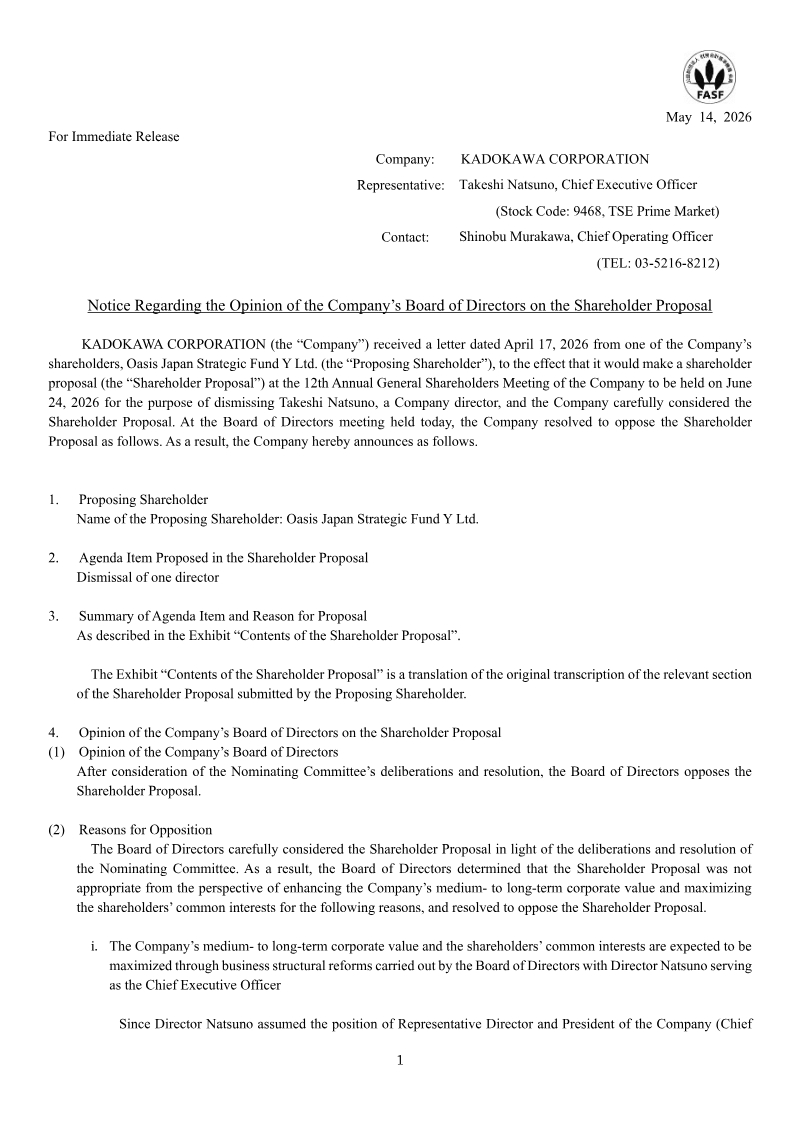
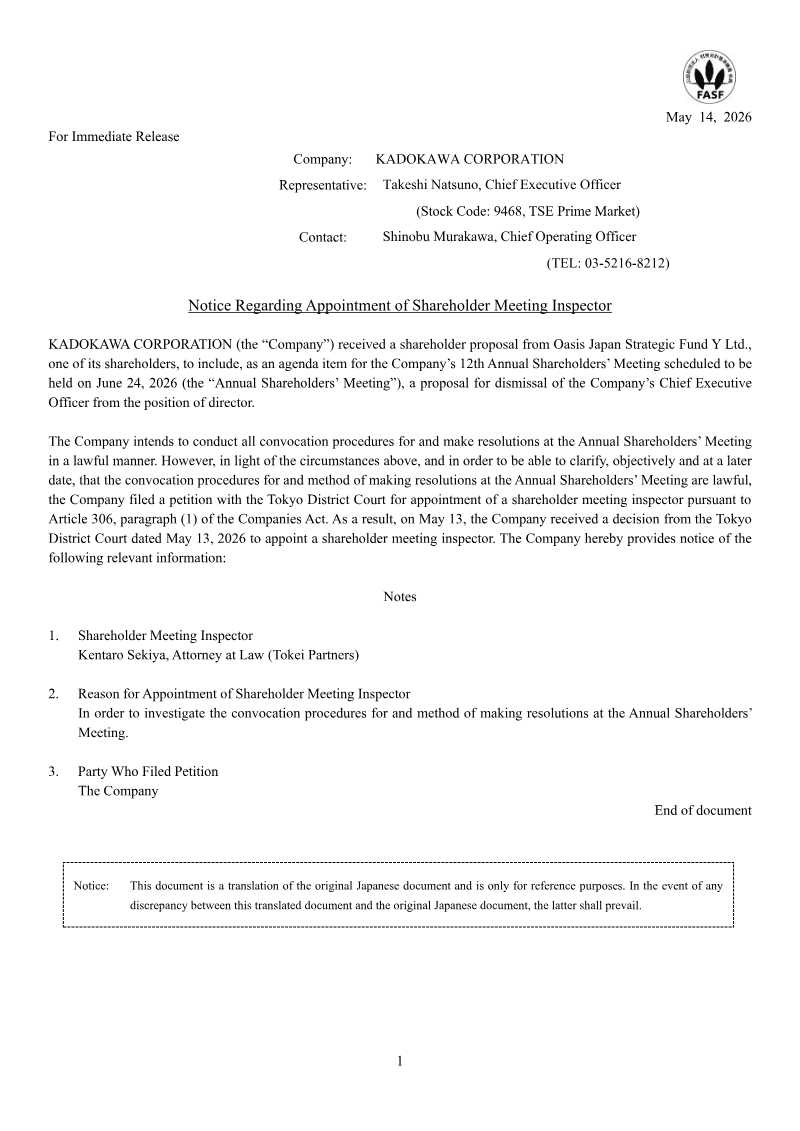
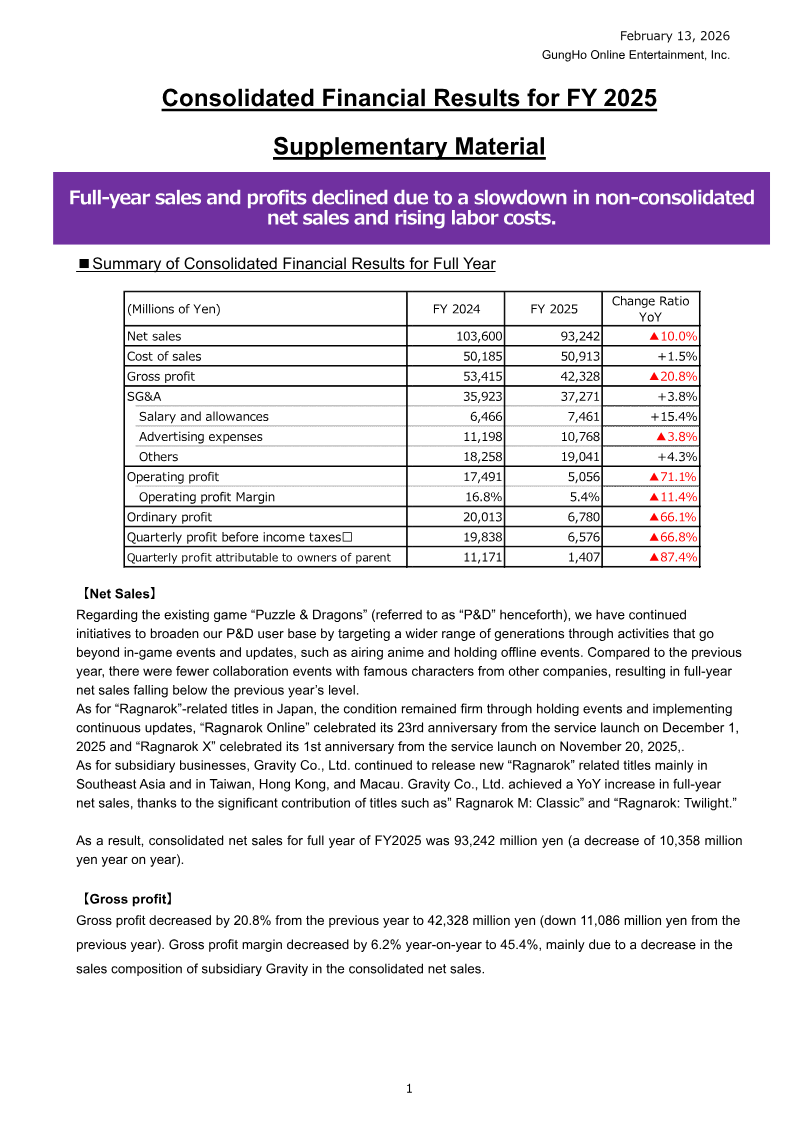
GungHo Online Entertainment reported a significant decline in financial performance for the fiscal year ending December 31, 2025. Consolidated net sales fell 10.0% year-on-year to 93,242 million yen, while operating profit plummeted 71.1% to 5,056 million yen. The downturn was primarily driven by a slowdown in non-consolidated sales from the flagship title Puzzle & Dragons, which suffered from fewer high-profile character collaborations compared to the previous year. Profitability was further pressured by rising labor costs following the full acquisition of Alim Co., Ltd. and increased bonus payments in the fourth quarter, leading to a quarterly operating loss of 811 million yen in the final period. The geographic scope of operations remains centered in Japan, though subsidiary Gravity Co., Ltd. provided a strategic buffer through successful releases in Southeast Asia, Taiwan, Hong Kong, and China. While Puzzle & Dragons remains the company’s core asset with 63 million downloads in Japan as of April 2025, newer titles like Ragnarok M: Classic and Ragnarok: Twilight contributed to Gravity’s year-on-year revenue growth. Additionally, the company expanded its multi-platform presence with the December 2025 global launch of LET IT DIE: INFERNO on PlayStation 5 and PC. Methodologically, the findings are based on consolidated financial statements and internal download tracking data. The results highlight a transition period for the company, characterized by a shifting sales mix and higher fixed costs. Despite the decline in annual net profit attributable to owners—which dropped 87.4% to 1,407 million yen—the company maintains a strong liquidity position with 130,474 million yen in cash and deposits, supporting continued investment in its long-term service titles and new global releases.
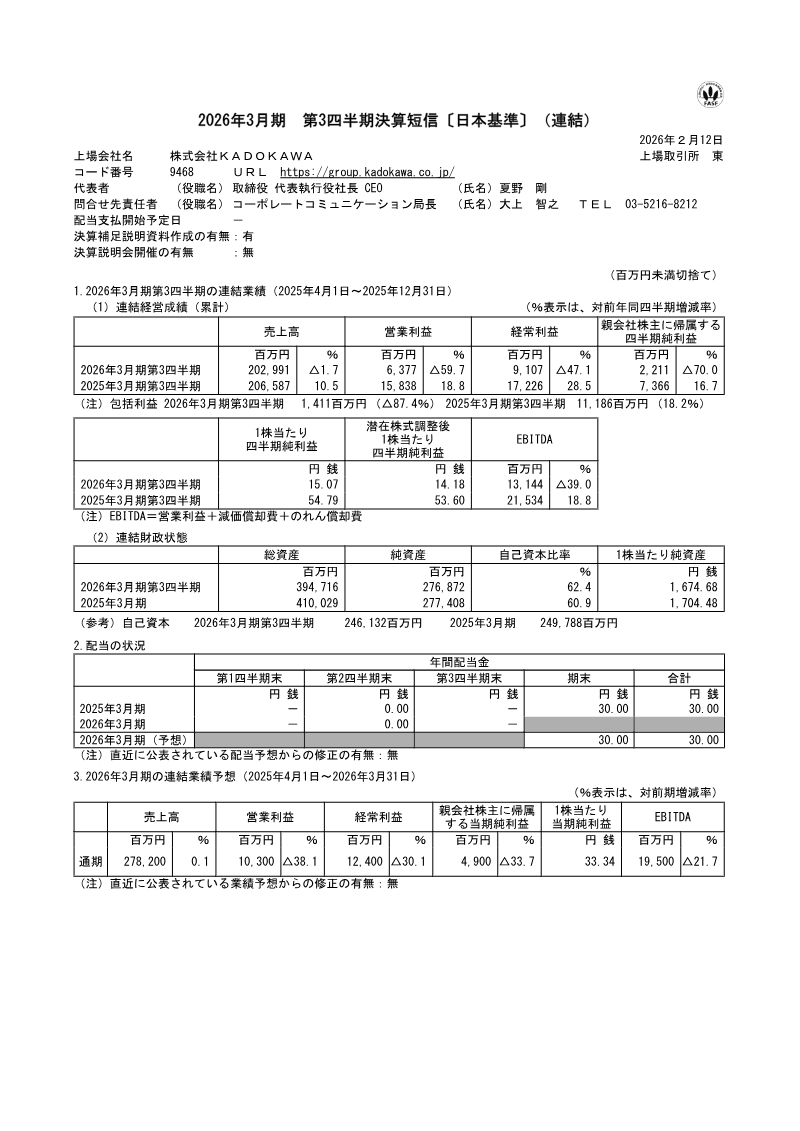
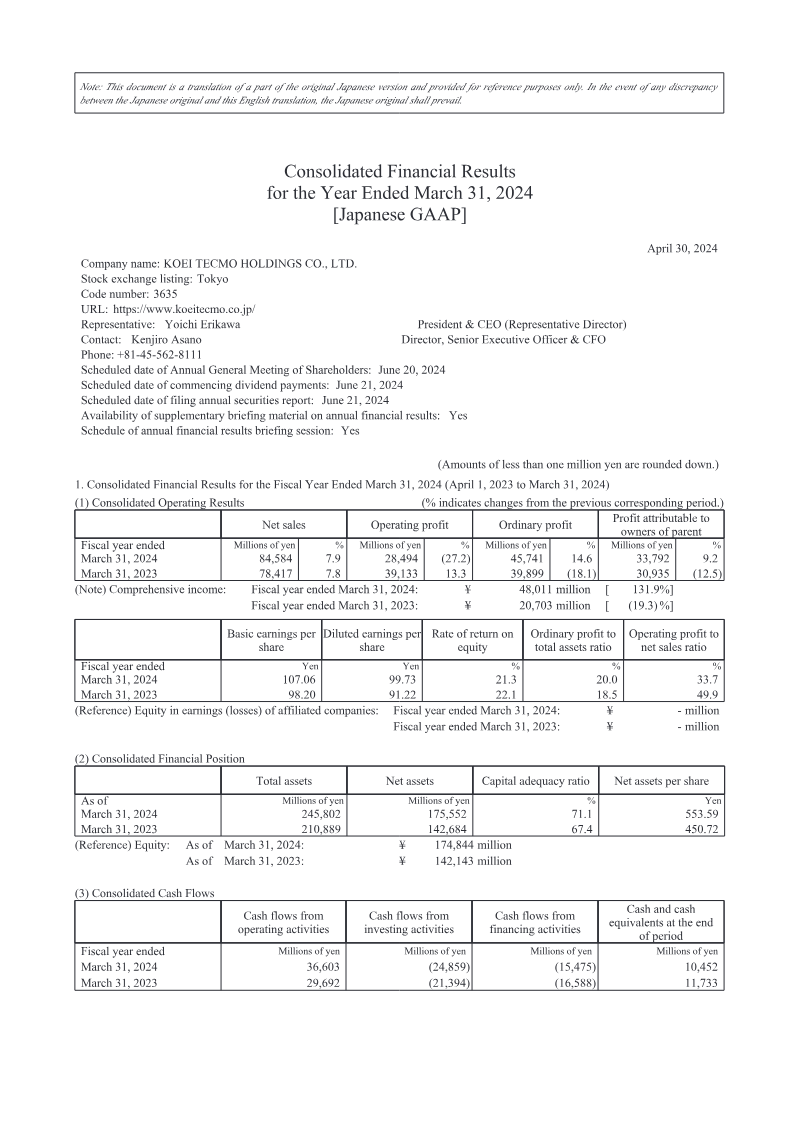
This financial report details the consolidated results for KADOKAWA Corporation during the first nine months of the fiscal year ending March 31, 2026, covering the period from April 1, 2025, to December 31, 2025. The data reflects a challenging period for the Japanese media conglomerate, characterized by significant declines in profitability despite relatively stable net sales. Net sales reached 202.9 billion yen, a slight 1.7% decrease year-on-year, while operating profit plummeted 59.7% to 6.3 billion yen. Net income attributable to owners of the parent fell 70.0% to 2.2 billion yen. Performance varied significantly across industry segments. The Publication and IP segment saw a 90.2% drop in operating profit due to smaller-scale domestic hits and rising personnel costs, despite growth in overseas markets like the U.S. and Asia. The Animation and Live-Action segment transitioned to an operating loss of 904 million yen, attributed to a higher ratio of new, less established titles compared to the previous year’s major hits. The Game segment, led by FromSoftware, reported an 11.6% revenue decline; while the new title Elden Ring Nightreign performed well, it could not match the high bar set by the previous year’s Elden Ring expansion and repeat sales. Conversely, the Web Services and Education/EdTech segments showed resilience, with Web Services recovering from prior cyberattack impacts to post a 21.5% increase in sales. Strategically, the company continued its "Global Media-Mix with Technology" initiative, expanding its international footprint through the acquisition of Edizioni BD in Italy and SOZO Pte. Ltd. in Singapore. These moves aim to strengthen IP recognition and D2C capabilities in Europe and Southeast Asia. Despite the quarterly downturn, the company maintained its full-year forecast, projecting 278.2 billion yen in net sales and 10.3 billion yen in operating profit, while confirming a planned annual dividend of 30 yen per share.
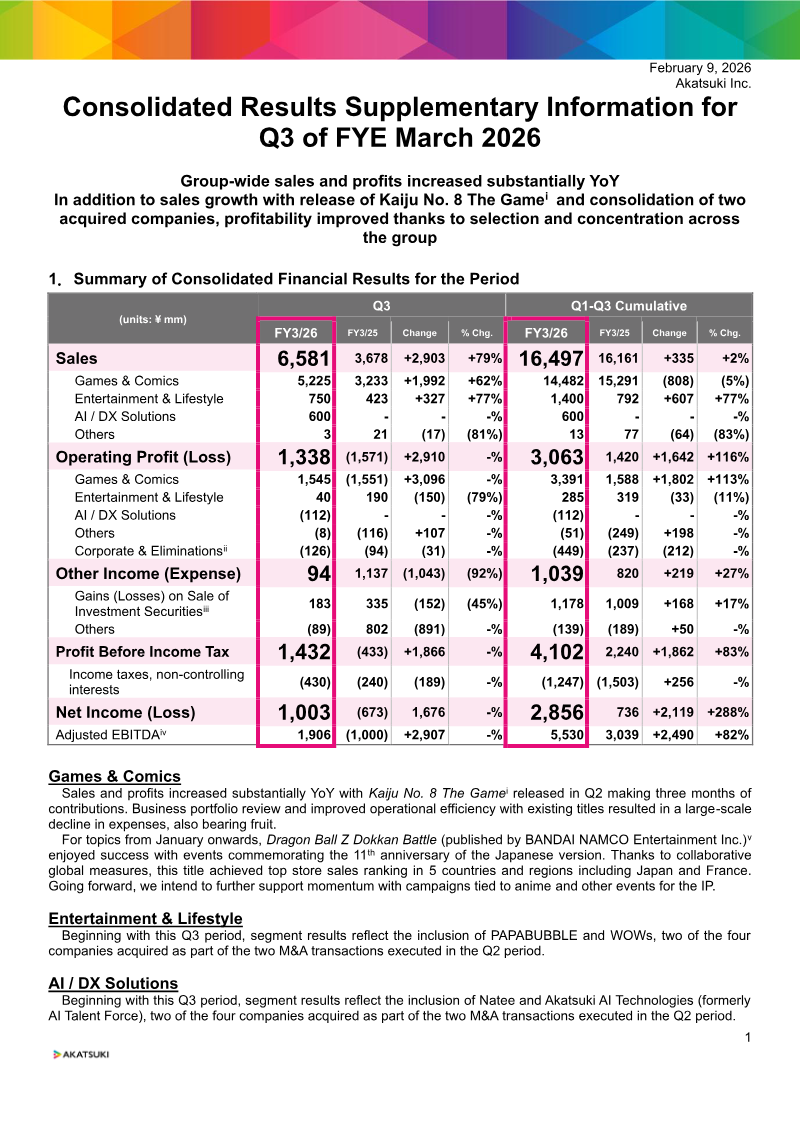
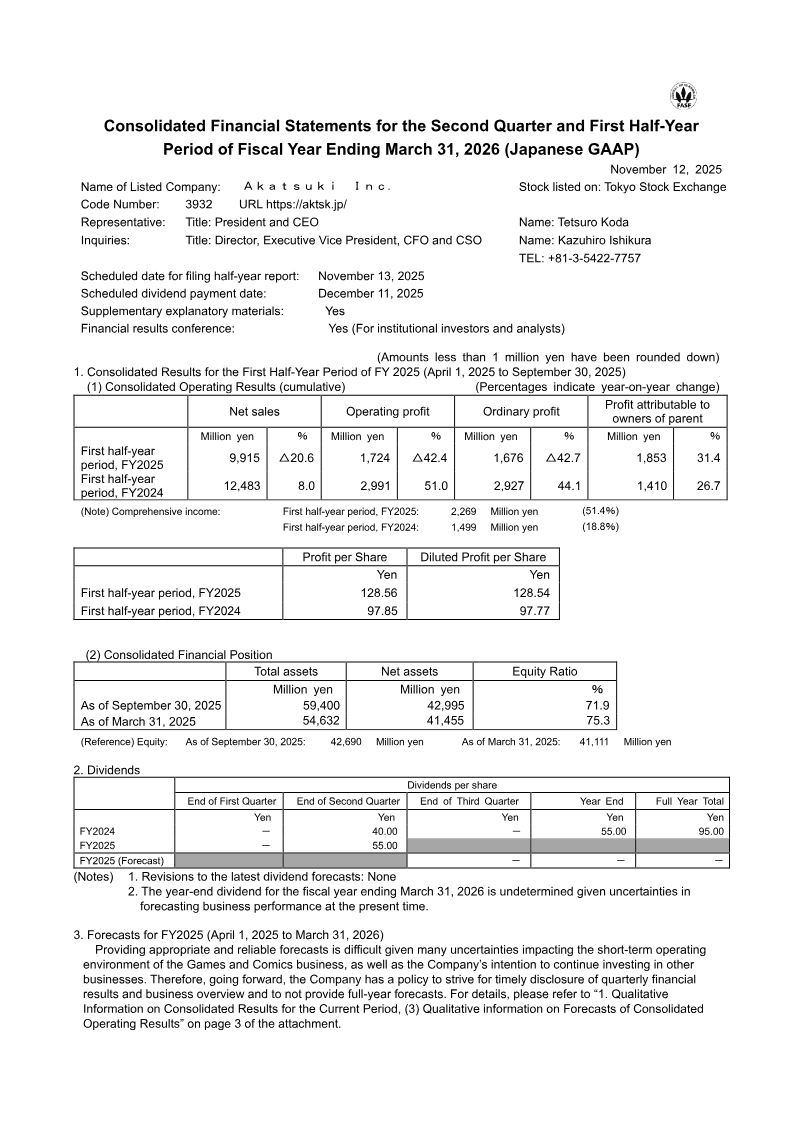
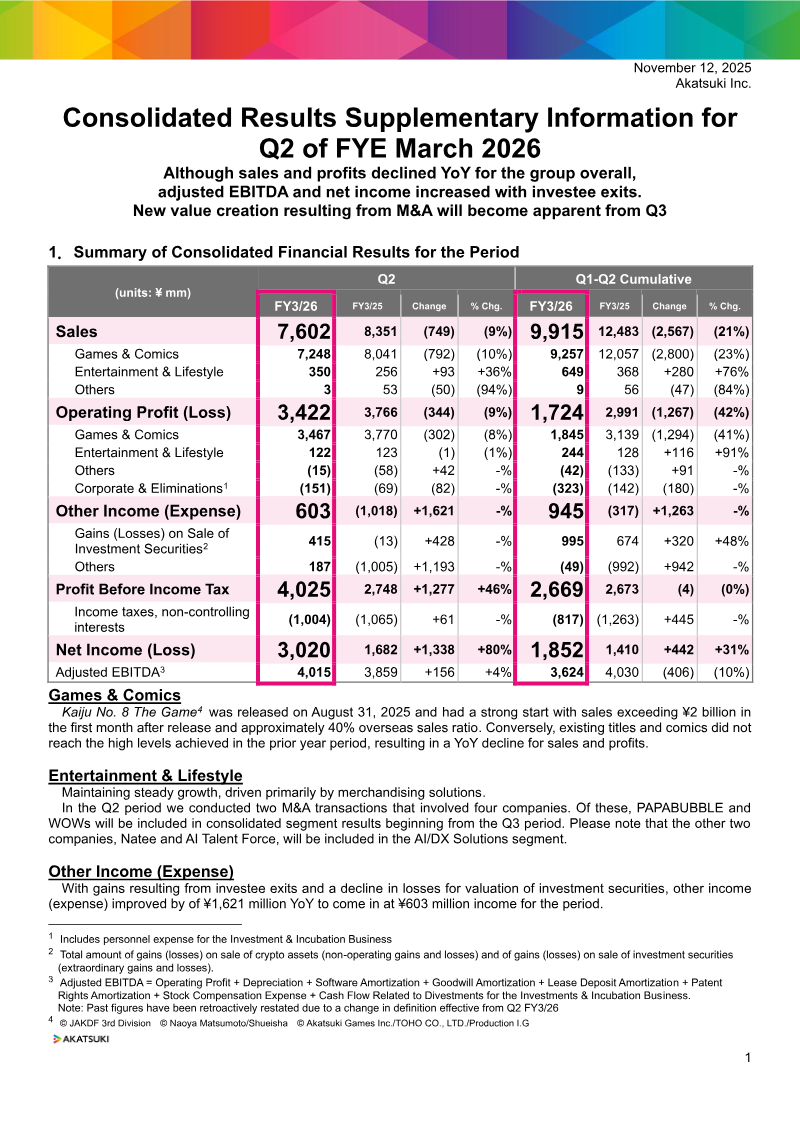
Akatsuki Inc. achieved a significant financial turnaround in the third quarter of the fiscal year ending March 2026, characterized by a 79% year-over-year increase in consolidated sales to ¥6,581 million and a return to profitability with net income reaching ¥1,003 million. This performance was underpinned by a strategic reorganization into three core segments: Games & Comics, Entertainment & Lifestyle, and AI/DX Solutions. Growth was primarily catalyzed by the successful launch of Kaiju No. 8 The Game and the sustained operational efficiency of legacy titles such as Dragon Ball Z Dokkan Battle, which continues to drive revenue despite inherent seasonal fluctuations tied to major anniversary events. The company’s operational structure has shifted toward a model of selection and concentration, marked by strategic M&A activity and a reduction in research and development spending as major projects moved into the operational phase. While personnel and outsourcing costs rose due to the integration of new subsidiaries like PAPABUBBLE and Akatsuki AI Technologies, the core gaming workforce saw a downward trend in permanent staff. Investment activities remain a vital component of the corporate value proposition, with ¥2.2 billion in proceeds realized from exits, including one IPO and two M&A transactions, during the cumulative nine-month period. Future strategy focuses on global IP expansion and optimized capital allocation, supported by a strategic alliance and a commitment to shareholder returns. The company has established a plan to return between ¥10 billion and ¥15 billion to shareholders through fiscal year 2028, utilizing a progressive dividend policy. Despite a slight decrease in total assets to ¥57,687 million due to lower accounts receivable, the group maintains a robust financial position intended to support long-term growth across its diversified entertainment and technology portfolio.
Akatsuki Inc. reported substantial year-over-year growth in sales and profitability for the third quarter of the fiscal year ending March 2026. Consolidated sales for the quarter reached ¥6,581 million, a 79% increase compared to the same period in the previous year, while operating profit rose to ¥1,338 million, reversing a loss from the prior year. This financial improvement was driven by the successful release of Kaiju No. 8 The Game, the continued performance of Dragon Ball Z Dokkan Battle, and the strategic consolidation of four acquired companies. The Games & Comics segment remains the primary revenue driver, contributing ¥5,225 million in quarterly sales. Profitability in this sector improved significantly due to a rigorous business portfolio review and enhanced operational efficiency for existing titles, which led to a large-scale reduction in expenses. Beyond gaming, the company expanded its scope through M&A activity, establishing a new AI / DX Solutions segment and bolstering the Entertainment & Lifestyle division. These new segments reflect the inclusion of acquired entities such as PAPABUBBLE, WOWs, Natee, and Akatsuki AI Technologies. Geographically, the company noted strong global performance for its legacy titles, specifically reaching top store rankings in five regions, including Japan and France. Financial data indicates a robust balance sheet with cash and equivalents totaling ¥33,266 million. The methodology for these results involves consolidated accounting of various subsidiaries and the use of Adjusted EBITDA to measure performance, which accounts for depreciation, amortization, and investment-related cash flows. Overall, the findings suggest a successful transition toward a more diversified and cost-efficient corporate structure.