Showing 6 of 7 results · 0.06s
AI in MTG: Moving Beyond Theory
Modern Times Group
document argues that artificial intelligence has become a strategic asset in mobile game development, transforming every phase of the lifecycle from ideation to live operations. It claims that
Presentation16 pages
Jun 2020
Play Like a Girl: Key Ways to Engage Asia's Growing Female Gaming Audience
Niko Partners
hours per week—their spending power is substantial. Female gamers contributed 35% of mobile gaming revenue in 2019, a figure projected to reach 39% in 2020. Contrary
Presentation1 pages
Capital Markets Event 2025: Coffee Stain Group
Coffee Stain Group AB
across all platforms, driven by rising consumer spend and the expansion of Steam, mobile, Game Pass and PlayStation Plus. Despite saturation and increased competition for player attention, Coffee
Presentation89 pages
May 2025
Consolidated Financial Results Briefing Materials: FY3/25
Akatsuki
growth phase where diversified IP solutions and global service expansions complement the established mobile gaming portfolio
Presentation46 pages
Feb 2026
Q3 for the Fiscal Year Ending March 2026 Results Presentation
Sega Sammy Holdings
Entertainment Contents Business struggled with underperforming new full game launches and a deteriorating user acquisition environment for mobile titles, most notably Sonic Rumble. Consequently, management has pivoted from
Presentation53 pages
Jan 2020
Slovak Game Industry Infographic
Slovak Game Developers Association
Slovak game industry demonstrates consistent growth and professional maturation, characterized by a robust increase in both turnover and workforce capacity. As of the end of 2019, the sector
Presentation1 pages
AI in MTG: Moving Beyond Theory
16 pages2k words
Summary
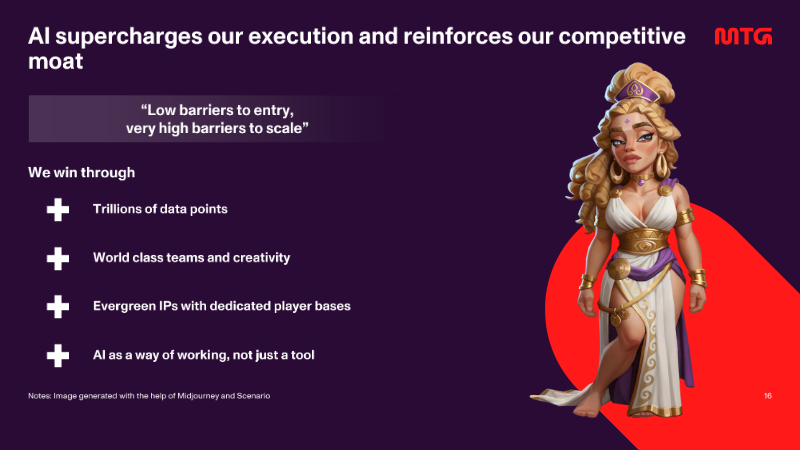
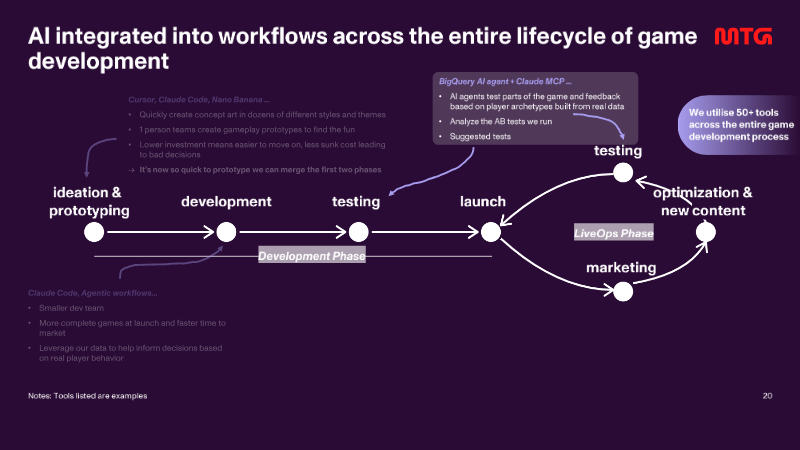
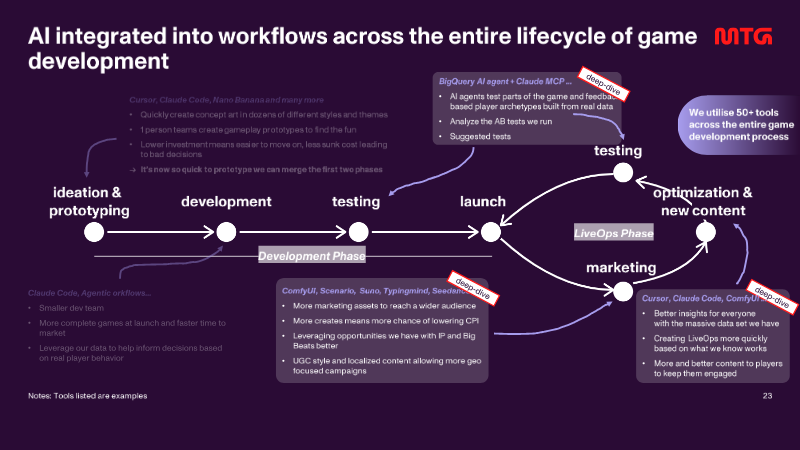
The document argues that artificial intelligence has become a strategic asset in mobile game development, transforming every phase of the lifecycle from ideation to live operations. It claims that AI enables teams to prototype, test, and launch content at a fraction of the time previously required, citing examples such as concept‑art generation in days instead of months and single‑person prototype teams that reduce sunk costs. The thesis emphasizes that the combination of trillions of player data points, world‑class creative teams, evergreen intellectual property, and AI as a workflow enabler creates a competitive moat that is difficult to scale for rivals.
Key findings include a 99 % cost reduction in marketing asset creation, an 80 % time saving on influencer spotlights, and a 75 % reduction in analyst turnaround times when querying data through AI agents. The document reports that five new games launched in 2026 adopted an “AI‑first” approach, allowing rapid iteration and simultaneous development of specialized content. It also highlights that AI agents can analyze A/B tests, suggest optimizations, and generate localized UGC‑style assets to lower CPI and improve player engagement.
The scope covers the global mobile gaming market, focusing on mid‑core titles with large player bases. Methodology is implied through internal tooling: 50+ AI platforms (e.g., Claude, Cursor, ComfyUI) and BigQuery‑based agents that process terabytes of data daily. The analysis suggests that AI integration not only accelerates production but also democratizes data insights, freeing analysts to tackle higher‑level strategic questions.
Pages

Insights
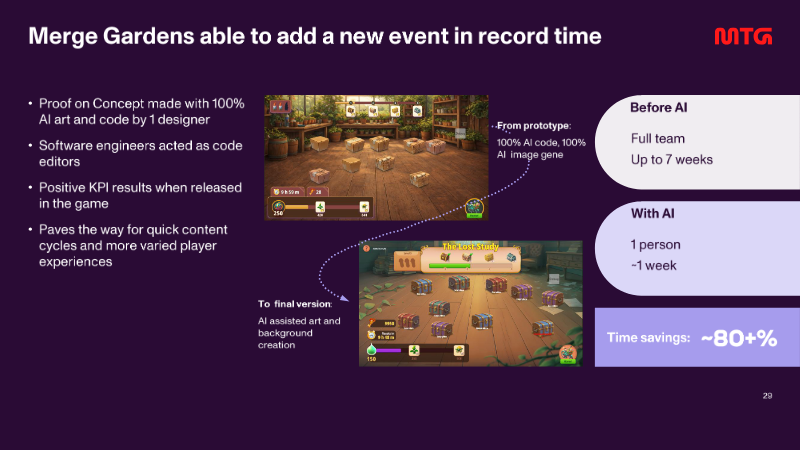
- Adopting an 'AI-first' development approach enabled the launch of five new mobile games in 2026, facilitating rapid iteration and simultaneous production of specialized content.
- AI integration has achieved significant operational efficiencies, including a 99% reduction in marketing asset costs and an 80% time saving on influencer spotlight production.
- Data analysis turnaround times have been reduced by 75% by utilizing AI agents to query large-scale datasets, allowing analysts to focus on high-level strategy.
- AI tools, including Claude, Cursor, and ComfyUI, have transformed production timelines, enabling concept art generation in days rather than months.
- The combination of AI-driven workflows, proprietary player data, and evergreen intellectual property creates a significant competitive moat in the mid-core mobile gaming market.