Showing 30 of 65 results · 0.13s
May 2020
Audited Consolidated Results for the Financial Year Closing on 31 March 2020
Nacon
priorities include expanding the Games as a Service (GaaS) model, leveraging 5G for cloud gaming, and growing the premium accessories business through brands like RIG. Long-term targets
Financial3 pages
Apr 2023
NetEase 20-F: FY2022
NetEase
inflow of RMB 9.91 bn. The company’s core businesses—games, Youdao, Cloud Music, and e‑commerce—are consolidated through Variable Interest Entities (VIEs), exposing NetEase to regulatory
Financial1 pages
2025 Half-Year Results: DON'T NOD
Don't Nod
narrative game based on a major IP signals a strategic pivot toward cloud gaming and external licensing, reinforcing the company’s narrative‑centric identity
Financial6 pages
Jul 2024
Form 10-K: 2024
Microsoft
performance reflects a strategic pivot toward artificial intelligence integration across its global cloud, productivity, and gaming ecosystems. The company’s primary thesis centers on leveraging its "Copilot" stack
Financial1 pages
Sep 2023
Games Investment Review: Q3 2023
DDM
Microsoft’s $68.7 billion acquisition of Activision Blizzard, cleared after the divestiture of cloud‑gaming rights to Ubisoft, dominated the corporate landscape. A concurrent leak revealed an ambitious
Financial43 pages
Jun 2024
Gaming Industry Report: Q2 2024
Konvoy
focus: Aligns with the broader VC shift toward early‑stage, high‑potential tech (cloud gaming, AI‑driven personalization, blockchain‑based economies). Thought‑leadership: Curated newsletters and event participation
Financial33 pages
Aug 2023
Gaming Report: Q2 2023
PitchBook
metrics derived from PitchBook’s proprietary VC Exit Predictor. Emerging opportunities identified span cloud gaming, user‑generated content, and real‑money monetization tools, exemplified by Triumph Labs’ recent
Financial10 pages
Nov 2025
Rapport Financier Semestriel au 30 Septembre 2025
Ubisoft
distribution channels, including traditional PC and console platforms, alongside an expanding presence in cloud gaming and subscription-based services via the Ubisoft+ model. The organizational structure relies
Financial1 pages
Oct 2020
Sales for First Half of FY 2020/21
Nacon
plans to release five new titles and a range of specialized controllers for cloud gaming and new hardware. Based on these trends, the company has upwardly revised
Financial2 pages
Jun 2025
Sony Group 20-F — FY2024 (June 2025)
Sony Group
also covers Sony’s investment in emerging technologies such as artificial intelligence and cloud gaming, noting strategic partnerships with major tech firms. Methodologically, the filing relies on audited
Financial1 pages
Jun 2022
Sony Group 20-F — FY2021 (June 2022)
Sony Group
discussion of risks, market trends, and strategic initiatives such as investment in cloud gaming infrastructure and expansion of Sony’s music streaming platform
Financial1 pages
Q1 Financial Results: Fiscal Year Ending March 2027
Nippon Ichi Software
market expansion to navigate a competitive landscape characterized by rapid technological shifts in cloud gaming, e-sports, and artificial intelligence
Financial13 pages
Jul 2011
Square Enix Annual Report FY2011
Square Enix
network-centric" model. This strategy responds to the rise of smartphones, browsers, and cloud gaming, which have lowered hardware barriers and necessitated a shift toward freemium
Financial72 pages
Mar 2026
Annual Report 2025: Environment, Social and Governance
Square Enix
partners like gumi Inc. underscore a commitment to expanding influence within blockchain, cloud gaming, and the metaverse
Financial18 pages
Aug 2023
Gaming Report: VC Trends and Emerging Opportunities Q2 2023
PitchBook
million early-stage round. Emerging opportunities are currently concentrated in user-generated content, cloud gaming, and novel monetization strategies. For example, Triumph Labs is highlighted for its plug
Financial10 pages
Apr 2024
Annual Report Pursuant to Section 13 or 15(d) of the Securities Exchange Act of 1934: China
NetEase
from CNY 65 billion in the prior year, driven largely by domestic game sales and cloud‑based services. Operating income rose to CNY 9.5 billion, reflecting improved cost
Financial1 pages
Aug 2024
Tencent Holdings Limited Interim Report 2024
Tencent
from 47 % a year earlier, reflecting higher monetisation of gaming, digital content and cloud services across China and overseas markets. The balance sheet strengthened, with total assets climbing
Financial122 pages
Jun 2020
Sony Group 20‑F: FY2019
Sony Group
Strategically, Sony is consolidating its group structure, launching the PS5 and cloud services to strengthen gaming, expanding music through EMI consolidation, and pursuing sustainability under “Green Management
Financial1 pages
Apr 2026
Giant Network 2025 Annual Report: China
Giant Network Group
digital‑culture products. Government policies encourage embedding traditional culture into game design, boosting AI and cloud R&D, and expanding overseas digital content. Giant Network aligns with these
Financial192 pages
Apr 2021
Form 20-F: FY 2020
NetEase
foreign‑exchange loss moderated the gain. Strategically, NetEase is diversifying beyond gaming into music streaming (NetEase Cloud Music), e‑commerce (Yanxuan), and intelligent learning, leveraging big‑data analytics
Financial1 pages
Apr 2020
Microsoft Form 10-Q: Q3 FY2020
Microsoft
transformation of enterprise clients and a surge in demand for cloud-based services, remote collaboration tools, and gaming infrastructure as global stay-at-home mandates took effect
Financial1 pages
Jan 2024
Form 10-Q: Q2 FY2024
Microsoft
billion. This growth was underpinned by a 24% increase in cloud revenue and a substantial surge in gaming revenue, the latter primarily driven by the $75.4 billion acquisition
Financial1 pages
Oct 2024
Form 10-Q: Q1 Fiscal Year 2025
Microsoft
Productivity and Business Processes, Intelligent Cloud, and More Personal Computing segments. Notably, Microsoft Cloud revenue grew 22% to $38.9 billion, while the Gaming division saw a 43% revenue
Financial1 pages
Jan 2022
Gaming Deals Activity Report H1'22
InvestGame
cover global markets and encompass all major video‑games subsectors, from console and PC titles to mobile and cloud‑based platforms. The analysis underscores that the record‑setting
Financial25 pages
2019 Interim Report: Tencent Holdings Limited
Tencent
revenue. While the company faced headwinds in PC gaming and media advertising, these were offset by strategic investments in cloud services and a diversified digital ecosystem. The company
Financial106 pages
Oct 2023
Microsoft Form 10-Q: Q1 2024
Microsoft
expansion was primarily fueled by the Intelligent Cloud and Productivity and Business Processes segments, alongside a 9% increase in gaming revenue. The company maintains a strong liquidity position
Financial1 pages
2021 Annual Report: Tencent
Tencent
company faced mounting operational costs in FinTech, cloud services, and research and development, alongside regulatory headwinds that impacted domestic gaming and advertising performance in the latter half
Financial322 pages
2018 Interim Report
Tencent
performance in digital content, online advertising, and cloud services. While the company faced a temporary 19% sequential decline in mobile gaming revenue during the second quarter—attributed
Financial102 pages
Jul 2022
Microsoft Form 10-K: 2022
Microsoft
term innovation in areas such as gaming, cybersecurity, and enterprise software. Risk factors identified include intense competition from other hyperscale cloud providers, regulatory scrutiny regarding antitrust and privacy
Financial1 pages
NetEase 1Q26 Investor Presentation
NetEase
mobile, PC, and console games. Beyond its core gaming business, the company operates diversified segments including intelligent learning solutions through Youdao, the NetEase Cloud Music platform
Financial13 pages
Audited Consolidated Results for the Financial Year Closing on 31 March 2020
May 20203 pages1k words
Summary
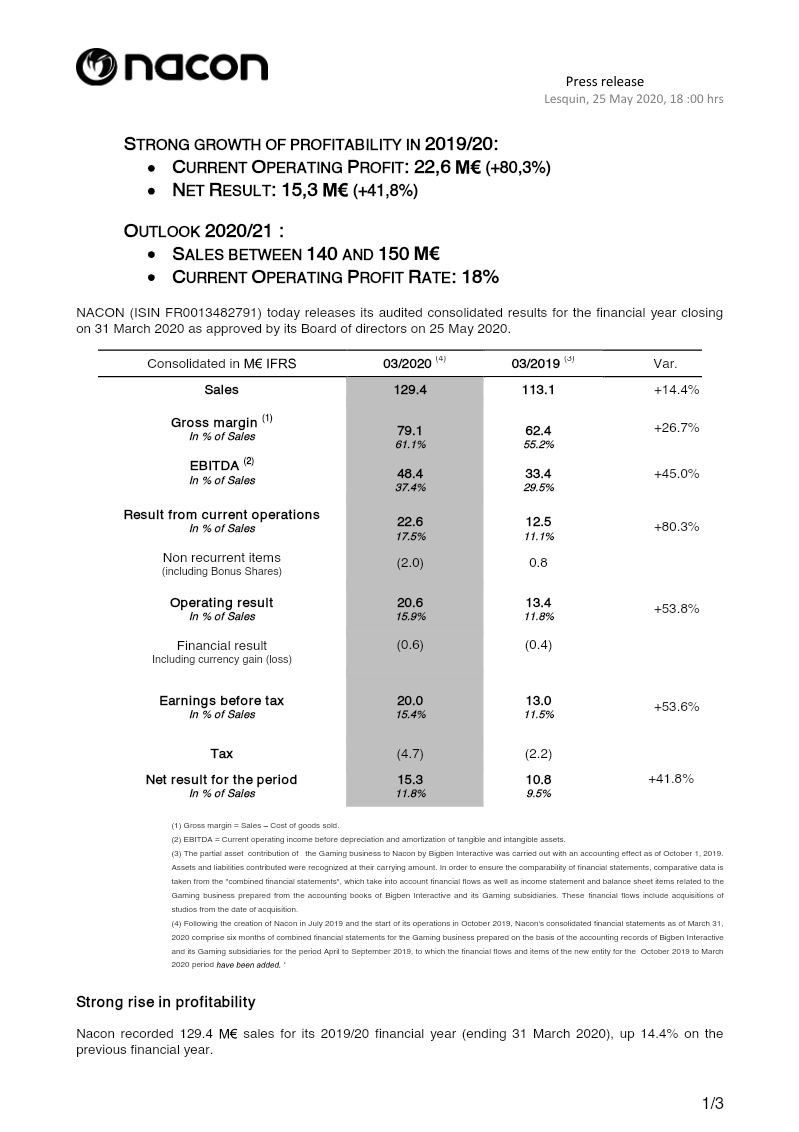
Nacon’s audited consolidated financial results for the fiscal year ending March 31, 2020, reveal a period of significant growth and successful structural transition following its initial public offering. The company reported annual sales of 129.4 million euros, representing a 14.4% increase over the previous year. This growth was primarily driven by a surge in digital game sales, which accounted for 69% of total gaming revenue. Profitability metrics showed even stronger momentum, with current operating profit rising 80.3% to 22.6 million euros and net profit increasing 41.8% to 15.3 million euros.
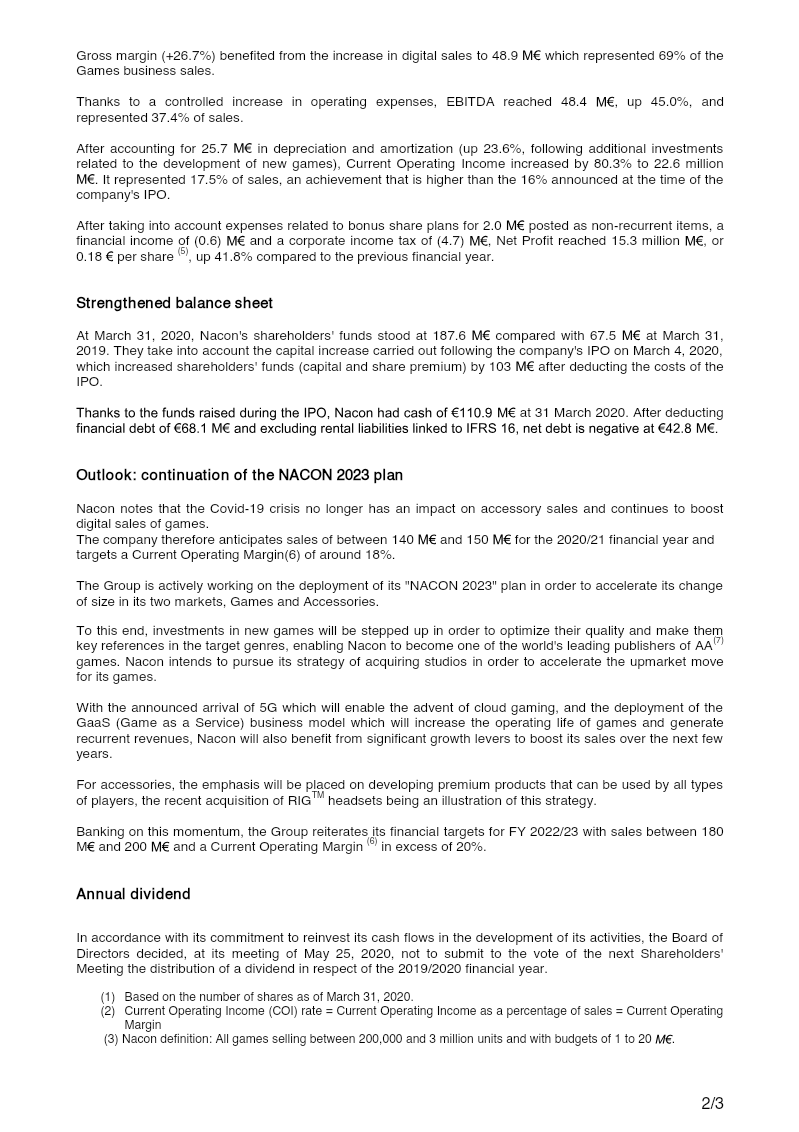
The financial data reflects Nacon’s evolution from a division of Bigben Interactive into a standalone entity. Following its March 2020 IPO, which raised 103 million euros, the company significantly strengthened its balance sheet, ending the period with 110.9 million euros in cash and a negative net debt of 42.8 million euros. This capital injection is intended to fund the "NACON 2023" plan, which focuses on studio acquisitions and the development of AA games—defined as titles with budgets between 1 and 20 million euros—to establish the company as a global leader in that segment.
Looking forward, the outlook remains positive as the company anticipates sales between 140 and 150 million euros for the 2020/21 fiscal year. Management noted that while the Covid-19 pandemic disrupted some operations, it simultaneously boosted digital software sales. Strategic priorities include expanding the Games as a Service (GaaS) model, leveraging 5G for cloud gaming, and growing the premium accessories business through brands like RIG. Long-term targets for the 2022/23 financial year include reaching sales of up to 200 million euros with an operating margin exceeding 20%. To support these growth initiatives, the Board of Directors elected to reinvest all cash flows rather than issuing a dividend.
Pages

Insights
- Nacon achieved 129.4 million euros in annual sales for the fiscal year ending March 31, 2020, a 14.4% increase driven largely by digital game sales accounting for 69% of gaming revenue.
- Profitability grew significantly, with current operating profit rising 80.3% to 22.6 million euros and net profit increasing 41.8% to 15.3 million euros.
- Following a 103 million euro IPO in March 2020, the company holds 110.9 million euros in cash and a negative net debt of 42.8 million euros.
- The 'NACON 2023' strategic plan focuses on acquiring studios and developing AA games with budgets between 1 and 20 million euros to secure a global leadership position in that segment.
- Management projects sales between 140 and 150 million euros for the 2020/21 fiscal year, with long-term targets of 200 million euros in sales and an operating margin exceeding 20% by 2022/23.
Showing 1 – 30 of 65