Showing 30 of 65 results · 0.13s
2021 Annual Report: Tencent
Tencent
company faced mounting operational costs in FinTech, cloud services, and research and development, alongside regulatory headwinds that impacted domestic gaming and advertising performance in the latter half
Financial322 pages
2018 Interim Report
Tencent
performance in digital content, online advertising, and cloud services. While the company faced a temporary 19% sequential decline in mobile gaming revenue during the second quarter—attributed
Financial102 pages
Jul 2022
Microsoft Form 10-K: 2022
Microsoft
term innovation in areas such as gaming, cybersecurity, and enterprise software. Risk factors identified include intense competition from other hyperscale cloud providers, regulatory scrutiny regarding antitrust and privacy
Financial1 pages
NetEase 1Q26 Investor Presentation
NetEase
mobile, PC, and console games. Beyond its core gaming business, the company operates diversified segments including intelligent learning solutions through Youdao, the NetEase Cloud Music platform
Financial13 pages
Jul 2021
Microsoft Form 10-K: FY2021
Microsoft
Cloud, and More Personal Computing. The Intelligent Cloud division, anchored by the Azure platform, experienced substantial expansion as enterprises accelerated the migration of workloads to the cloud
Financial1 pages
Apr 2025
Annual Report 2024: Fiscal Year Review
DoubleDown Interactive
platform strategy—leveraging a cloud‑based, scalable infrastructure and a three‑pillar content engine comprising licensed IGT titles, exclusive DoubleU Games slots, and proprietary in‑house development—positions
Financial1 pages
Feb 2026
Summary of Financial Results for Fiscal Year Ended December 31, 2025 (Japanese GAAP)
KLab
shifting toward the emerging GPU AI Cloud and AI Entertainment sectors to diversify revenue streams. The new GPU AI Cloud Business demonstrated promising initial growth, contributing ¥490.7 million
Financial19 pages
Mar 2026
Annual Report on Form 20-F: 2025
DoubleDown Interactive
digital entertainment and gaming sector. The primary thesis centers on the company’s transition toward a platform-agnostic service model, emphasizing the integration of cloud-based infrastructure
Financial1 pages
Annual Report 2019: Tencent Holdings Limited
Tencent
online gaming, and value‑added services—continued to expand, with monthly active users reaching 1.16 billion and subscription revenue rising to RMB 180 million. FinTech and Cloud segments
Financial274 pages
Mar 2021
Skillz Annual Report: 2020
Skillz
developers, cloud services (primarily Amazon Web Services), and open‑source software, exposing the business to operational disruptions, regulatory scrutiny, and cybersecurity threats. Regulatory uncertainty around skill‑gaming laws
Financial1 pages
Nov 2025
Skillz 10-K — FY2025 (November 2025)
Skillz
loss of any key game could materially harm performance. Regulatory exposure is broad: compliance with U.S., state, and international skill‑gaming laws, data‑privacy statutes (GDPR, CCPA/CPRA, COPPA
Financial1 pages
Consolidated Q1 2026 Report: The Huuuge, Inc. Group
Huuuge
through cloud-based infrastructure and business continuity planning. Looking ahead, the organization is managing ongoing legal scrutiny, including class-action litigation regarding the legality of its gaming products
Financial59 pages
Apr 2020
NetEase Annual Report: 2019
NetEase
Youdao education services, cloud music, and e‑commerce—contributed modest but growing revenue streams, with Youdao’s learning portfolio doubling in 2019 and cloud music achieving 800 million
Financial1 pages
Aug 2021
Form 10-Q: Q2 2021
AppLovin
games accounting for over one-third of its revenue in the first half of 2021. To sustain this trajectory, the company has committed to significant long-term cloud
Financial1 pages
May 2022
Take-Two Interactive Annual Report: Fiscal Year 2021
Take-Two Interactive
revenue recognition policies required significant judgment in estimating service periods for full‑game sales. Take‑Two’s risk profile highlighted concentration on a few flagship franchises (e.g., Grand
Financial1 pages
FY2024 First Quarter Financial Results Briefing
GREE
billion, with EBITDA at ¥1.3 billion. Performance across business segments is mixed: the Game and Anime Business generated strong earnings (¥1.56 billion operating income) driven by the Heaven
Financial7 pages
Sep 2024
Global Gaming Deals Report: Q4 & FY 2024
InvestGame
gaming industry’s merger‑and‑acquisition environment in 2024 evolved from primarily financial arbitrage toward transactions driven by clear strategic objectives. Activity levels remained above the pre‑COVID
Financial29 pages
FY2023 Third Quarter Financial Results Briefing
GREE
REALITY Studios Inc. and FIRST STAGE PRODUCTION for VTuber talent, and REALITY XR Cloud for B2B metaverse services, achieving 42 million annual visitor traffic. Commerce and DX businesses
Financial4 pages
2022 Interim Report: Tencent
Tencent
underscores a strategic shift toward operational efficiency and long-term growth in FinTech, cloud services, and Video Accounts. Governance and human capital management remained central to the company
Financial122 pages
Nov 2020
Unity 10-Q: Q3 2020
Unity
needs to fund R&D, sales, marketing and infrastructure as it scales its cloud platform. Geographically, 73% of revenue originates from global markets, exposing the company to regulatory
Financial1 pages
Apr 2022
Microsoft Form 10-Q: Q3 FY2022
Microsoft
underpinned by the Intelligent Cloud segment, which generated $19.1 billion, a 26% year-over-year increase, largely fueled by Azure and other cloud services. The Productivity and Business
Financial1 pages
Tencent 2026 First Quarter Results Presentation
Tencent
year-over-year increase in domestic game revenue and a 13% rise in international game revenue, driven by titles such as Peacekeeper Elite and VALORANT Mobile. Marketing services
Financial25 pages
Feb 2024
Annual Report: 2023 FY
Unity
Strategically, Unity maintains a dual‑solution model: Create Solutions (real‑time engine and cloud services) and Grow Solutions (monetization, mediation, publishing). The company emphasizes its extensive creator community
Financial1 pages
Tencent Second Quarter 2026 Results Presentation: China
Tencent
increase year-over-year, supported by strong performance in domestic gaming, marketing services, and fintech. Net profit attributable to equity holders reached 68.4 billion
Financial28 pages
Annual Report 2017: Tencent
Tencent
billion monthly active accounts, and robust gains in digital content, payment services, and cloud infrastructure. The company’s operational success was supported by a disciplined approach to capital
Financial246 pages
May 2023
NVIDIA Quarterly Report: Form 10-Q (Q1 FY2023)
NVIDIA
worked to normalize channel inventory following a period of weakened demand in the gaming sector. Despite this top-line pressure, net income rose to $2.04 billion, bolstered significantly
Financial1 pages
Feb 2023
Roblox 10-K: FY 2022
Roblox Corporation
filing outlines a high‑growth, user‑generated content platform that monetizes through in‑game purchases (Robux), advertising, and premium subscriptions. In 2022, bookings rose to $2.87 billion
Financial1 pages
FY2023 Third Quarter Financial Results: GREE
GREE
rising to ¥3.08 billion QoQ, largely due to upfront promotional investments for app games, while commission fees increased to ¥4.11 billion as sales expanded. Total costs climbed
Financial28 pages
Jan 2024
Game & Network Services Segment
Sony Group
Game & Network Services segment demonstrates a robust market position characterized by a PlayStation 5 monthly active user base of 118 million and a significant increase in per-console
Financial39 pages
Feb 2023
Form 10-K: Fiscal Year 2023
NVIDIA
platform provider, NVIDIA leverages a fabless manufacturing model to serve the data center, gaming, professional visualization, and automotive markets. The company’s strategy centers on integrating hardware, software
Financial1 pages

2021 Annual Report: Tencent
322 pages116k words
Summary
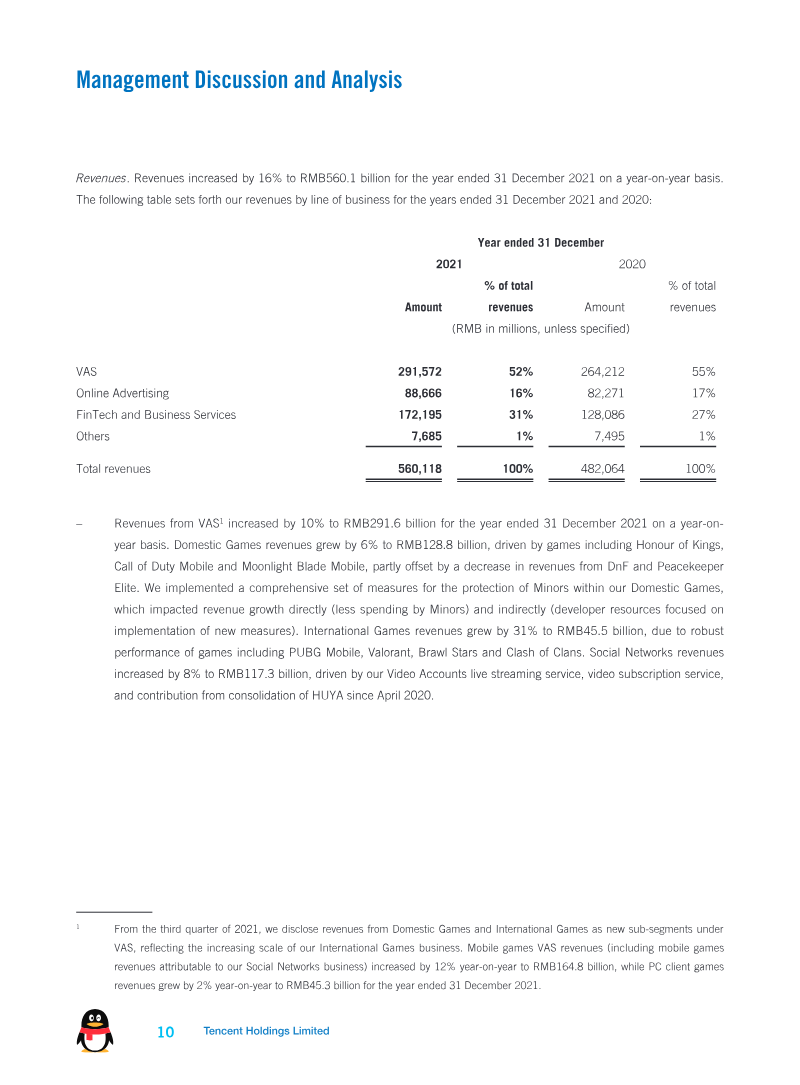
Tencent’s 2021 annual report details a year of significant financial expansion and strategic recalibration. The company reported a 16% year-on-year revenue increase to RMB 560.1 billion, while profit attributable to equity holders rose by 41% to RMB 224.8 billion. This profit growth was heavily influenced by substantial non-IFRS gains from investment disposals, most notably the divestment of its stake in JD.com. Despite these gains, the company faced mounting operational costs in FinTech, cloud services, and research and development, alongside regulatory headwinds that impacted domestic gaming and advertising performance in the latter half of the year.
The report highlights a strategic pivot toward long-term sustainability and operational efficiency. To navigate foreign investment restrictions in China, the company continued its reliance on "Structure Contracts," which allow for the consolidation of domestic operating entities. Governance remained a central focus, with the board maintaining a "Three Lines of Defence" risk management model to address emerging challenges, including macroeconomic volatility and heightened regulatory scrutiny. The company also demonstrated a commitment to social responsibility by pledging RMB 100 billion toward "Sustainable Social Value" and "Common Prosperity" initiatives, while setting a goal to achieve net-zero carbon emissions by 2030.
Covering the 2021 fiscal year, the report encompasses Tencent’s diverse global operations, including its international gaming footprint, enterprise software, and digital content segments. Financial health remained stable, supported by a robust cash position and active capital management, including share repurchases and extensive employee incentive schemes. By year-end, the company had successfully expanded its workforce to over 112,000 employees and reinforced its internal compliance infrastructure to align with evolving global and domestic standards, ensuring that its diverse portfolio of listed and unlisted investments remains integrated within a rigorous, transparent governance framework.
Pages

Insights
- Tencent reported a 16% year-on-year revenue increase to RMB 560.1 billion and a 41% rise in profit attributable to equity holders, reaching RMB 224.8 billion.
- The significant profit growth was largely driven by non-IFRS gains from investment disposals, specifically the divestment of the company's stake in JD.com.
- Operational performance in the latter half of 2021 was constrained by regulatory headwinds affecting domestic gaming and advertising, alongside rising costs in FinTech, cloud services, and R&D.
- The company committed RMB 100 billion toward 'Sustainable Social Value' and 'Common Prosperity' initiatives while establishing a goal to reach net-zero carbon emissions by 2030.
- Tencent continues to utilize 'Structure Contracts' to navigate foreign investment restrictions in China and maintain the consolidation of its domestic operating entities.
Year ended 31 December