
Report104 pages
Annual Report 2025
Annual Report 2025 details a landmark financial year for Games Workshop, characterized by record-breaking growth and the company’s promotion to the FTSE 100. For the 2024/25 period, total revenue rose to £617.5 million, with profit before taxation reaching £262.8 million. This performance was driven by a 14.2% increase in core sales—particularly within the trade channel and North American markets—and a near-doubling of licensing operating profit to £49.5 million, bolstered by the exceptional success of the Space Marine 2 video game.
The company continues to leverage a vertically integrated model, expanding its global footprint to 570 retail stores across 24 countries and an independent retailer network spanning 71 nations. To support this growth, significant capital investments are underway, including the construction of a fourth manufacturing facility by 2026 and a comprehensive IT systems overhaul slated for completion by 2029. While navigating macroeconomic challenges such as projected tariff impacts and supply chain disruptions, the Group maintained a robust liquidity position with £132.6 million in cash and distributed a record £20 million in profit-sharing to its workforce.
Strategic priorities have shifted toward long-term value alignment, evidenced by a new remuneration policy that introduces share-based compensation for executives and a "Triennial Share Award" linked to revenue and profit targets. Sustainability remains a core focus; despite a rise in total emissions driven by global freight, the company surpassed its 2032 reduction targets for Scope 1 and 2 emissions through facility electrification. Looking forward, the Group is prioritizing internal talent development, digital engagement through Warhammer+, and a potential media partnership with Amazon to further scale the brand's global reach.
- Games Workshop achieved record financial results for 2024/25 with £617.5 million in revenue and £262.8 million in profit before taxation, leading to its promotion to the FTSE 100.
- Licensing operating profit nearly doubled to £49.5 million, largely driven by the commercial success of the Space Marine 2 video game.
- Core sales grew by 14.2%, fueled by strong performance in the trade channel and North American markets.
- The company is scaling infrastructure with a fourth manufacturing facility scheduled for 2026 and a major IT systems overhaul targeted for 2029.
- Management has implemented a new executive remuneration policy featuring share-based compensation and a Triennial Share Award tied to specific revenue and profit targets.
+1
Games Workshop GroupAug 2025
Report2 pages
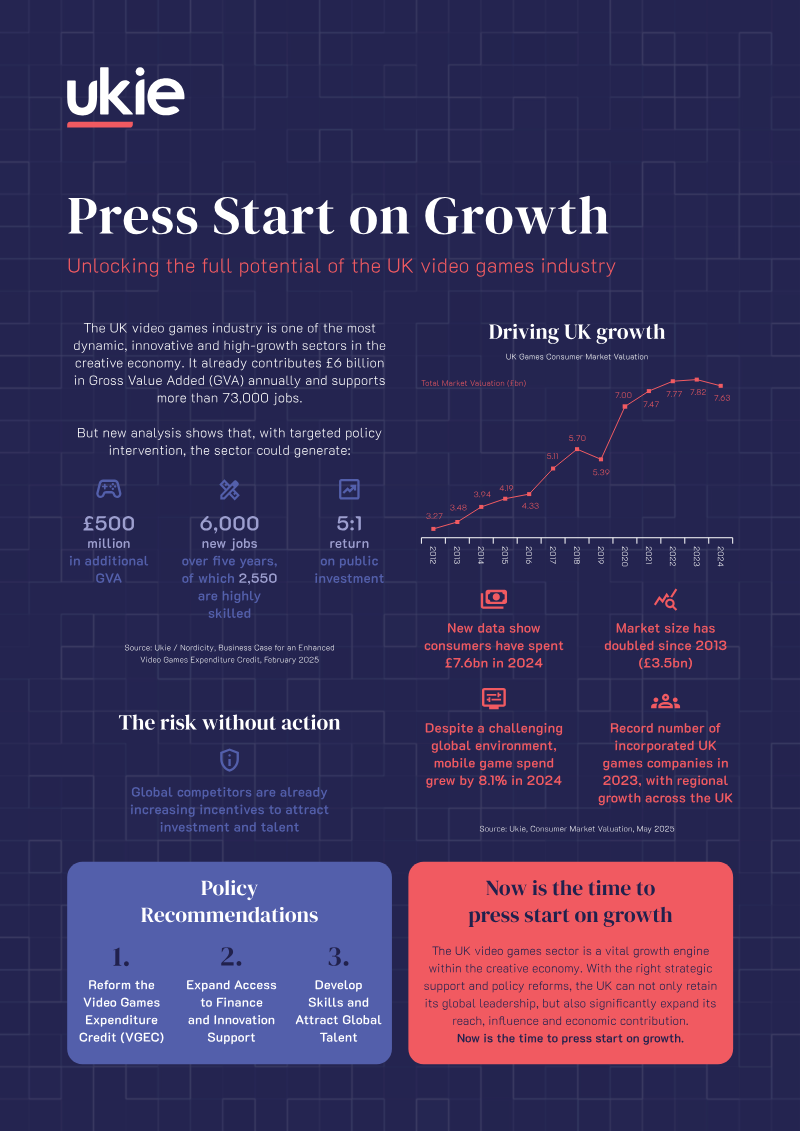
Press Start on Growth: Unlocking the Full Potential of the UK Video Games Industry
The analysis argues that the United Kingdom’s video‑games sector is a high‑growth pillar of the creative economy, already delivering roughly £6 billion in gross value added (GVA) and supporting more than 73 000 jobs, and that strategic policy action could lift its contribution to about £7.6 billion in 2024 and generate an additional £5.7 billion GVA and up to 5.4 million jobs over the next five years. The assessment covers the full UK market from 2022 through 2024, spanning software, hardware, live events, esports, ancillary merchandise and related media, and benchmarks performance against Western‑European averages.
Key findings show a continued erosion of physical boxed software, which fell 34 % year‑on‑year and now accounts for only 4 % of total spend, while mobile games grew 8 %—still below the 13 % regional average. Full‑game digital purchases slipped due to a thin slate of blockbuster releases, yet overall game volume remained stable. Live‑event spending contracted 15 % after pandemic‑related cancellations, whereas esports surged 44 % YoY, driven by a rise in UK‑based tournaments. Subscription revenue rose modestly as price hikes offset a near‑saturation of console subscriber bases. Hardware sales weakened for PS5 disc and Xbox consoles and for the Nintendo Switch, while the PS5 digital edition posted record software sales at a lower price point. Game‑culture engagement declined 13 % across PC and console categories, and related toy and merchandise sales fell 8.5 %.
The conclusions stress that without targeted reforms—particularly in financing, skills development, and talent support—the sector risks losing its global leadership. Conversely, coordinated policy could unlock further growth, broaden international reach, and reinforce the UK’s position as a leading hub for video‑games innovation and cultural influence. Data are drawn from industry sources such as Omdia, Ukie, NielsenIQ/GfK Entertainment, BFI, Comscore and the Official Charts Company, reflecting a comprehensive market‑valuation approach across multiple
- The UK video games industry currently contributes £6 billion in gross value added (GVA) and supports over 73,000 jobs, with the potential to add £5.7 billion in GVA and 5.4 million jobs over the next five years through strategic policy intervention.
- Physical boxed software sales have collapsed, falling 34% year-on-year to represent only 4% of total market spend.
- Esports experienced a significant surge of 44% year-on-year, driven by an increase in UK-based tournaments, contrasting with a 15% contraction in live-event spending.
- Mobile gaming in the UK grew by 8%, though this remains below the 13% regional Western-European average.
- Hardware sales for major consoles, including the PS5 disc edition, Xbox, and Nintendo Switch, weakened, while the PS5 digital edition achieved record software sales at a lower price point.
+1
UkieMay 2025

Report38 pages
Is the Past the Future of Gaming?
Remakes and remasters have become a cornerstone of the video‑game market, now generating roughly two hundred releases each year and projected to reach about thirty titles in 2025. Their commercial performance consistently exceeds that of the original versions, exemplified by the Resident Evil 4 remake, which sold ten million copies within two years of launch, and the continued success of other high‑profile updates such as the Crash series. This growth reflects a broader industry shift toward leveraging established intellectual property to secure reliable revenue streams.
A survey of 1,500 gamers identifies nostalgia as the dominant motivator for purchasing these updated titles, with more than eighty percent seeking the emotional comfort of revisiting familiar experiences. Seventy‑one percent view remakes as a means to introduce classic games to younger players, while between sixty‑seven and eighty‑five percent appreciate the opportunity to discover titles they missed originally. Players also demand contemporary enhancements, ranking higher‑resolution textures, smoother animation, improved lighting, remappable controls, and bug fixes as essential. Nevertheless, the audience is split: roughly thirty‑five percent each prefer strict fidelity to the original or the freedom to alter narrative and gameplay, highlighting a tension between preservationist and innovation‑leaning attitudes.
Pricing expectations reveal a nuanced market perspective. Nearly half of respondents anticipate remakes to be priced slightly below new releases, while a quarter are comfortable with parity, twenty percent expect a more substantial discount, and a small segment seeks free or bundled options. These preferences shape release strategies, with developers balancing cost, value perception, and the timing of launches to maximize appeal.
While nostalgia‑driven updates can boost sales, an overreliance on remakes risks dampening creative innovation. Gamers express a clear desire for a blend of faithful revisions and fresh original IP, suggesting that sustainable growth will depend on integrating modern improvements with new, inventive experiences across the global gaming landscape.
- Remakes and remasters have become a major industry pillar, with roughly 200 releases annually and projections indicating 30 high-profile titles for 2025.
- Commercial performance for remakes frequently outperforms original releases, evidenced by the Resident Evil 4 remake achieving 10 million sales within two years.
- Nostalgia is the primary consumer driver, with over 80% of 1,500 surveyed gamers citing the desire for emotional comfort as their main motivation for purchasing updated titles.
- Consumer demand for remakes is split between preservation and innovation, with roughly 35% of players favoring strict fidelity to the original and 35% preferring narrative or gameplay changes.
- Players prioritize technical modernization in remakes, specifically requesting higher-resolution textures, smoother animation, improved lighting, remappable controls, and bug fixes.
MTMJan 2025
Report23 pages
UKIE Annual Review 2024
Ukie’s 2024 annual review presents a comprehensive account of the UK video‑games sector’s performance, strategic direction and advocacy work over the past twelve months. The central thesis is that the industry, now a £6 billion economic engine supporting 76 000 jobs, must be “supercharged” through coordinated efforts to energise businesses, empower talent and elevate games as cultural and educational assets. The review outlines the new five‑year “Supercharged” strategy, which frames Ukie’s campaigning and support programmes for the next decade.
Key findings highlight robust economic contributions: consumer spending on games rose 4 % to £7.82 billion, while a joint analysis with FTI Consulting estimated video‑game technology spill‑overs added up to £760 million to UK GDP and created nearly 10 000 jobs in 2021. International trade activities at Gamescom and GDC generated over £70 million in business wins and attracted more than £150 million of foreign direct investment for 180 UK companies. Policy influence is demonstrated by over 100 engagements with MPs, successful submissions to Ofcom on online safety, and a manifesto that secured inclusion of the sector in major party election platforms. Education initiatives reached 299 470 learners through the Digital Schoolhouse programme, and IP protection actions removed 1.5 million infringing links and prevented £100 million of illicit digital sales.
The review’s scope covers the UK video‑games ecosystem from indie studios to multinational publishers, spanning 2023‑24 and encompassing economic, cultural and regulatory dimensions. Methodologically, the analysis combines internal data on events, memberships and media coverage with external research collaborations, consultation responses and round‑table workshops to produce evidence‑based recommendations. The narrative underscores a commitment to diversity, with a newly approved five‑year EDI strategy and over 20 inclusion‑focused events, positioning the sector for sustained growth and global competitiveness.
- The UK video games sector is a £6 billion economic engine supporting 76,000 jobs, with consumer spending rising 4% to £7.82 billion in the 2023-24 period.
- Video game technology spill-overs contributed £760 million to UK GDP and created nearly 10,000 jobs as of 2021.
- International trade activities at events like Gamescom and GDC generated over £70 million in business wins and attracted more than £150 million in foreign direct investment for 180 UK companies.
- Ukie’s IP protection efforts successfully removed 1.5 million infringing links, preventing an estimated £100 million in illicit digital sales.
- The Digital Schoolhouse education programme reached 299,470 learners, supporting the industry's focus on talent development.
UkieOct 2024

Report11 pages
Supercharged: Powering the Future of the UK Video Game and Interactive Entertainment Industry
The new five‑year strategy and action plan sets out a comprehensive roadmap for the UK video‑games and interactive‑entertainment sector, positioning it as the world’s leading hub for new intellectual property and innovation by 2030. Its core thesis is that sustained growth, enhanced global perception, and a resilient, diverse talent pipeline will secure the industry’s long‑term economic and cultural impact. The plan outlines four strategic priorities—transforming public and media perceptions, building a pro‑games policy agenda, cultivating a highly skilled and inclusive workforce, and strengthening businesses through targeted support.
Key initiatives include three flagship campaigns: energising industry to turn innovative stories into globally successful IPs, empowering talent by nurturing creators and entrepreneurs, and elevating games to showcase British‑made titles as forces for good. The 2024‑25 action schedule launches a coordinated PR strategy, high‑impact partnerships with cultural and digital brands, and an evidence‑led lobbying effort aimed at more competitive tax reliefs, increased investment, and the introduction of a Digital Creativity GCSE. A new research and evidence base will underpin policy advocacy, while a sector‑wide skills network and the refreshed #RaiseTheGame programme will drive diversity, equity, and inclusion across the talent pipeline.
The plan also commits to environmental responsibility through participation in the Playing for the Planet Alliance and internal sustainability measures. Supporting stronger businesses will involve a refreshed membership strategy, expansion of the Ukie Worldwide platform for trade and investment, and the continuation of the Video Games Growth Programme. By inviting industry stakeholders to engage through surveys, working groups, mentorship, and board participation, the strategy seeks broad collaboration to deliver its ambitious objectives across the UK’s mobile, console, core and casual game segments throughout the 2024‑2030 horizon.
- The UK video game industry has launched a five-year strategy aiming to establish the nation as the global leader in intellectual property and innovation by 2030.
- The 2024-25 action plan prioritizes lobbying for more competitive tax reliefs, increased investment, and the introduction of a Digital Creativity GCSE.
- Strategic efforts to strengthen the workforce include the expansion of the #RaiseTheGame diversity, equity, and inclusion programme and the creation of a sector-wide skills network.
- Business growth initiatives include the expansion of the Ukie Worldwide trade platform and the continuation of the Video Games Growth Programme.
- The industry is formalizing its commitment to environmental sustainability through participation in the Playing for the Planet Alliance.
+1
UkieJan 2024
Report68 pages
The Economic Impacts of Video Game Technology Spillover: UK and Nordic Economies
The analysis quantifies how video‑game technology generates measurable economic benefits beyond the entertainment sector, arguing that spill‑over effects constitute a significant engine of growth for advanced‑technology economies. By applying the IMPLAN input‑output model to 2021 data, the study estimates that spill‑overs contributed roughly £1.3 billion of total output and £760 million of GDP to the United Kingdom, delivering £380 million of labour income and £250 million of government revenue while sustaining about 9,900 non‑gaming jobs. These positions are concentrated in information‑technology, business services and energy extraction, with average salaries 25 % above the national mean. In the Nordic region, comparable effects amounted to £190 million of output and £40 million of GDP, underscoring the broader relevance across Western Europe.
The research situates these figures within the wider UK games ecosystem, which comprises approximately 2,600 firms and 71,400 jobs across direct, indirect and induced employment. Spill‑over activity accounts for roughly 13 % of the industry’s gross value added and 19 % of its employment, highlighting the sector’s pivotal role in supporting ancillary markets. Sectoral case studies illustrate how real‑time engines (Unreal, Unity), VR/AR headsets and haptic devices are reshaping healthcare, oil and gas, architecture, horticulture, furniture design and automotive safety, delivering faster, lower‑cost visualisation, enhanced training and new revenue streams.
The findings extend to the United States, where about one‑fifth of software‑job growth in 2016 and $0.5 billion of software output are linked to game‑technology diffusion. Collectively, the evidence demonstrates that video‑game innovations act as a cross‑industry catalyst, generating substantial fiscal, employment and productivity gains across multiple high‑value sectors during the 2021‑2022 period.
- In 2021, video game technology spill-overs contributed £1.3 billion in total output and £760 million to UK GDP, while sustaining 9,900 non-gaming jobs.
- Spill-over activity from the UK games industry accounts for 13% of the sector's gross value added and 19% of its total employment.
- Non-gaming roles supported by game technology—primarily in IT, business services, and energy—command average salaries 25% higher than the UK national mean.
- Real-time engines like Unreal and Unity, alongside VR/AR and haptic hardware, are driving productivity and cost reductions in sectors including healthcare, architecture, automotive safety, and energy extraction.
- The economic impact of game technology is significant across Western Europe, with the Nordic region recording £190 million in output and £40 million in GDP from these spill-overs.
+2
UkieNov 2023
Report36 pages
Mobile Games: State of the Market & Playtime Q3 2023
Mobile games: state of the market & playtime Joint report of Apptica & Gamelight The purpose of this study is to analyse the state of gaming category in Q3 2023. All data presented in this report has been collected from Apptica and Gamelight platforms. "Games" category is defined by a store's tag. The basis of this analysis is made up of data from the Apptica's Store, Ad and Market Intelligence sections and Gamelight's playtime and app usage data.
- iOS remains the dominant platform for mobile gaming revenue, accounting for 56.01% of the total global share compared to 43.99% for Android.
- The United States and Japan are the leading revenue generators among major markets, contributing $2.92 billion and $2.03 billion respectively, with the six analyzed countries accounting for 59% of global gaming revenue.
- South Korea experienced the highest growth in game installs at 32% compared to Q3 2022, while the United States and France saw declines of 5% and 0.7%, respectively.
- Card games are the most engaging genre globally with an average playtime of 41.68 minutes, consistently ranking as the top genre for user engagement across analyzed regions.
- Average daily playtime is higher on iOS (38.69 minutes) than on Android (32.17 minutes) across the studied markets.
+6
AppticaJan 2023

Report108 pages
Creative Industries in the UK Report
The United Kingdom’s entertainment market reached a historic peak of £11.1 billion in 2022, representing a 6.9% year-on-year increase and nearly doubling its total value since 2015. This growth is fundamentally underpinned by a comprehensive transition to digital consumption, with digital services now commanding a 91% market share across the video, music, and gaming sectors. While physical formats generally continue a long-term decline, specific niches such as vinyl and 4K UHD Blu-ray demonstrate notable resilience, with vinyl revenue surpassing CD sales for the first time this century.
The video games sector remains the largest individual segment, valued at £4.66 billion. Digital software sales account for 90% of this spend, led by mobile gaming and console downloadable content. Although hardware sales faced challenges due to global supply chain constraints, the market remains robust, with digital sales for major titles like Elden Ring and FIFA 23 significantly outperforming physical retail. Similarly, the video market reached a record £4.43 billion, fueled by a 17.6% surge in subscription video-on-demand services. Approximately 68% of UK households now maintain an average of 2.5 streaming subscriptions, cementing the dominance of online distribution.
The music industry mirrors these trends, with subscription streaming accounting for 84% of its £1.99 billion valuation. Interestingly, 2022 saw a nuanced recovery for physical retail as high-street specialists and independent shops experienced a 12.6% growth in sales following the normalization of post-pandemic trading. Despite this resurgence of local brick-and-mortar outlets, online channels still facilitate nearly 95% of total music spending. Strategic initiatives like Record Store Day and the implementation of advanced data tracking continue to support the industry's evolution, ensuring that both digital innovation and traditional retail advocacy remain central to the UK’s creative economy.
- The UK entertainment market reached a record £11.1 billion in 2022, a 6.9% year-on-year increase that nearly doubles its 2015 valuation.
- Digital services now dominate the landscape with a 91% market share across video, music, and gaming sectors.
- The video games sector is the largest segment at £4.66 billion, with digital software sales—driven by mobile and console DLC—accounting for 90% of that total.
- The video market grew to £4.43 billion, supported by a 17.6% surge in subscription video-on-demand services, with 68% of UK households now averaging 2.5 subscriptions each.
- Music industry revenue reached £1.99 billion in 2022, with subscription streaming accounting for 84% of total valuation.
+1
ERAJan 2023
Report3 pages
UK Games Jobs Summary: November 2022
The United Kingdom games industry experienced a notable contraction in recruitment activity during November 2022, continuing a downward trend observed throughout the second half of the year. Open vacancies decreased by several hundred positions compared to the previous month, leaving the market with over 500 fewer available roles than in June 2022. This decline aligns with broader global and domestic technology sector layoffs. While major development hubs such as London, Guildford, Leamington Spa, Cambridge, Edinburgh, and Manchester remain the primary centers for recruitment, these locations have seen a significant reduction in active job postings.
The downturn has impacted various industry segments and disciplines unevenly. Mobile studios recorded the highest proportional reduction in open roles, often attributed to the fulfillment or removal of positions following major corporate mergers. Despite the general decline in volume, the market shows resilience in specific areas; two less prominent geographic regions bucked the national trend by increasing their job offerings. Furthermore, while senior and experienced roles remain prevalent, there was a recorded increase in advertised junior positions, suggesting a continued interest in developing entry-level talent despite broader economic headwinds.
Data indicates that Software Engineers, Producers, and Senior Environment Artists are among the most sought-after titles. Programming, Art, and Design remain the dominant hiring categories, though most disciplines have seen a net loss in postings. The age of available jobs suggests a mix of immediate needs and long-term vacancies, with over 600 new jobs added in the month preceding the summary. This analysis is based on a comprehensive database of UK game studios, which expanded by eight new companies during this period, providing a representative snapshot of the hiring landscape across AAA, AA, mobile, indie, and service-based sectors.
- UK games industry recruitment contracted significantly in November 2022, resulting in over 500 fewer open vacancies compared to June 2022.
- Mobile studios experienced the highest proportional reduction in job postings, largely driven by the completion or cancellation of roles following corporate mergers.
- Despite the broader market decline, the industry added over 600 new job postings during the month, and the total number of tracked studios grew by eight companies.
- While hiring volume dropped across major hubs like London, Guildford, and Manchester, two smaller geographic regions bucked the national trend by increasing their job offerings.
- Market demand remains concentrated in Programming, Art, and Design, with Software Engineers, Producers, and Senior Environment Artists identified as the most sought-after roles.
+1
Games Jobs LiveNov 2022
Report9 pages
The UK's New Immigration System
The UK’s new immigration system, effective since January 2021, represents a fundamental shift in how the video games industry manages international talent following the end of free movement between the UK and the European Union. The primary purpose of this framework is to transition to a points-based system that prioritizes specific skill levels, salary thresholds, and job offers, while encouraging domestic investment in training and workforce development.
Under the current rules, applicants must secure 70 points to qualify for a Skilled Worker visa, with mandatory requirements including a job offer from an approved sponsor, an appropriate skill level, and English language proficiency. Additional points are available for salary levels, roles in shortage occupations, and relevant academic qualifications, such as PhDs in STEM subjects. Beyond the standard Skilled Worker route, the system incorporates various specialized pathways, including the Global Talent visa for exceptional individuals, the Graduate visa for international students, and specific routes for innovators and intra-company transfers.
Businesses operating within the UK video games sector must navigate the complexities of becoming licensed sponsors to hire international staff, including EU citizens who arrived after December 2020. This process involves administrative oversight, potential immigration skills charges based on company size and contract duration, and adherence to evolving government roadmaps aimed at streamlining sponsorship management. Furthermore, the system introduces new regulations for business travel to the EU, EEA, and Switzerland, where visa-free travel is generally limited to 90 days within a 180-day period for meetings, with more stringent requirements for specific professional services. The government continues to refine these processes, with planned reforms for 2022 and 2023 intended to simplify license management and sponsor applications.
- Since January 2021, the UK video games industry must operate under a points-based immigration system that requires international hires to secure 70 points based on job offers, skill levels, and English proficiency.
- UK game studios must become licensed sponsors to hire international staff, including EU citizens who arrived after December 2020, which involves administrative oversight and potential immigration skills charges.
- Applicants can earn additional points toward the 70-point threshold through higher salary levels, roles in shortage occupations, or relevant academic qualifications like STEM PhDs.
- Specialized visa pathways exist alongside the Skilled Worker route, including the Global Talent visa for exceptional individuals, the Graduate visa for international students, and routes for innovators and intra-company transfers.
- Business travel to the EU, EEA, and Switzerland is now restricted to 90 days within any 180-day period for meetings, with stricter requirements applied to specific professional services.
TIGAJan 2022

Report91 pages
Annual Report 2022
Games Workshop achieved record financial performance for the fiscal year ending May 29, 2022, reporting total revenue of £414.8 million and a profit before tax of £156.5 million. This growth was characterized by a 10% increase in core revenue and a near-doubling of licensing revenue to £28.0 million, bolstered by major agreements with partners such as Nexon. Despite macroeconomic pressures including Brexit-related supply chain costs and the conflict in Ukraine, the group maintained a debt-free balance sheet and continued its policy of returning surplus cash to shareholders, declaring £77.1 million in dividends.
The group’s vertically integrated business model remains centered in Nottingham, UK, supporting a global retail network of 6,200 accounts across 72 countries. Strategic investments focused on "future-proofing" operations, including £16.7 million in design, £5.7 million in tooling, and significant upgrades to North American warehouse capacity and UK manufacturing facilities. While core gross margins faced a 5.6% decline due to rising freight and inventory costs, the licensing division’s high profitability helped offset these operational headwinds.
Sustainability and governance were key areas of focus, with the establishment of a Social Responsibility and Sustainability strategy and a commitment to science-based carbon reduction targets. Although total greenhouse gas emissions rose by 5% due to business expansion, revenue-based emissions intensity decreased by 6%. Governance transitions included a leadership succession plan and the appointment of a new Audit and Risk Committee Chair. The board confirmed the group’s long-term viability through 2025, supported by robust cash reserves and a simplified executive remuneration structure that aligns leadership interests with long-term stability rather than short-term targets.
- Games Workshop achieved record financial performance for the fiscal year ending May 29, 2022, with £414.8 million in total revenue and £156.5 million in profit before tax.
- Licensing revenue nearly doubled to £28.0 million, driven by major partnerships including Nexon, which helped offset a 5.6% decline in core gross margins caused by rising freight and inventory costs.
- The company maintained a debt-free balance sheet and returned £77.1 million in dividends to shareholders, reflecting a continued commitment to surplus cash distribution.
- Strategic capital investment totaled £16.7 million in design and £5.7 million in tooling, alongside significant infrastructure upgrades to North American warehousing and UK manufacturing facilities.
- While total greenhouse gas emissions increased by 5% due to business expansion, the company achieved a 6% reduction in revenue-based emissions intensity.
Games Workshop GroupJan 2022
Report18 pages
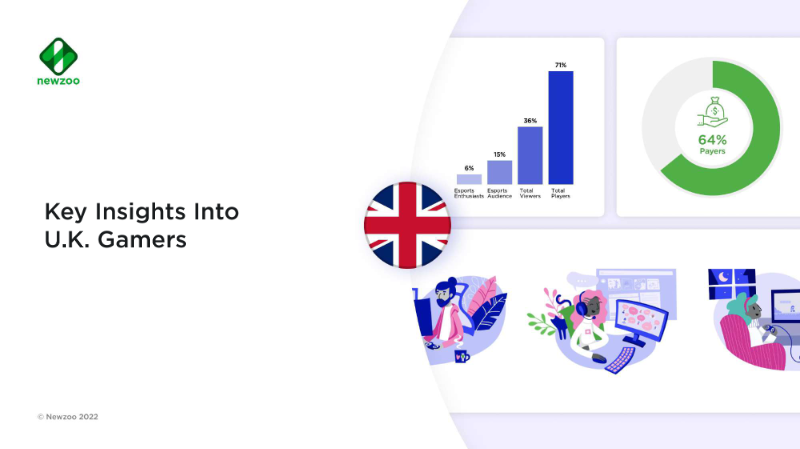
Key Insights Into UK Gamers
The United Kingdom represents a major global gaming hub, ranking as the sixth-largest market by revenue and tenth by player population as of late 2022. Research conducted among the online population aged 10 to 65 indicates that gaming is a primary entertainment pillar in the region, with 71% of the population identifying as game enthusiasts. This engagement is split between active play and content viewership, with 36% of the population exclusively playing games and another 35% both playing and viewing gaming video content.
The demographic profile of UK gamers is nearly balanced by gender, consisting of 52% male and 47% female players. While gaming spans all age groups, the 21-35 bracket is the most active. Motivation for play is driven primarily by the desire to unwind and relax, followed by the pursuit of achievement and social interaction. When categorized by persona, Time Fillers—those who play casually to pass the time—represent the largest segment, followed by Mainstream Gamers who engage deeply with both play and viewership.
Platform preferences show that mobile gaming has the highest reach at 46%, followed by console at 41% and PC at 29%. However, PC and console players demonstrate higher average weekly time commitments compared to mobile users. Financial engagement is also significant, with 63% of players identified as payers. The primary driver for spending is the availability of sales or special offers, though social motivations, such as spending to play with friends or family, also influence purchasing behavior.
The findings are based on a 2022 survey of 2,010 respondents in the United Kingdom, part of a broader global study covering 36 markets. The methodology utilizes a representative sample of the online population to track dozens of key performance indicators, including audience profiles, platform behavior, and monetization trends.
- The UK is a major global gaming hub, ranking sixth in revenue and tenth in player population, with 71% of the population aged 10-65 identifying as game enthusiasts.
- Engagement is evenly split between active players (36%) and those who both play and view gaming video content (35%).
- Mobile gaming has the highest reach at 46%, followed by console (41%) and PC (29%), though PC and console users dedicate more time to gaming weekly.
- The gamer demographic is nearly gender-balanced at 52% male and 47% female, with the 21-35 age bracket serving as the most active segment.
- 63% of UK gamers are payers, with spending primarily driven by sales, special offers, and social motivations like playing with friends or family.
+1
NewzooJan 2022

Report89 pages
Annual Report 2021
Games Workshop achieved record-breaking financial performance for the 2021 fiscal year, with revenue rising 31% to £353.2 million and profit before tax exceeding £150 million for the first time. This growth was primarily driven by the successful launch of the latest edition of Warhammer 40,000 and a 70% surge in online sales, which effectively offset the impact of global retail lockdowns. The company maintained a debt-free balance sheet and a strong cash position of £85.2 million, allowing for a significant increase in dividends to 235 pence per share and the distribution of £13.2 million in profit-share and discretionary bonuses to its global workforce.
The company’s vertically integrated business model remains centered in Nottingham, UK, where it designs and manufactures its core intellectual property. While the UK remains the production hub, the business is increasingly international, with 77% of sales generated globally across 73 countries. North America stands as the largest geographic market, contributing £145.5 million in revenue. To support this global expansion, the group is investing heavily in physical infrastructure, including new warehousing in the UK and US, increased plastic production capacity, and the development of the Warhammer+ subscription service and digital licensing portfolio.
Strategic priorities for the 2021/22 period focus on IP exploitation through media and digital content, alongside a commitment to environmental, social, and governance (ESG) goals. The company reported a 21% reduction in Scope 1 and 2 emissions and formalized an ESG steering group to oversee long-term sustainability. Despite operational challenges related to COVID-19, Brexit, and supply chain disruptions, the group’s high return on capital employed (184%) and robust liquidity position underscore a stable outlook for continued international growth and brand development.
- Games Workshop achieved record financial results in fiscal year 2021, with revenue increasing 31% to £353.2 million and profit before tax surpassing £150 million.
- Online sales surged by 70%, effectively offsetting the impact of global retail lockdowns and supporting the successful launch of the latest Warhammer 40,000 edition.
- The company maintains a debt-free balance sheet with £85.2 million in cash, enabling a dividend increase to 235 pence per share and £13.2 million in employee profit-sharing.
- International expansion remains a core driver, with 77% of total revenue generated outside the UK and North America serving as the largest geographic market at £145.5 million.
- Strategic focus for 2021/22 centers on scaling digital and media IP through the Warhammer+ subscription service and expanding manufacturing infrastructure in the UK and US.
Games Workshop GroupAug 2021

Report185 pages
Online Nation 2021 Report
Overview............................................................................................................................ 3 What we have found – in brief ........................................................................................................... 3 1. The online consumer ......................................................................................................
- Adults spent significantly more time online in 2020 compared to 2019, with the 18-24 age group showing the largest increase, particularly during lockdown periods.
- Despite a potential decrease, 6% of UK households (approximately 1.5 million) still lacked internet access in March 2021, though direct comparability with previous years is limited due to methodology changes.
- Social video platforms are actively launching new features to maintain and build engagement, exemplified by Snapchat's 'Spotlight' which gained 100 million users by January 2021 and offers creators a share of $1 million daily.
- TikTok removed 104.5 million videos in the first half of 2020 and 89.1 million in the second half, with 'minor safety' and 'adult nudity/sexual activities' consistently being among the top removal reasons.
- The COVID-19 pandemic led to a significant increase in online education for children, with nearly 90% of parents in Britain homeschooling their children in May-June 2020 and January-February 2021.
+1
OfcomJun 2021
Report34 pages
Creative Industries Statistics: United Kingdom (August 2020)
Creative Industries Statistics United Kingdom August 2020 Released: Official Statistics on Film, High-End 13 August 2020 Television, Animation, Video Games, Next release: Children’s Television, Theatre, Orchestra, Summer 2021 and Museums & Galleries Exhibition Frequency of release: Tax Reliefs https://www.gov.uk/government/org Section 1: Key points and summary 4 1.1 Summary ...
- Since its introduction in 2007, Film Tax Relief (FTR) has supported 3,470 films, accounting for £18.4 billion in UK expenditure. In 2019-20 alone, 300 films claimed FTR with £2.5 billion in UK expenditure.
- High-End Television (HETV) Tax Relief, introduced in 2013, has supported 635 programmes with £5.9 billion in UK expenditure. In 2019-20, 110 programmes claimed HETV tax relief, totaling £1.5 billion in UK expenditure.
- Video Games Tax Relief (VGTR) paid out an estimated £161 million for 2018-19, with 310 claims made by 270 companies. Since its introduction in 2014, the relief aims to promote sustainable production of culturally relevant video games in the UK.
- Theatre Tax Relief (TTR) paid out £71 million in 2019-20 across 1,115 claims, representing 3,580 productions. Since its 2014 introduction, TTR has disbursed £280 million for 12,065 productions.
- Children's Television Tax Relief (CTR) supported 25 British children's TV programmes in 2019-20 with £30 million in UK expenditure. Since 2015, 280 programmes have claimed CTR, totaling £299 million in UK expenditure and £59 million in payments.
HM RevenueAug 2020

Report82 pages
Annual Report 2020
Games Workshop achieved record-breaking financial results for the 2019/20 fiscal year, demonstrating significant resilience despite the operational disruptions caused by the COVID-19 pandemic. Annual revenue rose 5.1% to £269.7 million, while profit before tax reached £89.4 million. This performance marks the fourth consecutive year of record growth, driven primarily by a robust trade segment—which now accounts for 52% of total revenue—and a substantial increase in royalty income from licensing agreements in the video game and media sectors.
The company’s strategic focus remained on the global expansion of its Warhammer intellectual property and the modernization of its industrial infrastructure. Significant capital investments totaling £18 million were directed toward production and logistics expansions in Nottingham and North America, alongside the implementation of a new ERP system. While physical retail sales declined by 11% due to pandemic-related store closures, digital engagement and online sales saw marked growth. The company also successfully navigated the transition to IFRS 16 accounting standards, which brought £32.1 million in lease liabilities onto the balance sheet.
Geographically, North America remains the company's largest market, contributing £104.8 million to total revenue. Despite the economic uncertainties of the pandemic and Brexit, the Group maintained a strong liquidity position, ending the period with £52.9 million in cash and no utilized borrowing facilities. This financial stability allowed the board to maintain its commitment to shareholders through dividends of 145 pence per share and to support its workforce by providing full pay during shutdowns and distributing profit-share bonuses to all staff. The report concludes with a focus on long-term sustainability, ethical sourcing, and continued IP exploitation to ensure future viability.
- Games Workshop achieved record-breaking financial results for the 2019/20 fiscal year, with revenue rising 5.1% to £269.7 million and profit before tax reaching £89.4 million.
- The trade segment now accounts for 52% of total revenue, supported by a significant increase in royalty income from video game and media licensing.
- North America remains the company's largest market, contributing £104.8 million to total revenue despite pandemic-related operational disruptions.
- The company invested £18 million in capital projects, including production and logistics expansions in Nottingham and North America and the implementation of a new ERP system.
- Physical retail sales declined by 11% due to pandemic-related closures, though this was offset by growth in digital engagement and online sales.
+1
Games Workshop GroupAug 2020

Report69 pages
Annual Report 2018
Games Workshop achieved record-breaking financial performance during the 2017/18 fiscal year, characterized by a 39% increase in revenue to £219.9 million and a near doubling of operating profit to £74.6 million. This growth, which propelled the company into the FTSE 250, was primarily driven by the global success of the Warhammer brand and a 54% surge in the trade segment. With 76% of sales generated internationally, the company significantly expanded its Nottingham-based manufacturing and R&D facilities, doubling plastic injection molding capacity and increasing inventory levels to £20.2 million to meet rising global demand.
Strategic priorities focused on long-term infrastructure and digital engagement, including the implementation of a new ERP system and a successful relaunch of Warhammer 40,000 that drove 70 million digital community page views. Financial stability remained robust, with the company maintaining a debt-free position and increasing cash reserves to £28.5 million. While management monitored risks related to Brexit and supply chain interruptions, the return on capital rose from 72% to 120%. Governance remained stable, with the board defending the tenure of long-serving directors based on their deep industry expertise, while also implementing a revised remuneration policy to align executive pay with market rates following the year’s exceptional performance.
The company’s commitment to sustainability and compliance was evidenced by a reduction in greenhouse gas emissions through solar energy investments and the achievement of full GDPR compliance. Looking forward, the company remains focused on multi-channel retail growth and IP licensing opportunities. Independent auditors confirmed the integrity of the financial statements, noting that while inventory valuation and development costs require significant management judgment, the group remains a strong going concern with high liquidity and a clear trajectory for continued global expansion.
- Games Workshop achieved record financial performance in the 2017/18 fiscal year, with revenue increasing 39% to £219.9 million and operating profit nearly doubling to £74.6 million.
- The company’s growth was driven by a 54% surge in the trade segment and the global success of the Warhammer brand, which helped propel the firm into the FTSE 250.
- To support international demand, which accounted for 76% of total sales, the company doubled its plastic injection molding capacity and increased inventory levels to £20.2 million.
- Operational efficiency and capital allocation were highly effective, with the return on capital rising from 72% to 120% while maintaining a debt-free balance sheet with £28.5 million in cash reserves.
- Digital engagement initiatives, highlighted by the relaunch of Warhammer 40,000, generated 70 million page views on the company's community platform.
Games Workshop GroupAug 2018

Report70 pages
Annual Report 2017
Games Workshop achieved record-breaking financial performance during the 2016/17 fiscal year, characterized by a 34% increase in revenue to £158.1 million and a doubling of operating profit to £38.3 million. This growth was balanced across all primary channels—trade, retail, and mail order—and supported by a robust gross margin of 72.4%. North America emerged as the largest geographic market, contributing £57.0 million to the total revenue. The company’s vertically integrated model, centered on its Nottingham manufacturing hub, produced 30 million miniatures and launched over 400 new products, while royalty income from licensed video games like Total War: Warhammer provided high-margin supplementary growth.
Strategic priorities focused on long-term stability and cash generation, resulting in a 72% return on capital and a 76% increase in dividends per share. Despite this success, the period involved significant administrative and leadership transitions. Long-standing Chairman Tom Kirby announced his retirement, and the board addressed a technical breach of the Companies Act 2006 regarding an "unlawful dividend" payment of £1.9 million. This was rectified through shareholder resolutions to release directors from liability and treat the payment as a loan offset by future dividends.
Operational investments included a major ERP system upgrade and a continued commitment to the UK Living Wage and universal profit-sharing, which saw a £4.9 million discretionary payment to the workforce. Environmental and governance disclosures highlight a reduction in carbon emissions and an 85% waste recycling rate. While the company maintains a conservative "survivalist" fiscal strategy, its strong liquidity position—ending the year with £17.9 million in cash and no debt—underpins its viability as a going concern through the 2020 horizon.
- Games Workshop achieved record financial performance in the 2016/17 fiscal year, with revenue increasing 34% to £158.1 million and operating profit doubling to £38.3 million.
- The company maintained a 72.4% gross margin and a 72% return on capital, supported by a debt-free balance sheet and £17.9 million in cash reserves.
- North America became the company's largest geographic market, contributing £57.0 million in revenue, while royalty income from licensed titles like Total War: Warhammer provided high-margin growth.
- The Nottingham manufacturing hub produced 30 million miniatures and launched over 400 new products, underpinned by a vertically integrated business model.
- Shareholders saw a 76% increase in dividends per share, despite the company addressing a technical breach of the Companies Act 2006 regarding an unlawful £1.9 million dividend payment.
Games Workshop GroupAug 2017

Report30 pages
TIGA Genre Report 2016
Breakdown of platform releases Examples from different genres TIGA represents developers, digital publishers, service companies and education providers and is the trade association for the video games industry. Our core purpose is to strengthen the games development and digital publishing sector. We achieve this by campaigning for the industry in the corridors of power, championing the industry in the media and helping our members commercially.
- Action/Adventure is the most common game genre, with over 45 releases, followed by Arcade and Puzzle/Trivia, each with over 30 releases.
- Mobile platforms (iOS, Android, Windows Phone) show a higher number of releases in Casual, Puzzle/Trivia, and Action/Adventure genres compared to other genres.
- Desktop platforms (PC, Mac, Linux) have a significantly higher number of releases in Action/Adventure and RPG genres, with over 70 and 60 releases respectively.
- The UK has a strong history of developing Action/Adventure games, with many notable titles originating from the country, though other countries also excel in this genre.
- UK developers have a good track record in sports games, producing titles like 'Match Day' and 'Daley Thomson’s Decathlon', and are exploring new casual sports experiences.
TIGAJan 2016

Report65 pages
Games Workshop Group PLC Annual Report 2015
Games Workshop’s 2015 fiscal year was defined by a major leadership transition and significant structural reorganization aimed at stabilizing the business for long-term growth. Under the new leadership of CEO Kevin Rountree, the company reported a profit before taxation of £16.6 million on revenues of £119.1 million. While total revenue saw a 3.5% decline from the previous year—attributed to currency headwinds and internal restructuring—net profit attributable to owners rose significantly from £8.0 million to £12.3 million. This recovery supported a substantial dividend payout of 52 pence per share, totaling £16.6 million, reflecting a core strategic commitment to returning surplus capital to shareholders.
The company’s strategic focus shifted toward global expansion and operational efficiency, particularly through the rebranding of retail outlets to "Warhammer" and the implementation of a "one-man" store model to improve margins. Geographically, North America emerged as a key growth driver, contrasting with revenue declines in the United Kingdom and Continental Europe. A pivotal product milestone was the relaunch of the core fantasy line as Warhammer: Age of Sigmar. Simultaneously, the company expanded its high-margin licensing portfolio, which included 50 interactive products, and invested £6.4 million in a new global ERP system to modernize its digital and logistical infrastructure.
Operating with a workforce of 1,654 employees, the Group maintained a debt-free balance sheet and a strong cash position of £12.6 million. Governance and remuneration policies were updated to align with the new leadership, including a revised profit-sharing trigger based on sales revenue growth rather than operating profit. Despite some non-compliance issues regarding the UK Corporate Governance Code during the leadership handover, the company successfully formalized a global health and safety strategy and introduced a new all-employee Sharesave Plan. These initiatives underscore a transition toward a more standardized, scalable international business model focused on cash generation and disciplined capital allocation.
- Games Workshop reported a profit before taxation of £16.6 million on £119.1 million in revenue for fiscal year 2015, with net profit rising to £12.3 million from £8.0 million the previous year.
- The company maintained a debt-free balance sheet with £12.6 million in cash, supporting a dividend payout of 52 pence per share totaling £16.6 million.
- Total revenue declined by 3.5% due to currency headwinds and internal restructuring, with growth in North America failing to offset declines in the UK and Continental Europe.
- Operational efficiency initiatives included the rebranding of retail outlets to 'Warhammer,' the implementation of a 'one-man' store model, and a £6.4 million investment in a new global ERP system.
- The product portfolio was significantly updated with the relaunch of the core fantasy line as 'Warhammer: Age of Sigmar' and the expansion of a licensing portfolio comprising 50 interactive products.
+1
Games Workshop GroupAug 2015