Shelter
Game
2 documents in the library are about Shelter, from writers such as DiGRA. Each has a summary and key insights with the page they come from.
Connections
Each row is a game or company named alongside Shelter, each column a document, oldest first. A mark means that document names it. Select a row to see those documents.
Documents about Shelter
On Inhabiting Nonhuman Bodies: Review of Research Perspectives
This review by Iwona Marinov organizes and formalizes research perspectives on animal games, digital works that position players within the embodied perspective of a nonhuman animal avatar, and situates them within the broader field of ecogame scholarship.
- The review argues that a substantial body of work on animal games already exists across animal studies, environmental humanities, and game studies, but lacks an organized discourse in which its contributors recognize themselves as part of a shared conceptual field.
- Its central analytical question is whether inhabiting a nonhuman animal avatar can convey what it is like to be that animal, and it presents this as a methodological and ethical debate rather than a settled finding.
- Gualeni (2011) sees games as spaces of experimental ontology that can transcend human subjectivity, Eggertsson (2022) argues they convey nonhuman animal experience through a blend of biological fact and narrative fiction, and Caracciolo (2021) rejects this as illusory and warns it may reinforce human superiority as a colonizing act.
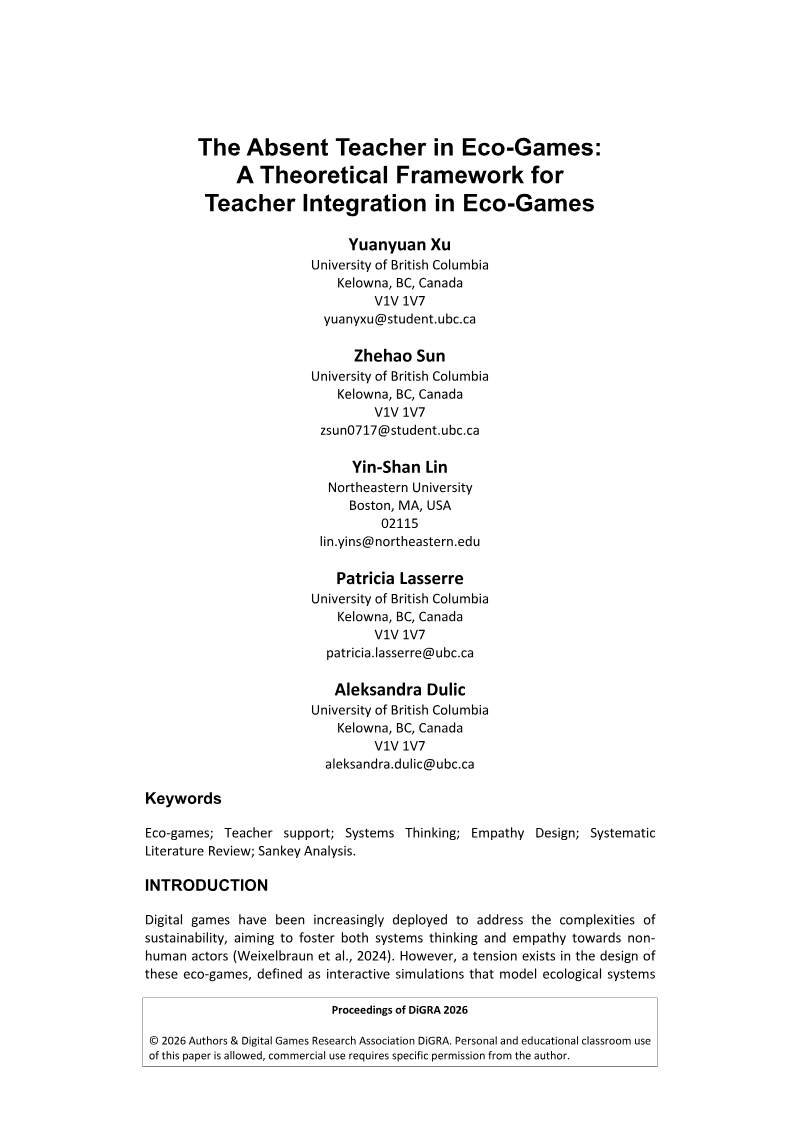
The Absent Teacher in Eco-Games: A Theoretical Framework for Teacher Integration in Eco-Games
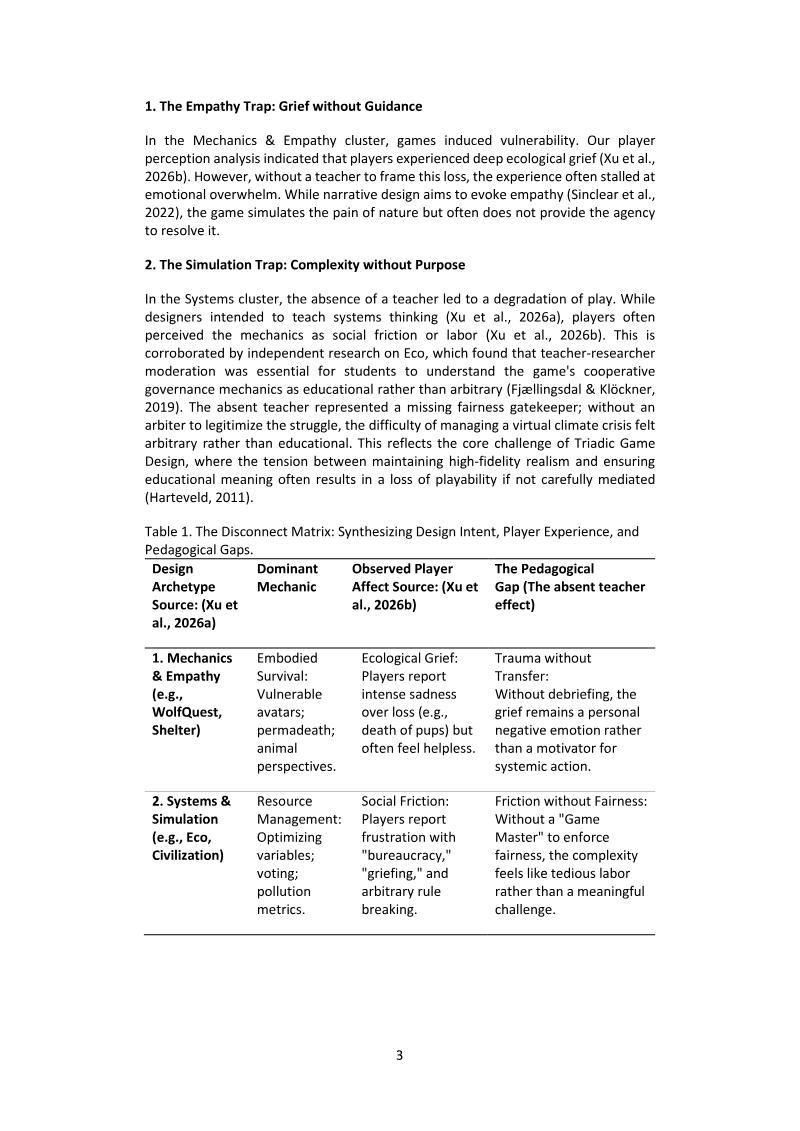
This paper argues that eco-games, which model ecological systems and human-nature relations, are typically designed as self-contained pedagogical tools, and that this design choice leaves a critical gap: the absence of teacher mediation.
- Eco-games are typically designed as self-contained pedagogical tools, leaving a critical gap in teacher mediation, and the authors argue this absence produces shallow engagement with systems thinking.
- The argument rests on a systematic literature review of 175 empirical studies plus a theoretical re-analysis of that dataset, which recoded teacher involvement into three roles: gatekeeper, facilitator, and absent.
- The authors propose "resilient flow" as the design target: sustained engagement achieved by scaffolding difficulty rather than removing it, since seamless-flow games eliminate the productive friction teachers provide.
Companies behind it
As the documents state it.