Path Out
Game
Documents about Path Out
Article
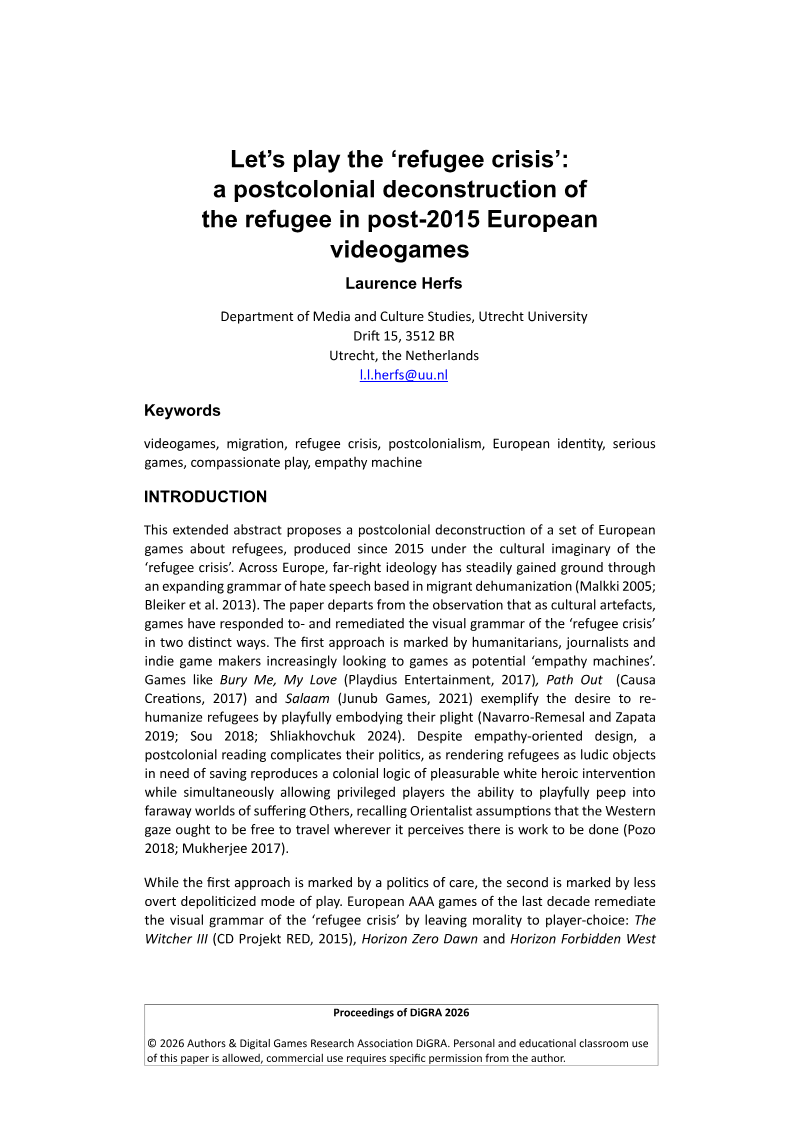
Let's Play the 'Refugee Crisis': A Postcolonial Deconstruction of the Refugee in Post-2015 European Videogames
This extended abstract offers a postcolonial critique of European videogames about refugees produced after 2015, a period shaped by the so-called "refugee crisis" and the growing influence of far-right ideology across Europe.
- The paper argues that post-2015 European refugee-themed games take two contrasting approaches: independent 'empathy machine' titles (e.g., Bury Me, My Love, Path Out, Salaam) that aim to rehumanize refugees, and mainstream AAA titles (e.g., The Witcher III, the Horizon series, Baldur's Gate 3) that treat refugees in a less overt, depoliticized way.
- Its central claim is that both approaches reify the refugee as a passive morality object, whether as a figure for European altruistic redemption or as a vehicle for increasingly fascist fantasies of control.
- The author contends that even empathy-driven games reproduce colonial logics of heroic Western intervention and Orientalist assumptions about the Western gaze's right to observe distant suffering.
DiGRAJun 2026
Article
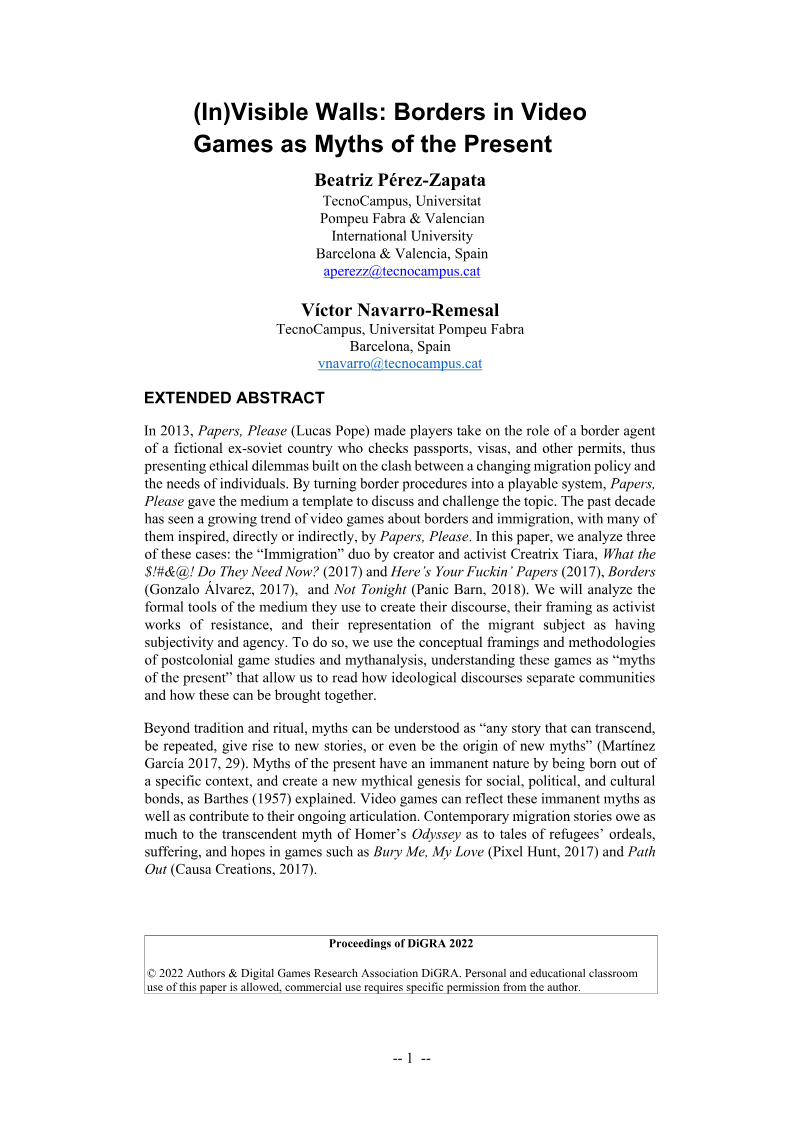
(In)Visible Walls: Borders in Video Games as Myths of the Present
This paper examines how video games about borders and migration function as contemporary "myths of the present," using postcolonial game studies and mythanalysis as its analytical framework.
- The paper uses postcolonial game studies and mythanalysis to argue that border and migration video games function as contemporary "myths of the present" that both reflect and actively shape social and political bonds.
- Its starting point is Papers, Please (2013), which turned border procedures into a playable system and inspired a growing body of games about immigration.
- The authors analyse three works in depth: Creatrix Tiara's "Immigration" pieces, Gonzalo Álvarez's Borders (2017), and Not Tonight (Panic Barn, 2018), the last set against the backdrop of Brexit.
DiGRAJan 2022