God of War II
Game
2 documents in the library are about God of War II, from writers such as DiGRA and Singapore-MIT GAMBIT Game Lab. Each has a summary and key insights with the page they come from.
Connections
Each row is a game or company named alongside God of War II, each column a document, oldest first. A mark means that document names it. Select a row to see those documents.
Documents about God of War II
Experiential Metaphors in Abstract Games
Jason Begy's "Experiential Metaphors in Abstract Games" argues that abstract games, which lack obvious representational "aboutness," can nonetheless be interpreted through experiential metaphor.
- Begy argues that abstract games, whose objects function as symbols rather than icons (e.g., Go and Rod Humble's The Marriage, versus the largely iconic Chess), can still carry meaning through experiential metaphor, a cognitive form of structural metaphor grounded in the player's lived experience of play.
- Meaning emerges when players map the affective texture of gameplay (tension, relief, panic) onto other experiences, relying on image schemata and systemic correlations within a game's formal properties.
- Both metaphor and simulation amplify some aspects of their source while masking others, so any interpretation depends on what a game emphasizes or omits.
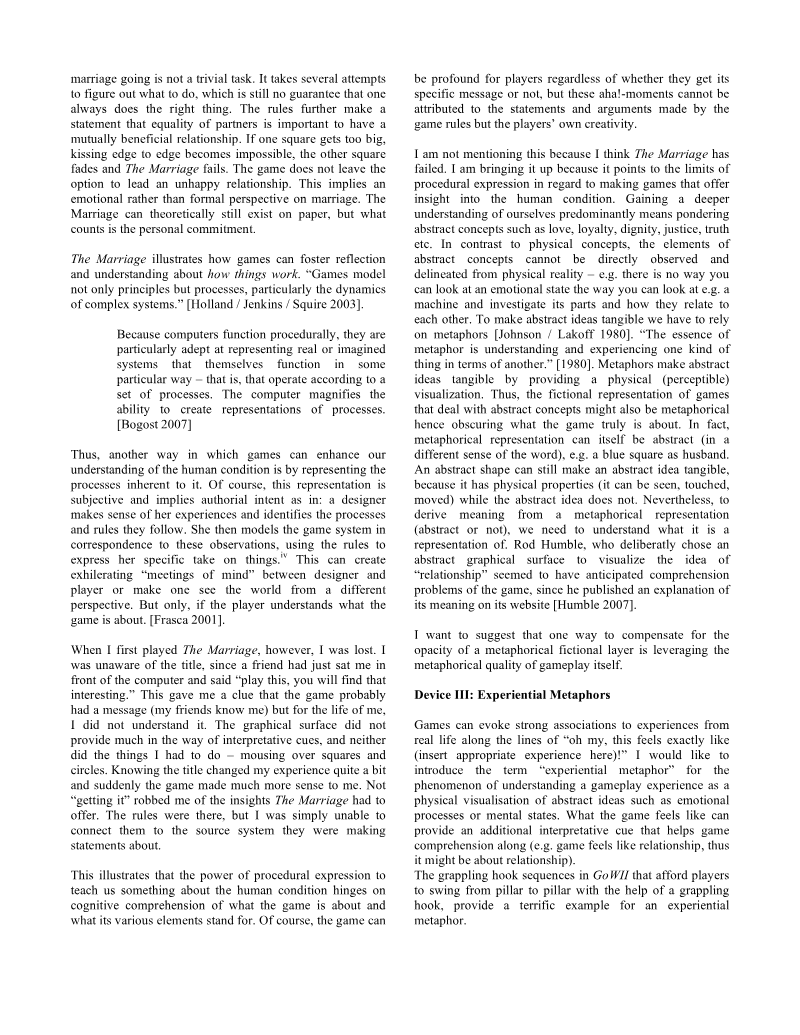
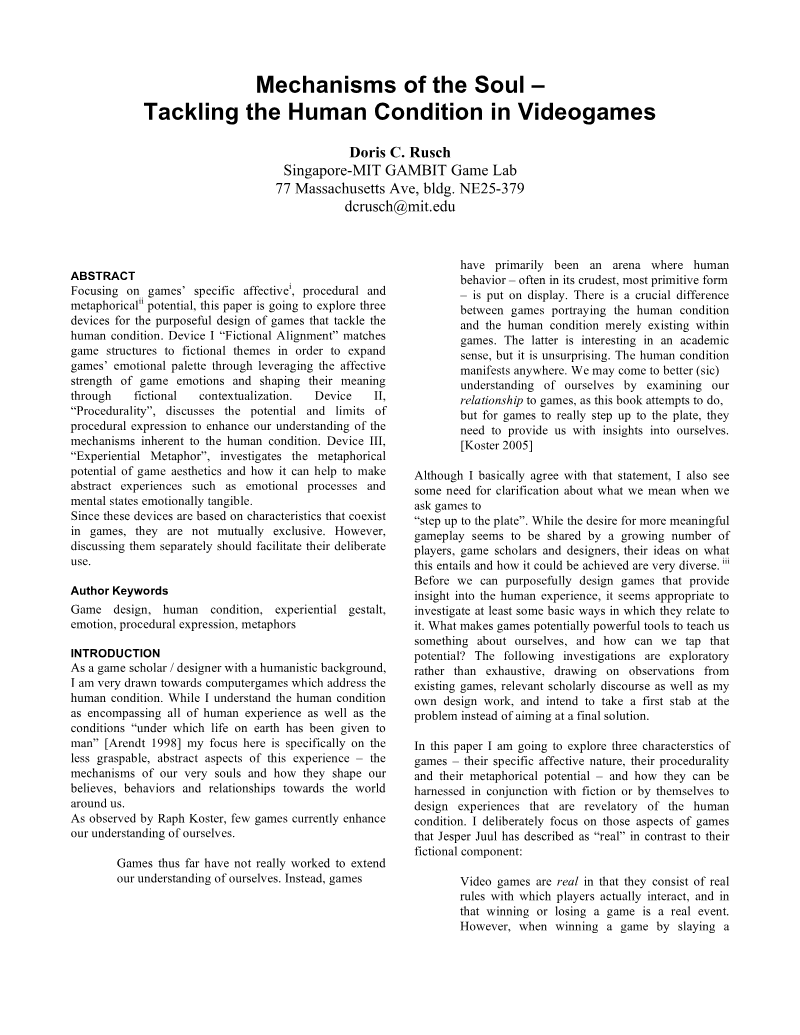
Mechanisms of the Soul: Tackling the Human Condition in Videogames
"Mechanisms of the Soul: Tackling the Human Condition in Videogames" by Doris C. Rusch argues that games are uniquely equipped to convey insights into the human condition, and that their greatest affective power lies in their rules and player-driven activity rather than in fiction alone.
- Games can convey insights into the human condition, and their greatest affective power lies in their rules and player-driven activity rather than in fiction alone.
- Fictional Alignment pairs game mechanics with narrative so that emotions produced by play and emotions depicted in the story reinforce one another, as in God of War II, where mechanics and cutscenes together make Kratos's shame, anger, and yearning for revenge tangible to the player.
- Procedurality, where a game's underlying systems model aspects of experience, succeeds only when players cognitively grasp what the game is modeling, as shown by the grappling-hook sequences and Rod Humble's The Marriage.