1 free read left. Create a free account for unlimited reading + AI research.
Create free accountArticle European Conference on Games Based Learning (ECGBL)
1 free read left. Create a free account for unlimited reading + AI research.
Create free accountArticleEuropean Conference on Games Based Learning (ECGBL)
Wealth Creation is a board game developed by researchers at Kasetsart University in Thailand. Its educational goals are grounded in the national curriculum and local cost-of-living realities.
"Wealth Creation" is a board game designed to strengthen financial literacy among high school students, developed by researchers at Kasetsart University in Thailand. The authors argue that while financial literacy is increasingly essential, classroom instruction remains central to building it, and that simulation games can cultivate sound financial decision-making when grounded in the national curriculum and local cost-of-living realities. The game challenges players to build wealth through income, investment, and asset trading across four life-stage rounds, using resource management, open drafting, random events, and loans. The authors contend that popular commercial games such as Monopoly and Cashflow 101 were built primarily for entertainment rather than classroom learning, which motivated the design of a game with explicit educational objectives.
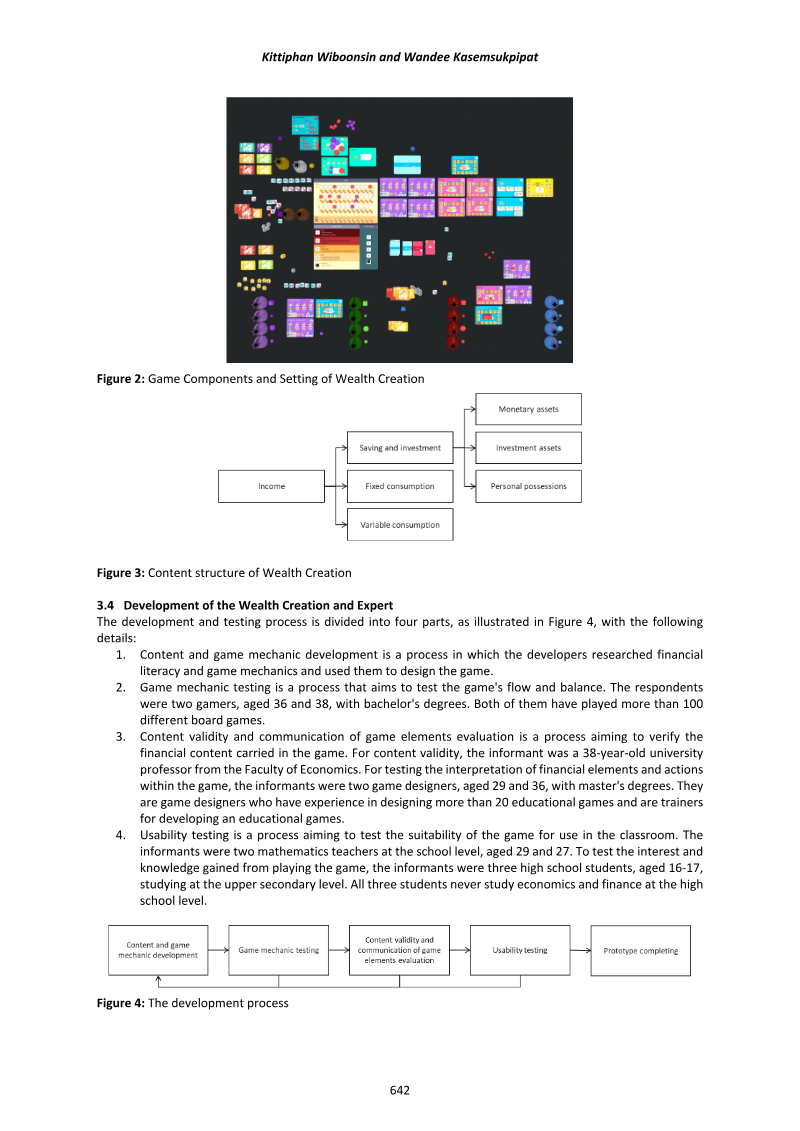
The development process was iterative and involved gamers, content experts, game designers, teachers, and three students aged 16 to 17. Early playtesting revealed several problems: unclear messaging, confusing price-movement symbols, and an exploit in which borrowing to invest could guarantee victory. The game also proved too easy to win, prompting adjustments to payouts and the expansion of income and asset options. Subsequent student testing indicated that the game effectively conveyed concepts including investment returns, asset liquidity, and insurance, and that students applied ratios and percentages to justify their investment decisions, suggesting genuine analytical engagement with the material.
The study's conclusions are tempered by notable constraints. Because development and testing took place during the pandemic, expert evaluations were conducted online and only audio data could be recorded, limiting analysis of players' facial expressions and emotional responses. The authors plan broader trials involving students with no prior board game experience and students from low-income households, followed by further refinement and the creation of manuals, lesson plans, and classroom materials to support teachers in implementing the game.



European Conference on Games Based Learning (ECGBL) · 2026



European Conference on Games Based Learning (ECGBL) · 2026



European Conference on Games Based Learning (ECGBL) · 2026



European Conference on Games Based Learning (ECGBL) · 2026



European Conference on Games Based Learning (ECGBL) · 2026



European Conference on Games Based Learning (ECGBL) · 2026



European Conference on Games Based Learning (ECGBL) · 2026



European Conference on Games Based Learning (ECGBL) · 2026



European Conference on Games Based Learning (ECGBL) · 2026



European Conference on Games Based Learning (ECGBL) · 2026



European Conference on Games Based Learning (ECGBL) · 2026



European Conference on Games Based Learning (ECGBL) · 2026
European Conference on Games Based Learning (ECGBL) · 2023