
Updated Mar 17, 2026 by Newzoo
Report · January 1, 2022
Published by Newzoo
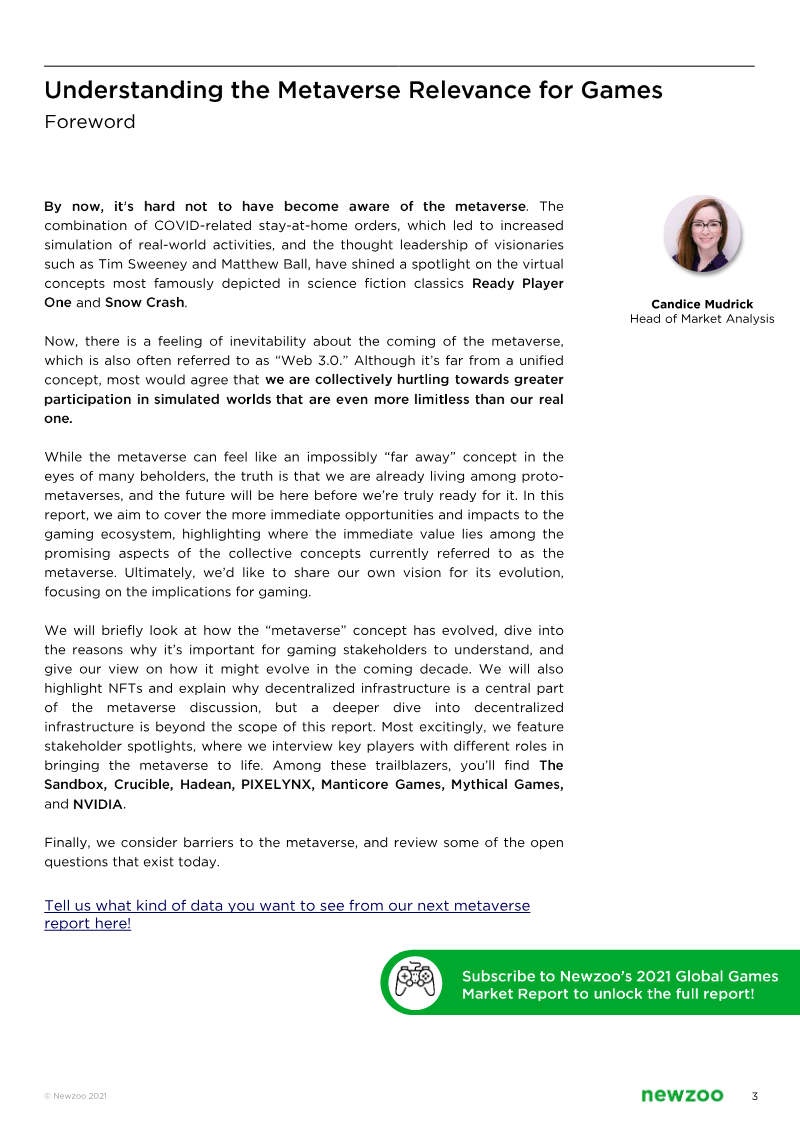
The virtual reality market is entering a period of significant expansion, with the global active hardware install base projected to reach 46 million units by 2024. This growth, characterized by a 42% compound annual growth rate, is primarily fueled by the rise of standalone headsets like the Meta Quest 2 and the release of high-quality software titles. While high-fidelity experiences still rely on PC-based hardware, the shift toward accessible, standalone devices has broadened the consumer base. Gaming remains the central pillar of the ecosystem, as 72% of headset owners identify it as their primary use case, and nearly 60% of users engage with their devices weekly. Demographically, the VR audience consists largely of high-earning, tech-savvy males who prioritize immersion and social interaction. Popular genres such as adventure, shooters, and simulation dominate the landscape, mirroring traditional gaming trends, while survival horror and high fantasy themes capitalize on the unique immersive capabilities of the medium. The market is also seeing a diversification of content, with a balance between VR-exclusive titles and integrated experiences that offer VR support alongside traditional play modes. The industry is maturing into a financially sustainable ecosystem through the adoption of hybridized monetization models, including downloadable content, subscriptions, and in-game transactions. Major investments from industry leaders like Meta, Sony, and Pico are driving the development of high-profile intellectual properties. Furthermore, the utility of VR is expanding beyond entertainment into social metaverse platforms and enterprise applications in healthcare, education, and manufacturing. This cross-sector growth is supported by the increasing versatility of 3D game engines, positioning VR as a critical technology for both consumer escapism and industrial innovation.
An Overview and Outlook of Virtual Reality in Games and Beyond Newzoo Trend Report 2022
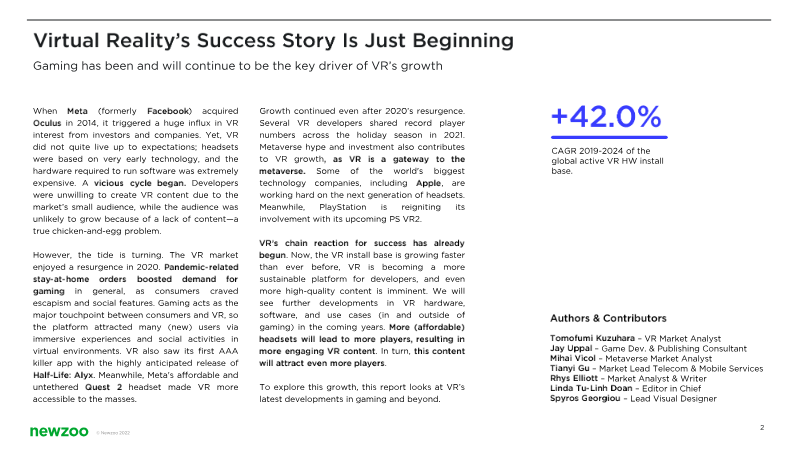
© Newzoo 2022 Growth continued even after 2020’s resurgence. Several VR developers shared record player numbers across the holiday season in 2021. Metaverse hype and investment also contributes to VR growth Some of the world's biggest technology companies, including , are working hard on the next generation of headsets. Meanwhile, PlayStation is reigniting its involvement with its upcoming PS VR2. . Now, the VR install base is growing faster than ever before, VR is becoming a more sustainable platform for developers, and even more high-quality content is imminent. We will see further developments in VR hardware, software, and use cases (in and outside of gaming) in the coming years. . In turn, . To explore this growth, this report looks at VR’s latest developments in gaming and beyond. When (formerly ) acquired in 2014, it triggered a huge influx in VR interest from investors and companies. Yet, VR did not quite live up to expectations; headsets were based on very early technology, and the hardware required to run software was extremely expensive. A Developers were unwilling to create VR content due to the market’s small audience, while the audience was unlikely to grow because of a lack of content—a true chicken-and-egg problem. However, the tide is turning. The VR market enjoyed a resurgence in 2020. in general, as consumers craved escapism and social features. Gaming acts as the major touchpoint between consumers and VR, so the platform attracted many (new) users via immersive experiences and social activities in virtual environments. VR also saw its first AAA killer app with the highly anticipated release of . Meanwhile, Meta's affordable and untethered headset made VR more accessible to the masses. Gaming has been and will continue to be the key driver of VR’s growth CAGR 2019-2024 of the global active VR HW install base. 2 – VR Market Analyst – Game Dev. & Publishing Consultant – Metaverse Market Analyst – Market Lead Telecom & Mobile Services – Market Analyst & Writer – Editor in Chief – Lead Visual Designer
Ecosystem Infographics 7 Active VR Install Base & VR Game Revenues 8 Top 100 VR Game Analysis 16 VR Headsets Overview & Case Studies on VR Games 19 VR Game Development 26 VR Hardware & Peripheral, VR Technologies 27 VR Gaming 32 The Metaverse 35
© Newzoo 2022 z XR is a term that encompasses any technology that alters reality by adding digital elements into a physical or real-world environment to any extent. It refers to any technology that blurs the lines between the physical and the digital worlds. Currently, the term XR encompasses all of VR, MR, and AR technologies. The computer-generated simulation of a three-dimensional image or environment that users can interact with in a seemingly real or physical way via special electronic equipment, such as a headset with an internal screen or controllers/gloves fitted with sensors. MR connects physical and digital worlds, using sensory and imaging technologies. The blended world allows users to interact with physical items, digital items, and environments using their own hands. All of this happens while wearing a headset. The number of directions of users' positional tracking in VR. The positional tracking relies on built-in or external sensors to capture movement. While 3DoF tracking only measures three types of directional rotation (rolling, pitching, and yawing), 6DoF adds three further directional movements (elevating, strafing, and surging), allowing players to physically move around in a virtual space rather than simply standing in one spot. VR-only games refer to VR games/apps that can only be played through VR (e.g., Half- Life: Alyx, Beat Saber). VR-Integrated games refer to VR games/apps that can be played outside and inside VR devices (e.g., Resident Evil 7, Star Wars: Squadrons). 4 (P7) • Manufacturers of consumer VR headsets, that are capable of 6DoF positional tracking and are required for consumers to engage with VR games. • Content distribution platforms that offer players easy access to VR games. Platforms include the Meta Quest Store, Steam, and the PlayStation Store. • Manufacturers of peripherals that provide haptics and/or enhance user immersion in the consumer VR gaming experience (excl. location-based VR). These peripherals include, for example, controllers, haptic gloves, full-body tracking suits, and treadmills. • Gamified virtual spaces whose core focus is meaningful player interaction and socializing, rather than on traditional gaming experiences. • Studios that are responsible for planning, developing, and releasing VR games and apps to consumers. • Tools and services that enable and support the development of VR games and apps. They range from game engines like Unreal Engine or Unity, which support the development of VR games/apps, to computer graphics software applications like Blender, which are used to model and simplify the planning and development processes of VR game/app development. • Cloud services and infrastructure that aim to increase access via cloud to high-end VR titles without requiring users to purchase the latest and most expensive VR devices. These technologies should theoretically enable players to stream high-fidelity PC VR-level games onto their standalone VR headsets through their internet connection. • Providers and manufacturers of the key hardware components that allow a VR headset to function by properly processing and executing commands. These include Qualcomm's Snapdragon CPU chipset (found in every Meta Quest headset), Intel’s processing cores, and NVIDIA’s GPUs for PC VR. A definition of the key terms used in the VR market
© Newzoo 2022 The methodology behind Newzoo’s active VR hardware install base & VR games revenues First, Newzoo’s VR market-sizing scope covers and . Therefore, we that can also be also used to play VR games. Degrees of Freedom (DoF) refers to the number of directions of users' positional tracking in VR. The positional tracking relies on built-in or external sensors to capture movement. While 3DoF tracking only measures three types of directional rotation (rolling, pitching, and yawing), 6DoF adds three further directional movements (elevating, strafing, and surging), allowing players to physically move around in a virtual space rather than simply standing in one spot. We believe that 6DoF is essential for immersive VR gaming experiences. Therefore, we ; for example, all smartphone-based VR headsets (Samsung Gear VR, Google Daydream, and Cardboard) and entry-level standalone headsets such as Oculus Go. Our definition of at the end of each year. This means that we . For example, if an Oculus Rift owner purchased a Meta Quest 2 in 2020, the Oculus Rift would not be counted as an active install base if the owner did not play the Oculus Rift in 2021. Furthermore, in order to count headsets as part of the active install base, headsets need to be produced by manufacturers, shipped by the manufacturers to retailers, sold by the retailers to consumers, and activated/played by the consumers. This that some research firms use for reporting. We categorize consumer VR headsets into the following : , , and . PC VR includes consumer VR headsets that require a VR-ready PC to run software, such as the and . Examples of standalone VR include the and , which do not necessarily require a PC or connecting the headset to a PC to play games. Lastly, our forecasts only include potential successors of existing brands and works confirmed or hinted at by new brands or suppliers. Both the new entry of game- changing headsets (brands) and introductions of high specs with aggressive prices could easily affect the market situation. To that end, Newzoo will continue monitoring the market closely and reflect the latest developments into our forecasts at the best possible time. 5
© Newzoo 2022 Ecosystem and market sizing
The global virtual reality market is undergoing a significant resurgence, transitioning from a niche hardware segment into a sustainable ecosystem. This evolution is primarily driven by the proliferation of affordable standalone 6DoF devices, such as the Meta Quest and Pico 4, which have lowered barriers to entry for mainstream consumers. While these standalone units may lack the raw performance of high-end PC VR setups, their accessibility has catalyzed rapid growth in the active install base. Data indicates that nearly 60% of VR gamers engage with their headsets at least once a week, signaling high retention and a shift toward consistent usage patterns. Gaming remains the primary gateway for consumer adoption, bolstered by the emergence of high-quality "killer apps" and the popularity of adventure and shooter genres. The market is also seeing a shift toward hybrid monetization models, including downloadable content and subscriptions, alongside an increase in social and fitness-oriented virtual environments. Beyond entertainment, VR technology is becoming increasingly essential for industrial applications. Powerful 3D engines like Unreal and Unity are facilitating the expansion of immersive technology into healthcare simulations, remote architectural planning, and education. The global active VR hardware install base is projected to reach 46 million units by the end of 2024, reflecting a compound annual growth rate of 42.0% since 2019. This sustained momentum is supported by continuous advancements in motion tracking and haptic feedback, as well as substantial investments from major software and hardware firms. As the technology matures, the integration of VR into both consumer lifestyles and professional workflows suggests a long-term trajectory toward widespread cross-industry utility.
The global games market is projected to generate $175.8 billion in 2021, representing a marginal 1.1% year-on-year decline. This temporary contraction is primarily driven by pandemic-related supply chain disruptions, hardware shortages, and significant delays in AAA game releases, which have disproportionately impacted the console and PC segments. Despite these challenges, mobile gaming continues to expand, accounting for $90.7$ billion or 51% of total market revenue. The Asia-Pacific region remains the dominant force in the industry, contributing over half of all global revenue and supporting 55% of the world’s three billion players. The long-term outlook for the industry remains robust, with total revenues expected to surpass $218 billion by 2024. This growth is fueled by the permanent acceleration of the metaverse trend, which has transitioned video games from mere entertainment products into essential social hubs. This shift has revitalized the virtual reality sector, particularly following the commercial success of the Oculus Quest 2, and has spurred a wave of consolidation through high-profile mergers and acquisitions. While privacy changes such as the removal of Apple’s IDFA present new hurdles for mobile marketing, the segment’s 4.4% growth indicates continued resilience. Strategic decision-making in this evolving landscape relies on granular performance metrics and consumer insights across dozens of global markets. By tracking key performance indicators such as monthly active users and retention rates for thousands of titles, stakeholders can navigate the complexities of game development and transaction advisory. Ultimately, the integration of social connectivity, immersive hardware, and mobile accessibility ensures that the gaming industry will continue its upward trajectory beyond the immediate disruptions of the early 2020s.
The global games market entered a corrective phase in 2022, with annual revenues projected to decline by 4.3% to $184.4 billion. This contraction follows a period of unsustainable pandemic-driven expansion and is further exacerbated by macroeconomic inflation, supply chain disruptions, and a sparse release schedule for major titles. Despite this short-term dip, the industry maintains a massive engagement base of 3.2 billion players and is expected to resume an upward trajectory, reaching an estimated $211.2 billion by 2025. While mature markets like North America and Asia-Pacific are experiencing revenue declines, emerging mobile-first regions such as Latin America and the Middle East & Africa continue to show positive growth. The industry is currently undergoing a structural shift toward platform-agnostic ecosystems and hybrid monetization strategies. As traditional mobile advertising faces challenges from privacy policy changes like Apple’s IDFA, console and PC developers are increasingly adopting programmatic in-game advertising to monetize the hundreds of millions of players who do not make direct purchases. This shift is supported by major platform holders like Sony and Microsoft, who are integrating non-intrusive, blended advertisements to create recurring revenue streams. Furthermore, the rise of user-generated content, cloud gaming, and blockchain-based models is redefining how players interact with and derive value from digital environments. Future market stability is increasingly tied to ecosystem-based analysis rather than hardware-specific metrics, reflecting a broader trend of cross-platform play and industry consolidation. Regulatory shifts in China have also prompted a strategic pivot toward global expansion in other emerging markets. As the industry evolves, success will likely depend on balancing diverse monetization models with authentic player experiences, while leveraging new technologies in virtual reality and cloud infrastructure to maintain long-term engagement across a diversifying global audience.
The metaverse represents the evolution of gaming from a service into a persistent, infinitely scaling platform characterized by social interaction, user-generated content, and functioning economies. Driven by technological advancements and the social shifts of the COVID-19 era, virtual spaces now host non-gaming activities like concerts and brand activations that attract tens of millions of participants. This transition is supported by a highly receptive consumer base, with 70% of gamers expecting these social hubs to increase their playtime. The industry is moving toward a direct-to-avatar economy where digital identity and creator-led markets are central to engagement across platforms like Roblox, Fortnite, and Avakin Life. Blockchain technology serves as a primary catalyst for this shift, enabling decentralized economies and play-to-earn models that provide players with true digital ownership. While current hurdles include high transaction fees and environmental concerns associated with early NFT models, the sector is transitioning toward scalable, green solutions like Layer 2 protocols. Establishing interoperable digital identities and seamless marketplaces is essential for aligning the economic interests of developers and creators. Furthermore, the move toward Web 3.0 requires a shift in the digital supply chain toward player-owned assets and open standards, such as Pixar’s Universal Scene Description, to ensure cross-platform collaboration. Despite this momentum, significant structural and technical challenges remain. Achieving massive concurrency—moving beyond sharded instances to thousands of users in a single persistent world—requires cloud-native infrastructure and radical improvements in network protocols. Additionally, the industry must navigate regional fragmentation caused by government regulations and the need for modernized IP laws. Ethical risks, including deepfakes, unmoderated content, and identity theft, necessitate a focus on safety and open standards. Ultimately, the games industry is positioned to lead the development of a mobile-accessible, community-driven metaverse that complements physical reality through democratized monetization and high-fidelity digital twins.