Related Documents



Report
The Golden Age of Video Game Remakes and Remasters
The video game industry has entered a definitive era of remakes and remasters, fueled by a risk-averse development climate and the significant purchasing power of nostalgic Millennial consumers. These projects serve as a strategic hedge against the rising costs of original intellectual property, allowing developers to re-engage dormant fanbases while attracting new audiences through modernized graphics and gameplay. Success in this sector depends heavily on timing and the specific nature of the renewal. Remasters perform most effectively when released within five years of an original title to capitalize on hardware transitions. Conversely, full remakes require a longer gestation period, typically between nine and twenty-five years, to ensure that technological advancements are substantial enough to justify a full-price purchase. Effective remakes must strike a delicate balance between preservation and modernization. Developers are encouraged to maintain the core essence and iconic moments of a title—such as specific art styles or dialogue—while aggressively updating outdated mechanics like quick-time events. Leveraging contemporary hardware capabilities, such as 3D audio and advanced rendering, is essential for meeting modern player expectations. By aligning these updates with a clear vision for modernization, studios can successfully bridge the gap between historical authenticity and current industry standards. This 2024 analysis provides a comprehensive overview of the global gaming landscape, focusing on the strategic advantages of revitalizing established franchises. While the findings highlight clear pathways to commercial success through market-tested IPs, the data is intended for informational purposes and reflects the broader trends shaping the current development cycle. Ultimately, the strategic deployment of remakes and remasters reduces financial volatility for studios while ensuring that classic gaming experiences remain accessible and relevant in a rapidly evolving technological environment.
VirtuosMar 2024


Report
Is the Past the Future of Gaming?
Remakes and remasters have become a cornerstone of the video‑game market, now generating roughly two hundred releases each year and projected to reach about thirty titles in 2025. Their commercial performance consistently exceeds that of the original versions, exemplified by the Resident Evil 4 remake, which sold ten million copies within two years of launch, and the continued success of other high‑profile updates such as the Crash series. This growth reflects a broader industry shift toward leveraging established intellectual property to secure reliable revenue streams. A survey of 1,500 gamers identifies nostalgia as the dominant motivator for purchasing these updated titles, with more than eighty percent seeking the emotional comfort of revisiting familiar experiences. Seventy‑one percent view remakes as a means to introduce classic games to younger players, while between sixty‑seven and eighty‑five percent appreciate the opportunity to discover titles they missed originally. Players also demand contemporary enhancements, ranking higher‑resolution textures, smoother animation, improved lighting, remappable controls, and bug fixes as essential. Nevertheless, the audience is split: roughly thirty‑five percent each prefer strict fidelity to the original or the freedom to alter narrative and gameplay, highlighting a tension between preservationist and innovation‑leaning attitudes. Pricing expectations reveal a nuanced market perspective. Nearly half of respondents anticipate remakes to be priced slightly below new releases, while a quarter are comfortable with parity, twenty percent expect a more substantial discount, and a small segment seeks free or bundled options. These preferences shape release strategies, with developers balancing cost, value perception, and the timing of launches to maximize appeal. While nostalgia‑driven updates can boost sales, an overreliance on remakes risks dampening creative innovation. Gamers express a clear desire for a blend of faithful revisions and fresh original IP, suggesting that sustainable growth will depend on integrating modern improvements with new, inventive experiences across the global gaming landscape.
MTMJan 2025
Financial
Remedy Entertainment Annual Report 2024
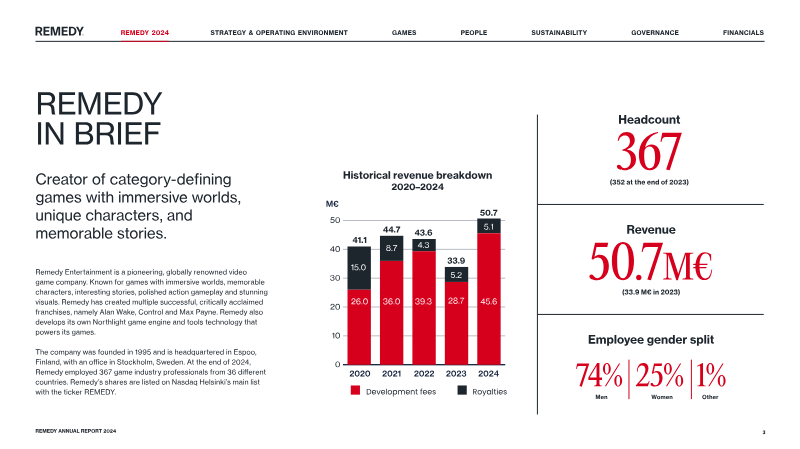
Remedy Entertainment achieved a significant financial turnaround in 2024, with revenue growing 49.3% to €50.7 million and EBITDA improving to €2.5 million. This recovery was driven largely by the commercial success of Alan Wake 2, which surpassed 2 million units sold and fully recouped its development and marketing costs. The company is currently executing a major strategic shift toward a self-publishing model for its owned intellectual properties, a move bolstered by reacquiring the full rights to the Control franchise and securing strategic financing through a partnership with Annapurna and a convertible loan from Tencent. The long-term strategy for 2025–2030 aims to double 2024 revenue by 2027 while achieving a 30% EBITDA margin. To reach these targets, the studio is focusing on a disciplined production pipeline managed through a six-stage gate process. Key upcoming projects include the multiplayer spin-off FBC: Firebreak, budgeted at €30 million, and Control 2, budgeted at €50 million. Both titles are scheduled to enter full production by early 2025. Additionally, the Max Payne 1&2 remake, fully funded by Rockstar Games, moved into full production at the end of 2024. Operating primarily from Finland with a global reach, the studio grew its headcount to 367 employees to support its portfolio of four major projects. Beyond game development, the partnership with Annapurna is designed to expand the Alan Wake and Control franchises into film and television, evolving these IPs into world-class brands. This expansion occurs within a global games market projected to reach $213.3 billion by 2027, positioning the studio to maximize royalty potential and commercial alignment through its new self-publishing capabilities and steady release cadence.
Remedy EntertainmentMar 2025



Report
The Game Development Renaissance
The global game development industry is undergoing a fundamental transition toward a more sustainable and efficient operational model, moving away from volatile hiring cycles in favor of long-term stability. With the market projected to reach $190 billion by 2025, industry leaders express significant optimism, as 77% of developers anticipate continued growth and a marked reduction in workforce instability. This evolution is characterized by a strategic shift toward leaner production cycles where studios prioritize creative intellectual property over the maintenance of internal technical infrastructure. Central to this transformation is the widespread adoption of externalized technology and third-party backend services. While only 6% of developers intend to rely on internal builds in 2025, nearly half plan to integrate specialized third-party tools to manage complex requirements such as cross-platform synchronization and unified player inventories. By outsourcing non-core technical burdens, studios can accelerate time-to-market and mitigate the financial risks associated with building bespoke systems. This shift enables a deeper focus on LiveOps and "forever game" models, which are increasingly viewed as the primary drivers of player lifetime value and long-term revenue. Furthermore, the industry is diversifying its financial and distributional strategies to bypass traditional gatekeepers. Developers are increasingly leveraging alternative funding sources, such as crowdfunding, and utilizing direct-to-consumer webshops to avoid high app store fees. As studios embrace sophisticated metagames and personalized engagement strategies, the integration of cross-platform capabilities and web-based distribution is becoming a strategic necessity. This new paradigm emphasizes technical agility and creative innovation, positioning the industry for a period of disciplined, technology-driven expansion.
MetaplayJan 2025