Country & Regional Reports·Updated Apr 30, 2026 by Niko
What can I help with?
AI-powered answers with citations from the library.
What can I help with?
AI-powered answers with citations from the library.
Report · January 1, 2025
Published by Niko
The Chinese mobile gaming market is currently undergoing a significant shift in distribution dynamics as developers increasingly challenge the traditional 50% take rates imposed by domestic Android app stores. While global discourse remains focused on the 30% take rate standard contested in the Epic v. Apple litigation, Chinese developers face a more restrictive domestic environment where smartphone manufacturers and major tech firms consolidate power through the Mobile Hardcore Alliance and the Global Developer Service Alliance. These entities justify high fees by providing integrated marketing and distribution services, yet these costs have become a primary point of contention for major studios. To circumvent these high fees, prominent developers such as miHoYo, Lilith Games, and NetEase are increasingly adopting direct-to-consumer distribution models. By leveraging high-quality intellectual property, substantial marketing budgets, and community-driven platforms like TapTap and Bilibili, these studios can bypass traditional stores entirely. This strategy allows developers to retain significantly higher gross profit margins—often exceeding 95%—compared to the 50% margin typically realized through standard distribution channels. The success of these titles has begun to force concessions, as evidenced by Xiaomi offering reduced take rates to high-profile games like Genshin Impact. The industry landscape is bifurcated, as smaller developers often remain dependent on traditional stores for the reach and infrastructure necessary to sustain their operations, viewing the 50% fee as an acceptable cost of doing business. However, the rise of direct distribution and community-centric marketing signals a broader trend where quality content and brand loyalty are becoming more influential than traditional store placement. As developers continue to prioritize direct engagement and alternative platforms, the dominance of traditional Android app stores in China faces mounting pressure, potentially reshaping the economic model of the global mobile gaming industry.
Take Rates in China – Will Quality Development Beat Out Traditional Distribution? Epic v. Apple Sets the Stage for Developers Evaluating High Take Rates in China Apple charges 30% of every transaction that takes place in apps distributed through the App Store, worldwide. China App Store is no exception. In 2020 Epic Games challenged this “standard” in an anti-trust case that has received wide recognition in the West. Epic says that the 30% “take rate” is too high and wants to offer its own store on iOS as an alternative. The Epic Games Store, currently available on PC, charges a 12% take rate to third-party developers who distribute via that store. Epic says that it only costs them around 5% to process payments, 1% for the CDN bandwidth and 1% for other costs, which means the total cost per transaction is only around 7%. Epic takes roughly 5% profit on top, while Apple takes approximately 23% profit, assuming the costs are equivalent. Notably, 28 Chinese app developers filed a complaint against Apple in 2017 for its abuse of market power which included removing apps and charging a high take rate for in-app purchases. Apple has a significant market share globally and roughly 25% of Chinese gamers play games on iOS smartphones. Chinese iOS gamers generally spend more on games than do Android gamers, with roughly 40% of mobile game revenue from iOS smartphones. Epic could afford the risk of Fortnite getting kicked off the App Store for violating payment policies in protest to the 30% take rates, but smaller developers cannot afford that risk. China Developers Aren’t Challenging Apple, but Look Out Local Android Stores
game revenue from iOS smartphones. Epic could afford the risk of Fortnite getting kicked off the App Store for violating payment policies in protest to the 30% take rates, but smaller developers cannot afford that risk. China Developers Aren’t Challenging Apple, but Look Out Local Android Stores While the media focuses on Epic v Apple, Chinese game developers are starting to challenge domestic Android app stores. This is something not seen in the West, although Google Play, the world’s largest Android app store, also charges a 30% take rate. Android is an open platform and 3rd party stores exist on it, which is not possible with Apple’s closed system. While Epic Games did initially try and bypass Google Play on Android, by distributing the game directly, the company ended up changing course and putting its game on Google Play.
Google Play is not in China. Google services are essentially banned in China. The void is filled by hundreds of Chinese Android app stores, with about 10-20 of them taking the vast majority of market share. Many of these dictate their own take rates, as high as 50%. Some developers tacitly protest that fee, including Lilith Games (Rise of Kingdoms), miHoYo (Genshin Impact), and Giant Interactive (Pascal’s Wager). These games are not distributed through big stores, rather directly from the developer or via platforms that charge lower take rates. Kaeya @Pluto Genshin Impact
Android App Store Ecosystem in China Chinese smartphone manufacturers including Huawei, Oppo and Vivo dominate the domestic Android smartphone market. These three, along with others, formed the Mobile Hardcore Alliance in 2014 to consolidate Android app distribution. Smartphone manufacturers pre-install their own app stores on their branded Android devices and share resources to increase appeal to developers. In 2020 the Global Developer Service Alliance (GDSA) was launched by smartphone manufacturers, including Huawei, Xiaomi, Oppo, and Vivo, to create a joint platform that would allow developers to upload apps and games to all their app stores simultaneously. This is another effort to simplify the disjointed China Android ecosystem and consolidate power with smartphone manufacturers. Smartphone Stores As a result of the proactive approach to recruit apps and distribute them easily, smartphone manufacturers are the dominant force in China’s Android app distribution market. They have pushed out most competition from smaller companies, though large tech firms, such as Tencent and Alibaba, are still competitive. Tencent’s MyApp store is one of the most popular app stores on Android due to its integration with WeChat and distribution of Tencent games. Soon the manufacturers and tech giants determined they could justify charging 50% take rates, by offering integrated services such as distribution across all GDSA partners and marketing services to promote games. App distribution is a profitable business for smartphone manufacturers, which often see low margins on hardware sales.
giants determined they could justify charging 50% take rates, by offering integrated services such as distribution across all GDSA partners and marketing services to promote games. App distribution is a profitable business for smartphone manufacturers, which often see low margins on hardware sales. For example, gross profit margin for Xiaomi’s smartphone sales is just 7.2% while its Internet Services, including app and games distribution, enjoys gross profit of 64.7%. The largest developers have had some success negotiating lower take rates. NetEase was able to negotiate a lower fee for in-app purchases in Fantasy Westward Journey while Tencent was able to negotiate a lower fee for some of its key titles. These are the only two who have publicly said they have done so, but even NetEase has been unable to extend this offer to its newer titles. Game developers have effectively been forced into accepting the 50% take rate on these app stores as it has been the only way to reach a broad audience. If Epic v Apple is causing a harder look at the 30% rate, the 50% rate may be short lived.
2021: Huawei Pokes at Tencent At the beginning of 2021 Niko Partners became aware of a revenue dispute between Huawei and Tencent, with the former removing all Tencent games from its app store due to a disagreement on take rate charges. This dispute was resolved the same day, but it continues to show how more developers are looking to exert their power over traditional app stores to maximise their gross profit margin. One must acknowledge the irony in that example, because Tencent also charges a 50% take rate for apps and games that are distributed through its store yet fought Huawei’s identical rate as unfair. We also became aware of NetEase opting for direct distribution rather than via traditional app stores for one of its newest titles, Yu-Gi-Oh: Duel Links, which was released January 14. Chinese Devs Going Direct NetEase is not the only company opting for direct distribution. Duoyi (Shenwu), Giant Interactive (Battle of Balls), and G-Bits (AskTao) have all dropped from app stores and gone direct to Android gamers. Other examples of developers that are going direct for specific titles are: Hypergryph (Arknights), QC-Play (The Marvellous Snail), Giant Interactive (Pascal’s Wager), Lilith Games (Rise of Kingdoms), and MiHoYo (Genshin Impact).
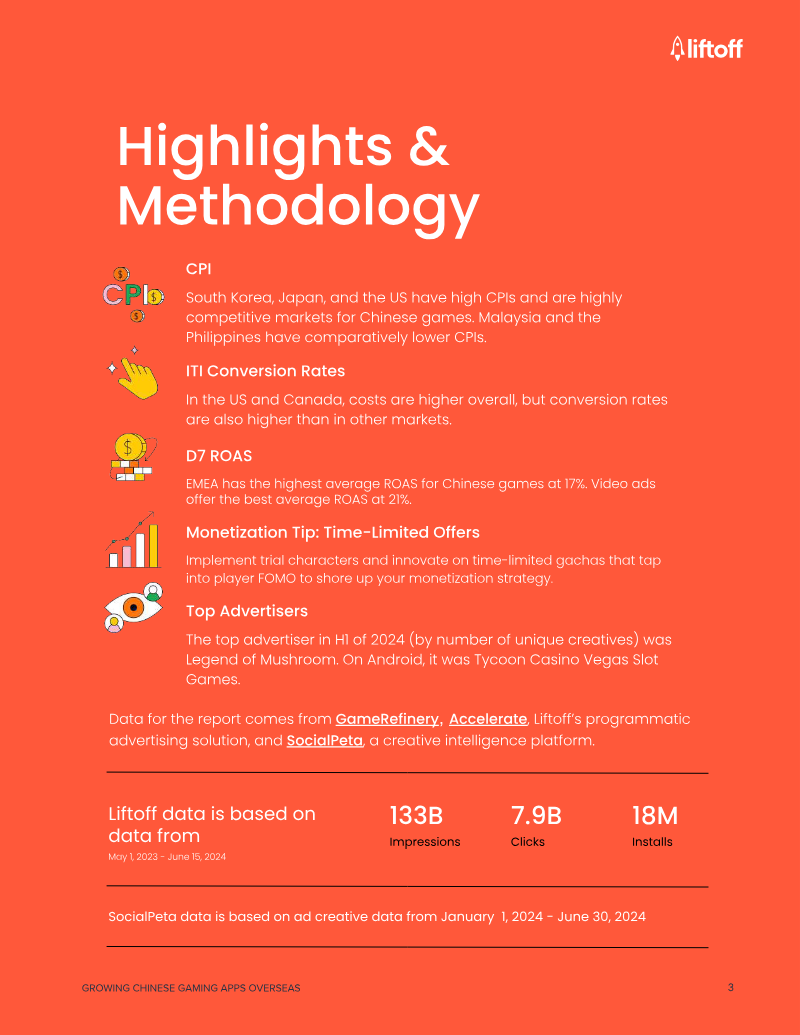
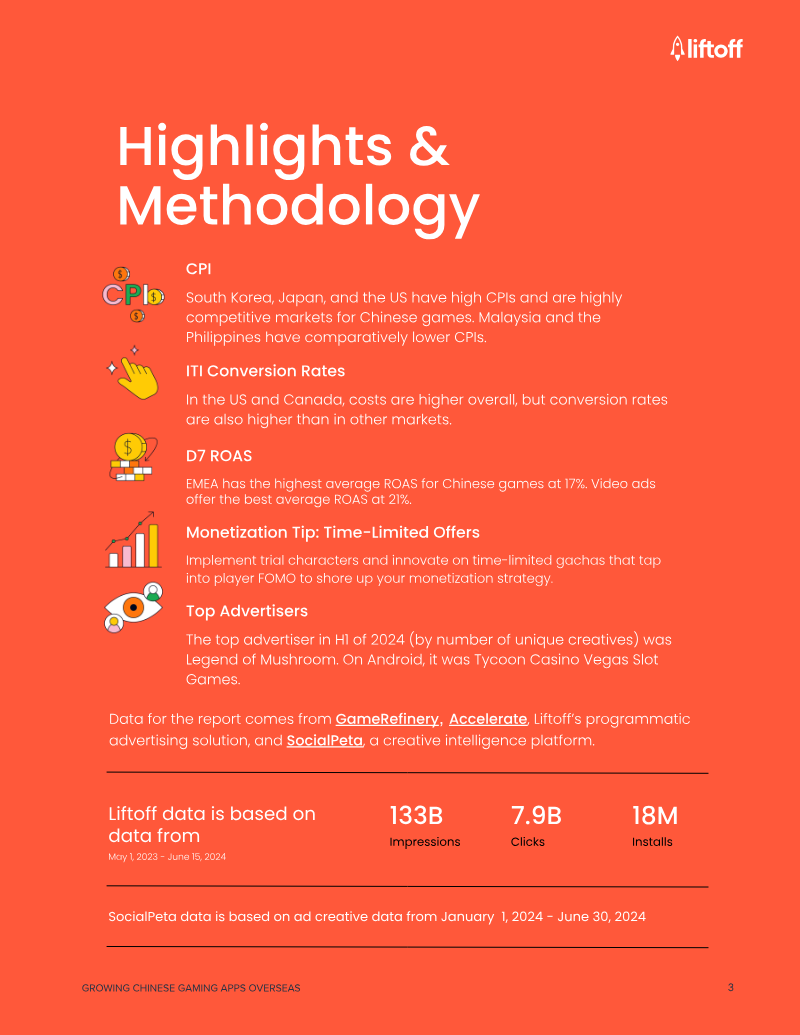
Chinese gaming developers are aggressively expanding their global footprint by leveraging sophisticated monetization models and high-volume, AI-driven marketing strategies. The primary objective for these publishers is to balance the high revenue potential of mature markets like the United States, Japan, and South Korea against the rising costs of user acquisition. By prioritizing video advertising, which currently yields the highest Day 7 return on ad spend at 21%, developers are successfully capturing market share in competitive strategy and RPG segments. Success in these international territories is increasingly predicated on hyper-localization and technological integration. Publishers are utilizing generative AI to streamline the production of localized ad creatives, voice-overs, and performance-tested copy, allowing for rapid iteration and regional customization. Leading titles demonstrate that high-engagement gameplay loops—such as the inclusion of social hangout spaces, customizable home systems, and minigame integrations—are essential for sustaining long-term retention. These efforts are further bolstered by strategic partnerships with local influencers and the implementation of innovative, time-limited gacha mechanics. To maintain consistent growth, developers are diversifying their engagement tactics through gamified live events, including seasonal collections and interactive board-style challenges. These features, combined with trial character systems, allow publishers to cater to varied player motivations while maintaining a steady revenue stream. By synthesizing competitive intelligence with agile content updates, Chinese gaming apps are effectively navigating the complexities of global expansion, ensuring that both monetization and user interest remain high across diverse geographic regions.
Chinese gaming applications continue to exert a dominant influence on the global stage, particularly within the strategy and role-playing game segments in mature markets such as the United States, Japan, and South Korea. While these regions offer substantial revenue potential, they are characterized by intense competition and elevated costs per install. To navigate these challenges, successful publishers are shifting toward hyper-localized strategies that tailor art styles to regional aesthetic preferences—favoring manga-inspired visuals in Japan and realistic or cartoon aesthetics in Western markets—while utilizing local influencers to establish brand credibility. Technological innovation serves as a primary driver for operational efficiency and user acquisition. The integration of generative AI has become essential for the rapid localization of ad creative, voice-overs, and marketing copy, ensuring both speed and brand compliance. High-performing titles currently leverage high-volume, innovative campaigns that incorporate minigames and AI-enhanced visuals to capture player attention. Beyond acquisition, long-term retention is increasingly supported by the implementation of social hangout spaces, home-building systems, and character trial models that balance accessibility with monetization. Monetization strategies have evolved to prioritize engagement through sophisticated, time-limited mechanics. Publishers are frequently employing box gachas, pull-milestone rewards, and gamified event structures such as diceboards and bingo to incentivize spending. Furthermore, the consistent deployment of diverse live events remains a critical requirement for maintaining player interest and competitive viability. By combining these aggressive monetization tactics with a commitment to continuous content updates, Chinese developers are effectively sustaining growth and deepening their footprint across the global gaming landscape throughout 2024.
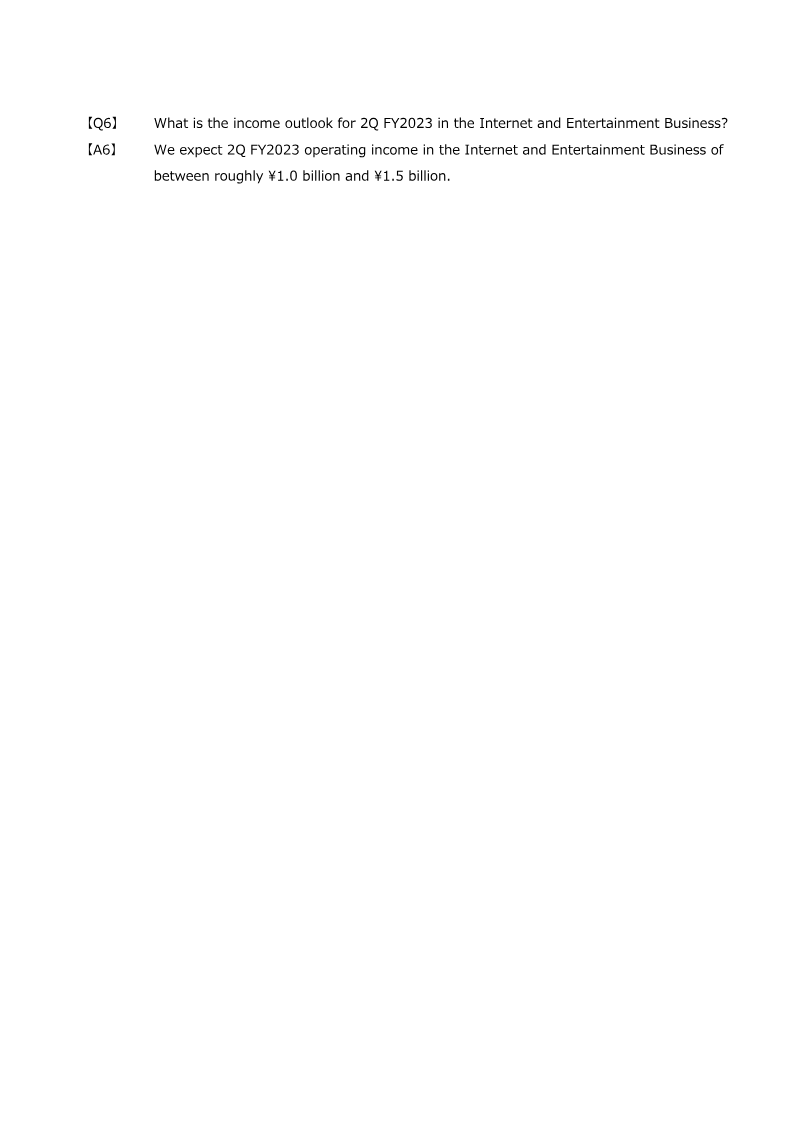
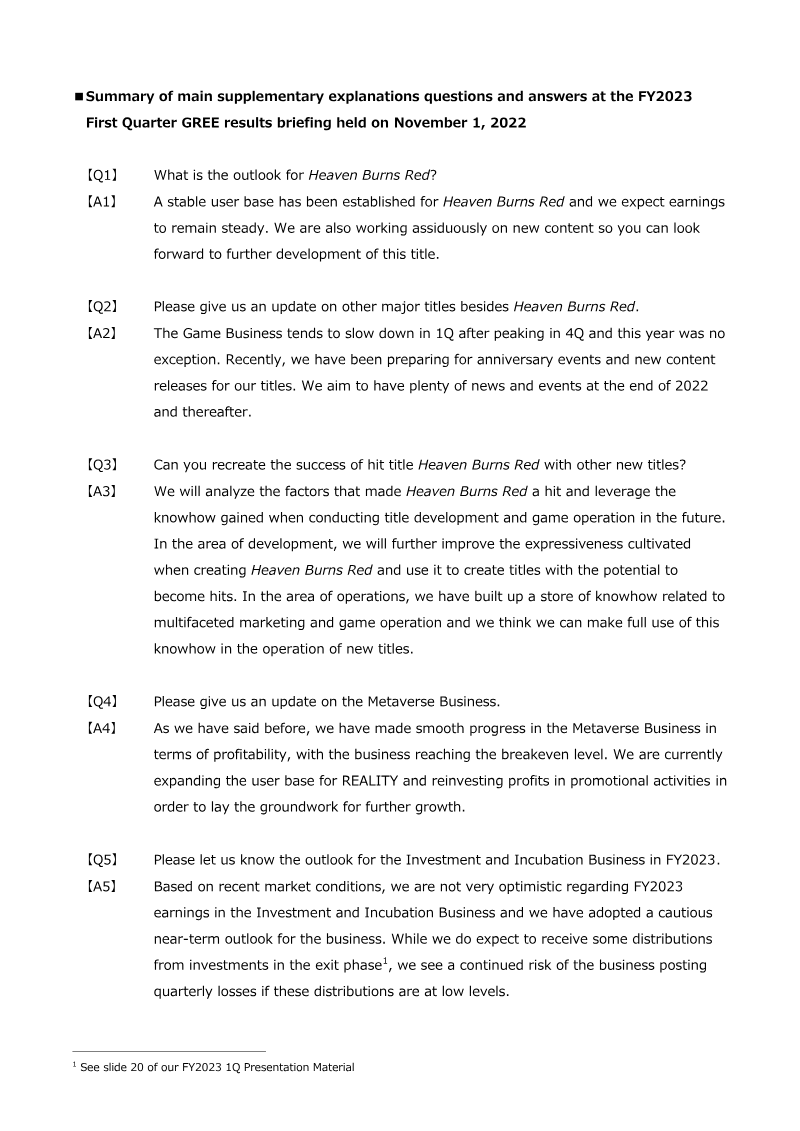
The financial performance for the first quarter of fiscal year 2023 reflects a period of stabilization and strategic reinvestment across key business segments. The game business experienced a typical seasonal slowdown following the fourth-quarter peak, yet maintained a solid foundation through the sustained success of Heaven Burns Red. This title has established a stable user base, and its high level of visual expressiveness and multifaceted marketing approach now serve as the internal benchmark for future development and operational strategies. Management anticipates a recovery in momentum toward the end of the calendar year, driven by planned anniversary events and new content releases. The metaverse business has reached a significant financial milestone by achieving breakeven status. Current efforts are focused on expanding the user base for the REALITY platform, with profits being systematically reinvested into promotional activities to secure long-term growth. In contrast, the outlook for the investment and incubation business remains cautious due to volatile market conditions. While some distributions from investment exits are expected, there is a recognized risk of quarterly losses if these distributions fail to offset operational costs, leading to a conservative earnings forecast for this segment in the near term. Projected operating income for the internet and entertainment business in the second quarter is estimated to fall between 1.0 billion and 1.5 billion yen. This guidance accounts for the ongoing transition of the game portfolio and the deliberate reinvestment strategy within the metaverse sector. Overall, the strategy emphasizes leveraging the technical and operational know-how gained from recent hits to ensure the scalability of upcoming titles while maintaining a disciplined approach to emerging business segments and venture investments.
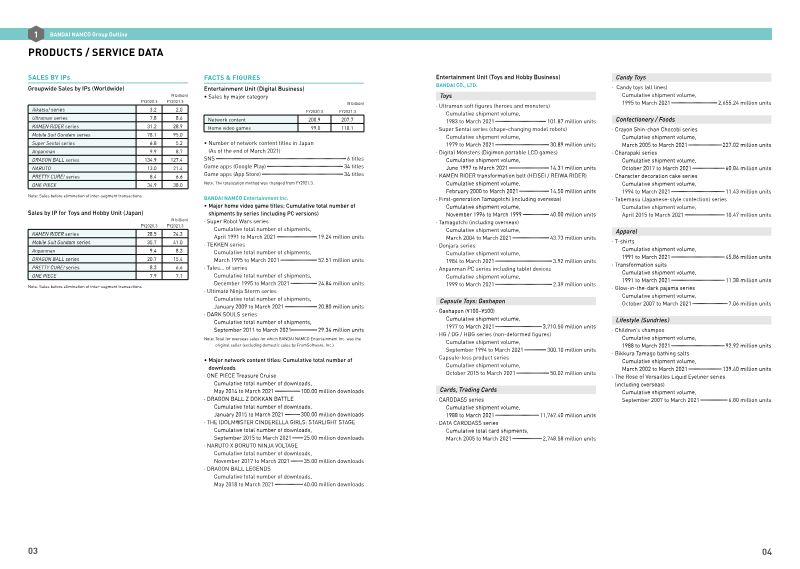
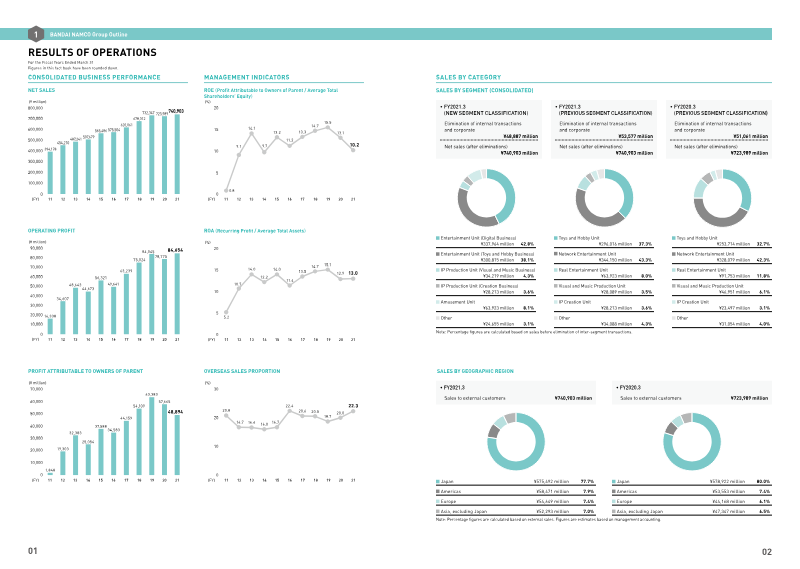
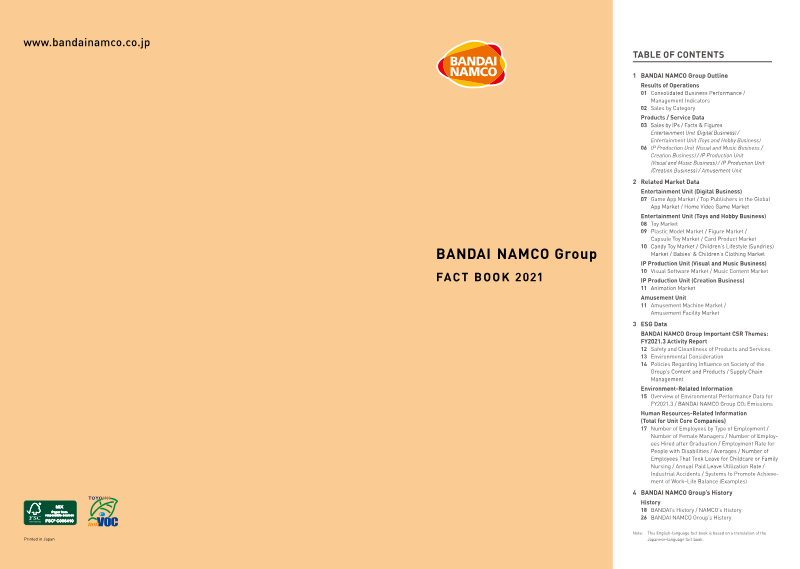
The 2021 Fact Book presents a comprehensive overview of Bandai Namco Holdings’ strategic direction, emphasizing its transformation into a globally integrated entertainment conglomerate and its commitment to corporate social responsibility. Central to the narrative is the thesis that sustained growth across toys, video games, animation and amusement can be achieved through diversified product portfolios, expansive international operations, and proactive sustainability initiatives. The company’s evolution is traced from a collection of independent toy, arcade‑machine and media firms to a unified group after the 2005‑2007 merger of Bandai and Namco. Key milestones include the launch of flagship lines such as Gundam models (over 500 million units shipped), Tamagotchi (exceeding 20 million units), and Zatchbell Battle (300 million units), as well as the development of major video‑game franchises—TEKKEN, DARK SOULS III and Tales—collectively surpassing 50 million sales. International expansion is evident through subsidiaries and regional headquarters in North America, Europe and Asia, reinforced by repeated listings on the Tokyo Stock Exchange and industry recognitions such as Cannes Best Actor and TSE awards. Environmental and social performance data for fiscal year 2021 highlight a suite of CSR actions, including CO₂ reduction targets, supply‑chain safety measures and work‑life‑balance programmes, all framed within the “NEXT STAGE” mid‑term plan aimed at deepening engagement with a mature fan base and broadening cross‑media offerings. The Fact Book thus underscores Bandai Namco’s dual focus on market leadership and sustainable corporate practices across a worldwide footprint and multiple entertainment segments.