1 free read left. Create a free account for unlimited reading + AI research.
Create free account
The Kobayashi Maru - No-Win Scenarios in Games - Extra Credits
Key insights
6 takeaways- 01In Klondike Solitaire, approximately 21 percent of all deals are mathematically impossible to complete, illustrating that unwinnable scenarios are a common feature in games relying on initial seeds.
- 02Unwinnable game states are an inherent trade-off in procedurally generated titles, where randomness is prioritized to provide vast, scalable content without the need for manual oversight.
- 03The 'Kirk' approach to no-win scenarios involves circumventing game rules to force a victory, which effectively negates the intended challenge and the value of the experience.
- 04The 'Picard' philosophy suggests that accepting failure as an inevitable part of life—where one can make no mistakes and still lose—fosters resilience and self-awareness in players.
- 05While unwinnable states are often categorized as design flaws, they can function as tools for psychological growth by forcing players to confront situations beyond their control.
- 06The value of games containing no-win scenarios lies in the process of testing oneself against insurmountable odds rather than the guarantee of a successful outcome.
Ask AI about this video
Transcript
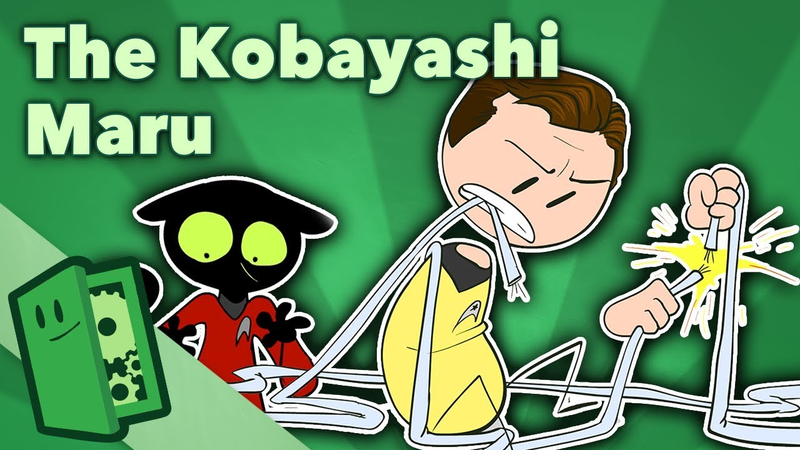
If you would all be so kind to quickly follow me down this rabbit hole real quick. Picture yourself trying to kill a few minutes in a waiting room. So, you pull out your phone or laptop and open up Solitaire. Now, in that moment, do you start to feel like Captain Kirk? Well, you should because just like the infamous Kobayashi Maru scenario from Star Trek, there's a chance right now that you've been dealt a hand that is entirely unwinnable. So, let's take a second and examine something that we often take for granted when we sit down to play a game. The idea that it can be won. Recently, our illustrious EC streamer Will has been playing a lot of Slay the Spire at Ascension 20 over on our Twitch channel, which you totally should go check out via the link below after the episode because it's fun as heck. And he's been musing a fair bit over the way that the game makes itself harder and whether or not all of those increases in difficulty make some runs of the game unwinnable. Is it possible that from before you begin your first fight, you're doomed to failure? And if so,
does that make the game any less worth playing? Now, before we dive in, let's go over some terminology just to be sure that we're all using the same words to describe the same phenomena. When I say a game is unwinnable, I mean that there's no set of player generated moves and randomness that will allow the player to achieve victory. No matter what you do, no matter how many times you reload and try, you won't be able to win. It's pretty easy to establish you can end up in an unwinnable state in the middle of a game of Solitaire or Spire and we can also work backwards from there to show that it's possible no matter what set of moves you make that you'll end up in a similar or even identical position and be doomed. In the case of Solitaire, the randomness is locked in once you shuffle and deal the tableau of cards onto the table. And from the very beginning of any hand of Klondike, the most popular form of Solitaire in the US and Canada, there's a 21% chance that the game isn't winnable. No matter what series of moves you make, you can't fulfill the victory conditions by by all the cards in rank order in their suited piles. And Slay the Spire is actually kind of the same,
though it's harder to see in Spire. Every possible move is determined before you start. This is also, of course, a problem unique to randomly generated games, because if we could test each and every seed or position during the design process, it would be possible to eliminate this fear entirely. But that's never really going to happen, because the very strength of randomly generated content is that it lets designers gain an extraordinary amount of possibilities without doing a ton of manually checked work. So, with all that said, is this the problem that even needs to be solved? Is the possibility of us not being able to win really ruining our enjoyment of games that rely on randomness to generate a scenario for us to play through? Well, I don't think so. Though to be fair, I don't know if that's the right question that I just asked myself. Because games with no-win situations, like Solitaire, are enjoyed by a ton of people, some of whom might not even know that unwinnable deals even exist. So, rather than debate the validity of doom scenarios in games, I think it would be much more interesting to take a look at the different ways we as players can approach this kind of loss. And we're
going to do that by boldly going back to a place we visited before the intro. Because one possible philosophy that is applicable here is given to us by Captain Kirk, and another one by Captain Jean-Luc Picard. Kirk rejects the notion that there's such thing as a no-win scenario. Therefore, when running the Starfleet test simulation, the Kobayashi Maru, where he's forced into choosing to go on a rescue mission designed for him to have no winnable outcome, he simply hacks the test and changes the situation for the better in order to fit and to prove his outlook is correct. But looking past whether or not you think that might be cheating, does this outlook really teach us anything? If our approach to losing is changing the conditions of the game or the test, do we really learn anything from our struggle? Sure, we accomplish something that looks like a win, but then we're no longer playing the same game that we were when we started. Plus, you know, if Kirk had been in that scenario IRL, his crew and all the folks he was trying to rescue would have been super dead. A different outlook is one outlined by Jean-Luc Picard in the Next Generation
episode Peak Performance. Lieutenant Commander Data, an Android, begins to doubt his abilities following a loss in a strategy game to a much more experienced player. When Captain Picard tells Data, "It is possible to commit no mistakes and still lose. That is not a weakness. That is life." What he's saying here is that we need to be able to accept that some challenges are beyond our reach and that losing to them doesn't define us. What matters is that we've tested ourself against the challenge and as long as we've learned something from that loss, it isn't a wasted experience. Okay, but fun Star Trek examples aside, in both games and life, we're going to encounter situations where we just can't win. In games, you have the option to step away, to restart and try again from a fresh save if you need to. If you stick with a no-win scenario, however, you might learn something about yourself that you can use in your life. You can begin to understand what happens when you're confronted with something that's out of your control. Because in life, sometimes you're going to lose, no matter what you do, no matter how hard you try. And while sometimes it's not fair, you can't
let that define you. So, that ability to predict how we'll feel, how we'll react to those situations should be the real lesson that we're after when we take on challenges that we know can't be won. Thanks for indulging us in this little roundabout discussion to get to a sort of life lesson. That was fun. But what do you think about no-win scenarios? Is their existence in games a hindrance, an opportunity for personal reflection, or something else entirely? Let us know in the comment section below. Oh, and one last thing. If you're interested in talking more about Spire, winnable games, or learning from failure, then may I suggest you go over and engage with us over on Twitch. Trek Bounts for days. We'll play Slay the Spire Monday through Thursday mornings from 8:00 to around noon Pacific Standard Time. Lately, he's been working on his Ascension 20 heart streaks, playing mods, and using the game as a gateway to talk about game design. So, if that sounds up your alley, beam on over and say hi via the link in the description below. And be sure to tell Will that Armok and Gelat are most certainly at Tanagra. See you next week.
Summary
The concept of the no-win scenario, famously exemplified by the Kobayashi Maru, is a prevalent yet often overlooked element in game design, particularly within titles that utilize procedural generation. The core thesis posits that while unwinnable states—where victory is impossible regardless of player skill or decision-making—are often viewed as design flaws, they serve as meaningful opportunities for personal reflection and psychological growth rather than mere failures of mechanics.
Randomly generated games, such as Solitaire or Slay the Spire, inherently risk creating unwinnable conditions because the game state is determined by initial seeds or deals. For instance, approximately 21 percent of Klondike Solitaire hands are mathematically impossible to complete. While developers could theoretically test every possible outcome to eliminate these scenarios, the reliance on procedural generation is a deliberate design choice that allows for vast, scalable content without manual oversight. Consequently, the existence of these "doomed" states is an accepted trade-off for the variety and replayability that randomness provides.
The analysis contrasts two philosophical approaches to these no-win situations. The first, modeled by Captain Kirk, involves circumventing the rules to force a win, which effectively changes the game and negates the value of the challenge. The second, articulated by Captain Picard, emphasizes the acceptance of loss as an inherent part of life, asserting that one can make no mistakes and still fail. By engaging with unwinnable scenarios, players learn to confront situations beyond their control, fostering resilience and self-awareness. Ultimately, the value of such games lies not in the guarantee of victory, but in the lessons learned through the process of testing oneself against insurmountable odds.















Comments