1 free read left. Create a free account for unlimited reading + AI research.
Create free account
The Genius Behind MTG's First New Card Type in 15 Years - Extra Credits
Key insights
6 takeaways- 01The introduction of the Battle card type serves as a strategic intervention to combat power creep and excessive game speed that rendered high-mana, late-game cards unplayable.
- 02Battles function as multi-stage assets that provide an immediate effect upon casting and transform into more powerful spells once a specific damage threshold is met.
- 03By requiring players to divert resources toward non-player targets, Battles effectively increase the total damage needed to win, naturally slowing the game's tempo.
- 04Battles represent the first new card type added to Magic: The Gathering in 15 years.
- 05The mechanic forces a strategic trade-off between attacking the opponent directly or attacking the Battle to unlock secondary benefits, preventing the 'steamroller' effect of aggressive decks.
- 06The design shift encourages a more dynamic, 'seesaw' gameplay experience by forcing defensive postures and facilitating longer, more interactive matches.
Ask AI about this video
Transcript
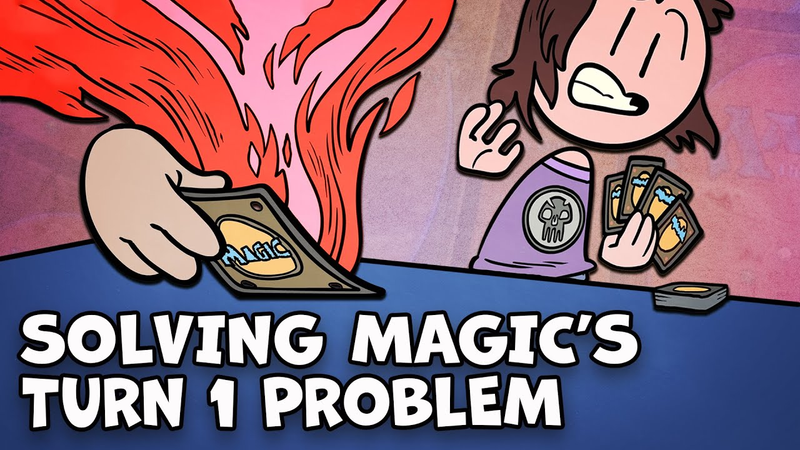
For decades, the first turn in any game of limited Magic the Gathering followed the same play pattern. Play a land, go. Play a land, go. Classic? Oh, you bet. Interesting? Not very. But then about five years ago, something odd happened. Common cards started showing up that were actually worth playing on turn one. Now, I'm pretty confident that this was because one of the goals of the Wizards design team was to make turn one matter in the grand scheme of the game, and in that, I think they succeeded. But man, oh man, did that have some unintended consequences. Thanks so much to Nebula for reliably being the best way to watch a ton of great content early and free of ads like this one. Magic is like almost no other game. It's been around for almost 30 years, and for most of that time, its design leadership has been fairly stable. As a designer, this is amazing. It means that you can watch their design thinking evolve, and you can get a pretty good idea of what they're trying to do with each set,
which leads us back to the push to make turn one interesting in limited. For years, even the most aggressive limited decks were loath to put in turn one plays. Usually, common one mana creatures were one ones with no or at best dismal abilities. But then the design team started to really push these cards. One one flyers with life link, cards that were key synergy pieces for the main decks in the format. Soon, the player base adapted, and everyone was tossing things out turn one, or at least the more experienced players were. Now, this had what might be an unexpected effect, though to give the team at Wizards their due, they probably did anticipate it somewhat. It made games faster. Meaning, all those late game bombs, those seven or eight mana gigantic critters that are so fun to play, well, they basically became unplayable. In limited, if something said it cost seven plus mana, its text better have been incredibly OP, because otherwise, you weren't playing it. And even if it effectively did win you the game, it meant that it had to become your whole game plan, what you built your entire deck around. This, obviously, wasn't the best, either. So, the team then had a new goal: slow down
games without losing the progress they'd made on making turn one matter. Now, they couldn't just up your life total or something, as that would break all older formats and the balancing they'd done in the past. So, what did they do instead? They created battles, the first new card type that they've introduced into the game in 15 years. Battles themselves are pretty straightforward. They have an effect when you cast them, and then when you do enough damage to them how much varies from card to card they flip over and become a much more powerful spell for you. Now, you probably see where this is going, right? If you're attacking your battles, you're not attacking the other player. So, if over the course of the game you had a battle in play with five health, and you decided that you need to flip it in order to win the game, well, now you have to do 25 damage instead of 20 to win, which is kind of like if your opponent had 25 life to begin with, but it actually goes so much deeper than that. That five-health battle? Well, it doesn't care if you do more than five to it. Let's say, the only creatures you have available to attack it had three
power and four power. If you want to flip it, you're now going to have to do seven damage to it. That's kind of like your opponent starting with 35% more life, give or take. There's another layer to it, though. Just by being on the board, battles slow down the game. Once you have a battle in play, your opponent always has to be worried about you attacking and flipping it. This means that they're going to have to leave more creatures on defense in case you have some tricky way of trying to get through. The sheer psychological effect of one of these hitting the table will often make your opponents more cautious and psych themselves out about things like haste creatures and removal spells. This all adds up to the games going longer and allowing for a much more, shall we say, swingy experience. Instead of just getting run over, the games feel like they have a lot more back and forth, which also helps make the games feel like they're going longer, especially for new players. Modern aggro decks often feel like a steamroller, which made games both unsatisfying and feel like they were happening way too quick. And in those sorts of games, you don't get to do any of the cool things you were trying to
do. With battles, though, we now see a play pattern where, yes, sure, there's sometimes an early aggro stomp, but then maybe you get one good turn, you flip one of your battles, and start to stabilize. Maybe you don't even flip your battle. Maybe just having it there is enough. Or maybe your opponent feels like they have to flip one of their battles, giving you just that little bit of extra breathing room for your stronger late game cards to come into play. It's this seesaw gameplay. The faster deck starts winning, then the deck with better card quality takes the lead, then it goes back and forth as people start dropping bombs. That makes the game feel like a longer, more satisfying experience. It isn't just I got rushed to down, or I stalled until they ran out of steam. It has dynamics. And then when you're telling your friends about these games, there's now kind of a story there, a bit of an arc, which I think is key. Because when people say they want a slower format in Magic, I'm guessing they probably don't mean specifically they just want the games to take more time. Kind of feels like they want a chance to be able to play a variety of decks and do big
things that might swing the game. Swinging us right back to where we began. A design decision that led to speed and power creep in Magic, a desire to reverse that effect, another decision to find a way to secretly increase the players' health without changing the game, and the genius of it is how many levels it worked on. But, there is one more question that does remain. What unintended consequences will future players have to battle out of from this change? Well, for the answer to that, we'll see you back here in a couple more years. Oh, damn, you're like slow rolling the old content train now, are you? That is a bold move, Cotton. Let's see if it works out for him. Oh, Casual Matt, I do not have time for your shenanigans today. No, no, no, no, no. You got it all wrong. I was actually just swinging by to pay you a compliment of all things for your guest spot as the voice of Bill Gates in LowSpecGamer's kick-ass new Nebula First video, The Secret Xbox. Well, what? Seriously, before that I never knew there was like so much drama at Microsoft at the time. Just really cool stuff. Aw, thanks so much for that. Yeah, but like real talk, how much did you have to pay LowSpec Alex to get that gig? Oh, nothing
actually. All of us Nebula creators just love helping each other out with projects, especially when we need to get them out early and ad-free over on Nebula. Amazing. Dude turned my burn into a promo. Actually, with the Nebula First feature over on Nebula, you get access to a whole bunch of great content from our creator friends way earlier than you can see it on YouTube. Sure, sure, but you're kind of like burying the lead, I think. Because thanks to Big Daddy Nebula's support, right? We can release all of our Extra History series episodes at least a full week early over there. Too true, Cash Mat. But actually, what I love watching on Nebula are a ton of my favorite creators like TierZoo, Moon Cat, and Chef PK, all without ads like this one. Aw, I thought you loved ads. Hey, shut up. Not to mention Nebula is home to a ton of other original shows you can't see anywhere else. Yeah, those are kind of the best, too. Actually, I just got finished watching Wendover's latest original on the logistics of commercial fishing. Turns out I had no idea how this multi-billion dollar industry actually gets fish from whatever water they're found in to my plate. Never going to take my sushi for granted again, I'll tell you that. Well, dang, Cash Mat.
With all that great content, Nebula sure must cost a pretty penny. Or at least as much as other streaming services. Nope. Actually, an annual Nebula plan will set you back 50 bucks total for a year. But if you do sign up with our link below, they knock 20 bucks off that price, meaning you pay $2.50 a month for this phenomenal streaming service that, bonus, doesn't, oh, I don't know, randomly remove shows from its library whenever they don't want to pay writers residuals. Dang, Casual Mat's going hard on this one. Oh, I'm sorry, BUT I AM JUST SO MAD ABOUT THAT. OKAY, OKAY. WELL, of course, I could keep talking to me, myself, and angry eye all day about how Nebula is awesome and its shows are great and that you directly support all of its creators when you sign up, but I just do think that you should check it out for yourself because it really is that great. And don't forget that when you sign up, again using our link below, your subscription directly supports our channel. So, thanks so much for that. Good damn it, guys, I can't I can't even. All right, deep breaths, buddy. Come on, let's go watch some Jetlag. Oh, I hear they uh they go to Japan in that one? They sure do, pal. They sure do.
A million big old thanks to Skyler Holmes, Kuya Coy, Joseph Blame, Dominic Valenciana, Casey Musgraves, Arclight Games, Angela Valenciana, and Ahmad Zia Turk for being fantastic legendary patrons.
Summary
The introduction of the Battle card type in Magic: The Gathering represents a strategic design intervention intended to address power creep and game pacing issues that emerged over the last decade. Historically, design efforts to make the first turn of limited play more impactful led to an aggressive meta where games concluded too quickly, effectively rendering high-mana, late-game cards unplayable. To counteract this without altering fundamental rules like player life totals, designers introduced Battles, the first new card type in 15 years.
Battles function as multi-stage assets that provide an immediate effect upon casting and transform into more powerful spells once a specific amount of damage is dealt to them. This mechanic creates a strategic trade-off: players must choose between attacking the opponent directly or attacking the Battle to unlock its secondary benefit. By effectively increasing the total damage required to win a game and forcing players to commit resources to non-player targets, Battles naturally slow the game's tempo.
Beyond the mechanical shift, Battles introduce a psychological layer to gameplay. Their presence on the board forces opponents to play more cautiously, often leading to defensive postures that prevent the "steamroller" effect common in aggressive decks. This creates a more dynamic, "seesaw" experience where momentum shifts between players, allowing for a more satisfying narrative arc within a match. By facilitating a return to longer, more interactive games, the design team successfully balanced the need for early-game relevance with the desire to preserve the viability of high-cost, high-impact late-game cards.












Comments