Market (Mobile)·Updated Mar 17, 2026 by AppsFlyer
What can I help with?
AI-powered answers with citations from the library.
What can I help with?
AI-powered answers with citations from the library.
Report · January 1, 2021
Published by AppsFlyer
The African mobile app market experienced a period of rapid acceleration between Q1 2020 and Q1 2021, driven by a young, mobile-first population and the unique conditions of the COVID-19 pandemic. Analysis of 6,000 apps and 2 billion installs across South Africa, Nigeria, and Kenya reveals that overall app installs grew by 41% during this period. Nigeria led this growth with a 43% increase, while South Africa saw the most immediate surge in downloads following strict lockdown measures. The gaming sector proved particularly resilient, with installs jumping 50% in Q2 2020 as consumers sought home entertainment. This trend extended to monetization, as in-app advertising revenue surged by 167% between Q2 2020 and Q1 2021. Furthermore, in-app purchasing revenue peaked in Q3 2020, accounting for one-third of the year's total revenue. While Android remains the dominant platform with a 54% increase in non-organic installs, iOS also showed growth despite a 21% rise in cost-per-install. Several structural trends define the current landscape, including the rise of fintech apps addressing the needs of unbanked populations and the emergence of super apps that consolidate multiple services to overcome device storage limitations. Despite this progress, challenges remain regarding connectivity, as mobile internet adoption in Sub-Saharan Africa stands at 26%, well below the global average. To succeed, marketers are encouraged to move toward a multi-moment maturity model by integrating durable measurement foundations, focusing on high-value user acquisition, and utilizing remarketing strategies to drive long-term engagement.
# Executive summary With 2020 now in the rearview mirror, and the latter half of this year kicking off, we're now able to look back on an unprecedented 12 months across Africa and how it impacted the state of mobile across the continent. Africa is one of the fastest growing regions in the global app market, with a young, mobile-first population driving a booming app culture. The unique conditions resulting from the COVID-19 pandemic have led to further acceleration of this trend. With lockdown restrictions put in place to combat the spread of COVID, people spent much more time at home and mobile users' screen time rocketed as a result. This impacted mobile marketing in a number of positive ways. Overall installs grew significantly in 2020, with in-app advertising (IAA) revenue receiving a boost alongside it. Crucially for marketers and developers looking to grow their apps, and even those looking to break into this space, these trends have continued into 2021. The latter half of 2020 saw much discussion across the mobile industry as to whether the pandemic was ushering in a "new normal", or whether we were looking at a more ephemeral state. The early signs for 2021 are encouraging for app owners and marketers alike, although it should be noted that the varying responses to the pandemic from different countries led to different effects on the state of mobile in that country. For example, South Africa applied the strictest restrictions out of the countries studied, and saw the highest increase in installs. # Key findings - Between Q1 2020 and Q1 2021, overall installs increased by $41\%$ - Non-organic installs increased on Android by $54\%$ , compared to just $19\%$ for iOS - The first set of restrictions in March 2020 had a huge impact on downloads of gaming apps, which increased by $50\%$ in Q2 2020 compared to Q1, compared to non-gaming apps which only increased by $8\%$ - 33% of the in-app revenue was generated in Q3 2020 - Between Q2 2020 and Q1 2021 in-app advertising revenue increased by $167\%$
# Introduction It goes without saying that the pandemic has had a knock-on effect on global economies and a huge number of companies. As the world began to come to terms with the pandemic, industries strived to adapt to the new global conditions – and mobile is one industry that has undoubtedly thrived during this time of reduced human contact. Mobile marketers in Africa were quick to recognise this, and moved to capitalise. In this report, we examine the state of mobile in Africa throughout 2020, covering the shifts caused by the pandemic right through to Q1 2021. We consider some of the future opportunities for developers and marketers in Africa, as well as guidance on how companies and brands can better understand the app market and make informed marketing decisions. We look forward to continuing to support mobile marketers in Africa with technology, data and insights so they can succeed in this exciting market. Daniel Junowicz, RVP EMEA & Strategic Projects, AppsFlyer Rama Afullo, Apps Lead, Africa, Google # Methodology AppsFlyer conducted an analysis of 6,000 apps and 2 billion installs across South Africa, Nigeria, and Kenya. - For analysis related to app installs, the timeframe examined was January 2020 to the end of March 2021. - For other KPIs, such as in-app revenue and in-app advertising revenue, the timeframe spanned 12 months between April 2020 to the end of March 2021. Vertical analysis was split between gaming and non-gaming apps.
# Q1'20 - Q1'21: Overall app installs grow across all verticals The African mobile app market showed strong growth throughout 2020 and into 2021, with overall app installs increasing by $41\%$ . Broken down by country, Nigeria showed the highest growth, with a $43\%$ uplift, compared to $37\%$ and $29\%$ for South Africa and Kenya, respectively. When we look at how different verticals fared over the same period, there were similar levels of growth, with gaming installs increasing by $44\%$ and non-gaming increasing by $40\%$ . However, while the rise of non-gaming apps was more gradual over the year, the first lockdown had a significant impact on gaming apps.
# Q2-Q3 2020: Great opportunity on Android, with iOS showing strong growth Android's larger market share within Sub-Saharan Africa has seen advertisers spend more budget on the platform. Non-organic installs increased on the platform by $54\%$ , compared to $19\%$ for iOS. The Cost Per Install (CPI) on iOS also increased by a significant $21\%$ between Q2 and Q3 2020, which meant iOS app developers were getting fewer installs for the same budget. The numbers indicate that towards the end of the year and into 2021, there was no change in non-organic installs on iOS compared to $40\%$ on Android. AppsFlyer top tip: Have a good native app for both Android and iOS and run paid marketing on both platforms to increase user acquisition. Measuring and analysing the performance of campaigns will ensure any investment is informed and worthwhile.
# Q1 v. Q2 2020: The impact of COVID It's impossible to look at the state of mobile in Africa over the last year without examining the impact of the COVID-19 pandemic. In order to understand the effect of these first lockdown measures on mobile, we compared activity in Q1 2020, before the restrictions, with Q2 2020. With people spending more time at home, it's not surprising to see overall app installs increase by $20\%$ . On a country level, South Africans were quick to take to their mobile devices as the first lockdown hit, with installs increasing by $17\%$ . The situation was more muted in Nigeria and Kenya, with increases of $2\%$ and $9\%$ respectively. These differences are likely due to the varying levels of restrictions exercised by the three countries, with South Africa facing the strictest. Gaming apps in particular showed strong performance during these early months of the pandemic, with installs increasing by $50\%$ across all three countries. In addition, non-organic gaming installs increased by $56\%$ during this time, likely because gaming marketers were increasing paid acquisition activity in response to consumers spending more time at home playing games on their phones. In comparison, non-gaming apps only increased by $8\%$ in the same time period, and non-organic installs fell by $17\%$ suggesting that marketers across these other verticals were restricting their advertising spend amid the uncertainty.
A survey conducted by Google and Savanta into consumers' mobile gaming habits as a result of COVID-19 showed increases in mobile game playing time, session time, and in-game purchases. As gamers are rewarded for watching advertising, through extra moves, power ups or other rewards, they are generally receptive to in-game advertising, which presents an opportunity for marketers. AppsFlyer top tip: Add paid media into your marketing strategy. Many brands, especially those on a budget, rely on owned channels or other creative strategies such as influencer marketing and giveaways to drive user acquisition. But it's clear that paid campaigns can have a significant impact on overall installs, as seen with gaming apps at the beginning of the pandemic, presenting a compelling case for other verticals to follow suit. # Q3'20: $33 \%$ of 2020's in- app purchasing revenue was generated in Q3 2020 Moving on from Q1 and Q2 2020 and into Q3, in-app purchasing (IAP) revenue numbers soared between July and September, with a $136\%$ increase compared to the previous three months, with the average share of paying users increasing by $20\%$ .
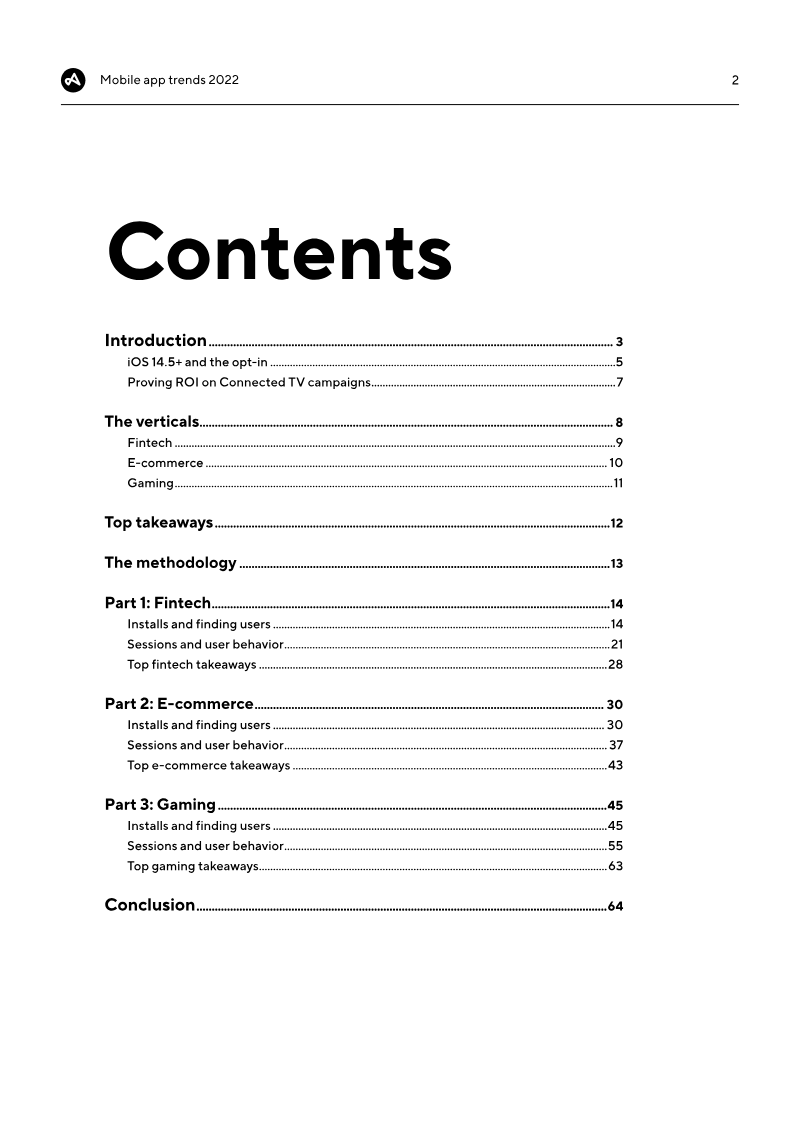
The mobile app industry underwent a transformative period of growth in 2020, characterized by a 50% year-over-year increase in global installs and a total consumer spend of $112 billion. While the fintech sector led in raw install growth at 51%, the gaming industry remained a dominant force with a $165 billion valuation, driven by a 43% surge in hyper-casual downloads. E-commerce demonstrated a distinct trend toward intensified user engagement; despite a modest 6% rise in installs, the vertical experienced a 44% increase in sessions and a 58% jump in in-app transactions, signaling a shift in consumer behavior toward deeper digital integration. User engagement metrics across the ecosystem reflected this heightened activity, with overall sessions rising by 30%. Fintech and e-commerce sessions saw particularly sharp increases of 85% and 44%, respectively. Within the gaming sector, performance varied significantly by sub-genre. Hyper-casual titles relied heavily on paid acquisition and faced rapid churn, whereas non-hyper-casual games maintained superior retention, reaching median session lengths of 45 minutes by day 30. Cost structures also diverged sharply, as acquisition costs for general gaming peaked at $2.52 per install in the fourth quarter, while hyper-casual costs plummeted to a low of $0.27. Sustaining growth in this increasingly competitive landscape requires a strategic pivot from volume-based metrics to sophisticated behavioral analytics. Developers must prioritize retention rates and effective cost per install (eCPI) to refine onboarding processes and ensure long-term profitability. Success in the current market depends on a data-driven, UX-centric approach that utilizes automation and real-time measurement to navigate evolving privacy regulations, such as iOS 14. Ultimately, the path to maximizing return on investment lies in personalized marketing campaigns and a granular understanding of vertical-specific user behaviors.
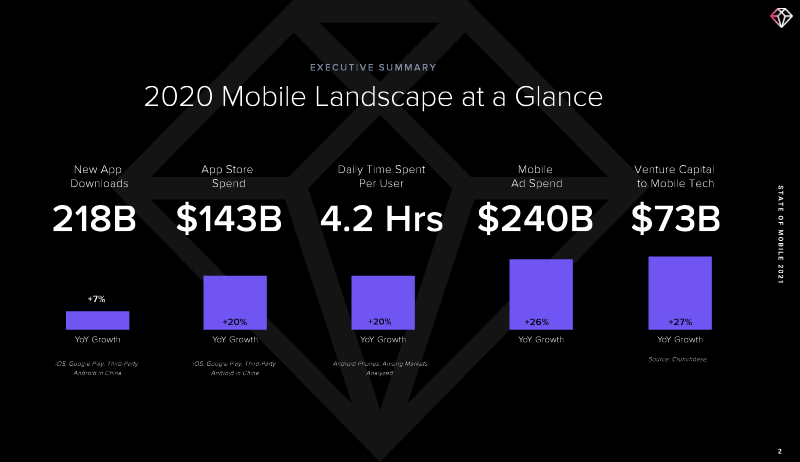
The mobile industry experienced a historic acceleration in 2020, effectively compressing two to three years of projected growth into a single twelve-month period. Global app downloads reached 218 billion while consumer spending surged 20% year-over-year to $143 billion. This shift was characterized by a fundamental change in consumer behavior, as global users averaged 4.2 hours of daily mobile engagement, surpassing live television viewership in the United States. Venture capital followed this momentum, with investments in mobile technology rising 27% to $73 billion. Mobile gaming remained the primary economic engine of the ecosystem, contributing 66% of total spend and positioning the sector to exceed $120 billion in 2021. The global pandemic acted as a catalyst for digital-first adoption across diverse sectors, most notably in finance, streaming, and retail. Time spent in finance apps increased by 45% globally, driven by the democratization of stock trading, while video streaming hours rose by 40%. Retail saw a 30% increase in usage as social commerce emerged as a dominant trend, projected to reach a $2 trillion market value by 2024. TikTok emerged as a standout performer, experiencing a 325% increase in engagement. This heightened activity fueled a robust mobile advertising market, which reached $240 billion in spend, supported by a 95% increase in ad placements within the United States. Specific categories saw unprecedented spikes in utility, with business app usage growing 275% and health and fitness spending rising 30% to $2 billion. Leading platforms such as Tinder, PUBG Mobile, and TikTok dominated their respective metrics for spend, active users, and downloads. Furthermore, specialized platforms like Azar and SmartNews demonstrated the success of integrating artificial intelligence and real-time data to capture Gen Z and news-seeking audiences. These developments underscore a permanent shift toward a mobile-centric global economy where digital engagement is the primary medium for commerce, communication, and entertainment.
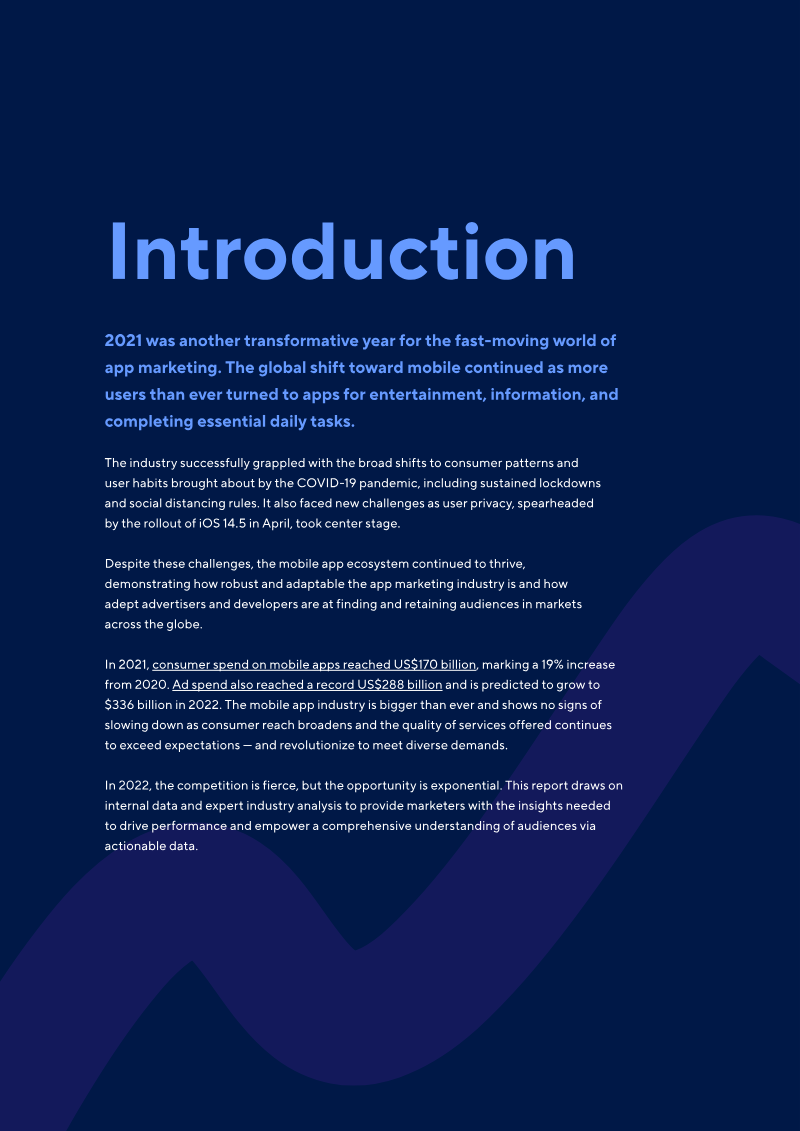
The mobile app industry experienced a period of robust expansion throughout 2021, characterized by $170 billion in consumer spending and $288 billion in advertising expenditures. Despite the implementation of Apple’s App Tracking Transparency framework, the sector demonstrated unexpected resilience as global opt-in rates reached 25%, significantly outperforming initial industry forecasts. This growth was distributed across several key verticals, with fintech and gaming leading the surge in installs at 35% and 32% respectively, while e-commerce maintained steady upward momentum with a 12% increase in downloads. Fintech emerged as a primary driver of engagement, particularly within the asset management and cryptocurrency subverticals. While traditional banking and payment apps maintained the highest share of installs, crypto apps achieved record session lengths exceeding 15 minutes. This heightened engagement occurred alongside a sharp rise in acquisition costs, with effective cost-per-install (eCPI) for fintech apps more than tripling. Consequently, developers are increasingly pivoting toward subscription-based models to ensure long-term profitability and offset the rising price of user acquisition. The e-commerce and gaming sectors mirrored this trend of higher costs paired with increased user value. Although e-commerce retention rates saw a slight decline, total in-app revenue jumped by 46%, driven by longer session durations in marketplace apps. Similarly, the gaming industry saw hyper-casual titles dominate download volumes while adventure and strategy games secured deeper engagement. Across all sectors, the transition toward higher-quality user bases is evident; while it is becoming more expensive to acquire users, those who remain are spending more time and money within apps, making retention and lifetime value the critical metrics for sustained success in a maturing mobile market.
The global mobile ecosystem experienced significant expansion throughout 2021 and into 2022, characterized by record-breaking consumer spending of $170 billion and a projected ad spend of $336 billion. Despite initial concerns regarding privacy changes following the release of iOS 14.5, the industry demonstrated remarkable resilience as App Tracking Transparency opt-in rates reached 25% globally, far exceeding early market expectations. This growth was distributed across key verticals including fintech, e-commerce, and gaming, with mobile e-commerce sales alone reaching $3.56 trillion. The fintech sector emerged as a primary driver of engagement, with installs and sessions rising by 34% and 53% respectively. While traditional banking and payment apps maintain the highest market share, cryptocurrency and stock trading platforms saw the most intense user activity, with session lengths nearly doubling. However, this heightened interest triggered a sharp increase in acquisition costs, with fintech eCPIs rising from $1.05 to $3.40 over the course of a year. Similarly, e-commerce apps saw a 46% surge in in-app revenue despite rising costs and declining retention, signaling a shift where users are spending more money and time per session even as new user acquisition becomes more expensive. Mobile gaming remains the dominant force in the app economy, accounting for 52% of total consumer spend. Global game installs grew by 32%, led by the hyper-casual subvertical, though action and adventure titles commanded the highest levels of engagement and session frequency. While Day 30 retention rates for games nearly doubled to 9%, the industry faces a growing divide between high-volume downloads and long-term stickiness. As user acquisition costs continue to climb across all regions—particularly in LATAM and EMEA—the focus for developers has shifted from pure volume to maximizing lifetime value and implementing sophisticated re-engagement strategies to sustain growth in an increasingly competitive landscape.