Related Documents
Financial
Summary of Main Questions and Answers at the FY2018 First Quarter GREE Results Briefing Held on October 27, 2017
The first quarter results for fiscal year 2018 reveal a strategic shift toward high-quality native game development and international expansion, particularly within the Chinese market. Financial performance during this period was characterized by an increase in commission fees, driven by both overall sales growth and a higher proportion of revenue generated from titles utilizing third-party intellectual property. Key contributors to coin consumption included successful late-2017 releases such as Another Eden, SINoALICE, and Senki Zesshou SYMPHOGEAR XD Unlimited. While a temporary decline in consumption is anticipated for these titles following their initial launch peaks, the long-term strategy focuses on scaling operational teams to enhance content depth and sustain user engagement. The operational outlook emphasizes disciplined spending in the game and entertainment segments, prioritizing internal system strengthening over aggressive advertising. Conversely, investment in advertising and media remains a priority due to a growing user base. Regarding international growth, the timeline for overseas releases is estimated at three to six months following a launch decision. Success in the Chinese market is specifically tied to maintaining the authenticity of original Japanese versions while collaborating with local partners for fine-tuned regional operations. Broader industry trends indicate rising user expectations and increased difficulty in player acquisition. To remain competitive, the strategy leverages a strong financial base to fund large-scale development and multi-media collaborations. Beyond mobile gaming, there is a continued commitment to the virtual reality sector, focusing on building development expertise and expanding accessibility through location-based VR experiences. This multifaceted approach aims to transition successful domestic titles into global hits while diversifying the technological portfolio to meet evolving market demands.
GREEOct 2017
Financial
Summary of Main Questions and Answers: FY2018 Third Quarter Results Briefing
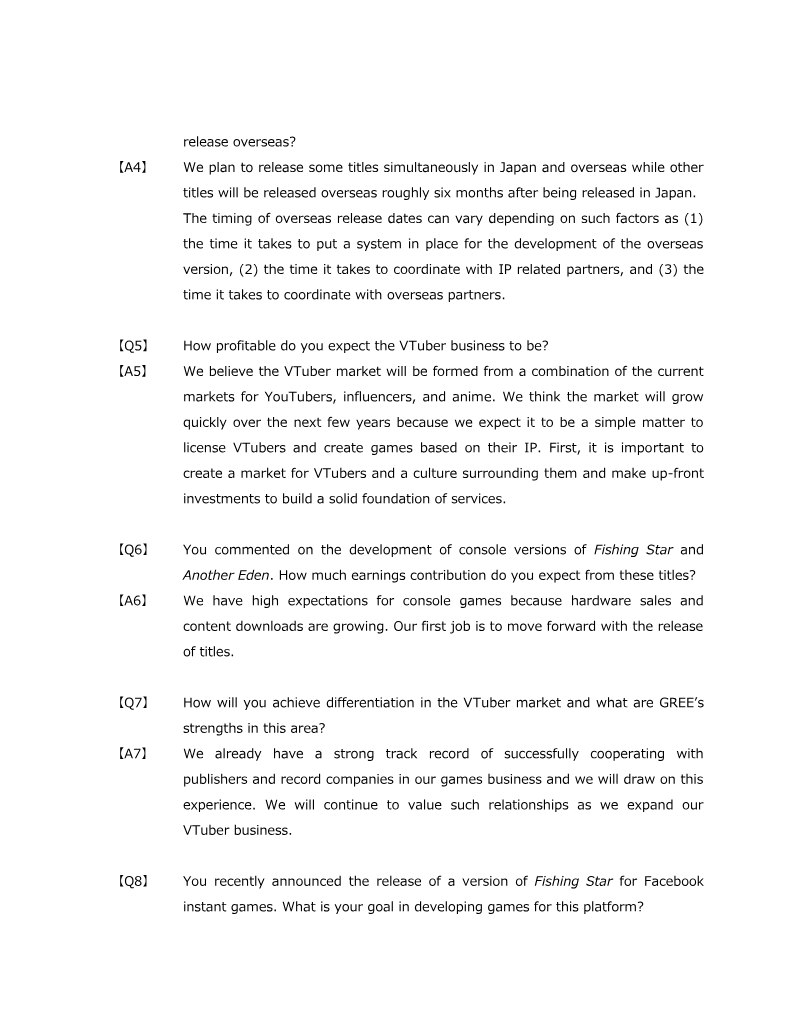
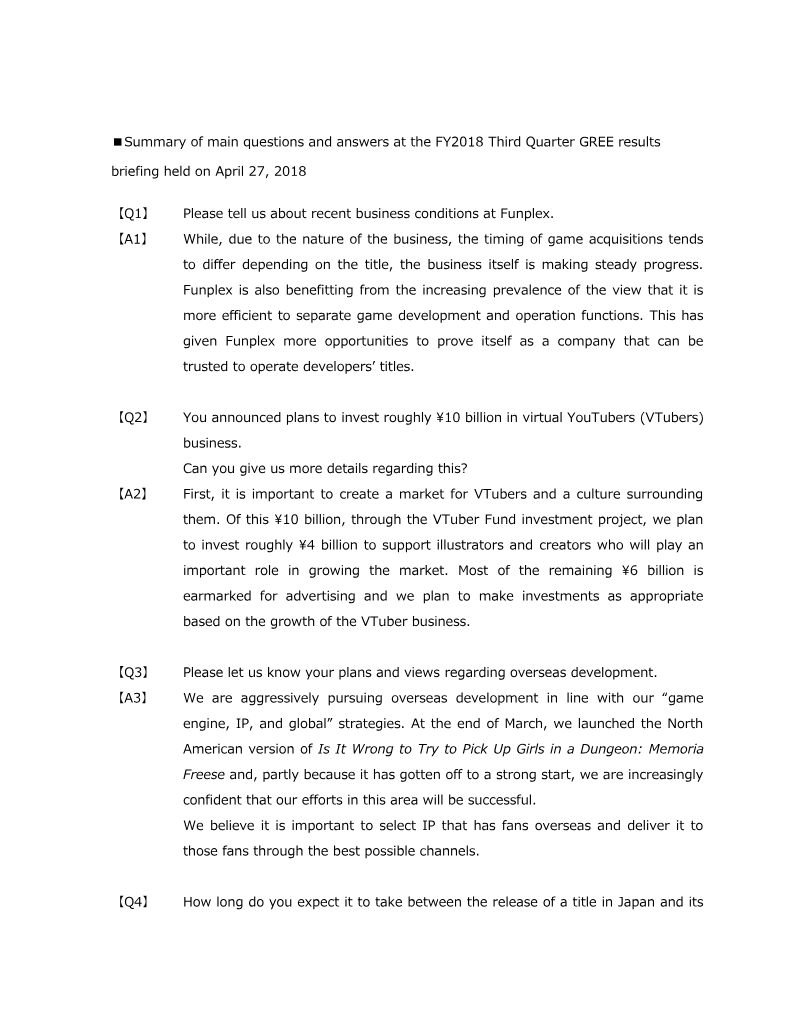
The third quarter of fiscal year 2018 marks a strategic pivot for GREE as it aggressively expands into the emerging Virtual YouTuber (VTuber) market and strengthens its international publishing footprint. A central pillar of this strategy is a planned 10 billion yen investment in the VTuber sector, with 4 billion yen dedicated to supporting creators and illustrators through a specialized fund and 6 billion yen earmarked for advertising and market development. This initiative leverages the company’s existing technical expertise in 3D character rendering and user interaction derived from its virtual reality business, aiming to capitalize on the convergence of influencer culture, anime, and gaming. Global expansion remains a primary growth driver, centered on a strategy of utilizing established intellectual property and optimized game engines. The successful North American launch of Is It Wrong to Try to Pick Up Girls in a Dungeon: Memoria Freese serves as a proof of concept for this international push. Management intends to release future titles either simultaneously worldwide or within a six-month window following Japanese launches, depending on partner coordination and localization requirements. Original titles like Another Eden and Fishing Star are also being adapted for console platforms and Facebook Instant Games to diversify distribution channels and reach broader audiences. Operational efficiency is being addressed through Funplex, which focuses on the specialized management and operation of existing game titles. This allows the broader organization to focus on high-quality content updates for top-ranking titles like SINoALICE. By separating development from long-term operations and utilizing a track record of collaboration with publishers and record companies, the company aims to build a sustainable ecosystem across mobile, console, and emerging digital media platforms. The overall outlook emphasizes front-loaded investment in new cultural markets to establish a foundation for long-term profitability.
GREEJan 2018
Financial
Summary of Main Questions and Answers at the FY2016 Fourth Quarter GREE Results Briefing
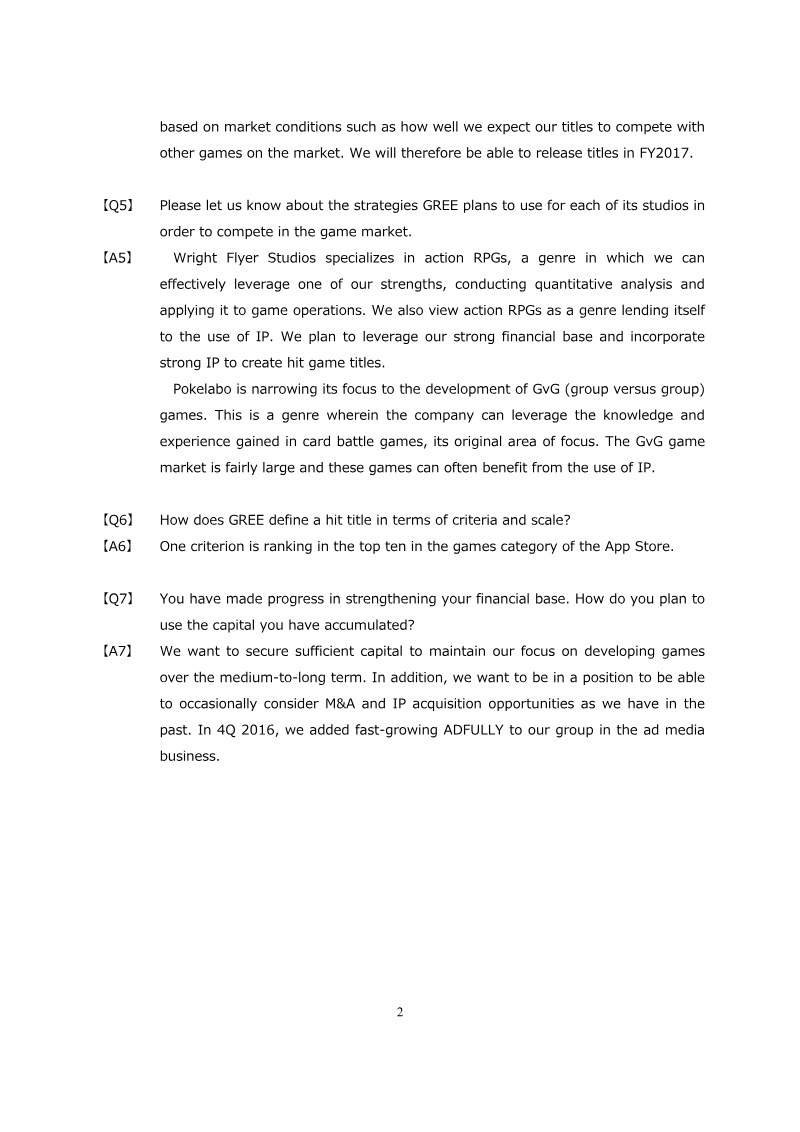
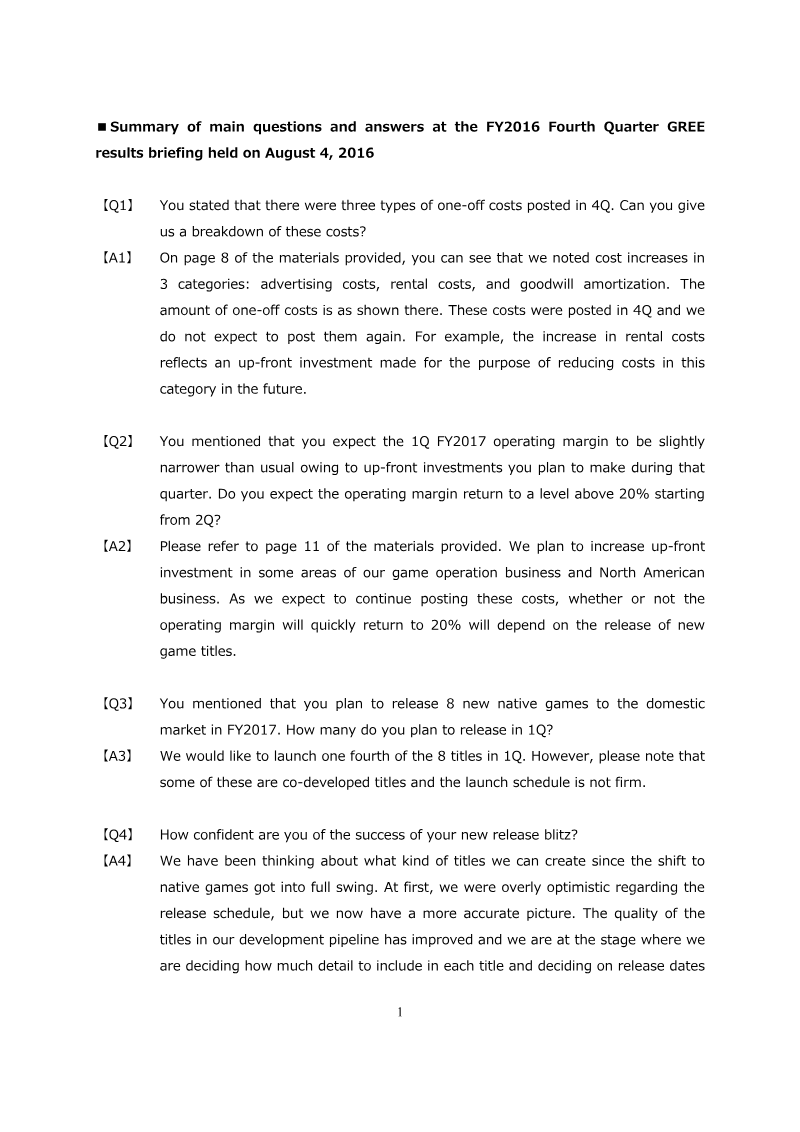
GREE’s financial performance for the fourth quarter of fiscal year 2016 was characterized by significant one-off costs and a strategic pivot toward native game development. These non-recurring expenses, which impacted the quarter’s bottom line, were primarily driven by increased advertising spend, goodwill amortization, and rental costs. The latter was framed as an upfront investment intended to reduce long-term operational overhead. While these specific costs are not expected to recur, the company anticipates a narrower operating margin in the first quarter of fiscal year 2017 due to continued aggressive investment in domestic game operations and North American business units. The strategic roadmap for fiscal year 2017 focuses on a "release blitz" of eight new native games for the Japanese market, with approximately one-fourth of these titles targeted for the first quarter. Management defines a successful "hit" as any title reaching the top ten in the App Store rankings. To achieve this, GREE is leveraging specialized internal studios: Wright Flyer Studios focuses on action RPGs and quantitative analysis, while Pokelabo concentrates on the Group-versus-Group (GvG) genre. Both studios are increasingly integrating external intellectual property (IP) to enhance market competitiveness and mitigate the risks associated with the shift from web-based to native mobile gaming. Capital allocation remains focused on long-term stability and strategic expansion. GREE intends to maintain a strong financial base to support multi-year development cycles while remaining active in the M&A market, as evidenced by the recent acquisition of ADFULLY to bolster its ad media business. Future profitability and the return to an operating margin above 20% are heavily contingent on the successful launch and sustained performance of the upcoming pipeline, as the company moves past its initial optimistic scheduling toward a more disciplined, quality-driven development process.
GREEAug 2016
Financial
FY2017 4Q Result Presentation
GREE, Inc. reported its fiscal year 2017 fourth-quarter results, highlighting a successful turnaround of its game business and a strategic shift toward global distribution. For the full year, the company achieved net sales of ¥65.4 billion and an operating income of ¥8 billion. The fourth quarter saw quarter-on-quarter growth with ¥19.2 billion in net sales and ¥2.4 billion in operating income, driven by the successful launch of four native games—including Another Eden and SINoALICE—all of which reached the top 20 rankings. A primary finding is the completion of a strategic pivot in overseas operations. The company decided to close international subsidiaries and consolidate all game development within Japanese studios to focus on global distribution. This transition resulted in a one-time extraordinary loss of approximately ¥6 billion due to asset write-downs and closure costs. Despite these charges, the company restored a double-digit operating income margin and reported that native games now account for more than half of total coin consumption, which reached a target of 10 billion coins. The outlook for fiscal year 2018 emphasizes a medium-term growth strategy centered on three pillars: game engines, intellectual property (IP), and global distribution. By reusing technical bases across different titles, the company aims to reduce development costs and increase investment in content quality. The pipeline includes six approved titles, with a focus on balancing first-party, co-developed, and third-party IPs. Additionally, GREE plans to expand its advertising and media business as a second major earnings pillar, focusing on high-retention apps and video production. While net sales are forecast to grow to ¥20.5 billion in the next quarter, operating income is expected to decline temporarily due to aggressive front-loaded investments in marketing and promotion to ensure long-term sustainability.
GREEAug 2017