1 free read left. Create a free account for unlimited reading + AI research.
Create free accountWhitepaper DiGRA
1 free read left. Create a free account for unlimited reading + AI research.
Create free accountWhitepaperDiGRA
The study notes that women constituted a growing majority of gamers by the mid-2010s. Representation changes are framed as partial and contested rather than complete.
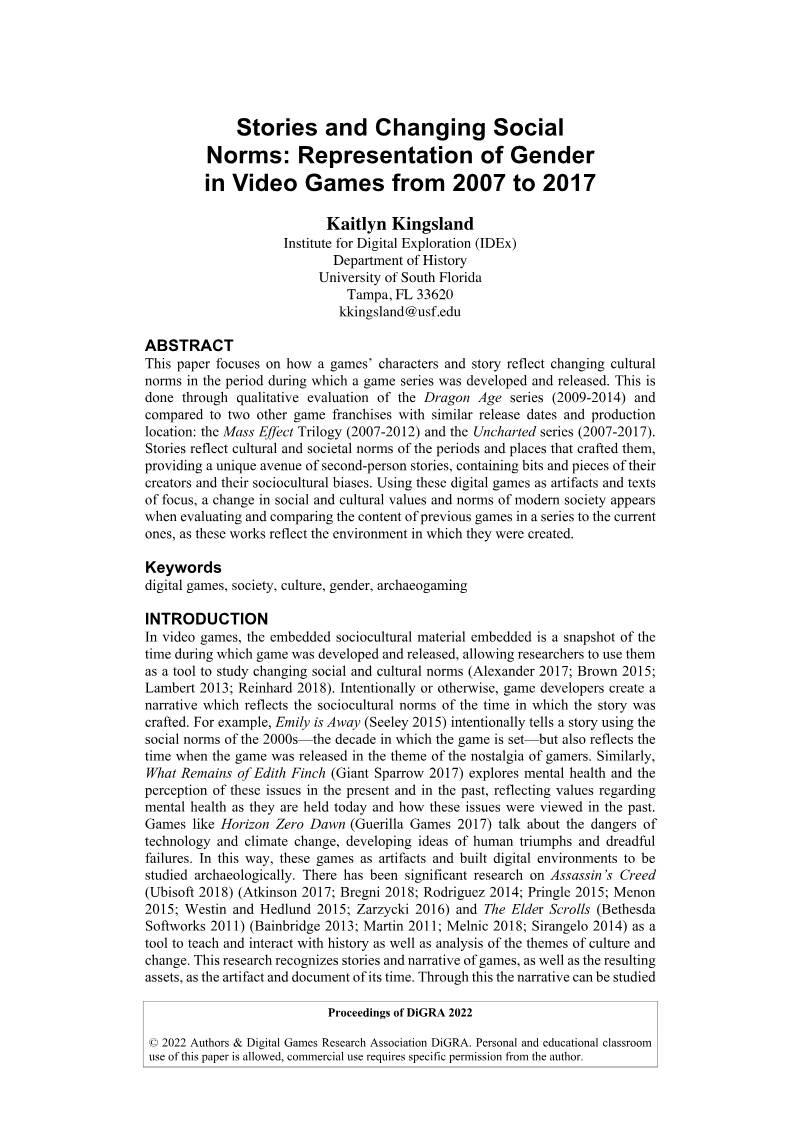
This study examines how gender is represented in three major video game franchises between 2007 and 2017, arguing that changes in game narratives reflect a broader shift in North American sociocultural attitudes toward gender. Its central case study is the Dragon Age series, which the author reads closely across its installments to show a movement from overt sexism, sexual violence, and objectification in Dragon Age: Origins toward greater female agency and inclusivity in Dragon Age II and Dragon Age: Inquisition. The analysis is qualitative and relies on the fantasy setting and default world states of these games, which allow the author to trace narrative and character choices over time.
The work extends this approach to the Mass Effect and Uncharted franchises, finding comparable patterns. Female characters in earlier installments of both series are often sexualized or underdeveloped, while later entries present more complex and empowered women and reduce objectification. Notably, Dragon Age: Inquisition includes a transgender character treated positively, a contrast the author draws against the frequently transphobic portrayals found elsewhere in the medium. Because the three franchises were produced by different developers, the author treats their parallel trajectories as evidence of a wider cultural pattern rather than the idiosyncrasies of a single studio.
The study situates its findings within industry context. By the mid-2010s, women constituted a growing majority of gamers, yet roughly half of surveyed gamers still perceived women as negatively represented in 2015, and women made up only about 22 percent of game developers in 2014. These figures frame the representational changes as partial and contested rather than complete.
The author acknowledges clear limits: the study does not determine what caused the observed shifts in representation. Its conclusions rest on a small number of franchises analyzed through close reading, not on a broad quantitative sample. The author proposes future research extending the analysis to subsequent Dragon Age and Mass Effect titles, later Uncharted installments, and independent games from the same period, and to examining whether recent cultural and political events have influenced diversity and sexism in these works.
Each row is a game or company this document names, each column a document, oldest first. A mark means that document names it. Select a row to see those documents.
DiGRA · 2023
DiGRA · 2023
DiGRA · 2023