Starting Your Career In a Post-Pandemic World
9 Jun 202360 min video
Transcript
[Music] my name is Sanjay MAV and I'm an associate professor of practice at USC and also a video game programmer I'm honored to share the stage this afternoon with everyone before I start please remember to silence your phones and fill out your session evaluations after the talk you'll get an email with a link we've set aside a good amount of time of for Q&A at the end so please save any questions until then breaking into the game industry has always been challenging but the onset of the co pandemic has caused some seismic changes and today we're going to focus on some key areas on how to start your career today things are especially tough right now with the economic landscape with all the layoffs that are happening and everything but don't lose hope while there isn't a magical sword we can give you to Vanquish the job search boss our hope is that our Collective wisdom will get you well on on your way so what's
changed sorry the GDC folks insist we have to put at least one meme into our talks so we're gon to focus on two areas today mainly how has getting notice changed how do you network how do you build a strong portfolio website what about the hiring and interview process what should you expect what are some ways to prepare yourself and how do you you succeed in finding the job that will be perfect for you so one common question is how do you get notice you want to be the penguin that stands out the first thing is to network so that you'll get to know people and learn about job opportunities that come up I'll turn it over who to adenda who's going to talk about her experiences networking online specifically on LinkedIn and Discord
hello everyone I'm adinda I'm a teacher and a freelance game journalist and I'm going to be really honest now right now because I despise networking but being anti- networking is basically my superpower I really know how it works very very well you guess what this was my profile picture or profile in 202020 and I received a scholarship to go to attend GDC in 2020 and I was literally going with this profile to GDC I'm not kidding at that time LinkedIn not did not matter to me so just a little bit about me I was working in Hong Kong as a game design um I teaches my game design course in Hong Kong and suddenly I was jobless I I didn't have a LinkedIn profile I hated networking so oh GE I moved back uh home to Europe and I tried to make my freelance uh business work with Facebook well don't do that uh
I need a functional LinkedIn profile because I was tired of this you know when you go back to your parents so at this moment I just receive every now and then every day I see receive an interesting high potential job offer on either LinkedIn on Discord interesting Discord groups so who guess who updated her LinkedIn profile Mah so before I'm going to give you all the best tricks because you're waiting for that we are going to look back and the inperson conference um and what do you notice in 2020 2021 no one attended in person well guess why and later on and 10,000 people were gone so where did the people go well they went back to you know LinkedIn and Discord this usage has been increased immensely
so you really need to adapt if you really want to stand out that's what I'm going to explain so your profile is really important you need a very good background you need uh to have a good headliner you need to show that you are interesting have the recruiter being interested in you and if you have not yet done it now right now have this hashtag Banner on your link time profile because recruiters will really recognize that you want a job okay second thing it's not about you it's literally my ability to create a strong network was directly related to my ability to show empathy curiosity and reconnect other thing everyone is cool you know everyone in this room so after this talk really don't run to the toilet please come have a conversation with a person next to you and quality matters over quantity for example the developer of please touch
the artwork liked my LinkedIn post about my interview and I just sent him a message and now we just have an interview together another developer uh I read an article about him I thought he had a cool insights I messaged him and now we are friends on LinkedIn it's super super easy just let them know that you're generally interested in people and they want to connect with you anyone so just do it just also do it with recruiters so this is my homework to you go to LinkedIn find your favorite company find the recruiter find that you have something in common and send a message not with I want a job but with really a genuine question or Jenine connection right because the quality of your connection is what influence your online reach because the algorithm of LinkedIn is terrible and it's the most unforgiving of all the other places
if you have 500 contacts then LinkedIn takes you serious but otherwise um it's it's not so basically you don't want to be washed out of the LinkedIn so um uh share resources with other people reconnect and other stuff I'm going to continue also with Discord because discords are really useful I love the conference Discord groups um it's hard to get in but if you once in it there are a lot of professionals and they share a lot of different different resources so what I really want to highlight is the woman in games um Discord groups they have weekly uh discussions uh and you connect really easily because everyone is really nice and another one which I would advise as well is Indie developer stsh we have a monthly Carousel networking event on Discord so another thing with Discord what's really important it's casual spontaneous really easy to reach uh you should understand use the reply feature
because it's es you scroll all the way down you need to identify yourself and uh you can use it with a lot of resources I'm continue and take give the talk back to [Music] sanj all right thanks agenda so networking certainly is important to learn about what job opportunities are out there but as you start putting together together materials for applications one key part of that is a strong portfolio website now you might ask do I really need a portfolio website yes you do in the past the advice for some disciplines like programming was that maybe you don't need one however in today's job market a portfolio is critical to stand out it gives you one spot to show your best work okay so you need a portfolio what should you put on it find example portfolios for your discipline critique
them what seems to work well what do you think needs work now since there's lots of information out there about artist portfolios and even the artist portfolio review that's happening right now I'll instead show you a designer and a programmer portfolio that I like first up here's an example of a game designer portfolio by David shaver while he has a lot of examples of his more recent professional projects he also has examples of his older personal projects I like how for each of these projects there's a lot of detail about what tools were used what was worked on and so on there's screenshots videos and even a download for a playable build but what I really like is how the site shows the thought process behind the design decisions there are a lot of diagrams of different parts of the game design schematics of the levels and so on it makes you understand how thorough and comprehensive the design process was which will impress any prospective employer showing the process not just the outcomes is an important part of any portfolio
how about for programming here's an example of a programmer portfolio by Hugo Peters I like how the homepage has quick summaries of each different project including specific details of the contributions it's important that you also clearly articulate what your contributions were on group projects looking at the project Pages there are a lot of details and visuals about the features there even our code Snippets included in here while you don't necessarily need to go this in- depth for your portfolio I do like the idea of showing small code Snippets rather than just saying here's the full source code for my game which realistically most people aren't going to go through okay so those are some examples thanks to both David and Hugo for letting me share so as you start working on your portfolio here are some rules to keep in mind first have a clear Narrative of what you are good at for instance on David's site the focus is on designing building and scripting levels all the
top build projects illustrate this as another example if you're an aspiring Graphics programmer I want to see your graphics projects the board game you designed might be fun but it doesn't speak to your graphics abilities remember you don't have to include every project exclude projects that make your narrative unfocused in a similar vein make sure your most impressive work goes first for example on hego's site the first projects listed are the largest ones and don't just throw in all of your work pick the three to six things you're most proud of and focus on that having a lot of poor projects will hurt your portfolio you also want to make your site easy to navigate don't require lots of scrolling and clicking to be able to see your work every click makes it take longer to look at your work David's site is a good example of this from the main page you can quickly see the projects and then one click get more information
about them and to reiterate this point you should show the process making big games is a long journey and having insight into your process is invaluable both David and higo sites did a good job of this and also remember for larger projects uh be very clear about what parts you worked on if you were in a large group finally I want to see screenshots of your games at a minimum videos are good too but playable versions are best both of these portfolios use videos and animations quite a bit uh and just make sure that you test your load times because if you have a lot of them it may make your site take longer to load all right so we saw some examples and learned about some rules to follow but how do you actually build the website itself and the first question is well where should you host there are a lot of paid options I'm not going to list them but you can find them but for free hosting I suggest you use GitHub Pages
now one problem with GitHub pages is that if you have no prior web experience it can be a little daunting to get set up but I have good news I've solved that problem for you I made a template that's easy to use for a GitHub Pages portfolio it has a homepage with a grid showing your work then each project has its own separate page it's quick to navigate with only one click from the main page to a specific project it's easy to change out all the images projects and include however much detail you want on each project page I even made a sample one that I'm not showing here because it has some copyright information in it so where do you get it go here on ghub uh the QR code takes you to the same place the template does not require any knowledge of web development or coding there are included detailed instructions that you can follow to set up your site and a discussion for if you have any issues now if you weren't able to scan
the QR code right now don't worry it'll be up again later during the Q&A all right so you have a strong portfolio and learned about exciting job opportunities through your networking the next challenge your face is navigating the hiring process first up Lynette Fernandez is going to talk about how she survived 32 interviews in less than three months and lives to tell the story [Applause] hi I'm Lynette fernandis I'm a professor at Bradley University I teach game design and programming I'm very happy with my job I absolutely love it but it took a lot for me to get here in 2021 it got laid off and I interviewed with 32 companies in the span of two and a half months it was at at least 32 initial
interviews and several of them had successive interviews as well interviewing from home is no easy task in all honesty I hated it I hated interviewing according to the Bureau of Labor Statistics 20% 27% of job Seekers get a job after submitting about 10 applications it's a numbers game I played it I'm going to share with you some key points for my experience things that you'll experience as you go along too most of my interviews went really well but there was no job offer why I have no idea most of the time I would ask I would communicate I would never get any feedback how can I improve I have no idea I personally am a big fan of communication it should work both ways some interviews were just awful and I'll share why first of all I hated when they interviewer side was not prepared
and this happens repeating interview questions from previous interviews they didn't know who I was they didn't know what position I was interviewing for these things happen some were just a very bad experience it was based on how I was treated during the interview I'm a triple minority I'm a female person of color and an immigrant one of these things probably affected my interview and upset the interviewer some failed at proper communication incorrect dates times famously ghosting you no matter how many times you actually communicate with them incorrect topics about what the interview was about nobody likes being ghosted what did I do I moved on I was upset but I picked myself up and concentrated on the next interview I'm going to share a couple of interviewing tips that helped me when I was interviewing and hopefully might help any of you
first and foremost your workspace setup you should have a good space where you can actually interview from you want to make sure your background was clear when I was interviewing I had a gorgeous brick background because I had a loft in Seattle and that was Pro that proved to be very distracting and it was a big topic of conversation I changed that to a single panel curtain so we can talk about the conversation at hand next don't forget that you also want to make sure that that your laptop's plugged in whatever device you're using actually does not fail in in the middle of your interview you want to make sure that your camera works with your camera make sure your lighting is correct that you're not washed out or Doom and Gloom on the other side you want to make sure your microphone also works you want to make sure all of these work together prep this way before your interview don't play the can you hear me can you see me now game in your interview you don't want that
couple of things to Note have a glass of water ready dry mouth coughing very often happens make sure you have space for water make sure you put your pets away make sure you actually keep chores not running in the background keep your space free of distractions it's very important time management know your routines so you know your routines you know your kids' routines you know your pets routines make sure that you keep away from busy times if you know your kids come home at 4:00 maybe try not to schedule don't try to push yourself too much it's not all possible try as hard as you can don't schedule back-to-back interviews interviews have a Time chance to go over allow that buffer at time on top of that take breaks take breaks to step away take breaks to recharge and then come back to mentally prepare for your next interview let's not forget about physical
presentation so how you look matters you have got to present yourself well most likely you'll be on video that's exactly what's going to happen so dressing up helps you put yourself into better mood oops and also makes you puts you in a professional mindset this will really help if you feel frumpy and dress frumpy it will show through you don't want that lastly make sure you have materials in front of you you should be able to have a list of questions that you want to ask this is a two-way street you want to make sure that you have a pen and paper to take notes this shows that you care that you're listening and something that helped me was I put Post-its on the side of my screen um I have a tendency of talking really quickly when I get excited about something so I actually put talk slower on mine and it really helped because I
can concentrate better they can hear me better um something that I do now that I already have a job is put a post- a note that says you are not hungry because you know it helps these posted notes help so take advantage of the fact that you got screen space so I survived 32 interviews don't be afraid to go out in the world give it your all and get the job that you deserve I'm going to pass this now over to Luke who's going to talk to you about handling [Applause] feedback well thank you Lynette uh so as you can see in my title I'm a systems and content designer which basically means that I get paid to think ideate and write as you might imagine feedback is roughly maybe 90% of my day-to-day so I thought I might throw my hat into the ring on the
conversation so I first want to acknowledge the fact that feedback can feel quite scary at times I know I'm not the only one in this room who has worked tirelessly on an idea spent countless hours coming up with the Perfect Design the perfect system the perfect mechanic to just make the best game ever and you send it off and boom what feels like a total gut punch of a comment comes in and it just knocks the wind right out of your sales well it's something that is bound to happen at one point or another and it's something we want to make sure we're ready to deal with because it's inevitable and it be it can be quite overwhelming uh the example I have above is a document of a design spec I worked on for a personal project a few years back it was the basic game design document for a game Jam I worked on with some friends and as you can see with the comments it just got utterly torn to shreds but fear not I'm here to
equip you with the formula needed to conquer your toughest of feedback in a simple and effective manner through the feedback response formula yeah so this is a Formula you can use in situations where whether you agree disagree or anything in between so let's break it down step by step first whether we agree or disagree we want to acknowledge and reiterate the feedback next we want to clarify our proposed solution to address the feedback and finally we want to go about considering the implications of our changes so in the above I was given the feedback to uh add a mechanic to possibly help increase the difficulty of the game and while it was a good thought I didn't personally think it would help enhance the gameplay as much so I ended up pushing in back I made sure I was
confident in my decision so I kindly and politely ended up pushing back so let's dissect how I answered um by using the feedback formula now first I went about acknowledging the idea again it's important to let the viewer know that they've been heard and that you might have even gone about thinking about this again we want to ensure that you know it's not a last minute thing you didn't just put it together throw it together um without putting all the thought that really needs to go into it we then move on to explaining how we uh came about our solution and uh I clearly laid out why I didn't think the change was necessary the other designer recommended uh adding a mechanic but I responded by saying that I felt the level design could suffice for difficulty and finally we want to um empathize with the feedback we want don't want to be rude or outright dismissive of somebody's uh comments at the very least if we have to we don't we want to do so in a polite manner so I
made sure to let the commenter know that if my solution wasn't feeling adequate enough we could for sure come back and try this option so let's take a look into a more professional point of view uh when I got to my second round of interviews it was over four hours long and close to my third hour uh I met with my lead designer hi Russ um for my design test I was asked to pick a game that could be played with a deck of 52 cards and explain the rules so I decided on the game War because I knew it would be quick and easy to do and this was a great idea I was prompted to explain how I'd improve upon the game there in so I ended up proposing um a better uh betting mechanic and this would uh have players bet money um to kind of increase the uh level of risk and reward um but my interviewer brought up the concern that well what if players don't have change or feel comfortable betting good point so let's see how I applied
the feedback formula in my response so first I ended up acknowledging the concerns voiced in the feedback in this instance we were even agreeing with the points being made so after the acknowledgement we went about explaining our new solution and uh what if the players just bet the cards in their deck and finally we went about considering the impact of our proposed change and this would make the entire uh situation have uh self-contained so wrapping it all up we uh let's go through the Journey that we uh went through so first of all we realized that we were scared as feedback can be quite scary inherently and you're not alone if you feel that way um but by using the feedback formula that we learned uh you're able to now G um gain confidence in how you respond to feedback through two real world examples we went through so I'd like to turn it over to an amazing man and someone I'm proud to call my friend
[Applause] Dennis hello everybody my name is Dennis Gillum I currently work as a product manager at Electronic Arts in content moderation in a positive play group but previously in my previous career I was an aerospace engineer and I want to give you guys all advice on career change and how to go about it and how to find your dream job not just any job in the game industry oops the way I I found my dream job was by using the eeky philosophy I learned about eeka guy through a friend his name is David Lovejoy we took classes together in through a class called Product school and he taught me about this philosophy this philosophy is all about finding your reason for being your reason for being is combining what you love with a job that you can be paid for with the job that the world needs with
the job that you're actually good at but how do you go about combining these three well with this method I'm going to show you how I was able to find the center of with this approach But first you must understand that job hunting is a job within itself and you must have the time and the money to be able to take on this endeavor but this room is packed wall toall it wasn't easy for you guys to be sitting here in this spot so I know that you all are capable of doing it first what you can be paid for you want to limit your scope to the jobs that your research to five to seven companies you're going to be doing a lot of research and you want to be in these interviews you want to be distinguished you want to be look as like you are a professional and you want to sound like you're a professional it's going to take a lot of time and effort for you to inter get your interviewing skills to the point where it seems like you've been doing this type of job for years this right here is the eeky worksheet feel free to take a p picture if you want the the template will be
available at the end of the slides uh using this worksheet I looked at the jobs I was interested in uh and I compared it with the job that I I had back in 2021 which was an aerospace and I wanted to make sure I wanted to rate how I felt about that job versus the jobs that I was going to take into the future eeka guy as I said before is combining your personal interest your your knowledge in that subject matter what you can get paid for if the world needs it or not and combining all that score all into one first of all your passions matter your personal interest matter and you should put that first for me I was interested in game development I'm very much interested in creating games but I'm also very driven into making the world a better place and so the job that I focus I choose to focus on that I have a 10 right here in this spreadsheet is content moderation the job that I currently have now you want to evaluate your skills based on the jobs that you are listing in your worksheet I I had been on
several interviews prior to discovering eeky and each and every single time I kept being rejected and I had to look inward Within Myself to see where I needed to improve so the books that I use as a product manager to understand games more is games as a service by Oscar Clark uh decode and Conquer answering product management questions by Louis C Lynn for all of you it's up to you to determine what research methods you need what books you need to dive deep into to get better at your discipline I want you to bet on your future I want you to do the research of the job that you're choosing and understand the compensation packages understand the benefits that come with it and talk to friends you're here at GDC talk to people who are in the jobs that you want and understand uh if that compensation package if that's something that works for you and if it's not then choose something that you feel like can be paid equitably for and learn about your audience you can learn about your audience through events or by actually using the product
and see if this is something that actually the world needs what the world needs is not just measured by how much money it makes but does it actually improve the world does it actually make people happy for me that was something that was a core metric and that that's also why I chose to dive deep into content moderation but I want you all to also ask yourself that question what is if is a job that I'm choosing to go for will that make the world a better place uh press reset was a book that I used book by Jason Sher uh I had burnt out from Aerospace and I didn't want to burn out again so I did research on this book to understand what was going on in the game development process that was causing people to burn out so that way when I'm in that position I can do better for my co-workers so that we can all create great products while also being happy internally and at the end of that you're going to calculate your score and that is your reason for being for me I was very very happy that the job that I was personally interested in had a higher score than my previous job or else I'd
been very disappointed so at the end of the day what are you willing to risk in order to get the job that you want for me I'm a single male no spouse and so I had plenty of time and not a lot to sacrifice in order to undertake this endeavor but I had someone a CA named Adam Smith he asked me that he he has two kids he has a wife and he's in school and so like what advice did I have for him and I told him that he has to set aside that time has to understand what are the things he's not willing to risk in order to uh obtain his dream job and it might take him much longer than I am but we'll both be in that promised land so I used a habit tracker to determine what were my priorities my priorities was meditation uh making sure that I was mentally healthy I I received the therapist and every two weeks he and I we would talk about my journey he and I would talk about my burnout and the things I was doing to stay mentally sane I I needed to exercise in order to stay physically healthy I needed to make sure
that I wasn't eating out so much so I had the money to come out to conventions like this and I would track every single day to see if I had a good day and bad day and understand what was making me feel happy and continue to do those things what was making me feel sad and try to do those things less in conclusion it was only just last year last March where I was unemployed and I was sitting in these seats just like you and I was here networking trying to understand better what it is I wanted to be the impact that I wanted to have on the world and who I needed to talk to to get into that place H it was only June 15 2021 where I was completely burnt out and I was willing to do anything in order to be happy and to get the job that I wanted and to have that impact and uh it was only June June 22nd 2022 not too long ago that EA was able able to hire me into the position that I wanted and but prior to that if you see this chart over here all these green all those red dots I was having terrible days I would get rejected from jobs and it would be so hard to be resilient
because every job I interviewed for I truly wanted and it hurt to feel like I wasn't good enough but interview after interview I I started to look inward to myself and understand what is it that I needed to get better in order to get the job that I wanted and through this method I continued to train until I became the professional that I I knew that I was and June 22 I was able to get that job so you definitely do not need to burn out to have the motivation that I had in order to go through this method and here's Natalie to tell you about how to avoid burnout all right this needs to go down first I'm way too short for this so uh as Dennis just said uh you know you can be fire and Flame for your future job but you need to try to not burn out so one thing first about me I'm Natalie and I have anxiety and depression why am I telling you this well I'm still standing
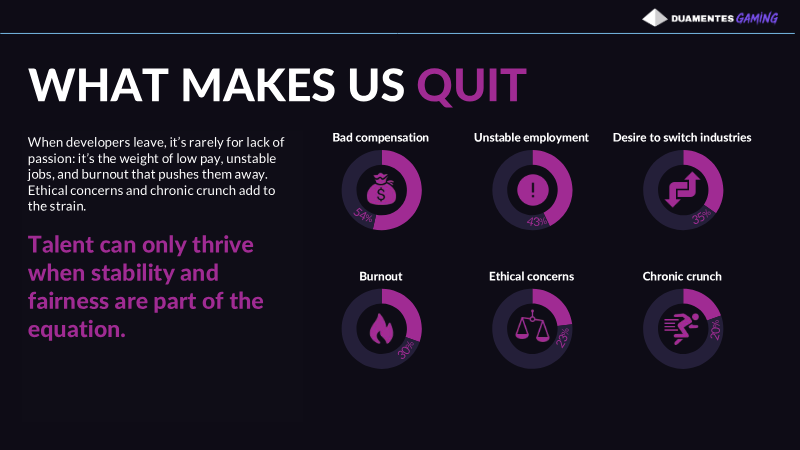
here and I kind of hope that some of you can get inspiration from this and I also want you to pay attention to your mental health when you're already on your job journey to like see whether a company fits you the same way you fit the company just to make sure that you're not going down the wrong path so mental health and numbers first thing is that take this as an uh industry um nonprofit that's working on decreasing and increasing decreasing stigma and increasing support there we go for mental health and Gams uh and also released um paper that's called the state of the industry so taken the numbers are taken from there for once uh the industry is incredibly lateral change friendly but we also lose a lot of people to other fields only a third of developers REM remain in the industry for 10 years and more the other thing is that the average numbers of employeer is like in a 5year period is 2.2 uh this kind of job instability is related to increased stress work anxiety and depression which is exactly what we don't want and uh well more than half of us
admit that crunch is an expected part of their jobs now for those that have not heard the term before crunch is compulsory overtime during the development of a game and often uncompensated the symptoms of crunching are related to burnout on the other hand then and are identified by emotional exhaustion reduced personal accomplishment and feelings of hopelessness so the impact on your job search there you might be thinking that's all fine and information that but what am I doing with it this this is kind of not encouraging if not the opposite well I'm telling you this because I personally chose to ignore that I took the first job I could get in marketing and I burned out in the trial period uh because neither me nor my employer saw it going anywhere and I'm still recuperating from that again sometimes it's not worth it to take that job so if you take one thing away from this talk let it be the notion that mental health is a valuable scarse resource and you should treat it like one now the other thing is that you shouldn't let the job shortage in quotations for a reason scare you my
company was just at a big convention H trying to compete with other employees for like new people to hire and like we are looking for people the jobs are there and don't let it scare you um and also the other thing is that like Dennis mentioned not the only jobs in games are not just programming and art and I want you to remember that you can find something that suits your needs and like find something that will make you happy however I do understand being scared like feeling like you can't afford it to be picky in a financial sense but also in terms of inexperience but you just need to believe in you you can do this and there's more than enough people willing to take you and even if you accept to go to a place that does crunch you should make a conscious decision about the tra of you're willing to take and can prepare yourself mentally in order to make it have less an impact of you the other thing is that you should take some time to hone your craft and value your hobby projects why am I saying this because I started as a programmer but I got hired for my experience in Twitch streaming uh it's
not as a content creator even it's just through the skills that I collected like social media marketing Community Management video editing minor graphic design you say it not only would I've never thought that some of these things are actually useful I also think that they allow me to do something that I love every day at my job which you guessed it kind of benefits my mental health so now the typical questions you're given to see whether you fit somewhere or whether something fits you are those self-elevation questions what kind of environment do you work well and what kind of team do you need where do you want to go where is your job path going trajectory wise however when I wrote that slide someone told me that I really appreciate dearly that those things can take 10 years to learn and you probably don't have the time so let me give you a shortcut until you intrinsically know the answer to those questions the awesome pseudoscientific results of personality tests and yes I'm serious not the bus feed kind I think I need to point that out but they can give you a list of your strengths and weaknesses when you can't come up within
yourself so you can start your self valuation from a solid Baseline and improve upon that instead of starting from scratch and some more sweet inside on knowledge the one that's on the on the screen right now is one that I took because it was part of the interviewing process for my company we actually use it to see how someone like feels and whether we have the kind of personality needs that this person would give us um it's a paid test it's called insights uh but there is comparable ones called 16% personalities that will give you similar information and another thing that they told me is that a typical startup makes the mistake of like only hiring people that are exactly the same like them but any good company will make sure to hire someone from every corner to make sure they're balanced so you don't need to be worried if the result scares you basically everyone is needed somewhere all right the other thing is that I also talked to L about is the fact that you can evaluate the company if you can't like evaluate yourself now because that's too hard you can just change the question around and the best
way to do that is when they ask you this Infamous question do you have any questions for us I would not believe how many people say no to this which not only leaves a bad impression because it shows you're not interested but you're also wasting a very valuable opportunity so instead you can ask what does a successful person at your company look like because that allows you to prepare and if even if this in youw goes wrong you can still use that knowledge for the next one and because we don't have time to give you an entire list there's a link take a picture I'm going to end on that slide for a reason with a good reverse interview so everything that you can ask a company to figure out whether they suit you now on that note uh do you have any question for [Applause] [Music] us all right thanks so uh we'll take questions now there's there's two mics you can line up I guess you're first on the left
all right hi I'm Josh Temple I'm a current senior at the games program at UC Santa Cruz uh earlier when you're talking about designing a good portfolio website you talked about uh a great narrative for me personally I'm bit of a programmer bit of a designer mixed together how would you maybe suggest going about crafting a narrative because like some of my projects are just like a board game that's like pure design that all did but then some of my other projects are like oh I just did the programming for this okay so the question is basically um I'm both a programmer and a designer what should my narrative be I have some design Focus things some program Focus thing uh so actually on on that note so the David shaver site I mentioned David is actually both a programmer and a designer uh he does a lot of scripting as well as level design so that would be like a good one to look at um but in general like so the one way you can sort of think about it is look at sort of job postings that are interesting to you and think about can you craft your portfolio
to match that job posting so if you're both a programmer and designer the first thing I would think is like do you think of yourself more as a technical designer or as a gameplay programmer find portfolios for either of those roles and look at job hostings for either of those roles whichever one you're most interested in like craft your narrative around that awesome thank you very much um all right so we'll do the next one on the right hello um I'm wondering if putting are the results of that personality test on our resume is a good idea uh so the question is should we put the results of the personality test on a resume well I'm going to take that one h no um it's one of those things where it's nice hack to get to know yourself and if you can figure something out that you can put on the resume instead that would make way more sense than just the like just the numbers because we all know those numbers are not the most accurate thing in the world but if you see a strength in there in the list that actually think like suits you describes
you why not put that on there instead okay thank you yeah don't put down that you're an infp whatever I I'm an infp actually but all right left side uh hi I'm aosh I'm a current senior um so I have two questions first uh I'm in college uh four years technically felt like two um do job people acknowledge that it's been two years for every senior that's here um because we did have like covid and uh it feels like our college experience is a little bit shorter than what is normally the case um and sometimes in like interviews I've done it's felt like they don't really feel like this is the case they're like why haven't you done more I don't know the whole world's shut down for two years so um so I guess the question is do companies like how do you navigate around Co so how do you naate the fact that I guess as a student during Co you may not have as impressive
portfolios and such as prior yeah Luke do you have something to say on uh so I graduated college in 2021 uh so I kind of empathize with you I kind of get that situation uh I think that you'd be surprised how understanding uh people would be in that situation like when I was applying to jobs I mean it was obvious like we were just coming out of the pandemic or even still kind of in it you know situation so people understood where you were coming from and while yes it's it's it's difficult um I think the being able to spin it in a way of like I did what I could and um if there's a way to show that you went over um Above and Beyond in that situation it'll look even better yep uh and then my second question is I noticed a lot of y'all were product managers or production or something and that's something I want to go into but I've always been curious what you recommend production portfolios look like because uh we do more soft skill stuff or at least in my opinion like
Trello Tas list or you know organizing meetings and stuff like that all right so the second question is uh what should a production or product manager portfolio look like Dennis do you have ideas um so in my previous experience um I've came out of a highly technical role uh I had a lot of trouble convincing game developers I was capable of taking my experience from Aerospace to game development so I took what I knew from product management Aerospace and created projects that appli to game development so in my portfolio I have two games that I've worked on and I broke them down on how I would analyze the target audience and how I would build features to drive metrics so my advice to you would be to do exactly that if you want to be a product manager I want you to take a certain game take your favorite game one that you have really deep knowledge Within and try to understand if you were to build a new feature how would you
engage that target audience okay yeah thank you um I think Natalie something to try in as well yes because I have an answer to both of your questions sure uh for once I was originally a programming student and I stopped that during the pandemic because I was just deeply unhappy with how studying was going uh but I also know that I'm part of the hiring process at our company and we hire not based on experience but on talent and values so as long as you can make like show people that you care and that you tried and even if you failed if you're being honest about that I can actually help uh there's a reason I shared my diagnosis with you not because I'm actually like you know it it it didn't change things if anything it made me stronger and the same thing with the uh resume thing like I put my Twitch streaming on there I'm pretty sure you put a hobby like you have a hobby that you did bring you through Co something that made you stronger in a way even if you don't notice it so if you can analyze it and put that on your resume somehow it shows that you've done things even if they're not studying if you DM for Dungeons and Dragons awesome you can write stories there is ways to to phrase
it in a nice way thank you so much all right uh right side yeah so I am a current sophomore at the college Charleston so I'm looking towards internships starting very soon I've got backgrounds in programming but I want to do narrative design is it is there any like special sauce for inter for internships or is it just email companies and ask do you have any because I know internship season is much more starting in the fall yeah so the question is as a sophomore looking for internship like what how does that differ than looking for a fulltime position um aenda something yeah maybe I can answer this like for example I see on LinkedIn if I follow companies that for companies they search for internships so literally if you follow those companies you will always receive their internship calls at the right time even faster than if they put it like online so sometimes they're already full very fast so I would really advise to uh like find people uh the like connect
with people with the company that you really like U make friends online and that's my advice with this yeah I think the other thing possibly you can do is just look at like it may be too late in this cycle but if you look at like when were the job applications out for the companies or roles that you're interested in and you can start preparing for the next cycle um I think typically smaller companies may still have openings right now but the big big companies have all kind of uh done done stuff by now um all right uh left side yeah hi I'm Sam I'm a recent graduate um and I was wondering most of what I do is narrative design I write a lot and it's I've always had trouble like presenting that in away on my portfolio that looks engaging because it's a lot of writing stuff it's not it's just a big block of text it's hard to like get like a screenshot of that that looks interesting I was wondering if you had any uh tips um I mean I'm not narrative programming I I'm more of a programmer
but I would suggest like if you can get something like twine where you can take your narrative and make it an interactive experience so it's not just I mean I think having your script or your your WR written document is is useful but if you can if you're going for games if you can show that you can take your your narrative skills and take something like twine which doesn't require much technical knowledge to be able to set up um I think that would really help your narrative portfolio thank you uh right side hi I'm a student who has skills in audio and music composition and I'm about to build my portfolio but how should I have a narrative that holds people's attention when all I really have is disconnected soundfree personal projects and also music separate from that so I guess the question is how do I hold people's attention as someone with skills in in audio when I don't have that much visual stuff right so the question is what should I do for a sound designmusic portfolio I mean I I think I would imagine in that case like they're
not expecting fancy visuals and videos of it but I mean if you have a video of your audio or sounds being used in a game project I think that would help um you could have samples of your music um on Soundcloud or whatever platforms you use so I think uh it's definitely it's going to be a little bit different than the examples I showed for sure um but again I would suggest regardless of your discipline try go go on Google Search for you know sound composers or sound designers in games what do their portfolios look like and that should give you some ideas to brainstorm off of thanks guys thanks for being here uh left side hello so I graduated last May and I've been applying to jobs ever since then over a 100 easily and I've only ever gotten one interview I have re overhauled my resume in portfolio about four times each now almost five is from all the advice I've done here and
um the one interview I had I actually made it to the design test I didn't get past that so I feel like I have the interview process down pretty well but my problem is Just Landing one in the first place and considering how many times I've updated my resume portfolio I don't know what's wrong I'm making more stuff to add to my portfolio and resume all right yeah so the question is um what do you do if you put out lots of applications but barely hear back from anything actually Lynette I'm curious so of the 32 interview like were there a lot more applications from that or how how like what percent of your I was giving out on average about I was applying to about 25 companies a day okay I really needed a job because I was an immigrant and I needed to stay in the country so when I say it's a numbers game it's the best cliche there is it's a numbers game okay the number of people that responded to me was very less the number of people that I could
communicate was even less though I accelerated my interview process so don't give up if you've already updated as much as you can it is a numbers game it definitely was at least 25 a day because that's I needed a job that I should probably so if you're doing everything you can don't be afraid you know to also ask for if they even if you are talking to HR don't be afraid to just be like okay if they if they say hey we're not looking just say hey you know can I would like to apply in the future can you tell me what I can do to improve myself just ask them for that a little bit little bit of feedback it always helps all right thank you very much I think something to add yeah oh sorry I have more to add to that um My Method works if you have the time if you don't need a job right now my method works like overtime so you definitely want to like Target the companies that you want to work for like please limit it the 100 is a lot but that's like it's like swiping right on Tinder you're looking for the most def desperate person um so I I want you to limit your
companies to five to seven companies I want you to research the roles in those companies that you want and the people who work in those roles I want I want you to cold email them and I could send you a template later I want you to cold email them and ask them about what it's like to work in that role and they could possibly look at your portfolio and I I want you to prepare yourself for those those roles when I was doing my interviews I was uh also applying like five to seven at a time and out of those five to seven I would typically get two which is like I don't know what percent that is someone can do the math on that um but every single time I would just do five to seven at a time because of that that methodical approach is so labor intensive but I in my experience and to the friends that I've given this advice to uh they tend to get more hits when they are they have a more targeted approach so I want you to tailor your entire approach to the specific companies that you are interested in because your passion will show okay luk
has I think just a quick yeah just just quickly my situation was very unique because I had a recruiter on LinkedIn actually reach out to me to apply for my position and the way I went about doing that uh is I like added every person on LinkedIn that was in the industry I could find essentially because you have to think of it as you like your LinkedIn is you advertising yourself and the only way people are going to see that is if people see your profile so the more people you can add the better but definitely to Dennis's point you know you want to tailor it to exactly what you want yeah I think the one thing having been on the hiring end of reviewing applications you can tell when an application is just a shotgun application that they're sending to lots and lots of places and it's the same generic cover letter so like I think if you can spend more time on specific what positions are you really excited about and interested in that would help I will say that is one struggle I have is I am a system designer that plays almost every single genre of game therefore I love thinking about almost every single mechanic there possibly is
and yeah I don't know what to choose so yeah I think that's something maybe to think about more like find you know maybe use iy method right let's go on to the thank you next question on the right when I'm creating my programming portfolio how do I find a balance between not enough information and too much to read sorry I couldn't hear the L not enough so I'm a programmer portfolio how do I find the balance between not enough information and too much to read too much to read um so I think uh what I would suggest is that you for program portfolio you're really focus on showing me like what are the coolest things that you've done don't give me your entire storage code for your whole game show me like the two or three really cool coding things in uh we can talk maybe a little bit more in the I can give you some more personalized advice maybe in the after session thing um because it's really going to depend on like what type of programmer role you're kind of interested in but um I think it's it's definitely possible to to find that balance for sure okay uh let's go on the
left side all right um hi there I graduated from RPI and I'm looking for jobs in uh narrative design and I think one of the things that I have found difficulty in actually is the tailoring process with how time intensive it is and I've been trying more to you know actually you know just mass apply for things but you know I keep hearing that like that's not as effective and it seems to go back and forth for me so like with respect to targeting companies um I'm wondering how exactly you're kind of supposed to balance you know your focus um on and like nail down and ensure that you can I guess get what you're looking for if a you don't think the company hires
you know the kind of person you are B you have like limited time to apply for each you know kind of role that's posted if there is one and see if like you are missing some crucial piece of your application that you need to get even to the interview um I know that's kind of a loaded question um um some you know if you can't like wait so long or don't have the time to like keep going back to those companies cuz you could be applying for years if you if you tailor like extensively can I summarize it real quick uh because we got we got trying to get a couple more questions but sorry so uh so the question is basically how do you find the balance between like tailoring it per specific application spending a lot of time on it and the balance between that and math applying for lots of stuff um because it's kind of two competing forces um I don't know
like dind there L San uh actually um like going back to what Luke just said earlier that sometimes the connection you have to people can matter even more than what you're applying for and how you're applying for so if that's what you struggle with and you realize you have some people skills and like can just go to places like this and talk to people get those business cards in at least in our company we always like add an extra for we met this person in person like that can help you and that can give you an up and you are a GDC so this is the best place to try it if you just get yourself out there like physically and connect with people that can mean just as much as like tailoring it a little bit more I see all right uh right side yeah uh student in college student in college still in the middle of it um but I'm looking and curious about what kind of roles like even exist in the industry for me to pursue after I graduate I don't really know what kind of specific
directions what what to even like tailor my resume 4 I'm not even at that stage yet but I want to start thinking about do you guys have any specific places any advice on learning figuring out getting information on what kind of like roles especially I'm not really a programmer or artist um so outside of those kind of roles um any places to look all right so the question is like I'm still kind of in college and I'm not sure exactly what roles I'm going to do but I know I don't want to do programming and art probably so I think Luke has a yeah so the role I have now um I I've worked a lot in liveops and I didn't know what that was when I was in school uh so it's there's a lot of roles that are kind of like coming to the surface that might not have even existed a while ago cuz things like live service games just didn't really exist back in the day but now that's a huge part of our industry so it's it's something you really have to
keep your ear to the ground of constantly looking to see what are the current trends what are new things uh what what would you suggest looking to do I keep my ear to the so honestly like um like any discords I kind of as adinda was saying is like um game game developer discords as well as GDC talks you know crazy like you can go through the Vault and then through the public YouTube like find oh I don't know what this role is that this person's talking about watch that maybe you'll be interested keep your mind open all right let I have something to add to that you only got like one minute so let me just do one last question but we can talk more uh we'll talk more outside as well let's see the question on the left last question um so I have a question um so earlier in the presentation the igy document template was um was mentioned but I don't see any QR code for it oh uh yeah maybe we can just give it to you after we'll give it to you outside right now and for the question was where's the KY method worksheet but yeah Dennis will
have the link you can give it to you afterwards um I think we're probably out of time now so if you have more questions we will be in the right across the way in the speaker area uh so wrap up area thanks [Music]
Auto-generated captions from YouTube — names and numbers may be misheard.
Key insights
Distilling the key insights…
Ask AI about this video
Cite this video
Citation
Generating citation…

















Comments