1 free read left. Create a free account for unlimited reading + AI research.
Create free accountWhitepaper DiGRA
1 free read left. Create a free account for unlimited reading + AI research.
Create free accountWhitepaperDiGRA
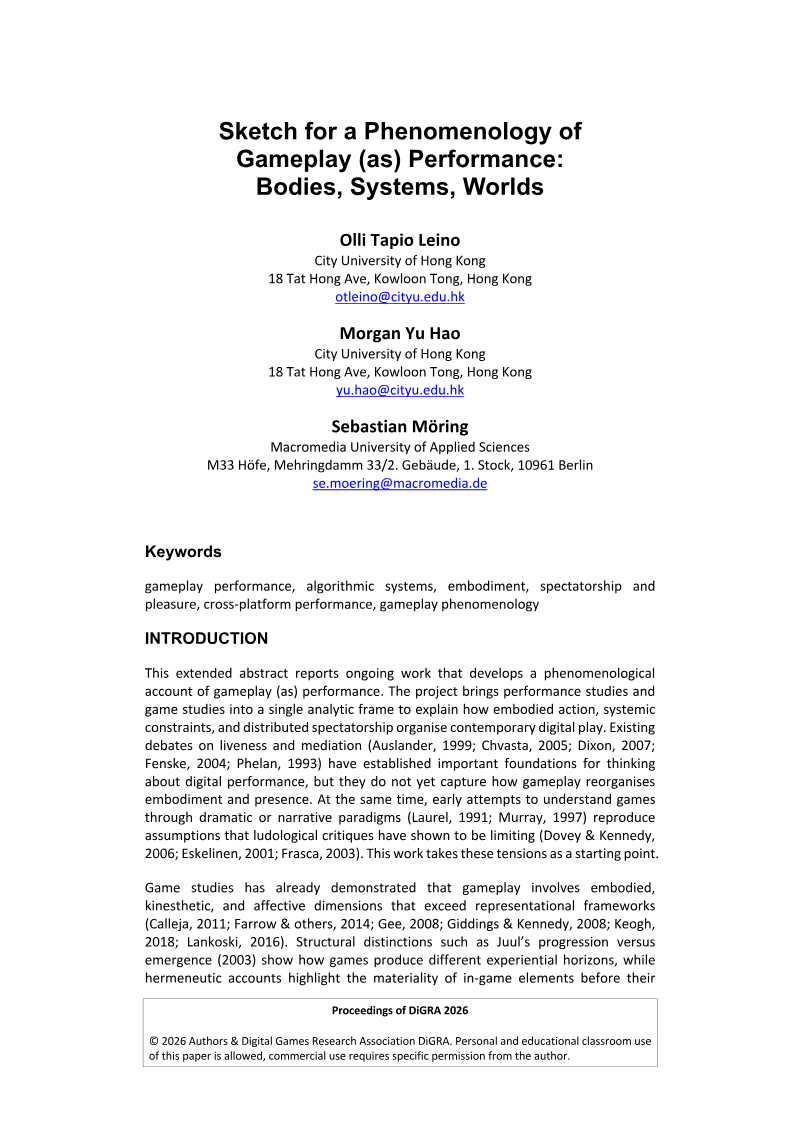
The paper argues that contemporary digital play is shaped by embodied action, the procedural constraints of rule-based systems, and distributed spectatorship.
This extended abstract outlines an ongoing research project that develops a phenomenological account of gameplay as performance, integrating performance studies and game studies. The central thesis is that contemporary digital play reorganizes embodied action, systemic constraints, and distributed spectatorship in ways not fully captured by existing dramatic or narrative paradigms. The project introduces the concept of the "gameplay condition," where rule-based systems establish an existential baseline for interpretation, imposing risks and consequences that structure meaning through exposure to system-imposed failure.
Key findings emphasize that gameplay involves embodied, kinesthetic, and affective dimensions beyond representational frameworks. Digital embodiment is not abandoned but reorganized across interfaces, avatars, and algorithmic processes, with spectators recognizing and responding to this reorganization as a source of tension, pleasure, and empathetic alignment. The scope of the analysis covers cross-platform gameplay, acknowledging that actions performed in a game engine can be watched live, in physical venues, or asynchronously, challenging assumptions of single spatial or temporal fields for performance. Liveness in gameplay is defined as the alignment of embodied effort, algorithmic risk, and spectatorship, irrespective of physical co-presence.
The methodology involves an existential configuration model with four dimensions: body, space, time, and world. This model analyzes how performers and spectators relate to each other and to the game system. Examples like Dead-in-Iraq and Mega GIRP illustrate how symmetric or asymmetric vulnerability and spatial/temporal access influence the legibility of performance. The "world" dimension integrates concepts of precarity, ludic challenges, and fictional pressures to clarify how meaning emerges from the interplay between embodied action and algorithmic structure. The project contributes to both performance studies by extending concepts of embodiment and liveness to algorithmic environments, and to game studies by offering a phenomenological account of gameplay that foregrounds systemic, embodied, and world-specific conditions rather than dramatic analogies. The research is supported by grants from the Hong Kong Research Grants Council.

DiGRA · 2026

DiGRA · 2026



DiGRA · 2026



DiGRA · 2026



DiGRA · 2026



DiGRA · 2026



DiGRA · 2026



DiGRA · 2026



DiGRA · 2026

DiGRA · 2026



DiGRA · 2026



DiGRA · 2026

PocketGamer.biz · 2026