1 free read left. Create a free account for unlimited reading + AI research.
Create free accountWhitepaper International Journal of Serious Games
1 free read left. Create a free account for unlimited reading + AI research.
Create free accountWhitepaperInternational Journal of Serious Games
This can limit the real-time observation of cognitive processes.
Serious games serve as a sophisticated medium for cognitive assessment, offering an ecologically valid alternative to traditional neuropsychological testing. By integrating psychometric frameworks directly into gameplay, developers can transform open-ended virtual environments into reliable instruments for measuring executive functions. This approach bridges the gap between game design and clinical evaluation, ensuring that player actions within a 3D environment provide quantifiable data that aligns with established psychological theories.
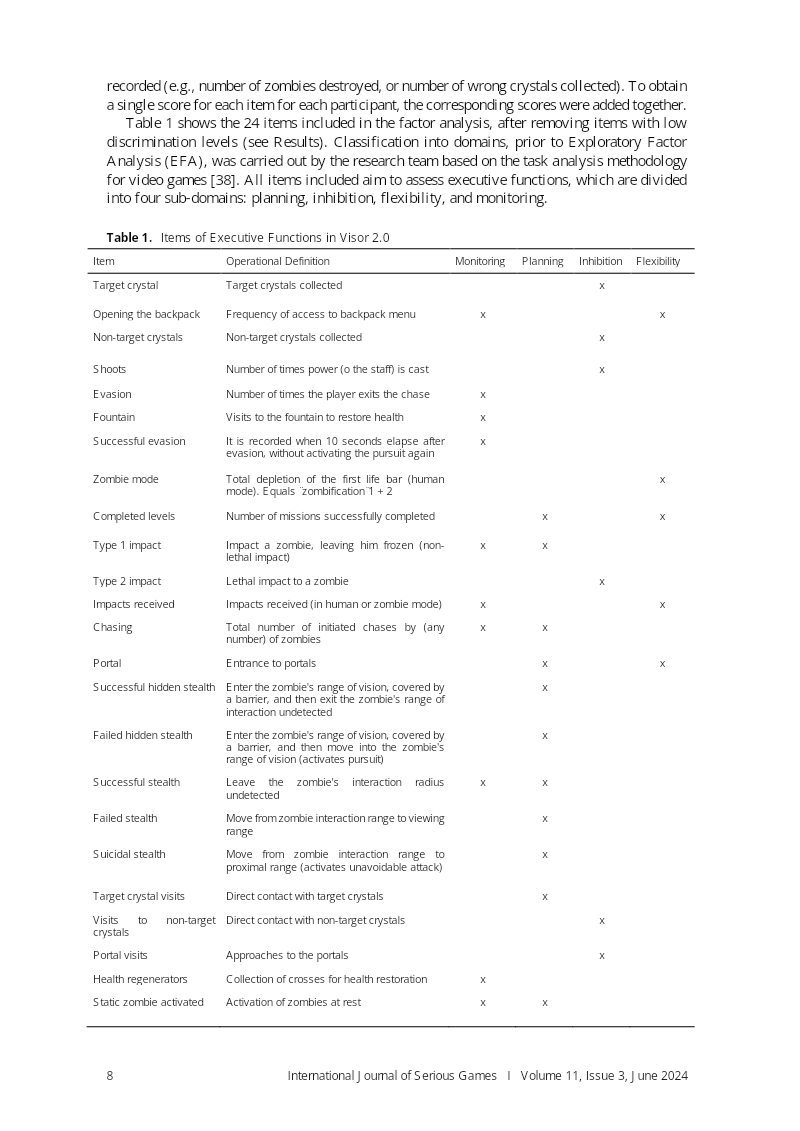
The validation of the Visor 2.0 platform demonstrates the efficacy of this methodology among children aged 5 to 12. Through exploratory factor analysis of 171 participants, the research identifies two core cognitive dimensions: inhibition and planning, and monitoring and flexibility. These factors exhibit high reliability and strong model fit, confirming that task-based analytics can capture complex cognitive traits without the intrusive nature of conventional testing. The success of this model underscores the necessity of embedding psychometric rigor into the initial design phase of serious games.
Ultimately, the transition toward gamified cognitive assessment represents a significant evolution in neuropsychology. By leveraging the immersive nature of virtual platforms, researchers can observe cognitive processes in real-time, non-clinical settings. This synthesis of game design and statistical validation confirms that when gameplay functionality is intentionally mapped to cognitive constructs, serious games function as robust, scalable tools for assessing developmental progress and executive function performance across diverse populations.



International Journal of Serious Games · 2026
International Journal of Serious Games · 2026

International Journal of Serious Games · 2026
International Journal of Serious Games · 2026
International Journal of Serious Games · 2026



International Journal of Serious Games · 2026
International Journal of Serious Games · 2026
International Journal of Serious Games · 2025
International Journal of Serious Games · 2025
International Journal of Serious Games · 2025
Serious Games Society · 2025
International Journal of Serious Games · 2025
International Journal of Serious Games · 2020