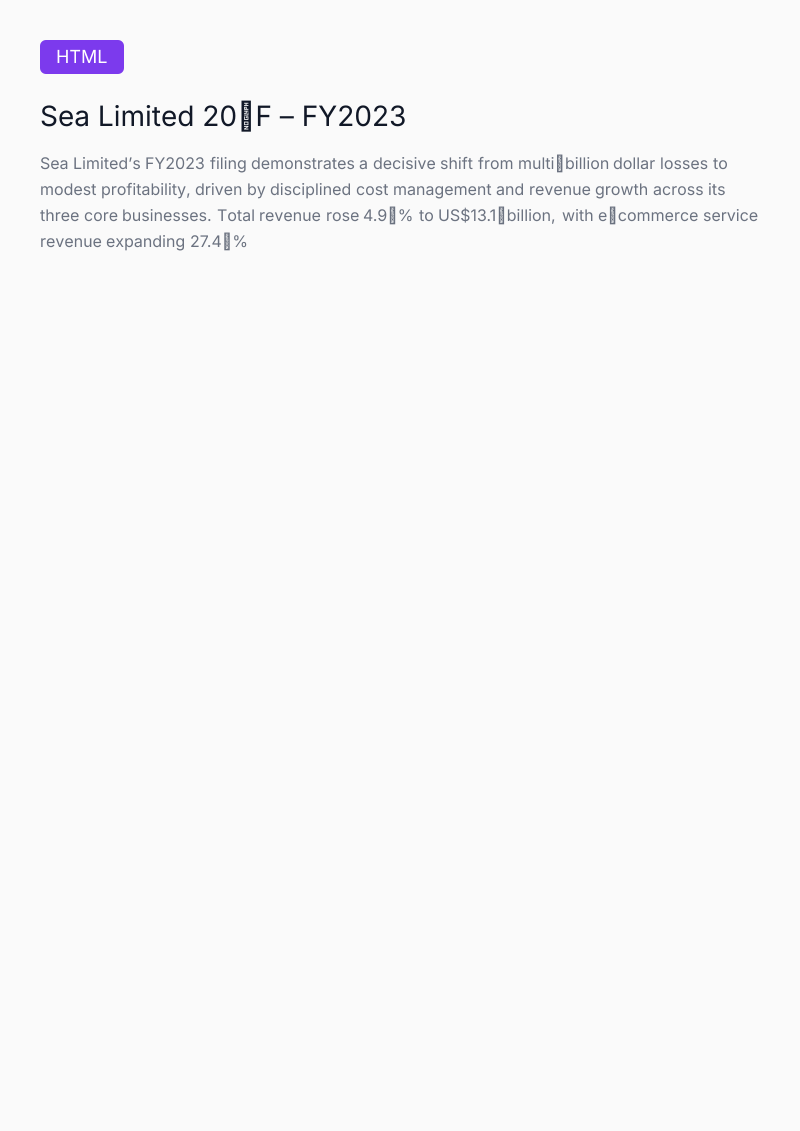
Sea Limited’s FY2023 filing demonstrates a decisive shift from multi‑billion dollar losses to modest profitability, driven by disciplined cost management and revenue growth across its three core businesses. Total revenue rose 4.9 % to US$13.1 billion, with e‑commerce service revenue expanding 27.4 % and digital‑financial services increasing 44 %. Gross profit improved to a 44.7 % margin, while operating expenses fell 16 %, enabling a net income of US$162.7 million after a loss of US$1.66 billion in 2022. The turnaround is attributed to a gain on debt extinguishment, reduced share‑based compensation expense, and tighter control of entertainment costs.
Geographically, the company remains concentrated in Southeast Asia, with Shopee’s marketplace generating US$78.5 billion GMV and 8.2 billion orders, while SeaMoney’s credit, wallet, banking and insurtech services expand across the region and Brazil. Regulatory exposure is significant: multiple jurisdictions—including Indonesia, Taiwan, Vietnam, Thailand, Singapore and Malaysia—impose foreign‑ownership limits, data‑protection mandates, e‑commerce licensing requirements and anti‑money‑laundering rules. Sea’s use of variable‑interest entity (VIE) structures and tiered “holdco” arrangements allows it to consolidate operations despite local restrictions, yet these arrangements carry regulatory and operational risk if authorities deem them non‑compliant.
Financially, cash balances stood at US$4.24 billion after heavy investment outflows and a net operating cash use of US$3.37 billion, while convertible‑note obligations of roughly US$3.2 billion were partially redeemed or converted. Capital expenditures reached US$258 million, and the company’s liquidity is expected to cover near‑term obligations. Governance remains concentrated, with founder Forrest Li holding 18.5 % of ordinary shares and Tencent providing an 8.6 % voting proxy; the board’s six directors collectively own 41.7 % of Class A shares.
Overall, Sea Limited’s FY2023 performance reflects a transition to profitability amid complex regulatory landscapes and concentrated geographic exposure, with continued focus on efficiency, ecosystem integration and risk management essential for sustaining growth.
Sea Limited · 2026
Sea Limited · 2025
Sea Limited · 2024
Sea Limited · 2023
Sea Limited · 2022
Sea Limited · 2021
Sea Limited · 2020
Sea Limited · 2019
Sea Limited · 2018
Sea Limited
Sea Limited
Sea Limited

Aream & Co · 2026
Drake Star Partners · 2026
Modern Times Group · 2026
Drake Star Partners · 2025
Drake Star Partners · 2025
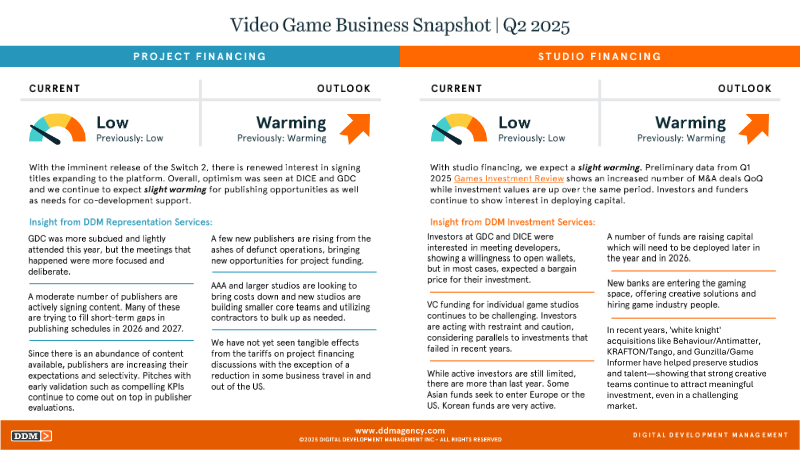
DDM · 2025
Drake Star Partners · 2025
Digital Development Management · 2025
DDM · 2025

Thunderful · 2025
DDM · 2025
Aream & Co · 2025