Key insights
8 slides
The setting
Nearly two decades of school LARPs in one Polish town.
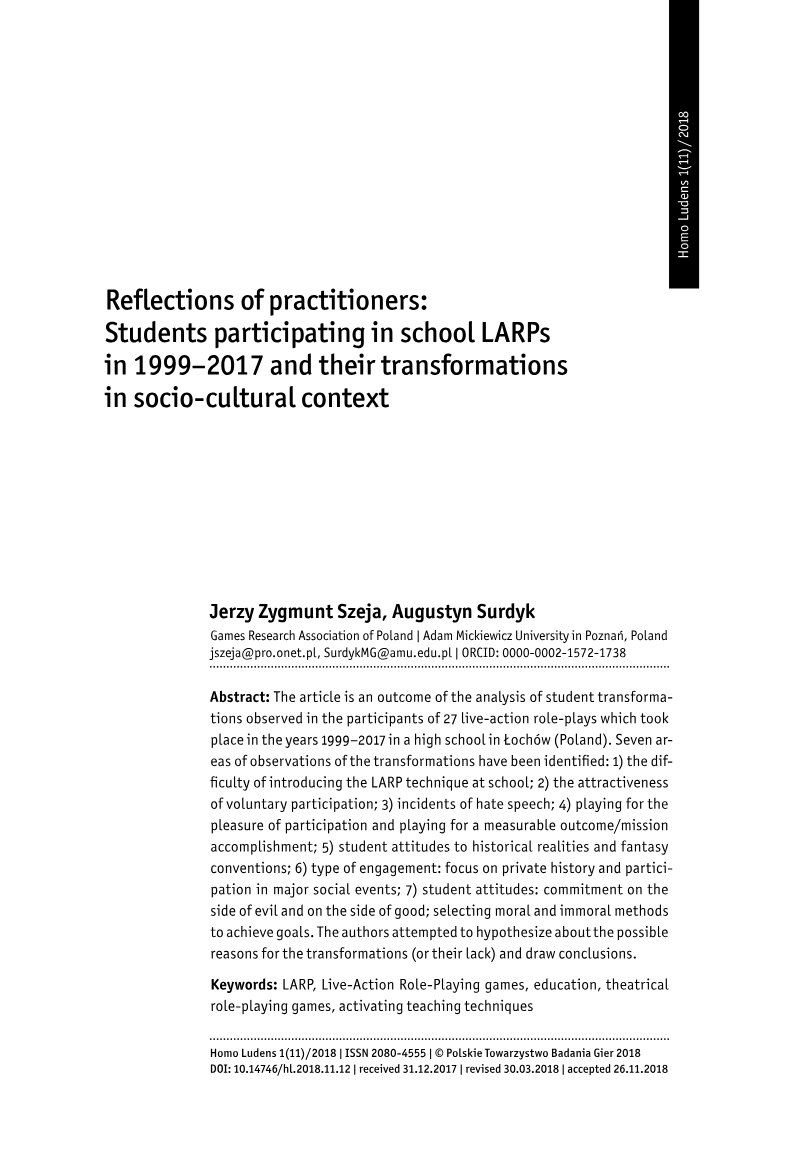
The study examines 27 theatrical role-playing games held at a general secondary school in Łochów, Poland, between 1999 and 2017. The authors track changes across seven dimensions.
1 / 8
- 01The study tracks 27 theatrical school LARPs held at a general secondary school in Łochów, Poland, between 1999 and 2017, examining changes across seven dimensions including ease of introduction, voluntary participation, hate speech, and moral choices.
- 02Introducing LARP into schools became easier over time, plausibly because fantasy conventions grew familiar through films and computer role-playing games, while securing participation became harder amid better transport and competing home and mall entertainment.
- 03No clear rise in hate speech during the games was found, suggesting that greater online visibility may explain perceptions that hate speech had increased.
- 04Play shifted gradually toward outcome-focused behavior, which the authors attribute to Poland's testing-oriented education system.
- 05Students showed stronger familiarity with fantasy literature such as Tolkien than with historical figures or authors like Sienkiewicz, and their interest in recreating historical realities declined.
- 06Character choices showed a decline in collective, socially oriented engagement across the years, with a recent apparent rebound plausibly linked to public debates about Polish history, while moral attitudes showed no clear long-term trend and players who began on an unethical path tended to persist.
- 07The authors conclude that active, theatrical methods remain valuable for engaging motivated students, though their findings are framed as hypotheses warranting further rigorous investigation rather than firm proof.
Ask AI about this article
Summary
This study, authored by Jerzy Zygmunt Szeja and Augustyn Surdyk of the Games Research Association of Poland, examines how school-based live-action role-playing games (LARPs) evolved over nearly two decades in Łochów, Poland. Drawing on 27 theatrical role-playing games held at a general secondary school between 1999 and 2017, the authors track changes across seven dimensions: the ease of introducing LARP into schools, the appeal of voluntary participation, the prevalence of hate speech, play oriented toward enjoyment versus measurable outcomes, attitudes toward historical versus fantasy settings, the type of engagement pursued, and the moral and ethical choices players made. The stated aim is to propose hypotheses about the causes of these shifts, and the authors frame their conclusions as reflections meriting further rigorous investigation rather than firm proof.
Among the central observations, introducing LARP became easier over time, plausibly because fantasy conventions grew familiar through films and computer role-playing games, while securing participation grew harder amid improved transport and competing home and mall entertainment. The authors found no clear rise in hate speech during the games, suggesting that heightened online visibility may account for perceptions of increase. Play gradually shifted toward outcome-focused behavior, which the authors attribute to a testing-oriented Polish education system.
Students also displayed stronger familiarity with fantasy literature, such as Tolkien, than with historical figures or authors like Sienkiewicz, and their interest in recreating historical realities declined. Character choices revealed a decline in collective, socially oriented engagement across the years, with a recent apparent rebound plausibly linked to public debates about Polish history. Moral attitudes showed no clear long-term trend, though participants who began on an unethical path tended to persist in it. The authors conclude that active, theatrical methods remain valuable for engaging motivated students.