1 free read left. Create a free account for unlimited reading + AI research.
Create free accountWhitepaper International Journal of Serious Games
1 free read left. Create a free account for unlimited reading + AI research.
Create free accountWhitepaperInternational Journal of Serious Games
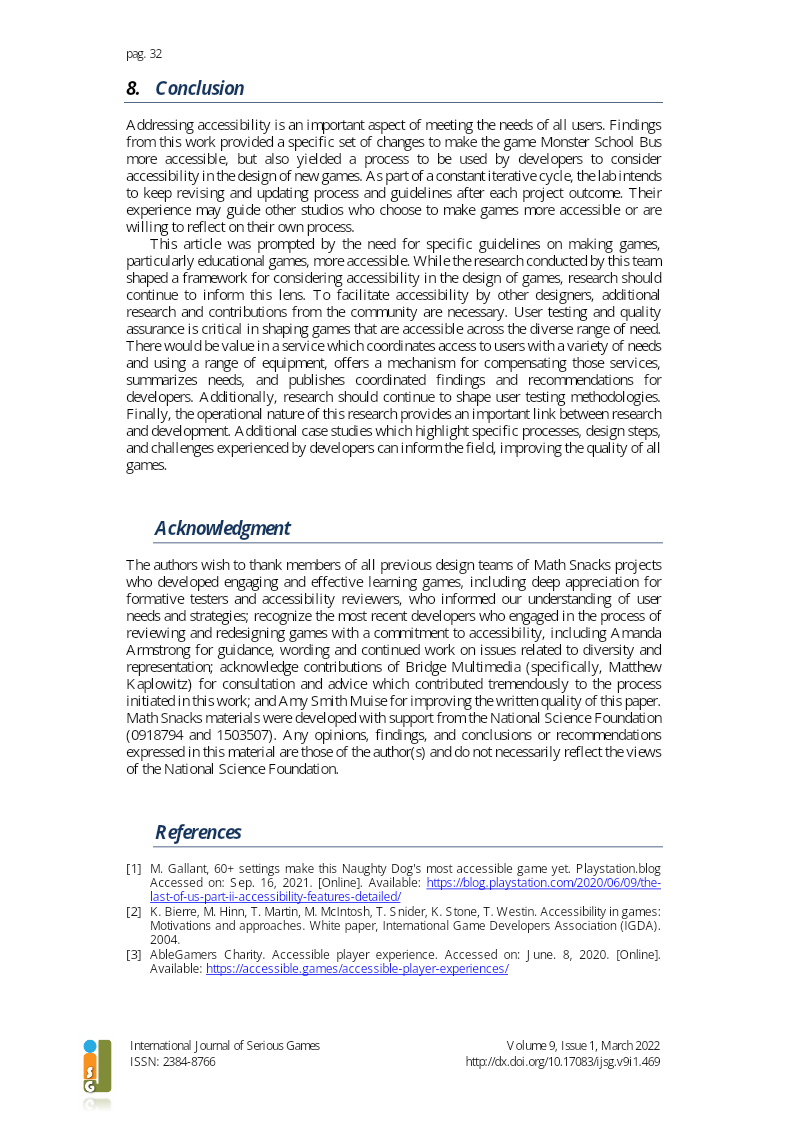
Accessibility should be a core design philosophy, not a post-production technical requirement.
Like designing a building with ramps from the start, rather than adding them later, it makes the structure better for everyone.
Core Principle. Accessibility as a core design philosophy results in a more intuitive and polished user experience for all players.
Educational game design requires a deliberate balance between pedagogical objectives and the diverse needs of players with visual, auditory, motor, and cognitive disabilities. By applying an iterative action research methodology to the Math Snacks suite, developers can successfully navigate the complex trade-offs inherent in retrofitting interactive media for 508 compliance. This process demonstrates that accessibility is not merely a technical requirement but a design philosophy that, when integrated throughout the development lifecycle, results in a more intuitive and polished experience for all users.
Key modifications such as remappable controls, standardized decimal representations, and the removal of restrictive time pressures illustrate how removing barriers enhances usability. These design choices prove that addressing accessibility contradictions often leads to superior gameplay mechanics and clearer communication of learning goals. Furthermore, the implementation of open-level selection systems and literal visual cues highlights the importance of flexibility in educational software, ensuring that diverse learners can engage with content at their own pace and according to their specific requirements.
To standardize these practices across the broader industry, development studios must move beyond treating accessibility as an afterthought. Success relies on fostering team-wide engagement, establishing evolving internal guidelines, and prioritizing continuous user testing. While current efforts demonstrate significant progress in creating inclusive digital environments, the industry requires centralized services and community-led research to coordinate testing efforts effectively. Ultimately, embedding accessibility into the core of game design is essential for fostering equitable learning outcomes and expanding the reach of educational technology to every student.



International Journal of Serious Games · 2026
International Journal of Serious Games · 2026

International Journal of Serious Games · 2026
International Journal of Serious Games · 2026
International Journal of Serious Games · 2026



International Journal of Serious Games · 2026
International Journal of Serious Games · 2026
International Journal of Serious Games · 2025
International Journal of Serious Games · 2025
International Journal of Serious Games · 2025
Serious Games Society · 2025
International Journal of Serious Games · 2025
European Conference on Games Based Learning (ECGBL) · 2026
International Journal of Role-Playing · 2026
DiGRA · 2026