1 free read left. Create a free account for unlimited reading + AI research.
Create free account
Power Creep - The Trouble with Expansions and Time - Extra Credits
Key insights
6 takeaways- 01Relying on raw stat increases to drive progression often leads to the rapid abandonment of legacy content and can trigger a mass exodus of the player base.
- 02Designers can mitigate power creep by introducing 'incomparables,' which are gameplay elements that provide distinct, non-numeric utility rather than simple stat upgrades.
- 03Focusing on unique abilities over raw power fosters diverse playstyles where the value of a choice is determined by context and skill rather than numerical superiority.
- 04While implementing incomparables requires higher development and playtesting costs than simple numerical adjustments, it provides greater long-term balance and design flexibility.
- 05Power creep occurs when new content introduces superior numerical performance, rendering existing game elements obsolete and devaluing historical player investments.
- 06When power creep is unavoidable, developers can preserve game health through structural constraints like rotating tournament formats or the use of legacy servers.
Ask AI about this video
Transcript
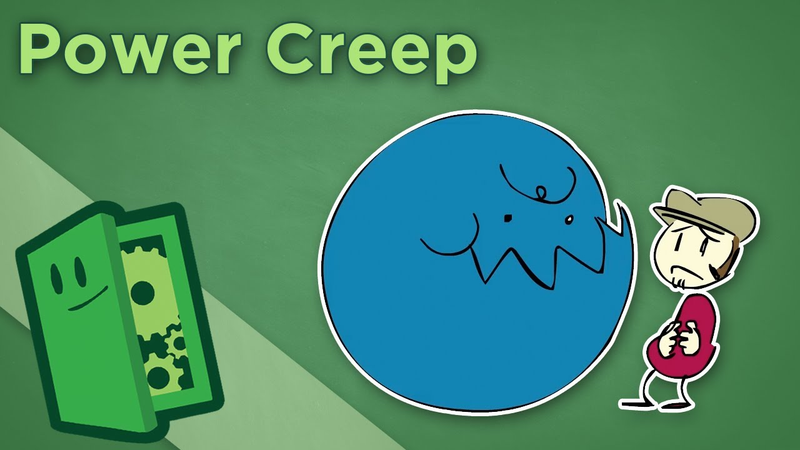
All right. So, Allison's taking a few weeks off to get a much-needed break and to settle into her awesome new job. So, we got a few guests and special surprises lined up for you guys over the next month. First up, I'm very pleased to present today's guest artist, Scott DeWitt. He's the artist behind the webcomic Fanboys and all around cool person. And he's here to help us talk about the issue of power creep. As video games move more towards experiences through online play, persistent worlds, or just constant patching, power creep is an issue that comes up more and more. And as this persistent online play becomes a bigger and bigger part of how games monetize, the issue of power creep becomes more and more of a consumer issue. So, what is power creep? Power creep is the concept that elements introduced to a game over time grow in power as compared to the original elements of the game. We saw it happen with World of Warcraft. Many of the items that were great at level 60 at launch aren't even worth looking at today. Many of the pre-level cap dungeons are no longer really on the
to-do list as they've been outmoded by dungeons that are faster, that give more experience, and give better loot. And you may view this as a natural part of design, but as a designer, you have to separate this into two different factors. First, a natural evolution. As the creators of a game get more tools available to them and get more experience making levels for that game, they're naturally going to start making better levels than before, thereby rendering some of the initial designs obsolete. And that's a great thing to happen to a game, but the second thing is power creep. Now, designers are human beings with real jobs to do, and when you're dealing with perpetual online experiences, there's never enough time to do that job. Sometimes it's very easy as a designer to say, "You know, if I just give the fans better loot or more XP for the same general experience, they'll be happy." And it's true. People like bigger guns and faster levels. We like to feel powerful. Many of these games are predicated on this fact. But this is a dangerous slope to tread. This leads to the rapid abandonment of old content and an unsustainable growth in power. This is a design time bomb for any company looking to make a perpetual game. There are plenty of games that have long ago fallen apart due to this issue, but it's becoming an even greater
problem now that we've changed how we plan to monetize games because for many games, it might now be more than just a path of least resistance. It might be something they choose to do. Probably the best example of this is the game Warstorm after it was acquired by Zynga. This was an interesting little online CCG that was purchased by Zynga in 2010. At the time of purchase, it had a host of issues and some trouble with power creep, but it was fundamentally a sound take on how to do an asynchronous collectible card game. After Zynga got at it, well, the next expansion was radically different. Now, I don't know if it was the fault of anyone at Zynga, but for any of you guys who play Magic, pretty much every card in that expansion essentially read protection from every card made before this set. I know that sounds incredibly silly, but someone somewhere must have said, "All right, I got a brilliant idea. People like cards that are way more powerful, right? We'll just make the next set a lot more powerful and it'll get everyone to buy tons of cards." But of course, this plan backfired completely because collectible card games are designed around the idea that part of what makes them sticky, part of what makes them so hard to give up, is that as a player, you're invested in your collection. And the bigger your collection gets, the harder it is to
walk away from it. So in this case, since all the cards people had previously bought were suddenly rendered worthless, a lot of them simply said, "Well, maybe now's a good time to quit." instead of starting over from scratch. If any of you quit World of Warcraft for a year or so and then went back only to realize that all the time you'd invested in getting the best gear for your character was now worthless and so you quit again, you've experienced one of the negative effects of power creep and you understand why it's fundamentally bad for business. But this doesn't stop people from thinking it might be a way to increase monetization, to get you to pay to keep up with everybody. Now, the designers behind World of Warcraft are good enough that they are well aware of this process and they've created all sorts of release valves such as heroic difficulty for the dungeons to stop the loss of old content. It was a brilliant decision. It improved play while helping to address an ever-growing issue with their game. But often, even the best designers have a hard time really creating content that doesn't slowly creep up in power. So, what can be done to keep power creep at bay? Well, there's really only one real answer, the use of incomparables. Incomparables in design are gameplay elements that the player sees as having a non-numeric relation to each other. So, for example,
the ability to do a short-distance teleport as compared to the ability to stun a single target are incomparable. It's apples to oranges. So, as a player, assuming neither ability is too out of balance, you can debate all day about which ability is better, and you'll never come close to an answer because the better choice depends on the situation and the player's preferred playstyle. League of Legends is sort of the current reigning master on this front. They've managed to create over 90 champions and several years of play based on this principle, and they've managed to do it without power creep. In fact, those of you who play League of Legends probably know that some of the most powerful champions in the game were actually some of the first they ever built because they got better over time at judging the actual effect of new incomparables. If you contrast this with something like World of Warcraft, where much of the gear simply has a set of numerical stats, by side-by-siding any new piece of gear that they create for the game with what you currently have, you can tell if the new gear is definitively better. If it's not more powerful, you end up disappointed because you're never going to use it, so might as well not be in there in the first place. But, if it is more powerful, it forces the power level of the game to start creeping subtly upward. The other advantage to incomparables is that if you can build
enough of them, over time, you end up having a lot more wiggle room in what might be considered balanced for your game. As the number of possible combinations of your incomparables reaches a point where anything in the ballpark of a reasonable that you put into your game can be countered by some crazy combination out there. Games like Ultima Online, Magic the Gathering, and to some extent, even League of Legends, count on this fact to allow them greater design freedom when creating new gameplay elements. Unfortunately, the two major problems with incomparables is that they generally cost more to create than simple numerical systems. I mean, changing data, i.e., numerical values, is easy, but creating new feeling skills or abilities either requires scripting or the manipulation of a very complex web of interacting numbers and flags. And incomparables also tend to force a game to be more skill-based, which isn't always what you want when designing. Of course, for paper games such as Magic the Gathering, this added cost for development isn't there, but in comparables generally also have a higher play test cost as well. After all, it's harder to make sure that you've worded Ice Cauldron in a way that everybody understands than to make sure that the new Grizzly Bears are clear and not breaking your game. There's also a final option to keep power creep at bay if
it's really going to threaten your game, and that is to artificially keep it in check. This is the option that Magic the Gathering took by creating type two, or standard tournament format. This allowed them to modulate power between blocks, and many hardcore Magic players have probably noticed how every few blocks the power of one of the newly introduced blocks is brought back down to around the magic mean of one mana per point of power for decent creatures without abilities. They then reintroduce old cards back into new sets, thereby making them legal to play again and not losing that content to power creep. EverQuest also did this after a fashion with their legacy servers. They allowed players to play the game as if it had just launched with none of the expansion pack content unlocked, and each time the players beat the most challenging monster in a given expansion pack or met some other specified goals, they would unlock the next expansion, thereby giving players the option to use and enjoy content that had otherwise been outmoded by those expansions. You'll find almost any game that lasts long enough, especially if it ever expects new players to join, has to do something to this effect. So, there it is, power creep, why it's terrible for business and can destroy the longevity of your game, along with a few thoughts on how to combat it. Hope that
helps you create more fantastic online experiences and better understand them. Big thank you to Scott for helping us out today. We'll see you next week. Oh.
Summary
Power creep represents a significant design and economic challenge for persistent online games, occurring when new content renders existing elements obsolete through superior numerical performance. While designers may rely on increasing power levels as a shortcut to satisfy player desires for progression, this practice often leads to the rapid abandonment of legacy content and can ultimately alienate players who feel their historical investments have been devalued. When game economies or collections are built on the assumption of permanence, the introduction of strictly superior items or mechanics can trigger a mass exodus of the player base.
To mitigate these risks, designers can utilize incomparables—gameplay elements that offer distinct, non-numeric utility rather than simple stat increases. By focusing on apples-to-apples comparisons of unique abilities, developers can create diverse playstyles where the value of a choice depends on context and skill rather than raw power. While this approach requires higher development and playtesting costs compared to adjusting simple numerical values, it fosters greater long-term balance and design flexibility.
When power creep becomes unavoidable, developers often employ artificial limitations to preserve game health. Strategies include the implementation of rotating tournament formats, such as those seen in collectible card games, or the use of legacy servers that allow players to experience content in its original, un-outmoded state. By proactively managing power levels through either design-based incomparables or structural constraints, developers can protect the longevity of their games and ensure that new content enhances the experience without undermining the foundation of the existing ecosystem.























Comments