Loading the document
1 free read left. Create a free account for unlimited reading + AI research.
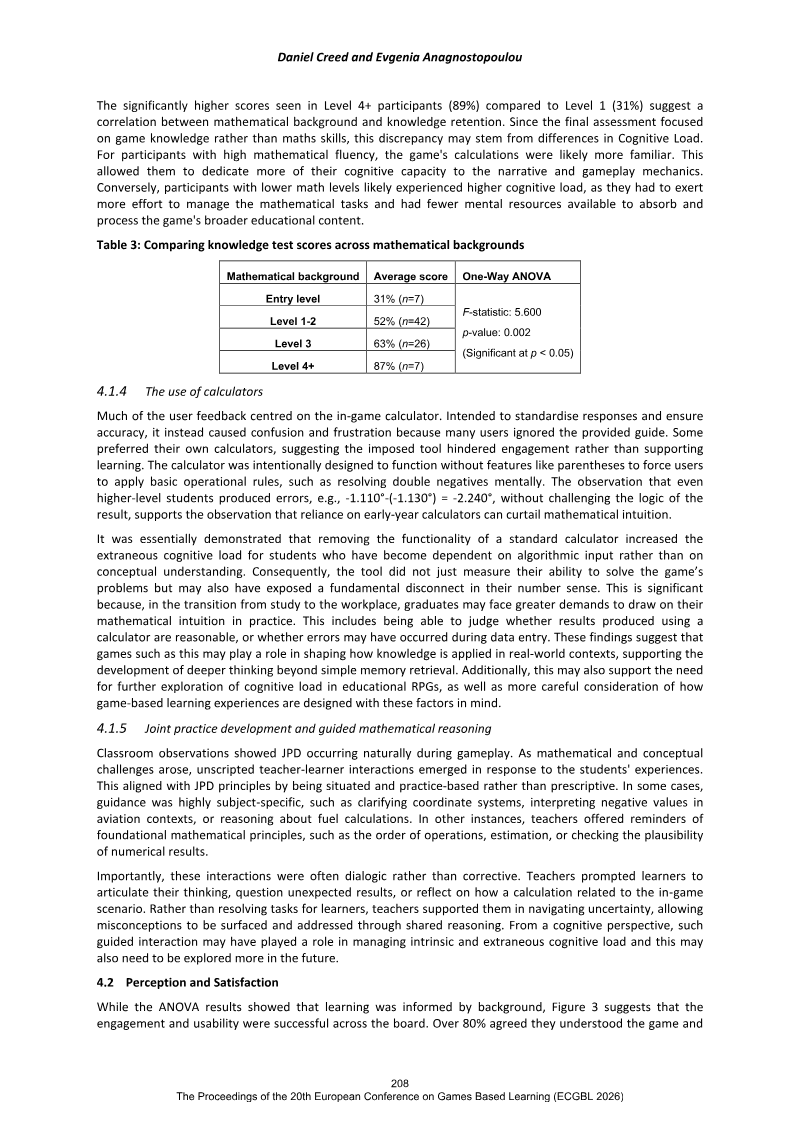
Create free accountWhitepaper DiGRA
1 free read left. Create a free account for unlimited reading + AI research.
Create free accountWhitepaperDiGRA
This work-in-progress document outlines the methodology for the PLAYCOMP educational project, which aims to measure the impact of indie games on secondary school students' personal, social, and learning-to-learn competence (European Key Competence 5). The project hypothesizes that improving teacher videogame literacy and providing game-mediated educational activities will foster the development of these socio-emotional skills in students aged 12-16. The study acknowledges the hesitation in integrating commercial videogames in classrooms but highlights the potential of non-educational games, particularly indie games, for developing critical thinking, interpersonal skills, cooperation, and conflict resolution.
The project will involve five secondary schools across Finland and Spain over three years. Teachers will receive training and support to implement a set of 20 activities (5 activities for each of 4 different indie games), designed using Universal Design for Learning principles. The impact will be assessed using a quasi-experimental methodology with a control group. Each participating school will include all four grades of Compulsory Secondary Education, with at least two lines per school year (one experimental, one control), resulting in an estimated sample size of 400 experimental students and a similar number of control students.
To measure Key Competence 5, the project adopts Bar-On's (2000; 2006) mixed model of Emotional Intelligence (EI), which conceptualizes EI as an interrelated set of competences, abilities, and emotional/social facilitators. This model encompasses 15 factors organized into five dimensions: intrapersonal, interpersonal, stress management, adaptability, and general mood. The chosen instrument is the EQ-i:YV (Emotional Intelligence Inventory: Youth Version), a 60-item self-report validated with the Spanish population by Ferrándiz et al. (2012), which measures these five dimensions through a 4-point Likert scale. The project emphasizes the importance of combining game-based educational approaches with rigorous evaluation methods.
Each row is a game or company this document names, each column a document, oldest first. A mark means that document names it. Select a row to see those documents.

DiGRA · 2026

DiGRA · 2026



DiGRA · 2026



DiGRA · 2026



DiGRA · 2026



DiGRA · 2026



DiGRA · 2026



DiGRA · 2026



DiGRA · 2026

DiGRA · 2026



DiGRA · 2026



DiGRA · 2026
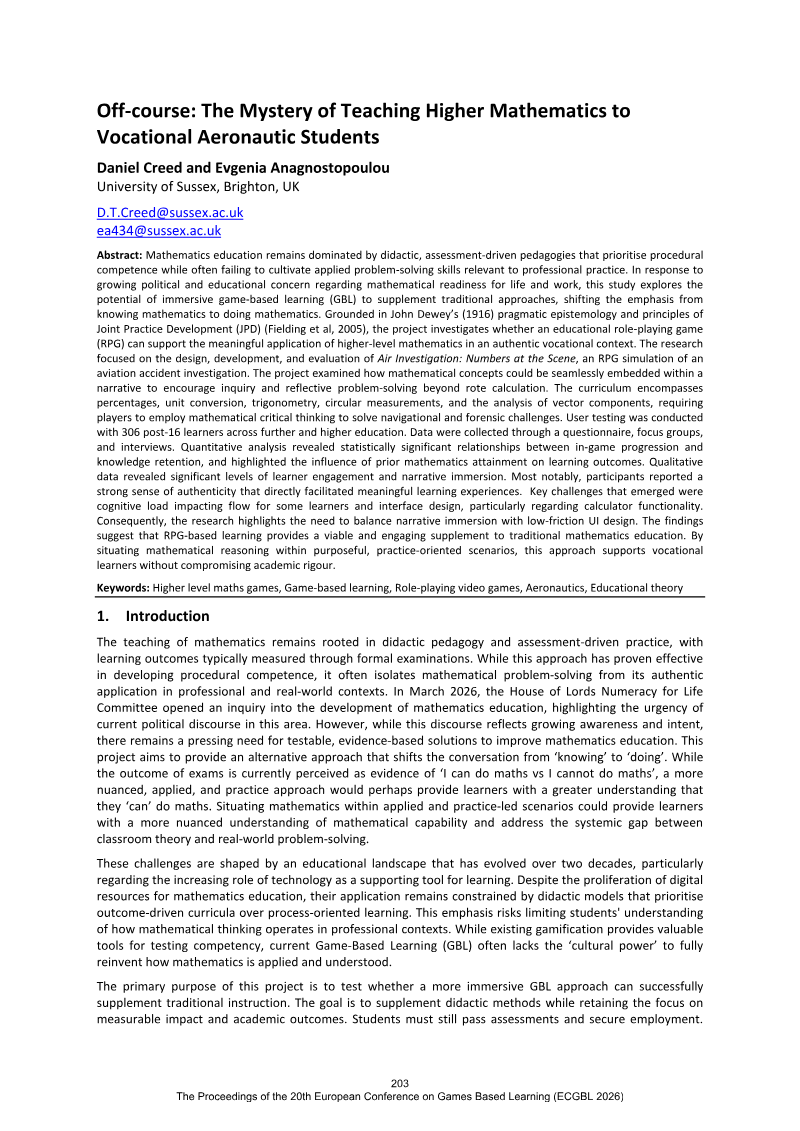
European Conference on Games Based Learning (ECGBL) · 2026