1 free read left. Create a free account for unlimited reading + AI research.
Create free accountWhitepaper European Conference on Games Based Learning (ECGBL)
1 free read left. Create a free account for unlimited reading + AI research.
Create free accountWhitepaperEuropean Conference on Games Based Learning (ECGBL)
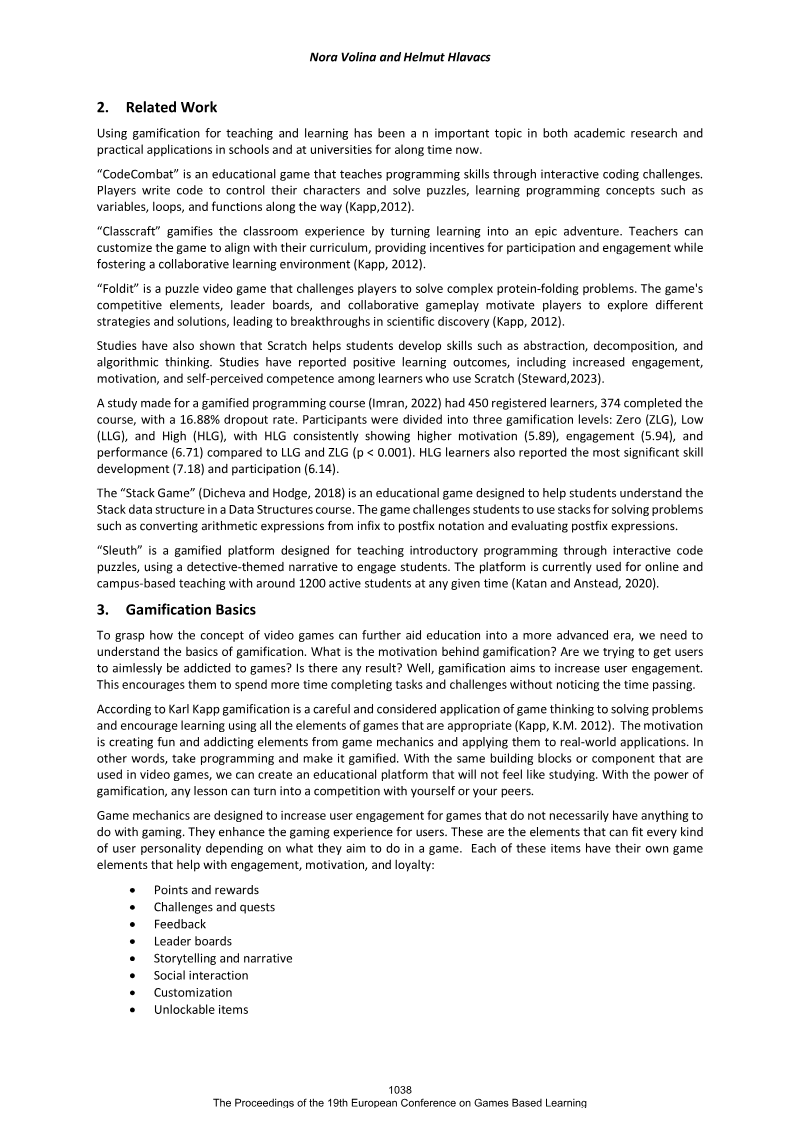
The pilot studied a mini-game in which players apply force and motion concepts by throwing a basketball into a basket. It aimed to determine whether gamified versions improve engagement and learning.
This study examines how level structure and gamification elements in a digital physics learning game affect competency acquisition in force and motion. The authors developed a mini-game called "Basketball Physics Challenge," in which players apply concepts such as initial velocity, throwing angle, gravity, and friction by throwing a basketball into a basket. The work aims to determine whether gamified versions of the game improve engagement and learning compared to non-gamified versions, and how the number of levels and the sequencing of game elements influence outcomes. The pilot was conducted with 20 secondary school students in Liechtenstein, who were randomly assigned and completed a crossover design in which they played both a gamified version (with scoring, time limits, and competitive elements) and a non-gamified version.
Results indicate that the gamified version produced slightly higher mean scores (1275.22 versus 1256.57), but the difference was not statistically significant (Mann-Whitney U test, p = 0.64). The order of presentation, however, had a substantial effect: players who first experienced the gamified version performed significantly better in the subsequent non-gamified session, with a large effect size (r = 0.64), while the reverse sequence showed a smaller, negative effect. Success rates were marginally higher for the gamified version (51.45% versus 48.55%), and the average number of attempts was slightly lower in gamified sequences, though this difference was also not significant. Scores generally rose across levels, with a notable dip at level 9 in the non-gamified version, and attempts increased in the highest levels, suggesting a difficulty threshold.
The authors frame these findings as preliminary given the very small sample, the non-normal score distributions that led to non-parametric analyses, and the exploratory nature of the pilot. They conclude that a balanced level structure and carefully sequenced gamification elements may be important for sustaining engagement without overwhelming learners, but that the effect of gamification on learning outcomes remains unclear. The study is positioned as groundwork for a larger main study and for the development of a competency model using competency-based knowledge space theory.

European Conference on Games Based Learning (ECGBL) · 2025
European Conference on Games Based Learning (ECGBL) · 2025
European Conference on Games Based Learning (ECGBL) · 2025
European Conference on Games Based Learning (ECGBL) · 2025
European Conference on Games Based Learning (ECGBL) · 2025
European Conference on Games Based Learning (ECGBL) · 2025
European Conference on Games Based Learning (ECGBL) · 2025
European Conference on Games Based Learning (ECGBL) · 2025
European Conference on Games Based Learning (ECGBL) · 2025
European Conference on Games Based Learning (ECGBL) · 2025
European Conference on Games Based Learning (ECGBL) · 2025

European Conference on Games Based Learning (ECGBL) · 2025
European Conference on Games Based Learning (ECGBL) · 2025