1 free read left. Create a free account for unlimited reading + AI research.
Create free account
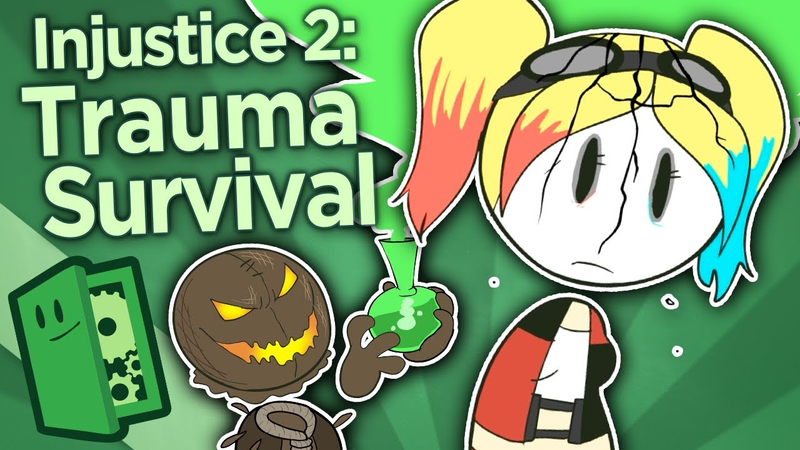
Injustice 2: Trauma Survival - Harley Quinn's Greatest Fear - Extra Credits
Key insights
6 takeaways- 01Injustice 2 depicts trauma as a permanent, ongoing experience rather than a temporary obstacle that can be overcome through sheer willpower.
- 02The game uses Scarecrow’s fear gas as a narrative metaphor to illustrate how psychological abuse continues to manifest as intrusive thoughts even after an abuser is deceased.
- 03The game challenges common media tropes by presenting a hero who is not 'fixed' or fully recovered, but who instead actively manages her triggers and trauma history.
- 04By framing trauma as a human experience rather than a plot device, the game validates the reality that survival and heroism can coexist with the ongoing process of healing.
- 05The narrative portrays the Joker’s manipulation through the use of feigned affection, highlighting how abusers leverage past emotional bonds to reassert control and undermine a survivor's current self-worth.
- 06Harley Quinn’s character arc demonstrates how abusers systematically erode a victim's identity and autonomy, making the rejection of ingrained behavioral patterns a difficult, non-linear process.
Ask AI about this video
Transcript
Trauma and trauma survival are topics that few video games tackle and that even fewer deal with well. These are incredibly difficult subjects that even older, more established media like print and film still struggle with. So, imagine my surprise when for 5 minutes, I saw these topics dealt with tastefully and with insight in Injustice 2. I just want to put a content warning up front because this whole episode could be a bit rough for anybody who's lived through abuse. In writing this, we talked to a number of trauma survivors. We are trying to address this subject in as respectful a way as possible because it's really important to talk about. But, we also understand that this is not our experience and at best we can only talk about trauma through the lens of the experiences of people we've loved and cared about in our lives. We're going to do our best. So, with that, because it's important, let's talk about the scene in Injustice 2 where Harley
Quinn fights the Scarecrow. Because this scene is about abuse. It's about the aftermath of an abusive relationship and the scars that it leaves. And NetherRealm pulled no punches here. They used the metaphors of the game to make this clear. After losing a fight against her, the Scarecrow throws a vial of hallucinogenic gas at Harley. Gas that makes people see their worst fears. And what does Harley see? Not some monster or some abstract terror, but her abuser. In the game storyline, the Joker is dead. His death is actually one of the inciting incidents for the whole Injustice alternate universe story. So, in the most physical sense, Joker can't hurt her anymore. But, that's one of the reasons that this scene is so worth talking about. It recognizes and acknowledges the fact that the harm doesn't end when physical or psychological abuse stops and that somebody doesn't just become okay because the abuse has ended. Harley Quinn is not okay and that's important. So many games and media in general, actually, even when trying to approach
trauma and survival of abuse in a supportive light, they show the character go through something horrific, but then they come out fine in the end because they're strong or something. But it's never fine. It never just becomes okay. You can't just get over abuse and go back to the way things were before. Yet we live in a world where so many people seem to think that you should. Where if you don't bounce right back, then you're just being too sensitive or weak. That things shouldn't be able to trigger you involuntarily, or that they wouldn't be able to if you were just thicker skinned about it. And I think the fact that we constantly portray trauma in media as something that you can just get over is partially to blame for that egregious misconception. Trauma is just that, trauma. It lingers, and it's something that can be set off when we least expect it. But there's another reason that this scene is important because the trauma victim here is also the hero. This is something we almost never see in media, especially games.
Often trauma is simply used as a means for the hero to accomplish their goals, to give them somebody to rescue or to protect or to save. Trauma is often used as a plot device rather than a very human experience that really needs to be explored. But here, like in Jessica Jones, we have a hero who is dealing with the aftermath of abuse and trauma. And this scene is heartbreaking because it feels like it was written by somebody talking from experience. Trauma isn't just a result of physical abuse, after all. In fact, the Joker doesn't become physically abusive until right at the end of the scene. No, this scene is about psychological abuse, the breaking down of the character's psyche so that they can be controlled, possessed by the abuser. We see this at the outset when the Joker refers to Harley by a term of affection, bringing her guard down so that he can immediately start cutting down her life choices and denigrating her identity, telling her that what she became without him in isn't really her. That she is really the person she was when she was with him and that she knows
it in her heart of hearts. He makes everything else that she has done sound juvenile, immature. He reduces her to a child and presents himself as the knowing adult. He tells her that all the choices she's made without him, they weren't real choices. They were mistakes. They were cowardly and that only he knows the real her. And for just a moment, this makes her fall back into old patterns. It's crushingly powerful because suddenly she's dressed the way he wants her to dress. She's his toy, just a doll, not a real person. Because to him, she never was a real person, just something to be played with. And in that brief moment, it's so easy for her, almost subconscious, to fall back on what she used to be. But she's done the work and she manages to break free. And it is so difficult to do. It hurts. It it almost brings her to tears. But we as the audience know that she has faced her trauma. She has worked through what's happened to her and working through it hasn't made her okay. It's not freed her
from that trauma, but it has given her the tools she needs to live with it, to pull herself back whenever those old patterns crop up. And she does just that. And in her rejection of that powerful lure into a harmful past, we see some true heroism. And that is when the Joker starts getting violent, pulling a gun and threatening her. While at the same time, expressing his disappointment, knowing that his disapproval still affects her. That he has done everything he can to reduce her will and to get her to think that it's important to please him. He has worked to condition her into thinking that his need, his approval, his lack of disappointment are more important, more valid than what she feels. But that no longer works on her. She rejects it and we see just how heroic this rejection really is, especially because, and this is one of the subtle details that I think is so incredible about this piece, Harley acknowledges that she still has feelings about their relationship, positive feelings. She knows it was horrible, and she knows and even says
that she never wants that again, and yet some small part of her still remembers it as love. And of course she does. Abusive relationships are complicated. They are never as simple as just being strong and rejecting that whole part of your life and becoming somebody new, as much of our media presents it to be. And again, I feel like I need to stress the fact that this sensitive portrayal of the realities of abuse came to us not just from a DC Comics fighting game, but from a DC Comics fighting game developed by the same studio that brought us Mortal Kombat. For real, hats off to the Injustice team. This was a brave thing to throw into a game, even more so a licensed beat 'em up. Realizing that the Scarecrow's fear gas could be an effective analog for a real-world trigger took insight and conscious examination of the material. Most of all, this scene required earnest consideration because it would have been so easy to make the trauma in this scene simply be a plot device or an agent for somebody else's heroics. But no, this
scene is about one of the game's heroes dealing in a very real way with the abuse and the trauma in her life. So, to those of you involved in making this sequence happen, I want to thank you for pointing out one thing. Harley Quinn is not okay. And that is okay. See you next week.
Summary
Injustice 2 provides a nuanced, realistic depiction of trauma and the long-term psychological effects of abusive relationships through the character of Harley Quinn. The game utilizes the narrative device of Scarecrow’s fear gas to manifest Quinn’s abuser, the Joker, as a hallucination. This sequence serves as a powerful metaphor for how trauma persists even after an abuser is deceased, challenging the common media trope that survivors can simply "bounce back" or overcome abuse through sheer strength of will.
The scene highlights the insidious nature of psychological abuse, illustrating how an abuser systematically erodes a victim's identity, autonomy, and self-worth. By portraying the Joker’s manipulation—using terms of affection to belittle Quinn’s current life choices and reassert control—the game demonstrates the difficulty of breaking free from ingrained patterns of behavior. Quinn’s struggle to reject these lures, despite still harboring complex, lingering feelings from the relationship, provides a grounded look at the reality of recovery.
Ultimately, the game is praised for treating trauma as a human experience rather than a mere plot device or a catalyst for external heroism. By positioning a trauma survivor as a hero who is not "fixed" but is instead actively learning to manage her triggers and live with her past, the narrative offers a rare, empathetic perspective. This portrayal succeeds by acknowledging that while trauma is a permanent part of a survivor's history, it does not preclude them from being heroic, and that it is acceptable for a survivor to remain in a state of ongoing healing.
















Comments