LegalPCF Group
Statement on Corporate Governance Principles in PCF Group S.A. 2020
17 Dec 202020 pages~67 min full read
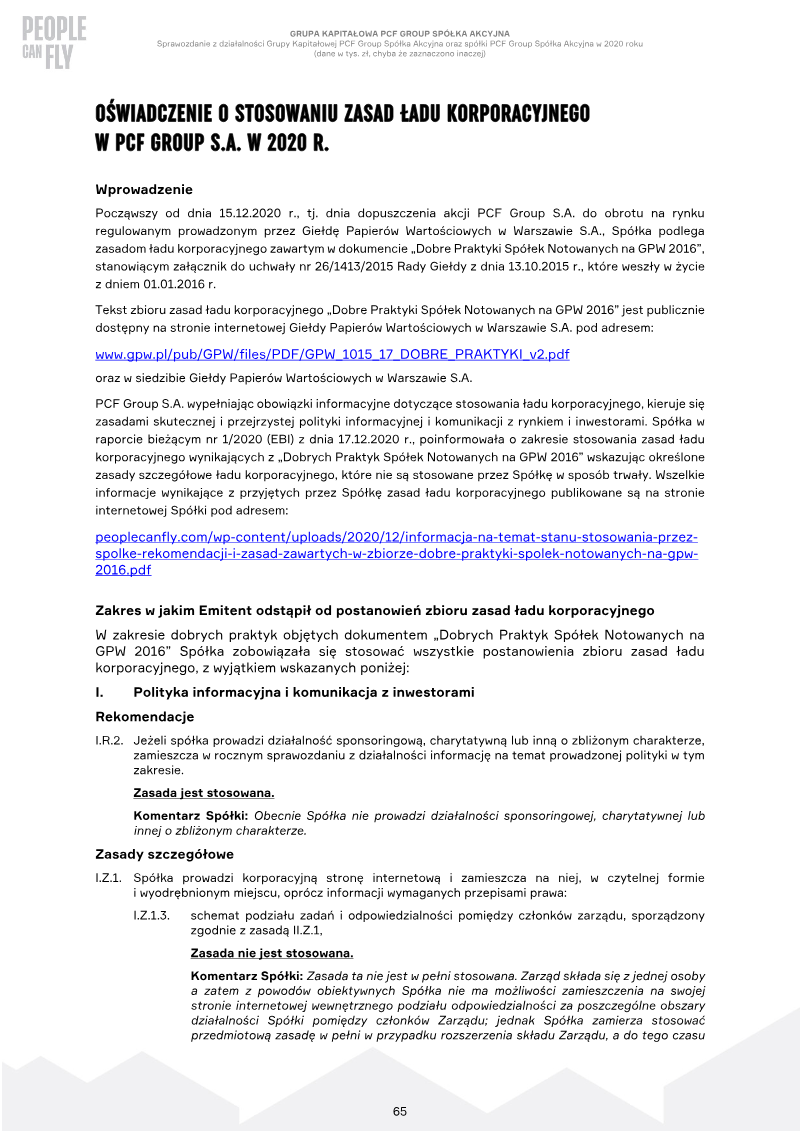
Following its debut on the Warsaw Stock Exchange in December 2020, PCF Group S.A. established a corporate governance framework aligned with the Best Practice for GPW Listed Companies 2016, while identifying specific deviations necessitated by its organizational structure. The company’s governance model is characterized by a high degree of centralization, featuring a one-person Management Board led by CEO Sebastian Wojciechowski. This structure resulted in several non-compliance areas during the 2020 fiscal year, including the absence of a formalized diversity policy and the lack of a management responsibility map. Furthermore, the company opted not to maintain separate internal units for risk management or internal audit, instead consolidating these oversight responsibilities within the Management Board and a newly established internal finance department.
Control of the company remains concentrated among a core group of founding shareholders who held 76.60% of voting rights at the end of 2020. This concentration is reinforced by specific personal rights granted through company statutes, which allow the founding group to appoint the majority of the Supervisory Board and the Chairman, provided they maintain a 40% voting threshold. Sebastian Wojciechowski retains the personal right to appoint the CEO as long as his individual voting share remains at least 25%. While share transfers are not statutorily restricted, significant lock-up agreements were in place for key shareholders and employees following the initial public offering, extending up to four years for certain share series.
Financial oversight is managed through a Supervisory Board and a dedicated Audit Committee, which monitors financial reporting and auditor independence. In 2020, Grant Thornton served as the company’s auditor, providing no non-audit services to ensure objective reporting. To address potential conflicts of interest arising from the dual roles of certain Supervisory Board members who also served as directors within the gaming studio, the company implemented composition changes in early 2021. As the organization matures, there is an expressed intent to adopt more formalized governance practices, including expanded financial data history and more sophisticated internal control schemes.
PCF Group · 2026
PCF Group · 2026
PCF Group · 2026
PCF Group · 2026
PCF Group · 2025
PCF Group · 2025
PCF Group · 2025
PCF Group · 2025
PCF Group · 2025
PCF Group · 2025
PCF Group · 2025
PCF Group · 2025
PlayWay · 2026
11 bit studios · 2025
PlayWay · 2025
PlayWay · 2025
PlayWay · 2025
PCF Group · 2025
PlayWay · 2025
PCF Group · 2025
PlayWay · 2025
PlayWay · 2025
PlayWay · 2025
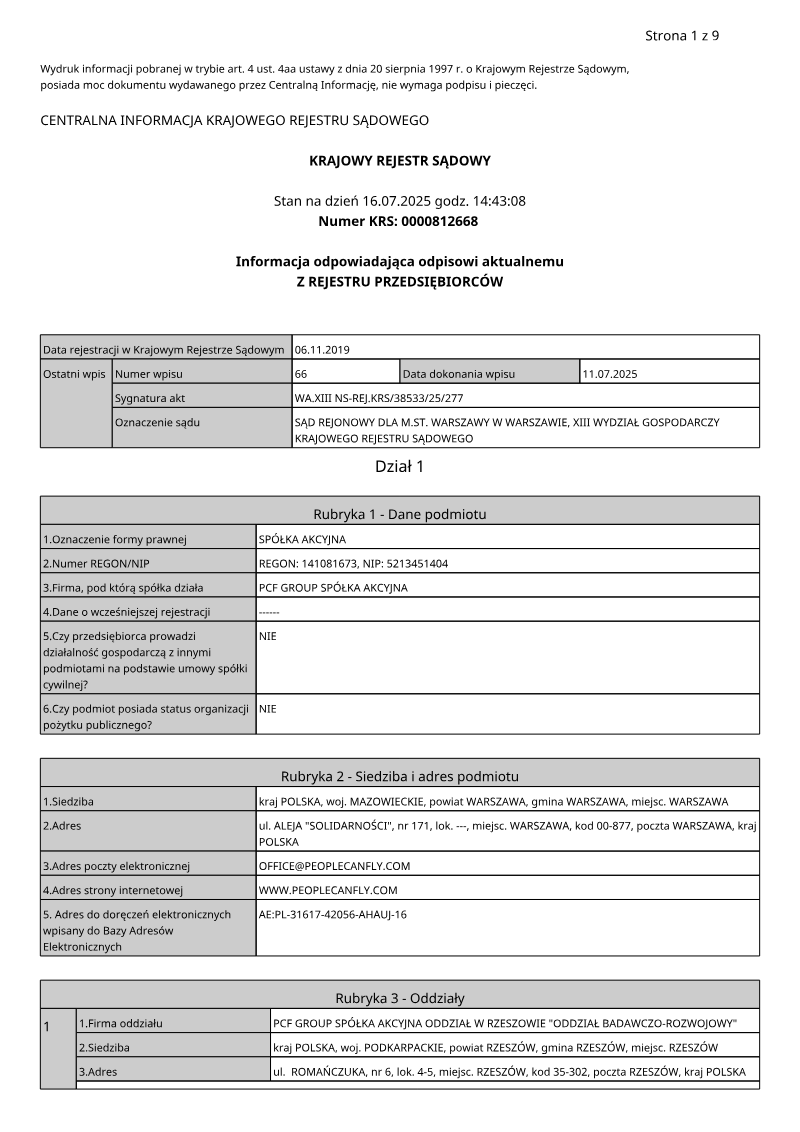
Centralna Informacja Krajowego Rejestru Sądowego · 2025