1 free read left. Create a free account for unlimited reading + AI research.
Create free account
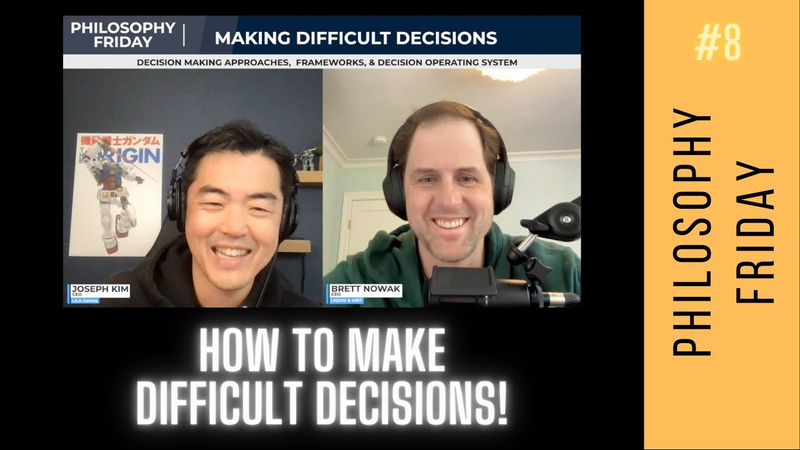
How to Make Difficult Decisions (Philosophy Friday #8)
Key insights
6 takeaways- 01Organizations should replace consensus-based, democratic decision-making with structured frameworks like the Directly Responsible Individual (DRI) model to increase operational velocity and reduce production friction.
- 02Pushing decision-making authority to the lowest possible level fosters autonomy and speed, provided staff operate within clear guidelines rather than rigid, bureaucratic rules.
- 03Distinguishing between reversible (two-way) and irreversible (one-way) decisions allows teams to act autonomously on low-risk tasks while reserving leadership escalation for high-stakes commitments.
- 04Leaders must establish psychological safety by treating mistakes as training opportunities rather than grounds for punishment, ensuring teams feel empowered to innovate and iterate.
- 05Leaders must accept full accountability for outcomes to create the organizational environment necessary for teams to take calculated risks.
- 06Effective professional decision-making requires balancing analytical rigor and first-principles thinking with an acknowledgment of the role luck and external variables play in long-term success.
Ask AI about this video
Transcript
All right. Hello and welcome everybody. We are here for another philosophy Friday. So, today we are going to be discussing how to make difficult decisions. And so, we'll talk about the specific kinds of decisions, frameworks, and as always philosophy around this topic. With you as always, you have your host myself, the Kiminator, aka Joseph Kim, CEO of Lila Games, and Brett Novak, CEO of leading mobile games research firm Liquid and Grit. What's up, Brett? And before we jump in, I know you this is a topic that you recommended and wondering if you could provide a little bit of color on this in terms of, you know, why you wanted to discuss this and is there any specific decision that you might be grappling with right now? Well, I just think decisions in general are a under analyzed, under developed skill in people and in organizations,
and I think they're also extremely, extremely important. In fact, the podcast I had with Tabor about decisions, I thought that came up a bunch unexpectedly when we were talking about his process, which is a great process. But, it just highlighted that decision-making is super important and it slows it's it's really the biggest thing that I think slows down a lot of organizations and it's one of the most important things in life as an individual. So, I was also curious about it in my for me because, yeah, I there's some big decisions coming up for me that I've been thinking about. We can talk about it later. It I thought maybe you would have some insight on better decision-making process. So, All right. Well, maybe we could start with, since we're in the gaming industry and in terms of like some of the difficult decisions that we may encounter in the games industry, maybe we could start with some examples. And Brett, I don't know if you have any in mind? Well, the biggest one was what genre to
go into. I actually at Liquid Grid was I've always thought in some ways, I don't know if I that I I may want to start a game and and maybe in a way that would be help supportive of our research. So, like sort of the idea is that we would potentially make some small games and then publish insights that we got from the games. And like I was thinking, well, what would be the process that we'd go about using to make decision about what genre to get into that would be best for us considering our situation. And so that is one. The other is whether or not to or what bold be to create. I think the other one that you mentioned in your list, which I think is a great one and super hard. We both experienced this together is whether you should kill a game or when you should kill a game. And then on a personal note, I think probably the biggest decision in your career is when to leave and what type of company to join.
Yeah. And those are really, I mean, kind of the keys to your success. Everything when you join the company is based off of that. So, those are some of the ones that I had listed. Maybe a couple others I could add would be I think a common one I did the point that you made in terms of, you know, should you leave for a new opportunity. I do think that that's a big one that comes across a lot for for folks in in which I do think it's good to get advice from different people and I think another one for me is, you know, hiring or firing somebody. Do you try to invest in someone longer term? How do you decide when it's worthwhile to pursue a longer term investment in someone or do you fire someone because they're not able to deliver value immediately? Uh and maybe like one other one I would add is just it in I think it's different based upon the company that you're at, but when you see something going wrong and then you're trying to decide, okay, should I try to have this difficult conversation
that might, you know, that speaks truth. Like you see a problem with something and then do you raise it to your manager or to the lead on a project or not? And depending on this, you know, so my philosophy is you always have that conversation, but I have seen at certain companies, you know, that can get you, I think we talked about it before, can get you assassinated. Well, maybe you should re-review that decision making framework of always do it. Well, actually, I I think longer term it it it it was a better outcome for me. But again, it's I I think it is situational. So, maybe now that we've kind of talked about some of the decisions and we can kind of dive into some of those leaders in terms of how you would approach some of those decisions, but maybe now we could talk about so, at game companies, how are decisions generally made and maybe discussing, you know, some of the structures or some of the things that that we've seen and
um I don't Brett, do you want to jump in and I I've I've got a whole kind of thought process around on this as well, but um it maybe you can kind of jump in and and uh tell us what what you think. Well, generally, ideally, I it's based on what it is is getting decided upon, right? If it's a very large decision, then it I think needs to go up higher in the chain of command. Similar to how the military does it, right? If and that's how I think about decision making, that's how I would do it at a gaming company, that's how I do it at Liquid and Grit, is for very important, high-risk decisions, that should go up the chain of command, just like you would imagine a small military unit calling in for sort of support from from uh from aircraft carriers or something like that, right? Like you would call that in to a higher superior to make that decision. Is that strategically okay? What's the risk? What are the impacts on the in terms of And and for a gaming company, it's
pretty similar, too, right? How much are you going to invest in this project? How much are you at risk? What are you potentially going to lose? And so that should go up the top of the chain of command. For smaller decisions, I think it should be the opposite. It should be pushed down to the organization. I think this is where a lot of organizations struggle is it should be given to the person who has the most information about it. And that person should try to make decisions very quickly because it's really the speed at which they make the decisions that's going to create the value for the company and overcome any mistakes. And that's that's kind of a little bit too hypothetical, but I would say that for example, if you have a product team, what I would do is say, "Okay, features that take zero to, let's say, five days worth of development time, the product manager and senior product manager can make decisions on their own for those decisions. If the feature is from a five days to, let's say, two-week
development cost, then those decisions need to be like moved up to the director of product. And if it's three weeks to beyond, then that needs to go to the general manager. And if it's a large game decision, then that needs to go to the owner of the company. Right? And that allows the individuals below to make fast decisions, but also for the company itself to overcome any risks that it may have by having it go up to the the higher chain of command for larger decisions. So Right. That's how we And I kind of like the the way that you're adding that nuance in terms of the in terms of making hard decisions, we should actually think about the different kinds of decisions being made and maybe have a different structure process for each. And then but I maybe I could also just like take a step back and talk about uh from my perspective what I have seen in terms of like the systems of decision-making at different organizations and I kind of break it up into four different kinds.
And kind of like what you have described is what I would call a leader-driven approach where you know, depending on the decision, you just go up the chain of command and the CEO or the leader or whoever's higher makes the call. And so I would call that the leader-driven model. Uh there's also the exact opposite of that model is the democratic model. You see this in I would say some European countries more frequently than others, but it's where it's like, "Okay, we need there's this hard decision. Okay, let's take a vote. Who Should we do this or should we not do this?" And I actually believe that's the absolute worst kind of decision-making structure you can have. There's also in my opinion, what I believe is the best system for me which is the basically it would it's a system that Asana popularized and calls AORs, areas of responsibility, but I believe it was rooted from a system from
Apple called DRI which is directly responsible individual, meaning that as opposed to like a leader-driven structure in terms of decision-making, what you instead do is you try to determine who is the best person who can make this call. And then you have like it's it's literally like a table. Here are all the key decisions that need to be made in the company and here's who owns the call. And so so at my company even though I'm the CEO if I give an AOR to a producer and and then for that call, I might say, "Hey, I completely disagree with you, but the producer overrules me even as the CEO." And but then it's like the tricky part of the AOR system is that you then need to determine who is responsible So, I'm I'm responsible for determining who makes the call. Rather than making the call itself, right? And then the final system, which
I don't think is appropriate for game development, but I do believe is a strong model, is the one popularized by Ray Dalio in Principles, which he calls a believability-weighted decision-making structure. And it's similar to the democratic system, but basically in a believability-weighted system of decision-making, every employee literally has a scorecard, and they have different types of expertise, and they're scored on their expertise. So, Bret might have a card, and and in that card it might say something like product management, you know, eight, design, five, something else, you know, and then depending on the decision, then it's like a democratically-weighted system where everyone votes, but Bret might have six votes, and I might have four votes on a specific decision, and and so that's kind of that system as well. And so, these are
the four kinds of primary decision-making structures that I have seen. I have seen probably um I've never seen believability-weighted decision-making system in game development. I've seen the other three. I've seen AOR as the least. I've seen probably most either leader-driven or democratically-driven. Usually, you see the democratically-driven more at larger companies, more of the leader-driven at smaller startups. And one of the reasons why I don't think that believability weighted type of system works is that I think it works in finance or in a in in an industry in which you make a lot of decisions and you can get a score very quickly, right? And so if you're investing in a stock and it's like, "Oh, that didn't go well." And you can you can quickly get a score for different kinds of decisions, then I think that's great. But in game development, because the cycle time is
so long, it might take you a long time to determine who's great at something or not. So, anyway, those are the four types of systems. And for me, I believe like the best approach for game development is either leader driven or AORS driven. I don't like the democratic system. But to to be honest with you, it wouldn't surprise me to see, like let's say if we were to Uh I it wouldn't surprise me if some successful game companies, like whether it's a Supercell or something like that, were more democratically driven than otherwise. And then maybe the one other follow-on point I wanted to make with respect to decision-making structures is that I actually think in a lot of companies the exact system of decision-making is not clear. And I think that that's a problem. I think that if you're in an organization and it's not clear how you make decisions,
then it leads to inefficiency and it leads to a lot of politics. Because it's not clear what system you're making, people are then in the background politicking and there's all this wasted inefficiency about what happens, right? But if it's clear, it's like, "Okay, Brett's going to make the call on this decision. Let's have the discussion and the debate." And then it's we have that debate, then it's like, "Okay, Brett, what's the call?" Boom. All right, let's go. It reduces so much [ __ ] so much politics, so much [ __ ] nonsense. And so, it's much more efficient. Now, I will say though that at some organizations, especially larger ones, that the system is sometimes, in my opinion, purposely obfuscated. And it's done so because I think that there are some organizations where you have a culture and a system in which you don't want to have clear
accountability. Because when something goes wrong and something [ __ ] up, you don't want to take responsibility for it. And so, you have these cultures in which the decision-making system isn't clear. It's sort of democratic. A decision somehow gets made. And then, when there's a when when there's a [ __ ] up or something goes wrong, then there's a lot of finger-pointing. And then, the pers- the people that survive are the ones who are more politically adept and have greater skill at politics and relationships rather than actual skill at making the game or doing things the right way. And unfortunately, I do think that that kind of a culture and those kinds of systems are pretty prevalent in the gaming industry. I think it's very sad. And it's just such a waste. Like, I have literally seen teams spending 4 hours working on presentations to management trying to figure out, "What's our story?
How do we How do we present this in a way where, you know, we present the best possible narrative?" Instead of spending 4 hours figuring out, "How do we fix this [ __ ] problem?" How do we spend 4 hours of six people's time on the problem rather than the cosmetics and the dress-up and and trying to like cover your ass. And I just think it's such a sad sad state at some companies that I hope over time gets fixed, but I will say nobody talks about. And that's what you're going to get here on Philosophy Friday. We're going to KEEP IT REAL. OH, YEAH. WELL, I mean, definitely I think we've all experienced that type of culture. I I I love those frameworks and I think the one that I would go with and what we do at Liquid & Grit, but what we would do if we if I was running a gaming company, which again I think I may eventually again uh would be leader
driven. With caveats, okay? So, leader driven with the idea that that decisions are pushed down within the organization. And what we do at Liquid & Grit and what I would again would do at the gaming company as well is we have guidelines and not rules. And so, we build in a uh standard operating procedures. We have them all written down. And what we train our people to do is to learn to make decisions on their own and make them quickly and also decide what decisions they should make and what decisions they should ask their manager to make. Right? Yeah. And and there's a lot to unpack there, but basically what we're training in the beginning First of all, we don't give people who are new really the ability to make any decisions that are going to negatively affect the company. They just don't have access to anything, right? Everything they're working on is backed up. It doesn't involve clients or whatever. That's one. And as they develop in the
organization, we teach them through what we've written and just through their managers, "Hey, that's a decision you should make, right?" Cuz a lot of times that person will say, "Hey, Brett, uh what do you think about this sentence?" And my response won't be, "Oh, I think it's good." It'll be, "That's a decision you should make on your own. This is an This is not a decision that you should be bothering you know, you you're me or bothering your manager to make, right? Like that is a clear decision that's that's something you own. And through that process we start developing and through our writing that like hey, this is the the level of area that you should make your own decisions on. And that's I would say that's still leader driven, right? Because that person is the leader of that area, kind of like what you're saying. I I think a little bit between the A the AOR and the lead driven, but they sort of own that and then their manager owns this decision area and then their their manager's managers owns this and then I own sort of like this higher higher level. And I I think that works
best because in my opinion, it's the speed of making decisions that is so important. And to be fast, you have to push decisions down the chain of command. And it's that speed that will overcome any like minor mistakes, right? It you'll be able to basically overcome if someone makes the wrong decision or whatnot. And so I really that's how I believe. And I think even in with gaming companies it's the same thing. I I just generally feel like why I don't like the AORs is if you have the the the head of design making decisions and then their decisions like hey, I do all the art and then the PM's making all the decisions in in the game in let's say the tuning and the game designers making all the decisions in in the game design aspect. I mean, we've talked about this before. It's it you're you're you're building a camel instead of a horse, right? Because someone has, you know, someone wants the tuning to be the PM wants the tuning to be super tight, the artist wants to make
it super cartoony and the game designer wants to make it RPG like, right? And it's like okay, you guys all made your best individual decisions. Those are the best that you know, to you, but no one has this like collective vision. And I think there's something to that collective vision. You see it in the movie industry, you see it in the music industry, you see it in artists, right? Like it's this it's generally this one person who is really the the driver of the vision. But that person doesn't have to be a tyrant, right? And I think that's the caveat, right? Yeah, and I think that's a good point that with the AORs driven model, there could be a situation if people are maximizing for themselves, a more holistic vision of the product may not get maximized. And I also think that to your point on like the leader driven model, I think that to some degree that could be a blend of leader driven and AORs because sometimes what you'll see is
you'll see a leader that makes a decision, but but then ask, "Okay, well, you know, I trust Bill. Bill's saying we should do this." And I kind of believe Bill. So then some of those decisions do effectively in practicality get pushed down a little bit. But um so I again, my preference is AOR driven model, but I do believe in both. I like leader driven, I like AORs driven model. I just don't like believability for gaming for the gaming industry, and I don't like the democratic model. Um and but at the same time I would say that um we probably see more examples of leader driven models that are successful in the industry. I don't see a lot of companies doing the AOR driven model, but I I hope that more do. And maybe the the one caveat I would have on the leader driven model is that depending on And I think also it depends on your specific execution of that model.
But uh sometimes what you'll have is you'll have a bunch of like, you know, essentially sycophants politicking up to the person that makes the decision, right? It's like And then and then you have all this, you know, kind of kiss-ass culture to the leader because they want to get their decision, you know, they want they want to influence the leader. And then you have all these weird things. You have pre-meetings. You have all this other nonsense. And so I, you know, that's that's one of the other dangers of that. But I personally do believe I agree with you, Brett. Leader-driven model, absolutely viable. I think AOR-driven model is viable for me. And um and the the only thing I would say is to be careful in terms of even with a leader-driven, even with the AOR-driven model, there's a lot in the execution of that model that will determine success or failure. And if the decision-making model is not clear, you are likely in a bad culture. I'm just going to put it out there.
Or it's something that you need to address, right? That that's Yeah. I would probably say that my I I I I really don't I think that I want to be clear that leader-driven model is a tyrannical leader-driven model. I personally would say that my model is the maybe better put is like the military model. I mean, I read a lot of military unit strategy books and have building my company. And that's the model that I that I take, right? It's it's a leader-driven with a hierarchy of command, right? So it's it's many many leaders in the organization with one highest leader. And then there's leaders all the way down. And all those leaders have units that they're managing, right? The smallest managing themselves. And then above them is they're managing a small unit. And above them they're managing multiple units. And above them they're So my belief is really the military is highly incentivized to have figured these things out because if they don't,
we all may die. So uh they I do study military organizational design a lot and apply a lot of those principles to to and actually the book that I've referenced Product Management and Flow, the one of the last chapters is about using some of this design to operations and that's where that's somewhere where I got inspiration from that. So, Yeah, and if people have not read in terms of military um in lessons from the military, another great source of insight and wisdom is Jocko Willink, uh Extreme Ownership, Discipline Equals Freedom, incredible books, absolutely incredible books for insight in terms of uh your building a company and being successful in things like that. And maybe the next topic just to even go a little bit deeper also into your point about different kinds of decisions and things like that, but I thought maybe we could dig a little bit deeper in terms of how should we think about the process
for evaluating or making the difficult decision. So, there's the different structures, but let maybe we could dig a little bit deeper into like kinds of decisions and things of that nature. One point I'll make before handing over to you, Brett, is um Jeff Bezos is it was kind of famous in his Amazon shareholder uh report or news shareholder letters talking about one year he talked about one-way versus two-way doors. And I think I've got the quote here. So, let me actually read what he said there. And this talks about for him two different kinds of decisions. So, I'm reading from his shareholder newsletter, uh some decisions are consequential and irreversible or nearly irreversible, one-way doors. And these decisions must be made methodically, carefully, slowly, with great deliberation and consultation. If you walk through and don't like what you see on the other side, you can't get back to where you were before. We can
call these type one decisions. But most decisions aren't like that. They are changeable, reversible. They're two-way doors. If you made a sub-optimal type two decision, you don't have to live with the consequences for that long. You can reopen the door and go back through. Type two decisions can and should be made quickly by high-judgment individuals or groups. And maybe I could stop there. And I I actually thought that that kind of aligned nicely with what you were talking about, Brett, in terms of, you know, some of these smaller decisions you maybe push down. But um in terms of kinds of decisions, I do think that this is relevant in terms of And especially for smaller companies, startups, right? Where speed is maybe a critical advantage for you to then understand what are the kinds of decisions you just need to move quickly on, make those decisions, and then and you know, not to say that you're just going to, you know, flip a coin on them, to have some thought, but it's not like you need to stress or obsess or
like have an, you know, analysis paralysis and and just really like wait too long on the type two decisions. But with a type one decision, I think you should be a little bit more careful, should consult more people, and spend more time on them. And it also kind of reminds me of when when Bezos is labeling this type one or type two, um there's a Daniel Kahneman book, um Thinking Fast and Thinking Slow. And this really reflects what he calls type one versus type two thinking. That there's kind of a deep thinking, type one thinking that you need for deeper decisions, more complex problems. And then for other kinds of problems, you can just think about it very quickly. And so, I thought that was actually a nice parallel. But Brett, what do you think? I mean, I'm a big Bezos fan myself, so I I really like this. I think one is you should try to avoid type one decisions as much as you can. For type two,
I think what what I think about in terms of organizational design is trying to have humans be optimized as best they can for what they do best really basically, which is a bad way of saying that basically you want humans to be making these decisions on their own because humans are very good at gathering a lot of input and then spitting out a strong result very quickly, right? And so you don't want to make this decision-making process too operationalized, too robotic because the the human if you if you hire well, that person is going to make a very good decision. They're going to have a ton of information and they can make it very quickly. That's very and then you repeat that over and over again over days and weeks and years for your organization. It's a massive amount of speed that you can make up over your competition. A massive amount of learning, right? Because you can make two decisions for every one your competitor can make. You can fail twice You can fail 50% of the time and be equal with them, right? And
so it's huge advantage. I always sort of say it's like if you can beat the chess master champion if you have five moves or two moves to their one move, right? It just doesn't You just like going to overpower them. So I think that's really where you want to build in guidelines again and not rules with this, which is like and and you want to train your people and I and we are very critical about this skill. And we we basically we talked a little bit about hiring and firing, but this is definitely something that we just we really uh take a critical eye on early on with people. It's like are they making the right decisions? Do they understand this? And are they asking their manager the right questions at the right times? And if they don't pick this up uh pretty early on, we do let people go because it's so important to our organization that they kind of understand this and they're and they're not afraid to make a decision. And and I think this is also critical JK cuz I I know what you're going to want to say because this is unfortunate, but
a lot of organizations the leader then blames that person for making a mistake and this is part of the the sort of agreement that you have to have as a leader. If you're going to give responsibility to somebody to make a decision and they made a decision that was wrong or you disagreed with and you find out later you are not allowed to penalize them for that. Okay? And this happened to me a couple weeks ago. I had my lead analyst uh say something like, "Hey, we should just do this thing that one of our subscribers asked." And I was not opposed to it. I said, "No, like we don't need to do this. It's not worth it. It's going to take more time than you think. Blah blah blah." Well, that but then I said, "Fine, if you want to do it, we'll do it, right? Like go for it, right?" So, I had agreed with her decision. Fast forward 2 weeks later and that thing that that she was overwhelmed with work, okay? And that thing that I had we had debated about was still going on,
right? And I wasn't in my best frame of mind and I made a comment over Slack thankfully cuz I could delete it and I said something about it like, "Hey, I didn't want to do that in the beginning." That was a failure on my part as a leader because even though because I had agreed to go forward with her with her recommendation, therefore that was, you know, that had moved forward. I had agreed. It was it was my responsibility and and we're both Jocko disciples in many ways, so uh extreme ownership says it's it's on us, but I then later apologized and made sure that she knew that it it wasn't, you know, her fault. That's not something you can do. So, if you uh build this system, you also have to build in a culture that making decisions isn't going to get you penalized in some way. Now, Yeah. if you make dumb decisions over and over again, and if you make decisions that don't fit within this framework over again, then you need to decide to let that person go, right? And so you need to make sure that they're making but if 85 90% of the time they're making wise
decisions, and you think they're wise decisions, that's that's sort of what you have as a leader have to be acceptable with and be supportive of, and understand that 10 15% of the time that decision is going to be different from what you would have made. It may be a mistake, and that's okay. And you can't go around like, you know, penalizing people for that. Um Sorry, that was I that was a little long-winded, but I wanted to try to give a good example of of it. Yeah, I I think those were two really great points that you made, and especially with respect like so the first point in terms of the faster you're able to make decisions, the more reps you get in. And that kind of reminds me of, you know, just football and the importance of reps in football. If if for football fans, we all know that the more reps you get, especially live reps that you get, it's incredibly valuable experience. And it also reminds me of there for folks that have read Atomic Habits, there was a um there was a there was a story that um the author
talks about in Atomic Habits about a photography class, and they split the class into two. And um half of the class would be graded based upon taking like, I don't know, a few really high-quality pho- photos, but they would be graded upon the quality of just a few photos. And the other half of the class was be graded on quantity, just taking a bunch of photos. And what they found is I I may not be getting the story exactly right, but um but in in Atomic Habits it suggests that in fact, the people who just took a lot more pictures actually became better. And the the people that focus on a few things but trying to make them really good actually weren't were were not as good. And so um I do think that this notion of making a lot of decisions quickly, getting the live reps in, and just getting practice and reps. And then to your point about then retrospecting and improving, that is absolutely critical. And to your
second point I do I I like that you you kind of took ownership in terms of the system that you were using. The one thing the one other like concept I want to expound upon just because I see this mistake made at so many companies is this idea of responsibility and accountability. And I think in many companies these things are separated. And so as a leader, a leader at a company might be might say, "Okay, I'm making the call for this. You know, Sally, you're executing it. And when it [ __ ] up, it's like, "Sally, you [ __ ] up." But it's like, Sally may have wanted to do something completely different, but you blame Sally for your [ __ ] up. And so in my opinion, if you're going to have I I just think that responsibility and accountability have to be tied together in in my philosophy. Because when you separate those and somebody's executing your call I don't know. I
I I I kind of react negatively to to that. I kind of I'm like, "Well, [ __ ] you." You know, then give Let them make the call and let them execute it the way they want, right? Otherwise, they don't own the decision and you're going to blame them if it goes wrong. That's just so inherent You see this at a lot of large companies, and every time I see that I it it really like I I don't know. I I react very negatively to those kinds of systems or structures. Uh Yeah, I couldn't believe I agree more. And I I have two two comments and I'm I'm going to get them in because I know you're going to love the first one. And the first is is to to add to the football analogy. So, I'm a big Bill Belichick fan as we've talked about before. You see I'm wearing the Patriots. Today I'm I'm I'm repping my the A's. I also have as my one of my sons two of my sons are big A's fans. And so therefore I am as well. But one of the things that when I watch Bill Belichick during a football life and during a lot of the videos that I watch of him that he's doing with his team is he does a lot of situational training.
So, he'll be out there going, "Okay, it's third down on the one-yard line and the team has has is down by a touchdown. What are you going to do?" Right? Or you're it's 20 and long and there's 5 minutes left in the game. What are you going to do? And he'll continually do this with his players because similar to what I'm saying is he wants those decisions to get pushed down. He's not saying, "Hey, I'm the head the head coach. I'm going to make all the decisions." He realizes that in that moment that lineman the third lineman on his team has to be able to understand that when there's 20 seconds left in the game and they're on the one-yard line, they're likely going to try to jump the the snap. So, the best thing to do is to like hold steady, right? And he needs to push those decisions down. And that's really what a great organization does is it kind of like trains its people early on to be thinking critically, "Okay, this is happening. This is happening. Like this
is my responsibility. But I have to also understand all the variables. And as a coach or a manager or a leader, you can't just write all those things down. Like Bill Belichick's not going to predict what's going to happen in the Super Bowl this year when when we go to the Super Bowl and win it again. Uh but he's he's going to train his players to be thinking critically all the time. So, I I I love that analogy of the football because it I mean we We love the you know the football system. And the other thing that I wanted to add, which I completely agree, and you're usually sh- is throwing shade, but one thing I hate in organizations, and I had this in my last organization, and I I [ __ ] hated it, okay? I I I'm using the F-bomb because it's appropriate here. Is blame. I I I think that blame has no place in an organization other than the leader, right? And I'm that's very much a a Jocko type thing, but I just don't even believe in blame period. I believe in fixing things. That's it. If something
happens, I don't even really spend time on like who's to blame. I just want to figure out how it happened. I want to solve that problem. That's it. And whether it's solving that problem means letting someone go, or managing them, or training them, or building in systems to make sure it doesn't happen again. That's all I care about. And I was in my last organization, it was like, "Who's to blame here? You're to blame. You're to blame. You need to" and I think that's the one thing about the retrospectives that I don't love in in the traditional retrospectives is it kind of implies that the person writing the retrospective is to blame, and they are the one that is like sort of getting reprimanded. But, I love the idea of in the process of retrospective, but I hate the association of blame because I just think it's it's sort of like a useless emotion in an organization. It's just who gives a who gives a who? Like, just fix the problem and move on and improve. That's it. That's all I care about. So, I'm getting fired up here. About halfway through JK,
I get a little fired up, but Flashbacks of being in some crappy companies start trickling trickling in, and I'm like, "Ah, I got blamed for something." I was like, Yeah. Oh, yeah, you know what I Yeah. It's brutal. Well, I was just going to say, yeah, I think of organization. You know. I I think the culture and the environment is very important. Having like, you know, people talk about having a safe environment and I I do think that if you do have the right environment, I think it's to your point like blaming saying, "This is your fault. [ __ ] you." I think that's the wrong approach, but like, "Okay, wait. Sally, you did this wrong. Let's try to improve that and here's how I would improve it." You know, Bill, you know, based upon our retro, we think this happened, so let's try to improve that. I I think that's okay, but to your point when it's more antagonistic and it's like, "Okay, you know, somebody needs to We're trying to punish somebody for this." Then I I absolutely agree that's the the wrong approach.
And so, just kind of thinking in terms of our discussion so far, we've talked about high-level structures of decision-making. We've talked about different kinds of decisions, but I think that the third kind of thing that I wanted to talk about is having some kind of system or framework for making decisions. And And basically, what I mean by this is that I think that if you your company has some kind of operating philosophy, some kind of way an operating system of sorts, then it helps shortcut decision-making. And what I mean by this is So, for example, at my company, we have if we have kind of three different things that comprise an operating system, if you will. So, the first thing that we have is we have our company values. And basically, and we publish it on our website and and the values kind of dictate or kind of codify the way in which we think the business should operate and the reasons
why. The second thing that we have is our operating philosophy or our operating principles. And And that's basically it's very simple. It It It actually comes from Speaking about football, it comes from Jim Harbaugh, but we modified it a little bit. And in our system, our operating philosophy is first character, meaning whatever we do, we want to be a company of character. The second is discipline, and the third is cruelty. And that helps us make some decisions in terms of, you know, do we as a specific example that just happened the other day, you know, somebody alerted me that we owe a balance on a contract, but that vendor never completed the work. But they put a lot of effort in. And I said, "Well, you know what? We're a company of character. I'm just going to pay it out." Now, we use that that framework to help us speed up decision-making. And we maybe I can give better examples of that later. But the third thing that we have is we have like our operating mantra, which is basically
common sense rules. And what that does for us is like by repeating that mantra, common sense rules, it gives everybody in the company the ability to overrule any rule, any process. And if it doesn't make sense, then basically what we say is [ __ ] it. Like I Yeah, we have that rule, but common sense rules. And so then people aren't tied into a decision-making structure where it's like, "Well, we have this process. We have to follow it." That gives them the ability to like not do that. So again, in terms of For for us, we have our values that all the employees need to learn. We have our kind of operating philosophy, and we have this mantra. And what I believe that enables for us is when it comes to decisions, it's like being able to draw upon some of the the principles and philosophy that we have so that you can make decisions more quickly. I don't know. What do you think, Brett? Yeah. I mean, I love that. I mean, I think that's I think that's similar to
what we've talked about is the common sense is sort of how we're saying you know, I was going to pull up our SOPs, uh but it's which is that these are guidelines, not rules. Standard operating procedure. Yeah. Right. These are guidelines not rules is something we make very clear. Right. So even though we have this written down in our standard operating procedure, we're not necessarily you can still overrule that, right? If this is not something that you can't overrule and that and that puts a place in there. And what I think what you wanted but I think what we should probably talk about now which we haven't is the type one decision frameworks cuz that's that's also something that we haven't really touched on is those Okay. more difficult decisions. Uh if I mean I you're leading usually the podcast here. So but I think that was where you were kind of headed. I think feel like we've done a good job of talking about the type two which is you know basically it sounds like we're both in agreement that you should push those down the chain of command as much as you can. You should have guidelines. You should
train your people before they have more responsibility. You should do retros on decisions that may not have gone correctly. You shouldn't blame people. As a leader really the responsibility is placed on you. I do really believe in ownership and accountability and responsibility being the same person. And I think we're both generally in favor of the leadership with some caveat models at the you know so you know we I think you were saying that you like the the AOR which is kind of an interesting model as well and I think as you that may be make more sense when you get larger. But but I I was thinking maybe we talk a little bit about the type one decisions if you you know if you wanted to move on to that stuff. Um so Yeah, let's do it. I get I guess in terms of the I'll I'll lead this JK. I'm I'm trolling you. Yeah, please. Yeah, well I mean I was curious to to hear how you think about making some of those larger decisions, right? So let's say it's a type one decision. Okay, so
it's a it's an irreversible decision theoretically. Which uh, it's more important to the company. How do you think about going about making those decisions? Yeah, and I think that and maybe because of my background is more of a structured analytical type of person, it would it would depend on the type of decision, but I do try to have some kind of framework when it comes to these kinds of decisions. So, for example, uh, one of the things that you mentioned was, you know, what what kind of game do we make or what genre do we enter? And for something like that, we have a very simple framework, which is really kind of trying to understand, you know, one is market in terms of the size and growth of the market. Uh, second is what do we bring or what capabilities do we bring that we can add to that market? And, um, the third is in terms of, like, based
upon what we're doing, you know, how differentiated would that product be in in the market? And so, like, based upon that framework, we kind of evaluate, like, so for us, we started with five different game design ideas. And then we kind of looked at these ideas. I I I think that I well, I looked at the ideas in in that lens from that lens in terms of, okay, well, for this idea, how does this play out in trying to find like the concentric circles where they where they merge? I think um, Paul just from a feeling from a gut feeling would would say, I think this could be the best product that we could make. And then we kind of discussed it, and then we both wound up like deciding on the same on the same game design being our first product. And so, that's how we made that decision, um, as as an example. Um, but I I can go into other kinds of decisions and kind of like the framework and like the thought process that I I use for those decisions as well. I don't I don't
know if you if you want to bring up a a specific decision on your side, Brett. Well, just the one that I wrote down, which is the the one that I use when I'm doing sort of I guess the type ones or similar to type one decision-making framework. I use the framework that was outlined in the book called Smart Choices. I actually just found a blog post that summarized it really well. I don't know if I've ever I don't think I've ever read the book, but I did this this blog post did an awesome job of summarizing it. And when I'm making a large decision, for example, when I made the decision to start Liquid & Grit or when I made the decision to leave uh the gaming company I was at at the time, and I use this framework. I've used this framework in other instances. In fact, I'm trying or I have tried I made this frame I've used this framework. I've tried to implement this framework into our company and to have other people use it to kind of like push the larger decisions down cuz I'm being a little bit of the leader and
just making these decisions. And also to push my own discipline uh about decision-making. But basically, it outlines a framework for making decisions. It includes sort of the first step is to do a problem definition. So, what you know, what is the issue you're trying to solve or what is it you're you know, trying to to to really do? There's the objective section, and that's like what you want to have happen. And and that is like prioritized in terms of important to least important. I think ideally, there's maybe some weight to that because sometimes the first most important thing could be like 20 times as important as the second. So, I think the the next step is you do alternatives. So, it's sort of like this is one option that could happen. This is one outcome. For example, when I was thinking about whether or not to start Liquid & Grit or join Rocket Games at the time, which did very well, or join a large company. I think I was actually interviewing at Zynga. Uh Uh, do something completely different. Those would be the four different options, and then I basically
thought about the potential outcomes for it, which are the consequences, and then you go through this process, and there's trade-offs, and there's I'm looking at this here, uncertainty, there's risk tolerance, and there's managing risk, and probably the probably the one of the more interesting parts of it is the psychological traps. It sort of goes over the things that you have to be careful of as a human because as humans we have these biases towards anchoring, status quo, sunk costs, confirmation bias, and all these other things. So, when I'm making these type of decisions, I will actually take this framework. I have it in a Google Doc. I will create a new copy of it. I will start writing out exactly this this whole framework. I'll sit down, and it doesn't take that long. It but it and you want to constantly be sort of re-reviewing it and updating it. And what it allows you really I think the most importantly do is remember what is important to you because I think so often when we get to this process our
emotions kick in, and then what you'll see happen after you build this is you'll see like the fourth or fifth, sixth most important thing, objective, driving your actions, right? So, it's sort of like you're like, well, um uh example, if you were in gaming, right? And you liked a certain game genre. Well, if I was in running a gaming company, I think that would probably be maybe like the fourth or fifth most important thing is that we like the genre we're in. It wouldn't be the first. But that would be a good example of maybe that's emotionally driving a lot of your decisions. And when you've written that out, you can kind of step back and say, okay, well, yes, I like RPGs, but we really should think about casual because casual is more in line with our current players, it's got a better market, it's growing, or etc., etc. And And this framework really allows you to kind of like go back to those like important things. And similar to what we talked about with Adam, is it allows you to do the
analysis of competing hypotheses process, which is really a process of elimination, and remove the weaker ones. So, it's not finding necessarily data to support the result that you want. It's It's kind of chipping away and just kind of and showing which one has the best outcome. Which is different than sort of saying, "Well, let's just think about this one approach, and let's go find data to support it." And And I think that's why it it works well, too, is it's comparing different options. So, that That's really a great framework I found in my life, my personal life, in in business, that's just worked really well, and that's called SMART. It's from the book Smart Choices. Okay. And maybe that comment I can make in terms of like or or maybe some some of the thoughts I have as far as when it comes to career decisions, I think that maybe I'll give what what might be called a smart answer, and then also a dumb answer. And
so, the smart answer I think is that what what I've seen, like whether it's the framework that you described, or the other thing that I see a lot of people do is just basically have two columns, pros and cons, and then they'll look at different opportunities, they'll just put all the pros, all the cons, all the pros, all the cons, and then they'll just kind of like evaluate them. I I think that that's a common approach. I think the other approach that I would recommend for folks is just to really think deeply about, you know, what they want to do over the longer course of their career, let's say 10 years in the future, and then for that path, try to even understand or build your own I we talked about skills development matrices matrix before, but what skills or how would you get to that eventual point that you want to get to, and then what career choice gets you there? And I would also just orient towards not only the specific opportunity, but the people who you'll be working with because ultimately, in my opinion, um more often than not, it's not
necessarily the role or the company, but more the people that have a a stronger impact in terms of your career than than that. And then I would say like the other answer I would give, the dumb answer, would be that I think, and this is the anti-PM answer, okay? Which is that as as PMs we're always thinking about analysis, we're talking about how do you structure and reduce complexity and things of that nature, but I also don't want to discount the impact of luck and random chance in life. And sometimes, you know, and I I I'll often say, like for me, better lucky than good. And you know, as as an example, I would say that sometimes you can make the bad choice and it be good. Uh one example a couple of examples I can think of is, you know, I used to work as a management consultant and we did a lot of work for NTT. And maybe I shouldn't be saying
this, but one story I heard is that NTT Docomo, the the mobile division of NTT, when that division first started, the only people in that division were all the dumb people because that that was like the the the new the the new division, which wasn't making any money. But over time, they became, you know, and as mobile grew and things like that, that became the most important, the most money-making, the biggest opportunity. So everyone in Docomo who were kind of like the dumbest people became the most powerful and the people that controlled the company over time. Similarly, at Alibaba, Jack Ma talked about when he was first starting Alibaba, all the smart people left. It's like, if you had any brains, you would you would have thought that Alibaba was a terrible company, had no prospects, and they left. And the only people who were left at Alibaba during
the early days were all the dumb people. And then they became the most successful and the wealthiest people in in China. And so, I would say that like as much as as as much as there is a as much as you should take a structured and analytical approach to career decisions, I would, you know, I would not stress about it too much. And I would I think you should try to make smart decisions, but there's there's something that um I I used to have a mentor who was uh formerly um CTO of HP. And one of the things that he told me is like not to worry about too much in terms of career decisions in life, because the way he thought about it is like those those career decisions are essentially just boiled down to opportunities, choices, and experiences. So, in life, you'll be presented with a set of opportunities, which which company should I join? You make a choice, and that is just a different experience. And so,
you know, I for me, that that kind of made me relax a little bit in terms of, well, you know, it that's you know, it's it's life. It's a different set of experiences. And I think that as as much as some people may stress out a lot about some of these decisions in life, I I think that to some degree, you know, life is I mean, life is a set of experiences, and I think whatever experience you have, it it it can wind up it it can wind up going well, regardless of whether you make the most analytically, you know, um an- analytically best choice or not. Any thoughts on that, Brett? Yeah, I have a bunch of thoughts. I wrote I I wrote I wrote I wrote them down cuz I have so many thoughts on it. So, this is more so and and this I think we're transitioning more into the personal choices, which I think is extremely important to talk about, right? The individual I think we're I was referencing more business, but a couple of thoughts. One,
I think that a secret strength of mine has been my ability to basically make decisions before Okay, I don't know if this is Well, let me tell you I was 20 Sorry, let me Let me start that over, but basically when I was 25, I had no work experience. Okay, I'd never worked in an office. I basically played professional hockey, in the summer I would train, and I ended my hockey career at 25 years old, and I've literally never even sat on a desk before. Okay? And so, what I realized was that I couldn't really rely on my resume to get a job. So, what I did was I basically listed out all the the potential options I had, I narrowed it down, and I had narrowed it down to a very small, succinct option. I wanted to be in tech, BD, small company, and get experience. Okay? By having that confident knowledge, I basically could go talk to all those
people that I had previously talked to for advice and tell them exactly what I wanted. And when I went in for an interview, I could look across the desk and say, "Listen, this is exactly the type of company I want to work for." And they overlooked my lack of skill for the sort of confidence I had in this is what I want to This is what I want to do. I did the same thing when I got my job at Zynga. I didn't have any experience in product management, but when I got on the phone, I literally told Low Tony, who ended up being my boss, "This is exactly the job I want. Okay? This I don't have the PM skills, but I'm telling you right now, this is exactly what I want. Whereas other people come to the interview and what I see other people do is they're say, "Well, I'm just going to go throw my resume out there, see what's out there, you know, maybe get some interviews or whatever." And then they get through the process and the interviewer can sense that they're sort of just checking stuff out, right? And when you're competing against someone like me who's looking across the interviewer and saying, "This is exactly the company I want to work for." More often than not, they're going to go
with the person that's just looking across and saying, "I really want this job, right?" And once you get in there, then you just prove yourself. The second thing is I really do agree with the long-term vision that made things clear for me that I wanted to do several things that led to starting a company. I always wanted to start a company. And so, I knew that, for example, leaving business school early, even though it was an extremely difficult decision for me, was a better decision for me because I wouldn't have the debt of another you know, $100,000. I would have another year under my belt. I could start it earlier. Kids were coming. It just It just helped my decision a lot. And I think people say to me then, this is my next point, is like, "Well, I don't know, Brett, what I want to do." And I think to find that, one thing that's helped me is to think in extremes. So, it's hard to know what you want when you think about maybe becoming a senior product manager. That's kind of exciting, but not really. What's really exciting is being the head of your own gaming company that has a $100 million game, right? And if you go to the
extremes with your thoughts, it makes it clear what you want to do. And it's not necessarily that you're going to get there, but it just makes it clear like, "Hey, if this works out, that's what I want, right? If like if I could be on the Warriors like or then that's what I want to do, right?" And it just at least sends you in the the right direction. And you're certainly not going to get it if you never go in that direction. So, I think if you think in extremes, that helps the making better. Like for me, it was like, "Okay, I want to be the CEO of my own company and you know, that that kind of helped me go, okay, well, these paths." The The fourth thing, which is a Bezos thing, and I really do like this, is really double down on the knowns, right? So, Bezos is really well, I think known for saying, well, I'm 100% sure that people are going to want their stuff faster to them and cheaper, right? And those are two 100% knowns. And I think if you make decisions that are based in the known, and I think to your your boy,
Elon Musk, he would probably call that like the first the the the the first principles or whatever that is. It's like Mhm. Yeah, first principle thing is like, okay, well, what are the knowns? Like, I know that I love gaming. I know that I love creating. These other things I'm fuzzy about. So, if I double down the two knowns, and I'm a little fuzzy about these other things, I can kind of solve those over time, right? But I got these two knowns down, that's great. Let's go with those knowns. Do you know what I mean? And I think that's a good way. And then the last thing that I really like that you said, there was a great book by someone from D from Stanford Business School, and uh I think it's called like D School or something, where they combined the the development school and the business school. Anyways, she wrote a book on luck, but there's basically a lot of different studies on luck and how you can be luckier in life. And they come to things like you smile more, you talk to more people, you read the local newspaper, you um like a bunch of different things that kind of lead to luck and not not to say that, you know, there's not a lot of luck that involved in life. I was
certainly very lucky to the family I was born in and where I was born and all these different things, but there are a bunch of things that help you. And I'll give you an example, when I was in Seattle, I didn't have a job, I emailed a listserv of like 5,000 people that were in this like startup listserv. It was like, "Hey, I graduated from Harvard, I play professional hockey, and I'm looking for a job. That email got me five interviews, okay? And it's like, well, that kind of like ability to talk to people I don't know, to kind of swallow my pride, and just email a bunch of people that I don't have a job, allowed me to get those interviews, and I think there's an element of sort of creating your own luck, and there's actually like science behind that that you can research, but I do agree with the luck thing. But, you kind of have to put yourself out there to have that happen. I think a lot of people just sit behind there, you know, resumes, and they're like, "Oh, I sent out a bunch of resumes." And it's like, "Have you talked to your neighbor? Have you talked, you know, have you email blasted
Facebook? Have you Have you done all these random things that you don't really know what's going to happen? You may get lucky." That was a lot. I could talk for days about getting jobs, actually, okay, cuz I spent so much of my career fooling people that I that I should get a the job at their company. No, I think that's great. I I especially like the notion that you talk about of having some what you're calling it what do you know to be true or having some kind of North Star in terms of what do I ultimately want to do or achieve? And I think that when I think about my own decision to start Lila Games instead of just taking a job and kind of, you know, calling it in. Uh that ultimately for me, like, I was like, well, I'm not getting any younger, and if I have the one opportunity now to do something the way I want to do it to make an impact and the kind of impact I'd like to make on the world before I die, then this is this is it. And so, for me, that that made my decision a lot
easier. But, yeah, I would say the the one other thing is just to underscore in terms of the analysis, I do think it is helpful even though, you know, just talked about random chance and luck and things of that nature. But, like, for your specific decision, is there a framework or a way in which you can think about it to really highlight the important things that will go into that decision, right? And so, whether it's like choosing a game genre or picking a job or hiring or firing something somebody, what are the key things that will drive that decision? And if you can create a framework that isolates those things, and then you can like analytically look at that, I do think that that is one uh you know, really powerful way of helping you and not that you need to absolutely rely on that and and obviously we just talked about how luck can also play into um a decision or not, but it's kind of like poker, you know, sometimes you make the right call and it doesn't turn out, but over time, you
know, you you you you make decisions in a smart way and over time it it it works out. So. Yeah. Yeah, and I think the the the last point I want to make about that is I think what I've learned through entrepreneurship is being creative about solving problems or making decisions is where you can create probably the most value for yourself. And I and I've learned this, it took me about 5 years with Liquid & Grid to realize this, is my first instinct was, for example, if we had a problem I'd be like, I'll solve it, right? I'll be the one to make the videos that are going to put on LinkedIn. I'll be the one that posts the the comments or writes the reports or whatever. And I basically was probably I was making first thought decisions, right? To to sort of put in a framework for you, JK. It's like, okay, this is my first
solution, I'm going to go do it, I'm going to kind of muscle my way and get this done. And that led to me working a lot of hours, which is kind of necessary in the beginning, I'll admit. But what I realized later on is if I didn't bite on that first decision and meditated and thought and wrote it down and thought some more, maybe talked to some people that I respected and went on a surfing trip and thought about it on my ride out, I would always kind of like eventually come to a real a much better decision and a much more creative decision that ultimately would lead maybe not immediately but over time a lot more value for myself. Usually like a solution where I may have to do work for it for two or three months, but after two or three months I'll have it all written down and then someone else who's going to cost let's say 30, 40 dollars an hour, they can do it for me and then I can go on to the next thing and or that happens a lot in negotiations. For
example, people will I can think about this or what about that and I'll think more creatively and I think in life in general thinking that way and really pushing yourself to try to find alternatives and think about the other options and get creative with your negotiations, your business opportunities, your job, what you do on a daily basis, the meetings you go into. Like if you can sit down and push yourself to spend a little more time to make creative solutions for those decisions, you can create a lot of value for yourself and it's just hard. It's hard to do and it takes sort of takes you to kind of take off the gas and we all want to go go go and there's some value to that, but it's like a sometimes it's better to kind of sit back and take a day or two more to kind of like make that decision, so that's kind of the last thing I will say about decision making, but that's it, man. That's my mic drop for it.
Sounds good. Well, maybe we could just end the pod there with that last comment from you. But um yeah, I think that's it then, unless you've got any other comments, Brett. All right. Well, folks, I hope you If you If you got this far, thanks for listening, and we will catch you next time on Philosophy Friday. Catch y'all later. Bye, everybody.
Summary
Effective decision-making serves as a fundamental driver of organizational velocity and operational efficiency within the games industry. Many studios currently suffer from ambiguous, democratic processes that prioritize political consensus over decisive action, leading to stalled production cycles and internal friction. To rectify this, organizations should transition toward structured frameworks that clarify authority, such as the Directly Responsible Individual model or a tiered, leader-driven hierarchy. By pushing decision-making power down to the lowest possible level, companies can foster a culture of autonomy where staff are empowered to act quickly, provided they operate within established guidelines rather than rigid, bureaucratic rules.
A critical component of this operational shift involves distinguishing between reversible and irreversible choices. Organizations gain a significant competitive advantage by encouraging rapid, autonomous action on reversible, two-way decisions, reserving higher-level escalation only for high-risk, one-way commitments. This approach requires leaders to cultivate an environment that prioritizes problem-solving over blame, treating mistakes as essential training opportunities rather than grounds for punishment. When leadership accepts full accountability for outcomes, it creates the psychological safety necessary for teams to innovate and iterate with greater speed.
Beyond internal studio management, individuals can improve their professional trajectory by applying analytical rigor to complex career and business choices. Utilizing frameworks that define clear objectives and mitigate cognitive biases allows for more objective evaluation of alternatives. However, analytical models must be balanced with a recognition of the role that luck and external variables play in long-term success. By anchoring decisions in first principles, maintaining a flexible long-term vision, and actively creating opportunities through networking and creative problem-solving, professionals can generate consistent value and navigate the inherent uncertainties of the gaming sector more effectively.