Updated Jun 10, 2026 by XD
Financial
Published by XD
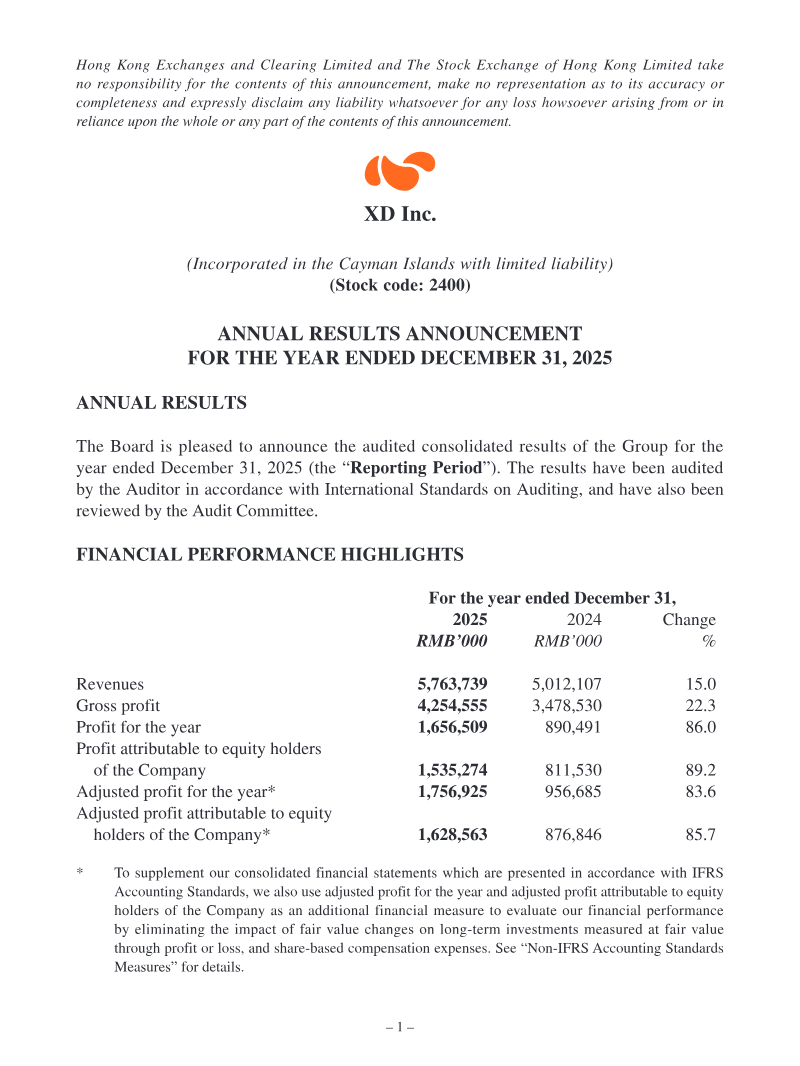
The announcement details XD Inc.’s launch of a HK$400 million Automatic Share Buy‑Back Program, effective June 12 2026 and scheduled to conclude by November 11 2026 or earlier if the cap is reached. The program is governed by a Share Buy‑Back Agreement with an independent broker, who will execute purchases independently of the company and its connected persons. The broker’s actions are constrained by pre‑determined parameters, ensuring non‑discretionary buy‑backs that comply with Listing Rules and the Securities and Futures Ordinance. A waiver from Rule 10.06(2)(e) was granted by the Stock Exchange, allowing buy‑backs during restricted periods surrounding interim results announcements; this waiver is justified by guidance letter GL117‑23 and aims to reduce operational burdens while mitigating insider‑trading risks. The program’s scope covers the Hong Kong Stock Exchange, with a five‑month duration and a target of HK$400 million in share repurchases. The company confirms that all bought‑back shares will be cancelled, and the program is not expected to trigger mandatory offer obligations under the Takeovers Code. Methodologically, the broker will disclose each purchase via next‑day disclosure returns, maintaining information barriers to prevent insider information flow. The Board views the program as beneficial for shareholders and emphasizes that buy‑backs will be subject to market conditions and broker discretion within the set parameters.
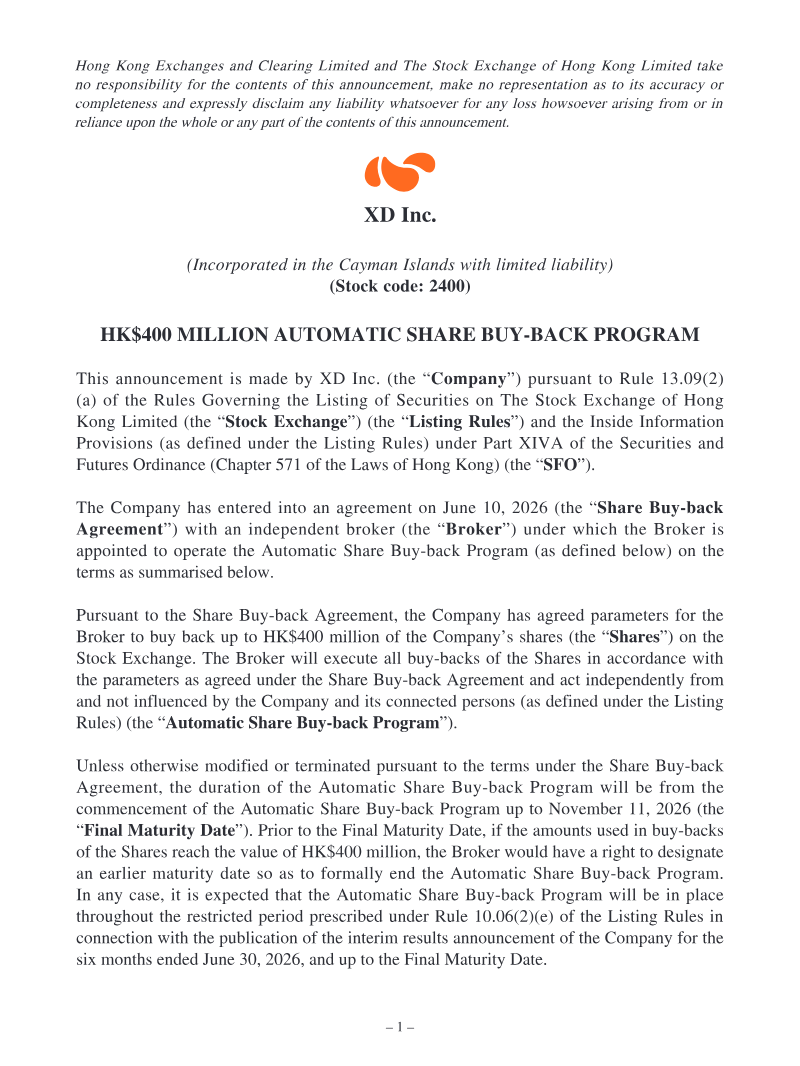
Hong responsibility expressly part of the Kong for the disclaim contents Exchanges contents any and of this liability announcement. Clearing Limited announcement, for any and The Stock Exchange no representation howsoever arising of Hong as to its from or in Kong accuracy Limited or take no make loss completeness the whole and or any whatsoever reliance upon of this XD Inc. 心动有限公司 (Incorporated in the Cayman Islands with limited liability) (Stock code: 2400) HK$400 MILLION AUTOMATIC SHARE BUY-BACK PROGRAM This announcement is made by XD Inc. (the “Company”) pursuant to Rule 13.09(2) (a) of the Rules Governing the Listing of Securities on The Stock Exchange of Hong Kong Limited (the “Stock Exchange”) (the “Listing Rules”) and the Inside Information Provisions (as defined under the Listing Rules) under Part XIVA of the Securities and Futures Ordinance (Chapter 571 of the Laws of Hong Kong) (the “SFO”). The Company has entered into an agreement on June 10, 2026 (the “Share Buy-back Agreement”) with an independent broker (the “Broker”) under which the Broker is appointed to operate the Automatic Share Buy-back Program (as defined below) on the terms as summarised below. Pursuant to the Share Buy-back Agreement, the Company has agreed parameters for the Broker to buy back up to HK$400 million of the Company’s shares (the “Shares”) on the Stock Exchange. The Broker will execute all buy-backs of the Shares in accordance with the parameters as agreed under the Share Buy-back Agreement and act independently from and not influenced by the Company and its connected persons (as defined under the Listing Rules) (the “Automatic Share Buy-back Program”).
. The Broker will execute all buy-backs of the Shares in accordance with the parameters as agreed under the Share Buy-back Agreement and act independently from and not influenced by the Company and its connected persons (as defined under the Listing Rules) (the “Automatic Share Buy-back Program”). Unless otherwise modified or terminated pursuant to the terms under the Share Buy-back Agreement, the duration of the Automatic Share Buy-back Program will be from the commencement of the Automatic Share Buy-back Program up to November 11, 2026 (the “Final Maturity Date”). Prior to the Final Maturity Date, if the amounts used in buy-backs of the Shares reach the value of HK$400 million, the Broker would have a right to designate an earlier maturity date so as to formally end the Automatic Share Buy-back Program. In any case, it is expected that the Automatic Share Buy-back Program will be in place throughout the restricted period prescribed under Rule 10.06(2)(e) of the Listing Rules in connection with the publication of the interim results announcement of the Company for the six months ended June 30, 2026, and up to the Final Maturity Date.
WAIVER FROM STRICT COMPLIANCE WITH THE REQUIREMENTS UNDER LISTING RULE 10.06(2)(e) Rule 10.06(2)(e) of the Listing Rules restricts a listed issuer from purchasing its shares under various circumstances, including during restricted periods preceding the periodic announcement of its results (collectively, “Restricted Periods”). In light of the Guidance Letter 117-23 (the “GL117-23”) published by the Stock Exchange which sets out guidance on automatic share buy-back programs, the Company wishes to implement the Automatic Share Buy-back Program and has sought, and the Stock Exchange has granted, a waiver from strict compliance with the requirements under Rule 10.06(2) (e) of the Listing Rules in respect of the buy-back of Shares under the Automatic Share Buy-back Program during the Restricted Periods (the “Waiver”). The Waiver will enable the Company, through the Broker pursuant to the Share Buy-back Agreement, to conduct buy-backs of the Shares during the Restricted Periods under the Automatic Share Buy-back Program. This will optimise the buy-back program administration and maximise the opportunities for the Company to implement the Automatic Share Buy-back Program to the fullest extent up to the targeted HK$400 million. Investors and shareholders of the Company (the “Shareholders”) should take note that:
m. This will optimise the buy-back program administration and maximise the opportunities for the Company to implement the Automatic Share Buy-back Program to the fullest extent up to the targeted HK$400 million. Investors and shareholders of the Company (the “Shareholders”) should take note that: (i) the Automatic Share Buy-back Program is a non-discretionary arrangement with respect to the Company, which (a) was established outside the Restricted Period, (b) sets out the pre-determined parameters for the Share buy-backs, and (c) generally speaking, can only be modified or terminated outside the Restricted Period (unless required by or for the purpose of compliance with applicable laws or regulations or directed or instructed by a relevant regulatory authority); (ii) the Automatic Share Buy-back Program will be effected through one single broker which, to the best knowledge of the Company, is not a connected person (as defined under the Listing Rules) of the Company; (iii) all Share buy-back decisions under the Automatic Share Buy-back Program will be made by the Broker in accordance with the parameters as expressly set out under the Share Buy-back Agreement and independently from and not influenced by the Company and its connected persons (as defined under the Listing Rules).
buy-back decisions under the Automatic Share Buy-back Program will be made by the Broker in accordance with the parameters as expressly set out under the Share Buy-back Agreement and independently from and not influenced by the Company and its connected persons (as defined under the Listing Rules). Each of the Company and the Broker will maintain appropriate Chinese walls or information barriers in relation to the Automatic Share Buy-back Program to ensure that no inside information of the Company will be given by the Company and its connected persons (as defined under the Listing Rules) directly or indirectly to, or received by, any personnel of the Broker involved with the execution of the Automatic Share Buy-back Program until a reasonable time after its completion or termination;
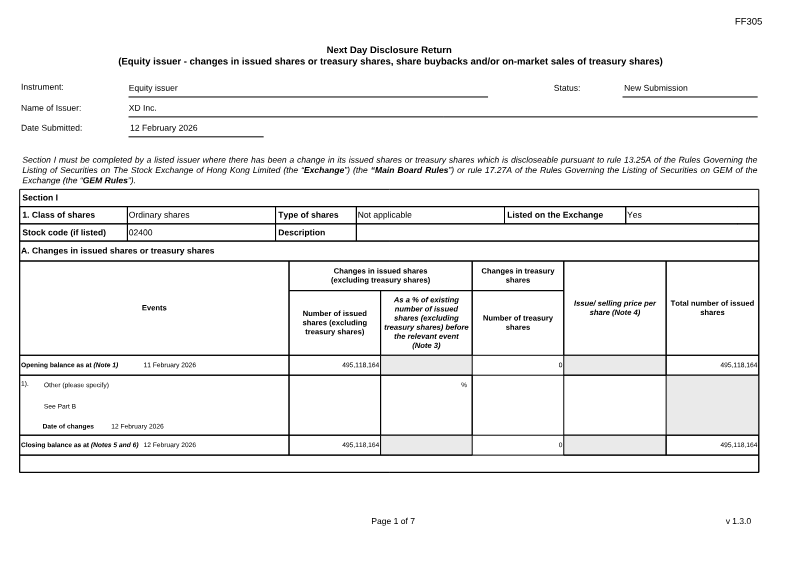
(iv) all Share buy-back of the Shares under the Automatic Share Buy-back Program will commence on June 12, 2026 and therefore the cooling-off period of at least 45 days will ensure a sufficient time gap between the commencement of the Automatic Share Buy-back Program and the expected commencement date of the Restricted Period under Rule 10.06(2)(e) of the Listing Rules in relation to the publication of the interim results announcement of the Company for the six months ended June 30, 2026, being July 29, 2026; (v) the duration of the Share Buy-back Agreement will be five months; (vi) each of the Company’s market capitalization as at the date of this announcement and average daily turnover volume in the six months immediately prior to the date of this announcement is above the benchmarks as set out under the GL117-23; and (vii) the Company published this announcement to disclose the key details of the Automatic Share Buy-back Program and will disclose any buy-back of the Shares conducted thereunder by way of next day disclosure returns in accordance with the requirements of the Listing Rules.
Giant Network’s 2025 annual report demonstrates a robust year‑over‑year performance, with total revenue escalating 72.7 % to ¥5.05 billion and net profit attributable to shareholders rising 23.1 % to ¥1.76 billion. Operating cash flow surged by 188.6 %, underscoring strong liquidity generation. The company’s dual‑core strategy—leveraging the MMORPG IP “征途” and the casual title “超自然行动组”—drives growth, supported by AI‑enabled development and cross‑platform expansion. Despite these gains, recent non‑recurring losses have yet to turn positive, creating some uncertainty about long‑term profitability. Regulatory developments in China have accelerated a focus on original IP and digital‑culture products. Government policies encourage embedding traditional culture into game design, boosting AI and cloud R&D, and expanding overseas digital content. Giant Network aligns with these directives through a research‑and‑operations model, heavy IP investment, and compliance tightening under new child‑online‑protection rules. Financially, operating profit rose 54 % to ¥829 million, while net profit increased 93 % to ¥947 million, largely due to higher investment income and lower tax expense. R&D spending more than doubled, reflecting intensified product development. Other comprehensive income swung from a positive ¥219 million to a negative ¥220 million, driven by fair‑value changes and credit impairment losses. The group maintained a conservative asset‑liability ratio, rising from 12.76 % to 18.67 %, and retained over 80 % voting control through founder‑controlled entities. Key findings highlight that core gaming revenue remains strong, investment income is mixed, and non‑recurring items significantly impact overall profitability. The report covers China exclusively, focusing on the 2025 fiscal year and encompassing gaming operations, IP development, regulatory compliance, and financial risk management.
Archosaur Games, a Hong Kong‑listed mobile‑game developer incorporated in the Cayman Islands and majority owned by Tencent and Perfect World, reported a 14.3 % revenue rise to RMB 1,304.4 million in FY 2025, driven by the launches of Dragon Raja: Cassell Gate and Immortal Skywalker in China. Gross profit climbed 11.8 % to RMB 923.7 million, but the margin slipped to 70.8 % because of higher IP‑holder commissions on licensed titles. Operating loss narrowed sharply to RMB 91.1 million from a ¥341.4 million loss in 2024, largely due to a 19 % cut in selling and marketing expenses; R&D spend remained flat. Net loss improved to RMB 36.7 million, an 87.2 % reduction versus the prior year, with an adjusted net loss of RMB 31.9 million after share‑based compensation add‑back. Cash flow and liquidity strengthened: operating cash usage fell 71.9 %, net current assets rose to RMB 1.48 bn and cash to RMB 1.09 bn, although gearing increased to 24.6 %. The group maintained a robust capital strategy with no external debt, Level‑3 fair‑value investments of RMB 2.24 bn, and a low credit‑risk profile for trade receivables. Governance structures met listing requirements; the board comprised two executives, two non‑executives and three independent directors, with audit, nomination, remuneration and risk committees each staffed by three members. Share‑based incentive plans remained within regulatory caps, granting 4.9 million RSUs and 4.1 million options in 2025. Geographically, Archosaur operates seven wholly‑owned overseas entities across Singapore, UAE, China, Japan, Korea and the U.S., while its Chinese subsidiaries are controlled through a complex contractual framework that navigates foreign‑investment restrictions. The company’s financial reporting follows IFRS and HKCO, with ongoing transition to IFRS 18 for revenue recognition. Overall, Archosaur Games achieved significant profitability improvement and strengthened liquidity while maintaining compliance with governance and regulatory standards across its global operations.
Tencent Holdings delivered a robust interim performance for the six months ended 30 June 2024, underscoring the resilience of its diversified internet‑services platform. Revenue rose 8 % year‑on‑year to RMB 161.1 billion, while profit attributable to equity holders surged 82 % to RMB 47.6 billion and non‑IFRS profit increased 53 % to RMB 57.3 billion. Gross profit expanded 21 % to RMB 85.9 billion, lifting the gross margin to 53 % from 47 % a year earlier, reflecting higher monetisation of gaming, digital content and cloud services across China and overseas markets. The balance sheet strengthened, with total assets climbing 4.9 % to RMB 1.655 trillion and equity reaching RMB 927.6 billion, driven by retained earnings of RMB 842 billion. Operating cash flow improved to RMB 126.5 billion, although financing activities generated a net outflow of RMB 99.8 billion, primarily due to share repurchases (RMB
Tencent Holdings reported a robust financial performance for 2023, with total revenue reaching RMB 609 billion—a 9.8% increase year‑on‑year—driven by value‑added services, online advertising and fintech & business services. Gross profit rose 23% to RMB 293 billion, lifting the gross margin to 48%, while operating profit surged 44% to RMB 160 billion, delivering a 26% operating margin and a 19% net margin. Net profit attributable to equity holders fell to RMB 115 billion, reflecting a 39% decline, yet non‑IFRS profit grew 36% to RMB 158 billion, and basic earnings per share were RMB 12.19. Operating cash flow improved to RMB 221.96 billion, offset by RMB 125 billion of investing outflows and a modest increase in total borrowings to RMB 197.4 billion. Strategically, the company set 2027 targets that include R&D investment of USD 78.5‑94.1 billion, overseas expansion of USD 31.4‑47.1 billion, and new product and service development of USD 15 billion. Cash is held almost entirely in RMB‑denominated accounts on the mainland, and the firm judges foreign‑exchange movements unlikely to materially affect results, monitoring leverage through a debt‑to‑adjusted‑EBITDA ratio. Governance remained a focal point, with the board adhering to the Model Code for securities transactions, an insider‑information framework, and comprehensive directors‑and‑officers liability insurance. Share‑option programmes granted roughly 58 million awards without performance conditions, while dividend policy stayed flexible, proposing a final dividend of HKD 3.40 per share. The board composition featured eight members, including one executive director, and operated five specialised committees that oversaw risk, audit, remuneration and governance. A three‑lines risk‑management model identified ten material risks, highlighting heightened concerns around market competition, innovation and business continuity. External auditors emphasized three key audit matters: revenue recognition for permanent virtual items, goodwill and investment impairment testing, and fair‑value measurement of Level 3 financial instruments. Overall, internal‑control, risk‑management and financial‑reporting systems were judged effective, supporting Tencent’s continued focus on user‑value creation, technological innovation and sustainable growth within the Chinese and global internet‑technology landscape.