1 free read left. Create a free account for unlimited reading + AI research.
Create free account
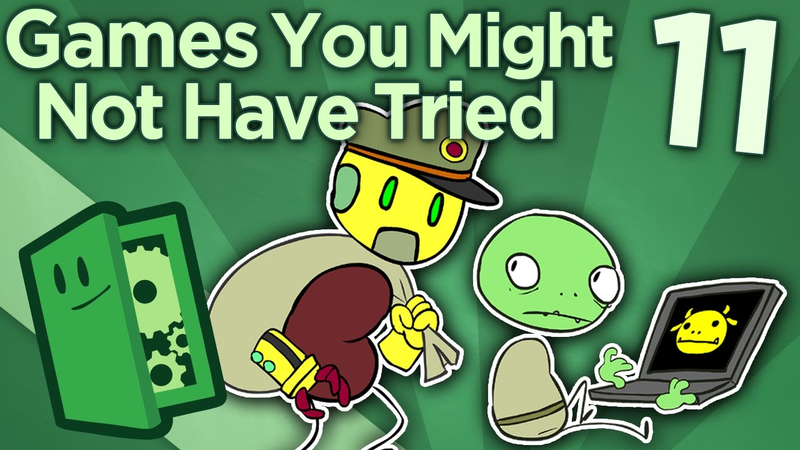
Games You Might Not Have Tried - ep 11 - Find New Games - Extra Credits
Key insights
7 takeaways- 01Niche titles can successfully streamline complex genres by removing secondary elements; for example, Reverse Crawl focuses exclusively on tactical combat by stripping away the exploration typical of the Heroes of Might and Magic formula.
- 02Game design innovation often requires prioritizing unique mechanics or atmospheric risks over mainstream polish, even when this leads to unconventional or flawed final products.
- 03Tactical depth can be achieved through specific mechanical constraints, such as the manual aiming requirements in SteamWorld Heist or the deep customization options found in Templar Battleforce.
- 04Hybrid media integration, such as the use of a physical companion book in Ice-Bound Concordance, offers a method for developers to expand gameplay beyond the digital screen.
- 05Platform selection significantly impacts user experience, as demonstrated by The Guild of Dungeoneering, which improved its accessibility and flow by transitioning from PC to tablet.
- 06Surreal art styles and narrative ambiguity are effective tools for building immersive horror experiences, as evidenced by the design approaches in The Cat Lady and Fran Bow.
- 07High-concept narrative frameworks, such as the relativistic social media themes in Killing Time at Lightspeed or the command-line hacking in Quadrilateral Cowboy, provide effective ways to explore complex social and technical concepts.
Ask AI about this video
Transcript
I sure hope you folks enjoy watching these as much as I like making them because I don't know, these are fun. These episodes always take us a couple of months to put together. So, by the time each one comes out, James has already got a new batch of games to recommend. Anyway, you know the drill. We don't promise that all these games are good, just that they're different. They're design is interesting in some way, even if the most interesting thing about them is how they fail to achieve what they're setting out to do. Anyway, enough talk. Have at you. Zero Time Dilemma. Years ago, we recommended 999 in one of these episodes. It's been quite the journey since then, but now the franchise, or at least this chapter of it, is coming to a close and the story is perhaps one of the best yet in the series. The graphics, not so much, but don't let that deter you. This game may handily demonstrate just how much better 2D graphics can look and that switching to 3D isn't always the best choice, but if you've followed the series so far,
you owe it to yourself to finish this one out. And if you haven't checked these games out yet, well, maybe get on that. Inside. We would be remiss if we didn't mention this one. Brought to you by the creators of Limbo, this is a dark and mysterious run through a puzzle-filled testing facility. James didn't find it quite as compelling as Limbo, but it's still a solid title and the atmosphere alone is worth your time if you want to learn how to build that sort of oppressive feeling into your own games. Reverse Crawl. James just tore through this one. It's one of those just one more battle type games that'll have you so sucked in that you won't realize the sun is rising and oops, you didn't sleep. The really
interesting thing about this game is that it takes the Heroes of Might and Magic or King's Bounty formula and does away with the exploration. Now, that might sound terrible. James felt that way too at first. I mean, exploration kind of seems like the lifeblood of those games. But by doing away with the exploration, Reverse Crawl is able to make the combat much tighter with specifically designed encounters and a progression system that really makes the player consider what they want to be able to play with. Add to that the fact that the player can't just barge into battle with a ridiculously broken combination of units, but instead has to pick from a wide variety of pre-made unit groupings for each encounter, and you get a tightly designed experience. You can even beat it in one night if you don't sleep. I don't recommend it, but I'm just saying you could. And this, my distinguished General Bots, is the new SteamWorld. SteamWorld Heist. Since we're talking strategy games, let's talk about this pleasantly
surprising little gem. This is a game that takes all the conventions of our isometric or top-down tactics games and puts them on a 2D plane, and it works. It works because the designers considered how 2D might change the formula, what they might be able to do with the design in 2D that it'd be harder in one of those other formats. And the conclusion they came to was to make you aim manually. Yep, this is a tactics game like any other, but sort of like Valkyria Chronicles, when it comes time to shoot, you've got to eyeball it. With no reticle to guide you, this makes variables like cover become a much more interesting and interactive element of the game than we saw even in games like XCOM. So, if you're looking for a quirky tactics game or even just like thinking about how we can push the formula, you might want to check out SteamWorld Heist. And of course, it all went according to plan. Now, a whole lot of you asked if we could talk about some tablet and mobile games on one of these lists, so let me just throw a slew of those at you before we get back to the weird PC games.
Let's start with Galactic Keep. Galactic Keep is exactly what I always wanted a storybook adventure to be when I was young. It takes some of the work done in Steve Jackson's excellent Sorcery series to the next level and really makes you feel like you're playing a solo tabletop role-playing module. Seriously, I'm not sure I've ever felt more like I was at the Barrier Peaks without a GM screen on the table. Out There. This game has no combat, and yet it is brutal. It's a rogue-like survival adventure where you are the last surviving member of humanity trying to make it home. It's vignettes are excellently written, but unlike most story-driven games, you will not easily reach the end of this story. I think it's the very fact that Out There presents a harsh universe where you will die time and again before ever being able to see one of its many endings that
kept drawing James back. If you like sci-fi, if you like rogue-likes, if you like narrative and are interested in a brutal challenge that never once involves firing a blaster, you better check this out. Icebound Concordance. Speaking of writing, here is a game that is all about writing. Or rather, it's all about rewriting. The game itself is a conversation with an AI built from the mind of a writer, and you are there to help it edit and rewrite its last book. That's pretty interesting in its own right, but then you get to the real bit, the Icebound Compendium. If you're willing to pony up $25 to pick up the companion book, you are in for something novel. I can't say much about the Compendium without spoiling things, but suffice it to say that periodically throughout the game, you will be prompted to search through the book for pages related to some of what's going on on screen. Then the game will use your iPad camera to scan the pages and to make the book itself come to life.
My only complaint here is that the book itself is poorly made. The cover fell off the binding of James's copy before it even got through the mail. Of course, that's a sample size of one James, so hopefully yours will be sturdier. The Guild of Dungeoneering. This game is here simply as an example of what a difference platform can make. James found this to be a mediocre strategy title when he first played it on PC, but on a tablet, its lighter, shorter sessions, and more casual strategy experience really works. If you want a relaxing strategy game to play on the go, it's worth trying. Really though, this game is worth buying for the songs alone.
Templar Battleforce. I haven't tried this game on PC, but the mobile version was exactly what James was looking for in a slightly more hardcore tactics game. If you want to play Space Hulk, but the actual modern Space Hulk video game didn't cut it for you, get Templar Battleforce. It's everything Space Hulk should be. It's got an interesting class system, a varied advancement tree, multiple ways to customize units of the same class, and yet the levels are short enough to play on the go. All right, that's enough mobile games. Let's return to the PC and let's get weird. Cat Lady We so rarely get to recommend adventure games, so I'm glad we get to talk about this piece of weirdness. There are a lot of counter-intuitive design decisions in
this game, sometimes on purpose, sometimes as pitfalls of the old-school adventure game ethos, but if you're looking for something surreal, creepy, and dark, Cat Lady has you covered. The art style perfectly fits the madness, feeling at times like Monty Python channeling Poe. And the decision to do away with the mouse entirely in an old-school adventure game and streamline things by going with a keyboard interface alone, that'll put you on a games you might not have tried list. Fran Bow We can't talk about horror games without talking Fran Bow. If you want disturbing and strange, this game has it in spades, but it's the ambiguity of this game that I love. I'll try not to spoil anything, but let's just say the game leaves itself open for interpretation, and I think that's great. Too often horror stories try to explain all their nightmarish surreality, and in doing so, kill the horror. And that's
not to say that horror stories shouldn't make sense, but leaving your nightmare world as an ambiguous metaphor is often so much better than feeling like you have to tie up all the loose ends by saying something like, "See, it was a dream all along." Fran Bow is an excellent example of this. Killing Time at Lightspeed I love the premise of this game. You've left Earth. You're traveling away at light speed, but you can still see your Facebook feed. But here's the catch, at relativistic speed, every time you hit refresh, a year has passed. You can touch base for one snapshot of everyone's lives back home, then it whirls past and time moves on for them, if not for you. My only complaint is that most of the time most of my friends back home simply talked about the news, and for me at least, that's not how social networks work. That's a big part of it, to be sure, but it's in the background of all the tiny day-to-day things that people
post. I would have loved to have more emphasis on the personal, on the relationships of people and their daily lives, as that backdrop would have given the big events of the world that much more impact. Seeing how they affected the people I loved, even as I whipped away from them at the speed of light. Anyway, neat game. Try it out. And finally, Quadrilateral Cowboy. What happens when you mix stealth capers with command-line hacking and a PS1 aesthetic? Well, you get Quadrilateral Cowboy. Your mileage may vary with the art style, but there is something so cyberpunk about actually hooking up a computer to a jack and having to turn off a security laser with a series of semicolon-delineated commands. Am I alone, though, in this making me long for a multiplayer game where one player plays the stealth action hero and the other one plays their off-site hacker buddy, like unlocking the doors and
shutting off security cameras in the nick of time with a command-line interface? That would be rad. Somebody get on that. Anyway, I think that'll do it for today. Thank you for watching. Recommend some of your own weird favorites in the comments below, and we will see you next week. Oh.
Summary
This analysis highlights a curated selection of underappreciated video games, focusing on titles that offer unique design philosophies, experimental mechanics, or distinct atmospheric qualities. The selection spans various genres, including strategy, horror, adventure, and survival, across PC and mobile platforms. The primary objective is to encourage players to explore titles that prioritize innovative design over mainstream polish, even when those experiments result in unconventional or flawed experiences.
Key recommendations include Zero Time Dilemma, noted for its narrative conclusion; Inside, praised for its oppressive atmosphere; and Reverse Crawl, which successfully streamlines the Heroes of Might and Magic formula by removing exploration to focus on tight, tactical combat. SteamWorld Heist is highlighted for its innovative 2D tactical combat that requires manual aiming, while Galactic Keep and Out There are lauded for their immersive tabletop-style storytelling and brutal, non-combat survival mechanics, respectively. The list also features Ice-Bound Concordance, which integrates a physical companion book with digital gameplay, and The Guild of Dungeoneering, which demonstrates how platform choice—specifically moving from PC to tablet—can significantly improve the user experience.
Further recommendations include Templar Battleforce for its deep tactical customization, and horror titles The Cat Lady and Fran Bow, both recognized for their surreal art styles and effective use of ambiguity. Finally, Killing Time at Lightspeed and Quadrilateral Cowboy are noted for their high-concept premises, exploring themes of social media at relativistic speeds and command-line hacking within a stealth-heist framework. The analysis concludes that while these games vary in execution, they serve as valuable case studies for developers and players interested in how specific design constraints and platform-specific adaptations can push the boundaries of traditional gaming genres.
















Comments