FinancialKoei Tecmo
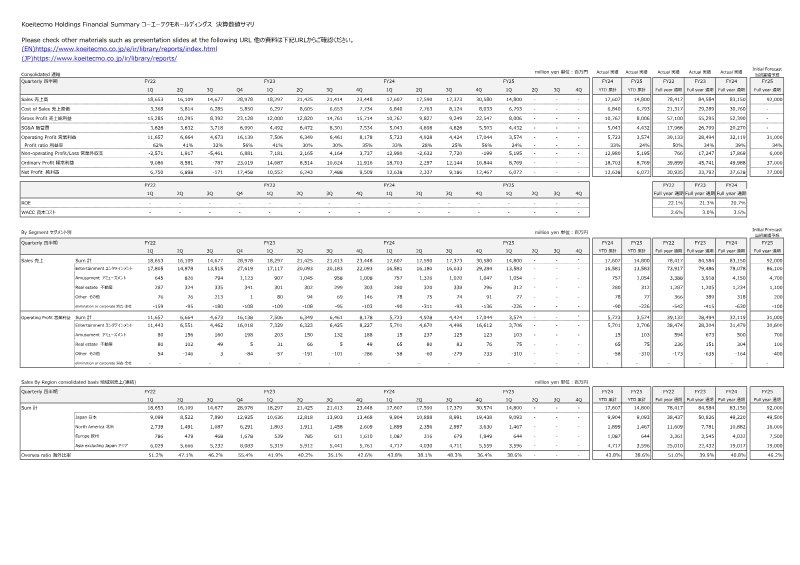
Consolidated Financial Results: FY2025 2nd Quarter Data Appendix
8 pages~16 min full read
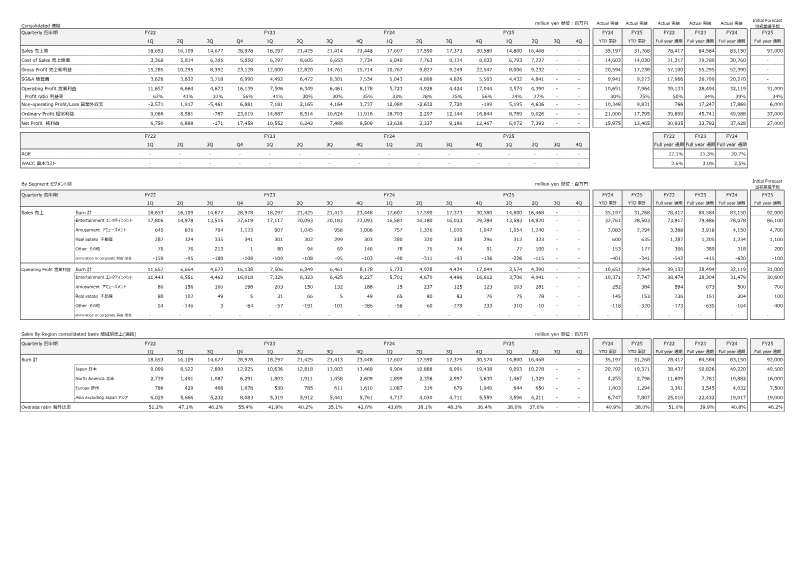
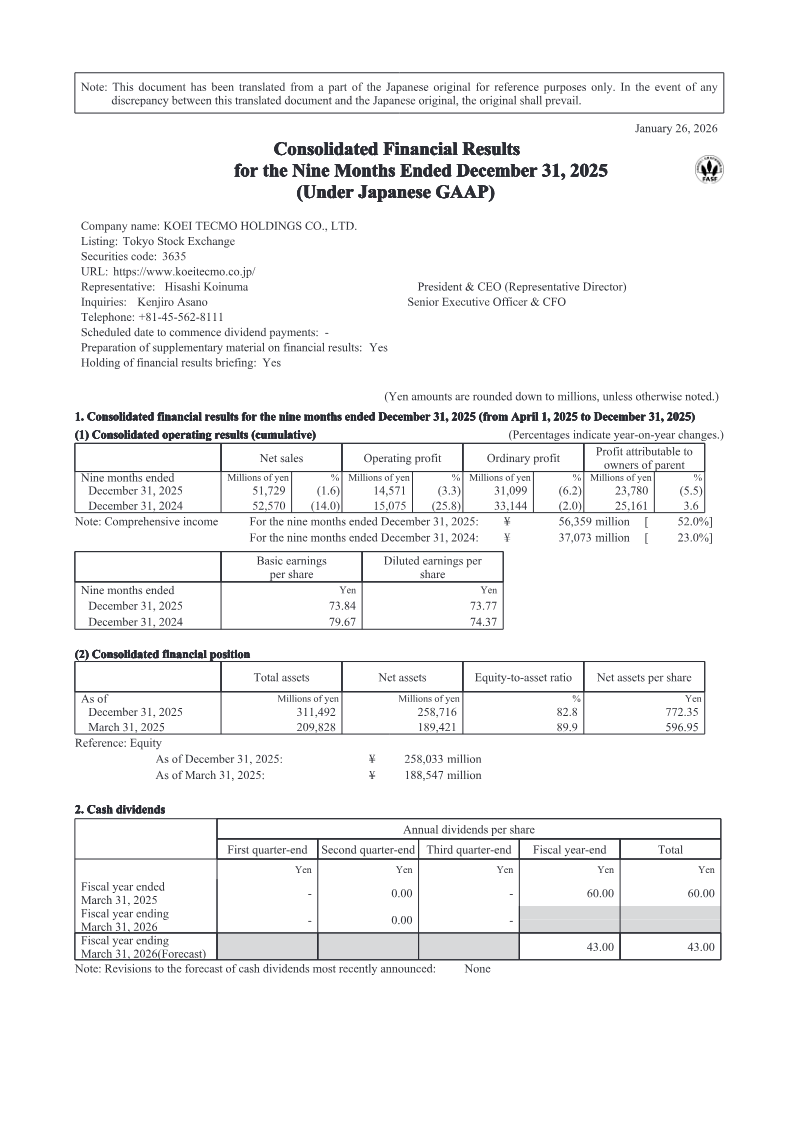
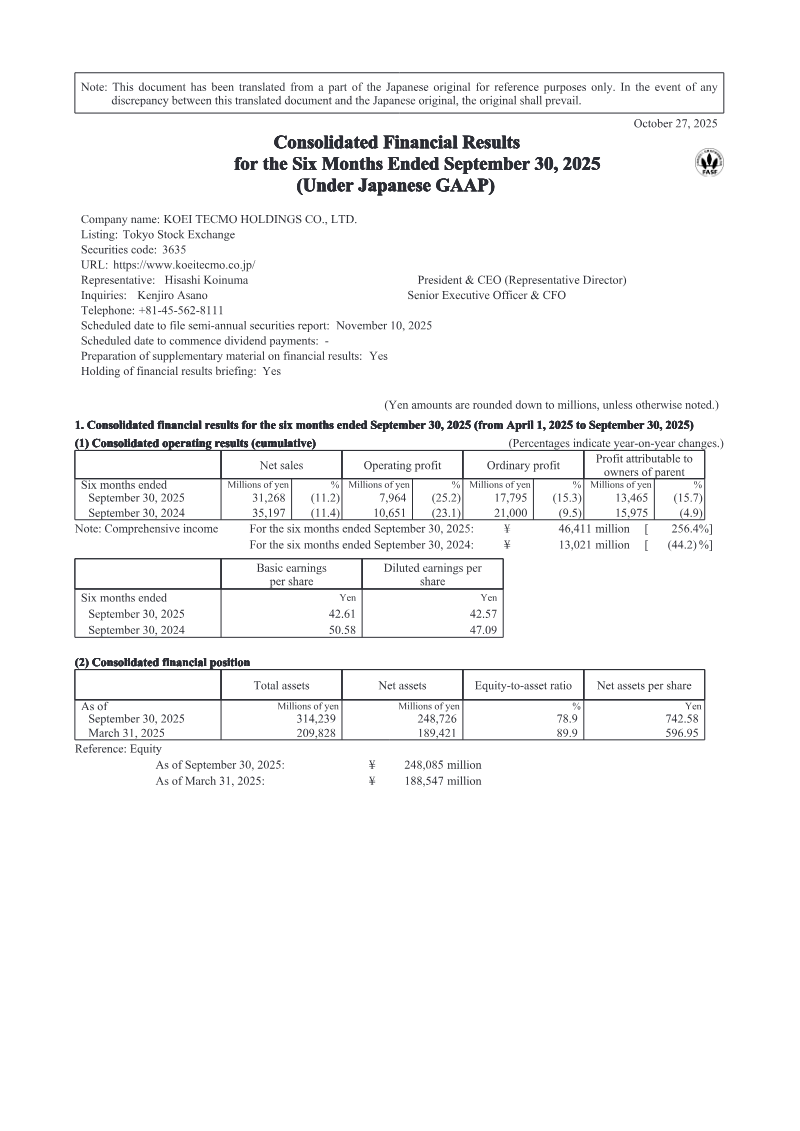
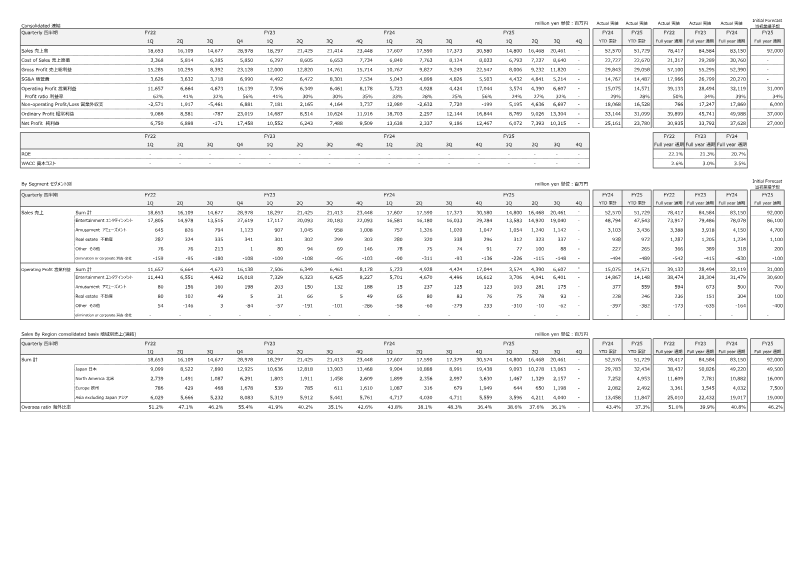
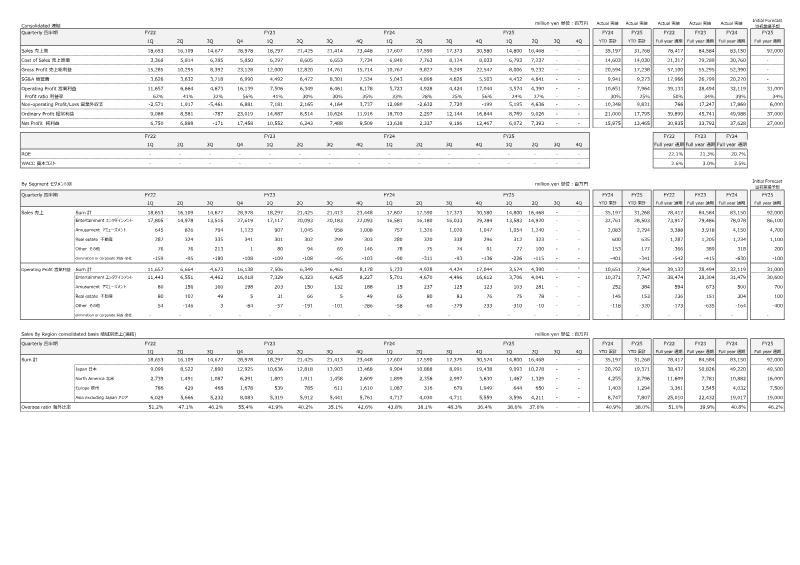
The consolidated financial appendix presents quarterly and annual performance for FY22 through FY25, focusing on sales, cost of sales, gross profit, SG&A, operating profit, and net profit across entertainment, amusement, real‑estate, and other segments. Sales peaked in FY25 Q4 at ¥28,978 million, driven largely by the entertainment segment (¥27,619 million), while cost of sales rose proportionally, resulting in a gross profit margin decline from 62 % in FY22 Q1 to 30 % by FY25 Q2. Operating profit fluctuated, with a notable dip in FY24 Q3 (¥4,673 million) before rebounding to ¥16,139 million in FY25 Q4. Net profit followed a similar pattern, reaching ¥17,458 million in FY25 Q4 after a negative result in FY24 Q3. Segment analysis shows entertainment consistently dominates revenue, contributing over 90 % of total sales, with amusement and real‑estate providing modest but stable contributions. Geographic revenue distribution indicates Japan remains the largest market (≈49 % of total sales), followed by North America and Asia excluding Japan, with overseas ratios ranging from 35 % to 55 %. Headcount grew from 2,413 employees in FY22 Q1 to 2,873 by FY25 Q4, reflecting expansion. Capital expenditure totals ¥789 million in FY22 and increased to ¥1,967 million in FY24, with real‑estate and equipment investments comprising the bulk. Digital sales maintain a high digital ratio (≈70 %) and online/mobile units account for 60–80 % of total sales units, underscoring a strategic shift toward digital platforms. Overall, the data illustrate robust revenue growth driven by entertainment titles, moderate margin compression due to rising costs, and a strategic emphasis on digital distribution across multiple regions.
Koei Tecmo · 2025
Koei Tecmo · 2025
Koei Tecmo · 2025
MIXI, Inc. · 2025
MIXI, Inc. · 2025
Koei Tecmo · 2025
Koei Tecmo · 2025
Koei Tecmo · 2025

Koei Tecmo · 2025
Koei Tecmo · 2025
Koei Tecmo · 2024
Koei Tecmo · 2024
Sony Group Corporation · 2026
Bandai Namco · 2026
InvestGame · 2025

Square Enix · 2025
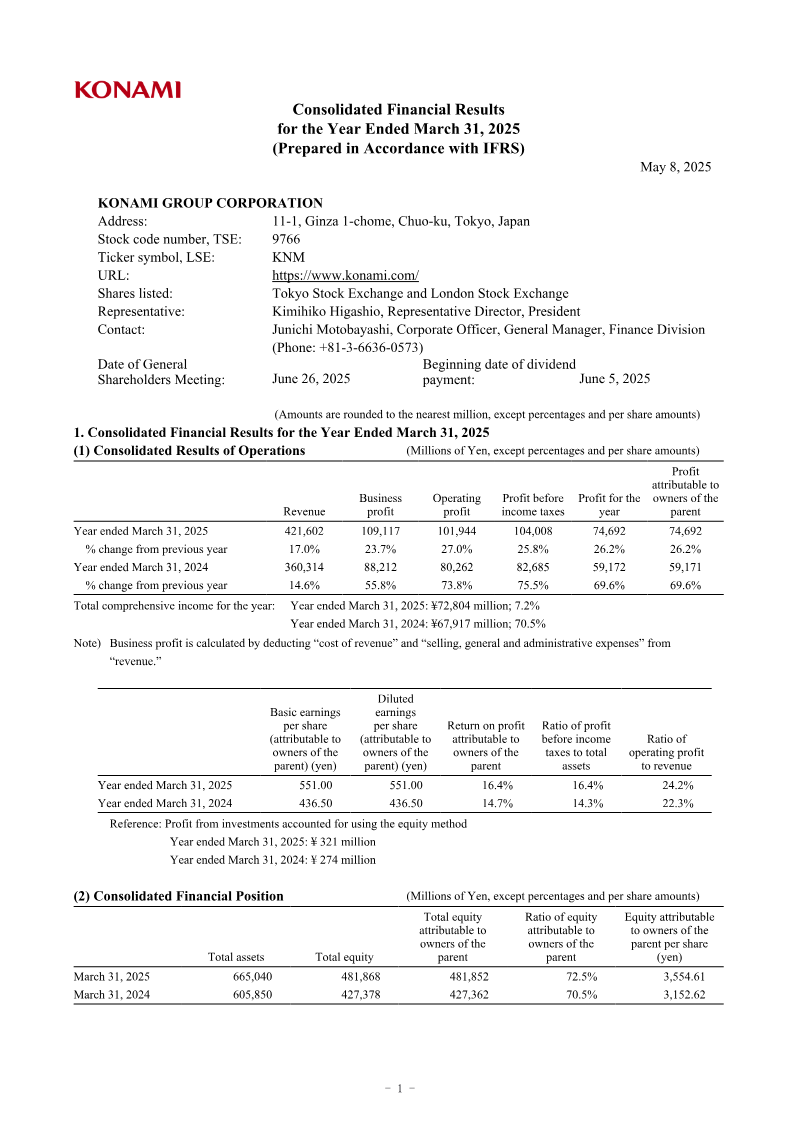
Konami · 2025

Nintendo · 2024
Bandai Namco · 2022
Bandai Namco · 2021
GREE · 2017
Bandai Namco · 2017
GREE Inc. · 2016
Bandai Namco · 2014