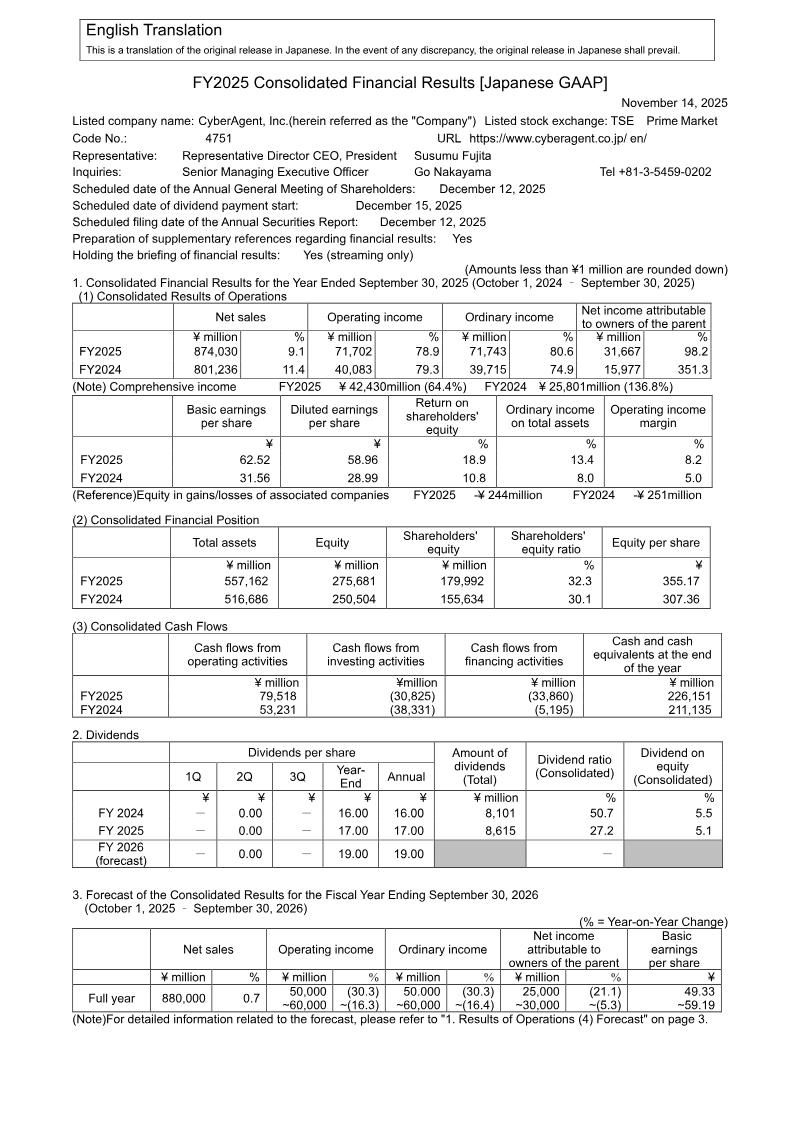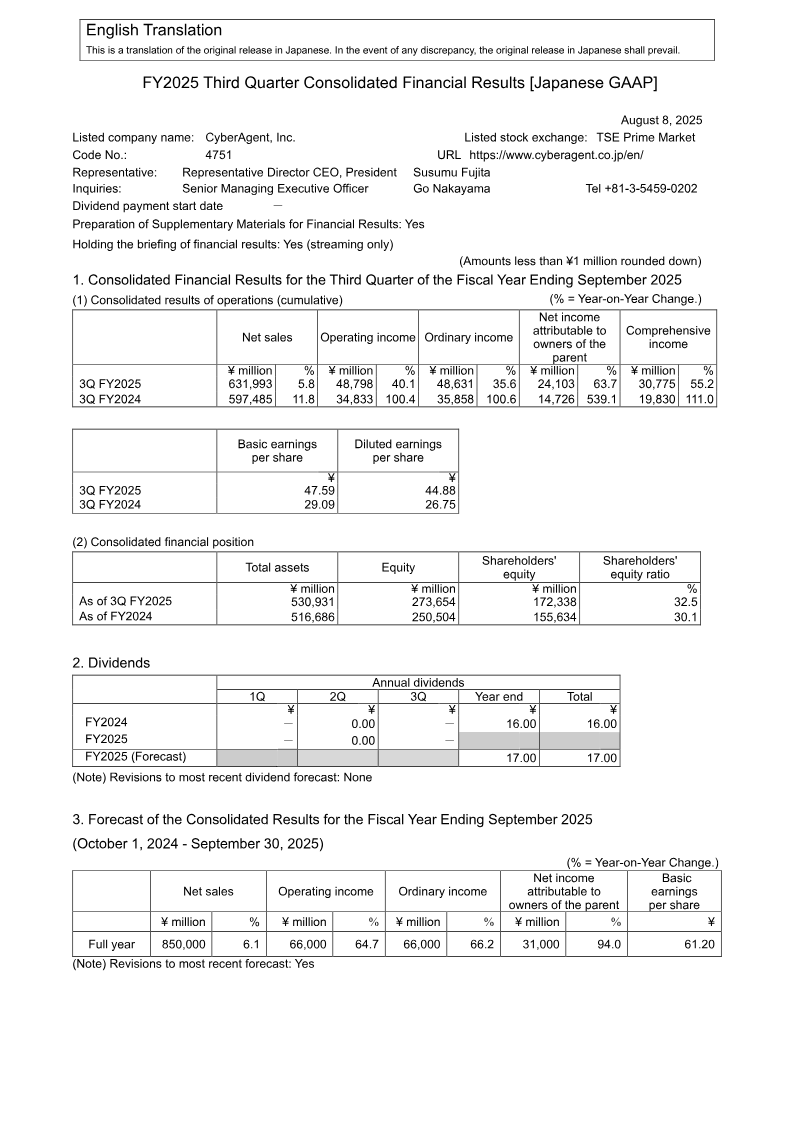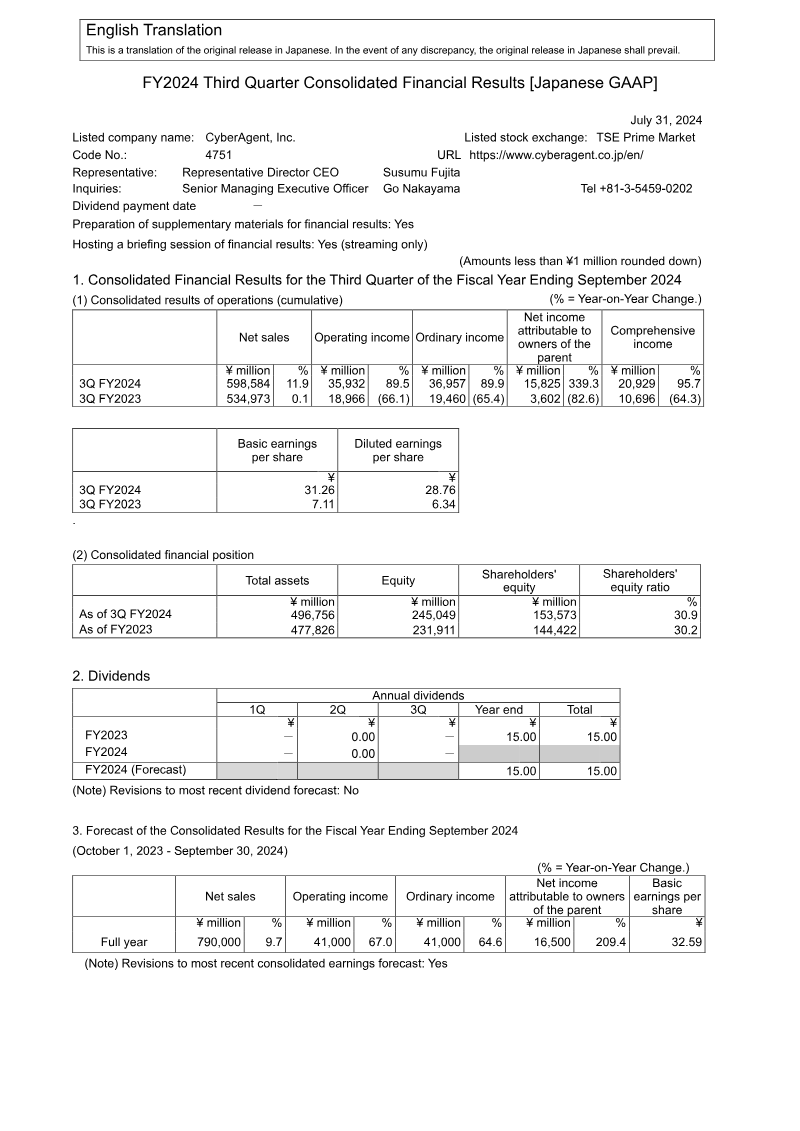
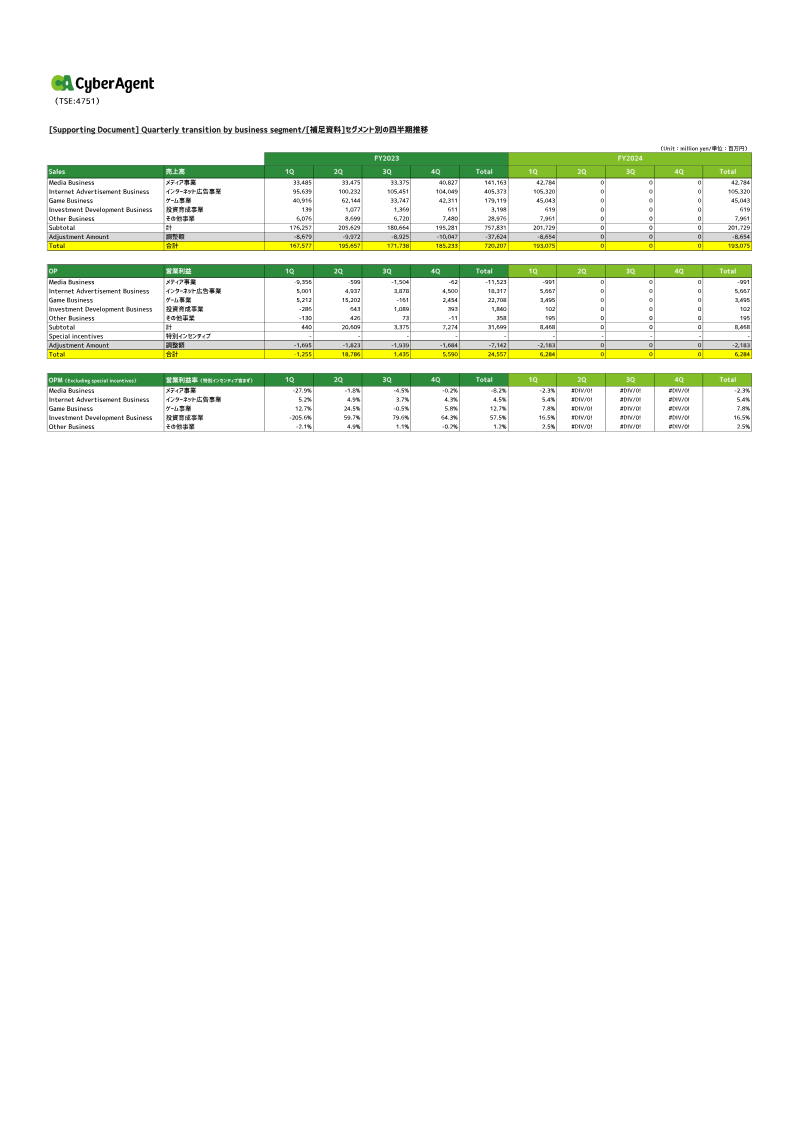
CyberAgent, Inc. reported a strong third‑quarter performance for FY2024, with net sales rising 11.9% year‑on‑year to ¥598 584 million and operating income increasing 89.5% to ¥35 932 million. Ordinary income attributable to owners surged 339.3% to ¥15 825 million, driven by record growth in the Internet Advertisement and Game segments. Net income attributable to owners rose 339% from ¥3 602 million in the same period of FY2023 to ¥15 825 million, while diluted earnings per share climbed from ¥6.34 to ¥28.76. Segment analysis shows the Media Business, anchored by ABEMA, generated ¥125 885 million in sales with a reduced operating loss of ¥489 million. The Internet Advertisement segment achieved ¥324 839 million in sales, operating income of ¥17 553 million. The Game Business contributed ¥151 070 million in sales and ¥26 844 million in operating income. Investment Development and Other segments posted modest sales but contributed to overall profitability. Total assets increased to ¥496 756 million, driven mainly by cash and deposits, while total liabilities rose modestly to ¥251 706 million. Equity stood at ¥245 049 million, with an equity ratio of 30.9%. The company maintained a stable share count of approximately 506 million shares outstanding. CyberAgent revised its FY2024 earnings forecast upward, projecting net income of ¥790 000 million and operating income of ¥41 000 million. The company also announced the acquisition of Nitroplus Co., Ltd., a content‑creation firm, to enhance its IP and media mix capabilities. The acquisition is expected to strengthen CyberAgent’s position in global entertainment markets, aligning with its strategy of integrating technology and creativity across digital platforms.
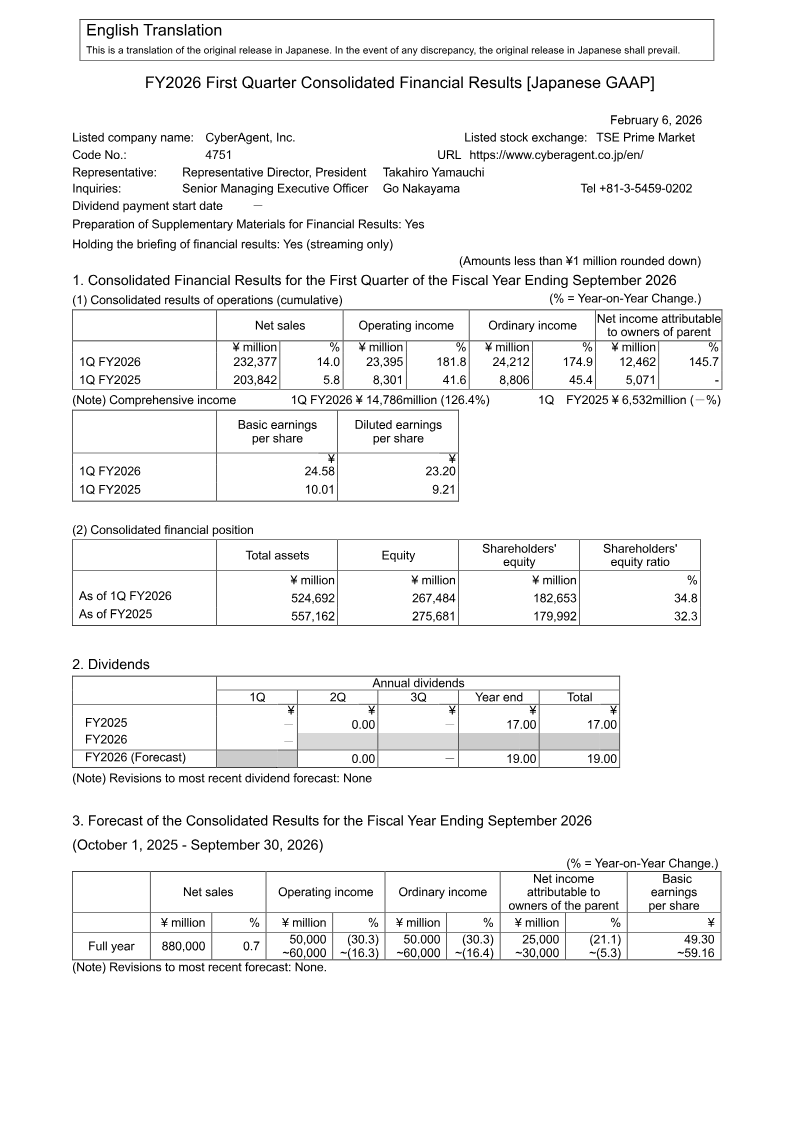
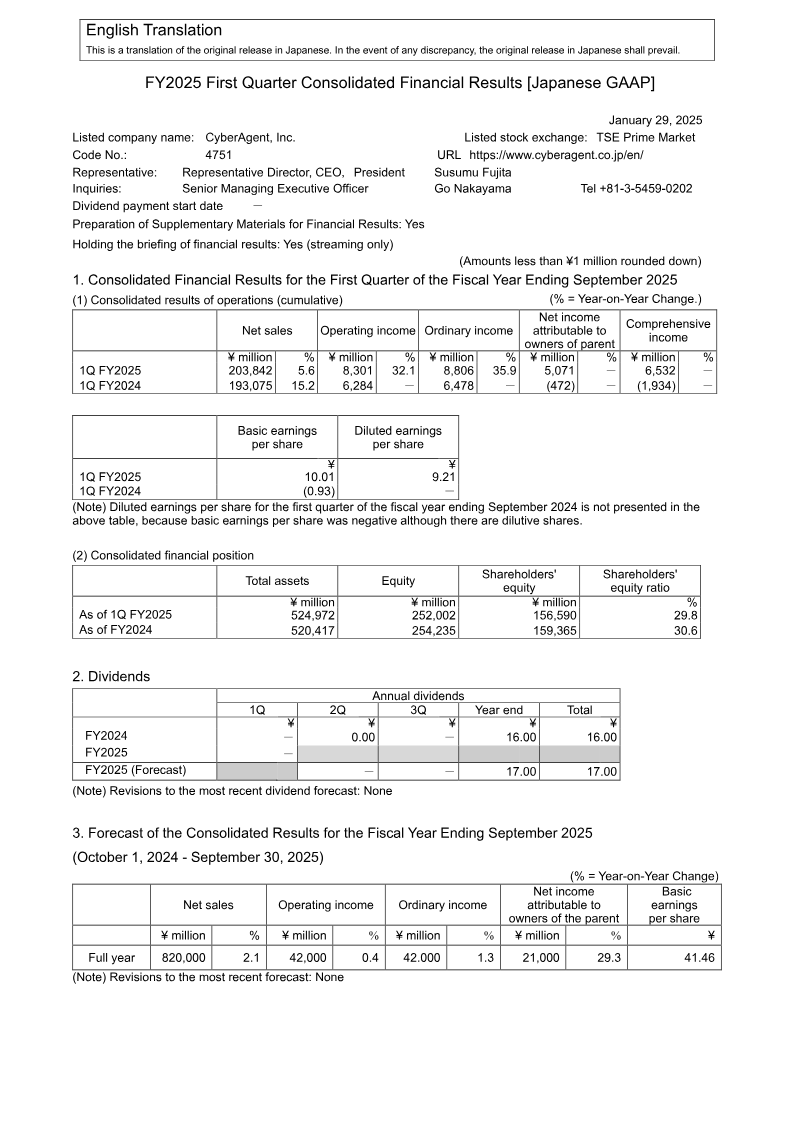
CyberAgent, Inc. reported a first‑quarter fiscal 2025 performance that marked a turnaround from the prior year’s loss. Net sales rose 5.6 % to ¥203,842 million, driven by a 10.5 % increase in the Media & IP Business (¥55,638 million) and an 11.8 % rise in Internet Advertisement sales (¥117,792 million). Operating income surged 32.1 % to ¥8,301 million, converting the prior‑year operating loss of ¥796 million into a profit. Ordinary income climbed 35.9 % to ¥8,806 million, and net income attributable to the parent rose from a loss of ¥472 million to a profit of ¥5,071 million. Earnings per share improved from a negative ¥0.93 to ¥10.01 basic and ¥9.21 diluted. Total assets increased modestly to ¥524,972 million, while equity fell slightly to ¥252,002 million due mainly to dividend payouts. The company’s forecast for FY2025 remains unchanged: net sales of ¥820,000 million (2.1 % growth) and operating income of ¥42,000 million (0.4 % growth). Dividend policy is unchanged, with a forecast annual dividend of ¥17.00 per share. The report covers Japan GAAP operations across four segments—Media & IP, Internet Advertisement, Game, and Investment Development—within the Japanese market for FY2025. No significant accounting policy changes or restatements were noted, and the company confirmed its going‑concern assumption. The financial statements are based on a consolidated basis, with 506 million shares outstanding and no material changes in the scope of consolidation.
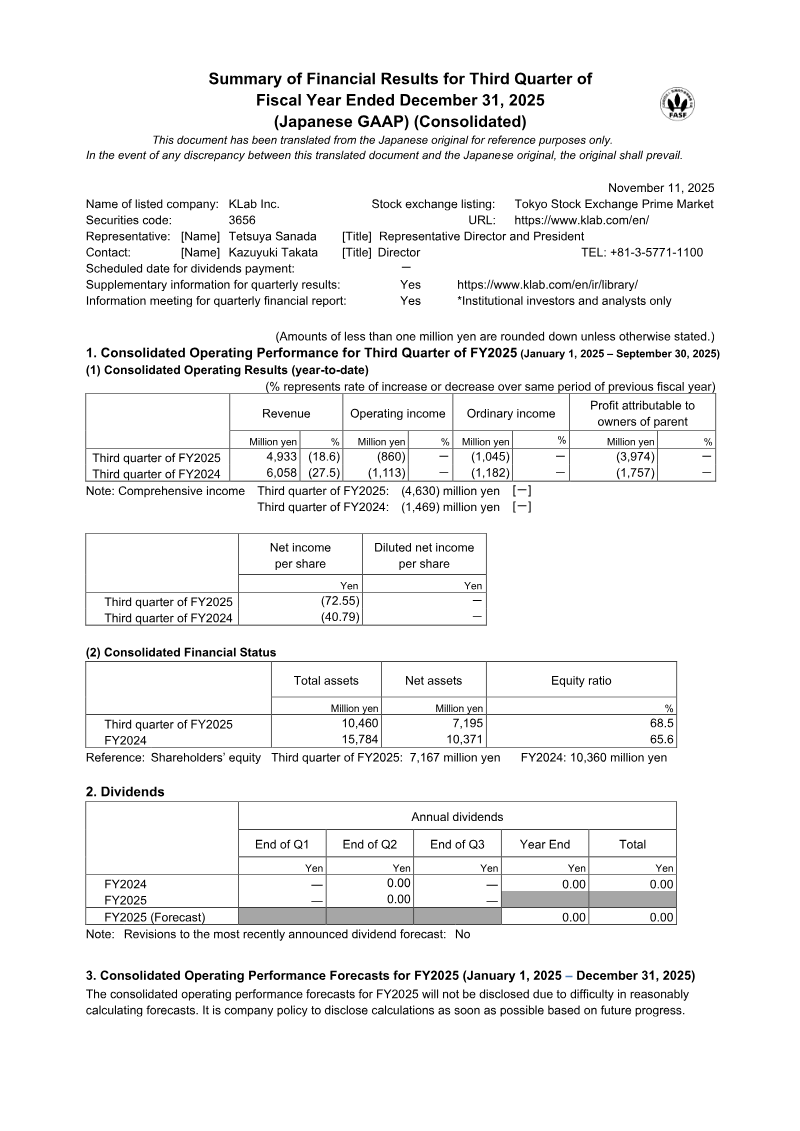
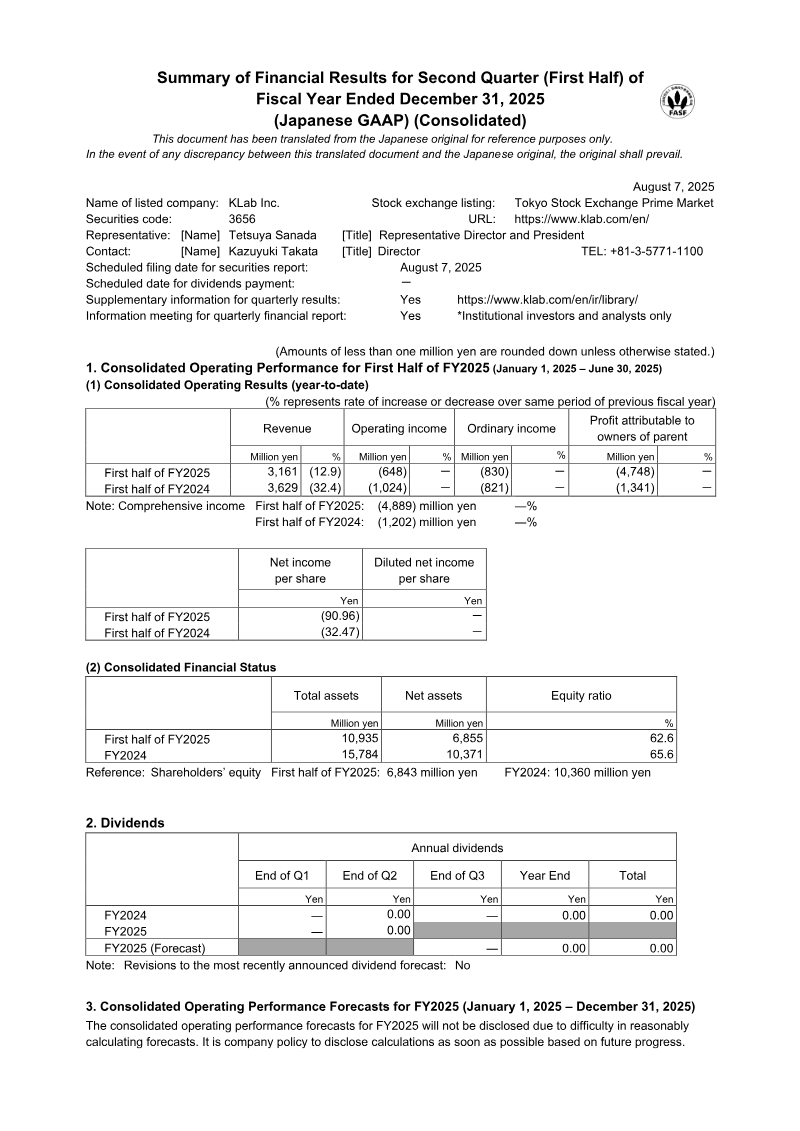
KLab Inc. experienced a significant downturn during the third quarter of fiscal year 2025, characterized by an 18.6% year-over-year revenue decline to ¥4.93 billion. This contraction was primarily driven by weakening performance in established titles such as Captain Tsubasa: Dream Team and a general decrease in income from paid users within the game business. Despite aggressive cost-cutting measures and a ¥1.57 billion gain from the sale of investment securities, the company recorded a substantial net loss of ¥3.97 billion. This loss was largely precipitated by a massive ¥4.42 billion impairment charge on software assets related to EA SPORTS FC™ TACTICAL and a reduction in goodwill following the divestment of GlobalGear Co. Ltd. The financial strain resulted in a decrease of over ¥3.1 billion in total net assets, though the company mitigated some impact by raising approximately ¥719 million through the exercise of stock acquisition rights. While four consecutive years of operating deficits have prompted scrutiny regarding the company’s status as a going concern, management asserts that no material uncertainty exists. This confidence is based on steady progress with major intellectual properties, including Dragon Quest and My Hero Academia, alongside a strategic pivot toward generative AI and blockchain ventures to diversify future revenue streams. Operating within the Japanese market during a period of rapid industry volatility, the company has withheld future performance forecasts. The current strategy focuses on maintaining liquidity through strict cost controls and asset sales while transitioning the business model to leverage emerging technologies. Despite the current net losses and the impairment of software in progress, the segment profit of ¥592 million suggests that core operations remain functional as the group attempts to stabilize its capital position and return to long-term profitability.