Related Documents

Whitepaper
Global White Paper on Mobile Advertising & Marketing Game H1 2022
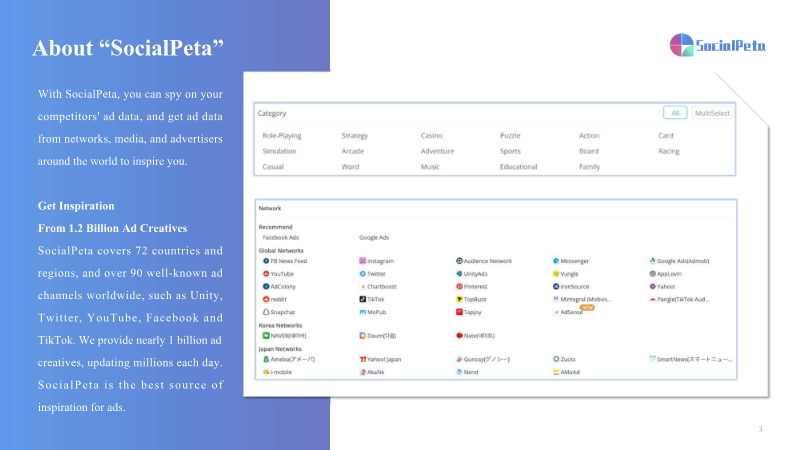
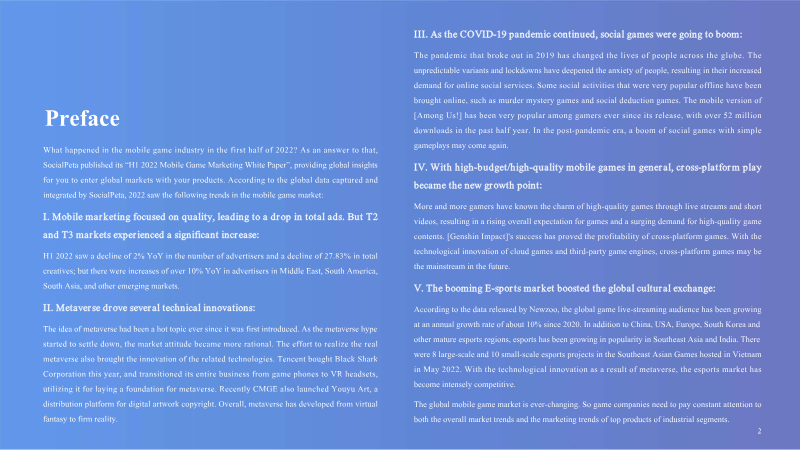
The first half of 2022 saw a contraction across the mobile‑app advertising ecosystem, with the total number of advertisers falling 5.79 % to a historic low of roughly 83 400 and creative volume dropping 27 % to 40 million assets. This downward pressure was most pronounced among mobile‑game advertisers, whose pool shrank to about 83 000 in January, while non‑game categories such as shopping apps retained the largest share of spend (≈12.5 % of advertisers and 17.2 % of creatives). Regional variation was stark: Europe and North America dominated non‑game advertising, whereas the Asia‑Pacific region, excluding China, was the only market with a net increase in advertisers. Mobile‑game advertising displayed divergent cost dynamics. The United States and Japan posted the highest average CPMs at $27.54 and $25.93 respectively, with iOS campaigns costing roughly 15 % more than Android. Female users and the 55‑64 age cohort commanded a 13 % premium on impressions, while South Korea recorded the peak CPI at $13.90. Playable ads delivered the lowest CPI but suffered the weakest return on ad spend, whereas banner formats generated the strongest ROAS. Strategy titles leaned heavily on video‑only creatives (>90 %) and began integrating casual‑puzzle mechanics to broaden appeal; interest in emerging formats remained modest, with only 16 % of players expressing curiosity about NFTs and 32 % about metaverse features. Creative strategies are shifting toward motivation‑driven, user‑centric formats such as rewarded video and playable ads to counter post‑IDFA fragmentation. Narrative‑driven ads are proving effective for simulation games targeting female audiences, delivering $12 million in revenue across key Western markets. AR‑enhanced placements on platforms like Snapchat achieve double the attention and 1.7 × the immersion of standard formats, while friend‑based recommendations outperform celebrity influencers by a factor of four. Regional opportunities are emerging in Tier‑2/3 India through vernacular campaigns and OEM inventory, and Turkey’s
SocialPetaJan 2022


Report
The State of Gaming 2024: An Analysis of the Current Mobile Gaming Market Trends
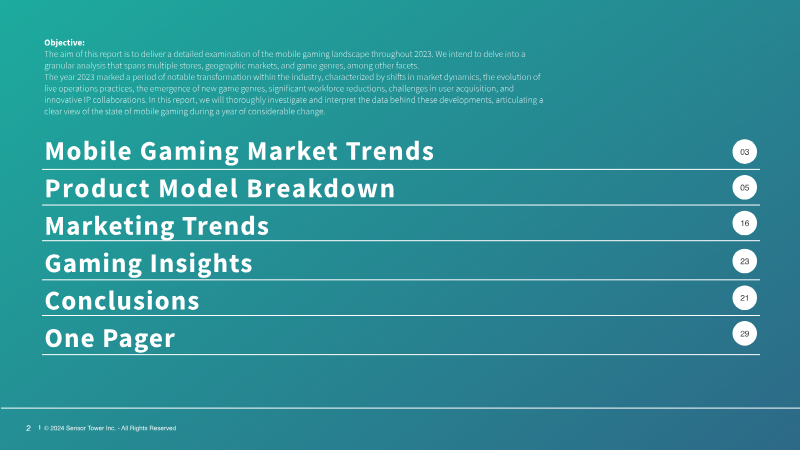
The global mobile gaming market underwent a significant correction in 2023, characterized by a 10% decline in worldwide downloads and a 2% drop in total revenue. This downturn was primarily fueled by escalating user acquisition costs and a post-pandemic stabilization of consumer habits. While the broader market contracted, a distinct shift toward casualization occurred, evidenced by an 8% increase in Casual game revenue and a 30% surge in the Hybridcasual segment. Conversely, Mid-core titles faced a 9% revenue decline, signaling a transition in player preferences toward more accessible experiences. Geographic performance diverged sharply as publishers pivoted toward emerging markets to mitigate rising costs in established territories. While the Asian market saw a 6% revenue contraction, the Middle East, Europe, and Latin America experienced revenue growth of 8%, 7%, and 4% respectively, despite falling download numbers. This regional resilience was often driven by high-profile intellectual properties, such as the success of Monopoly GO! in Europe and the expansion of Netflix’s gaming portfolio, which saw a 194% increase in downloads through the integration of major franchises like Grand Theft Auto. Strategic adaptations in 2023 focused on maximizing player lifetime value through Live Ops events and transmedia collaborations. Mobile gaming now commands 67% of global digital advertising spend, with marketing strategies increasingly segmented by platform; YouTube and TikTok serve as primary hubs for core gamers, while Facebook and Pinterest remain vital for reaching casual female audiences. To combat the challenges of the current landscape, the industry has embraced low-cost user-generated content and external subscription models, leveraging recognizable IP to bridge the gap between gaming and broader entertainment media.
Sensor TowerJan 2024


Report
The Gaming App Insights Report: Unlocking Growth Opportunities for Mobile Marketers
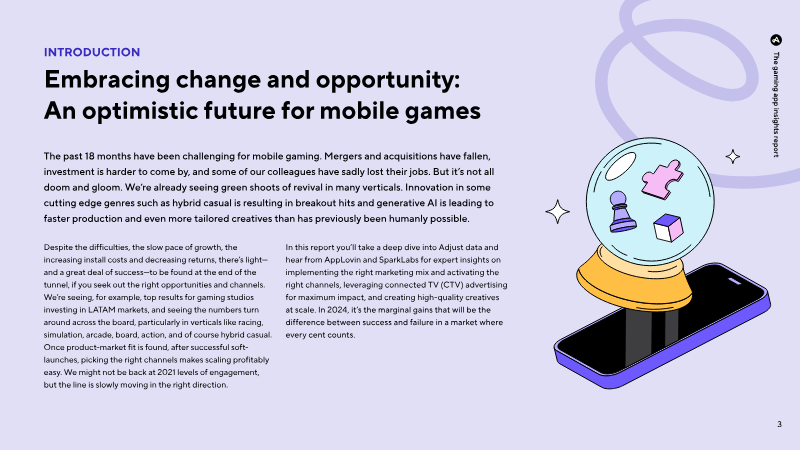
The mobile gaming industry is entering a period of stabilization and renewed growth following recent volatility, characterized by a 7% year-over-year increase in global installs during late 2023. While consumer spending saw a marginal decline throughout the previous year, early 2024 data suggests a recovery driven by the rise of hybrid casual titles and the integration of artificial intelligence to streamline production. This shift is particularly evident in the Latin American market and within specific subverticals like Racing and Simulation, which experienced install surges of 61% and 53%, respectively. Despite these gains, the landscape remains competitive as organic install shares dropped to 50% and median day-one retention rates softened to 28.3%. Monetization strategies are evolving as developers pivot toward hybrid models that combine in-app purchases with advertising revenue. Although global effective cost per install nearly doubled to $0.99 in 2023, in-app revenue grew by 6%, led by high-value genres such as RPGs and Adventure games. These categories command the highest lifetime value and average revenue per monthly active user, particularly in mature markets like the United States and Japan. Conversely, hyper-casual games continue to prioritize volume and efficiency, maintaining low acquisition costs despite a broader industry trend toward more complex, long-term engagement models. The industry has demonstrated significant resilience regarding privacy changes, with global App Tracking Transparency opt-in rates rising to 39%. This adaptation, coupled with the superior performance of hybrid casual games in click-through rates and ad revenue, indicates a strategic move toward data-driven marketing and diversified revenue streams. As the sector moves through 2024, success depends on balancing high acquisition costs in premium markets with the massive scale offered by emerging regions like India and Southeast Asia, all while navigating a more privacy-centric digital ecosystem.
AdjustMar 2024

Report
Newzoo Hypercasual Mobile Game Genre Report: Eastern vs Western Markets
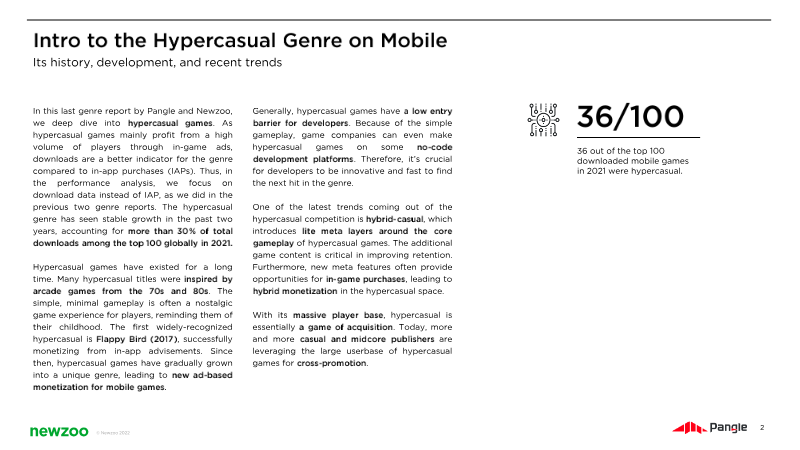
Hypercasual mobile games represent a significant and evolving segment of the global gaming industry, accounting for 36 of the top 100 downloaded mobile games in 2021. While the genre is characterized by simple mechanics and high accessibility, it has faced increasing competition, leading to a shift toward hybrid-casual models. These newer titles incorporate meta-features and live operations to improve player retention, which typically falls below 10% by the seventh day for standard hypercasual titles. The market demonstrates distinct regional variations, with hypercasual games enjoying significantly higher popularity in Western markets like the United States and United Kingdom compared to Japan and South Korea. In 2021, runner and racing subgenres overtook simulation and puzzle titles as the most downloaded categories. Demographically, hypercasual players across key markets skew male, are often full-time employees with mid-to-high incomes, and are younger than the average mobile gamer. Monetization remains primarily driven by in-game advertising, with interstitial video identified as the most adopted format, followed by rewarded videos and banner ads. However, hybrid monetization is rising, with developers increasingly offering in-app purchases for ad removal or exclusive content. Data from 2021 indicates that the hypercasual sector is highly dynamic; only eight of the top 36 hypercasual titles from 2020 remained in the top rankings the following year. To maintain growth, publishers are leveraging broad targeting strategies that are less affected by privacy changes like IDFA and are utilizing sophisticated retention optimization tools to acquire loyal users.
NewzooJan 2025