Updated Mar 21, 2026 by KLab
Financial
Published by KLab
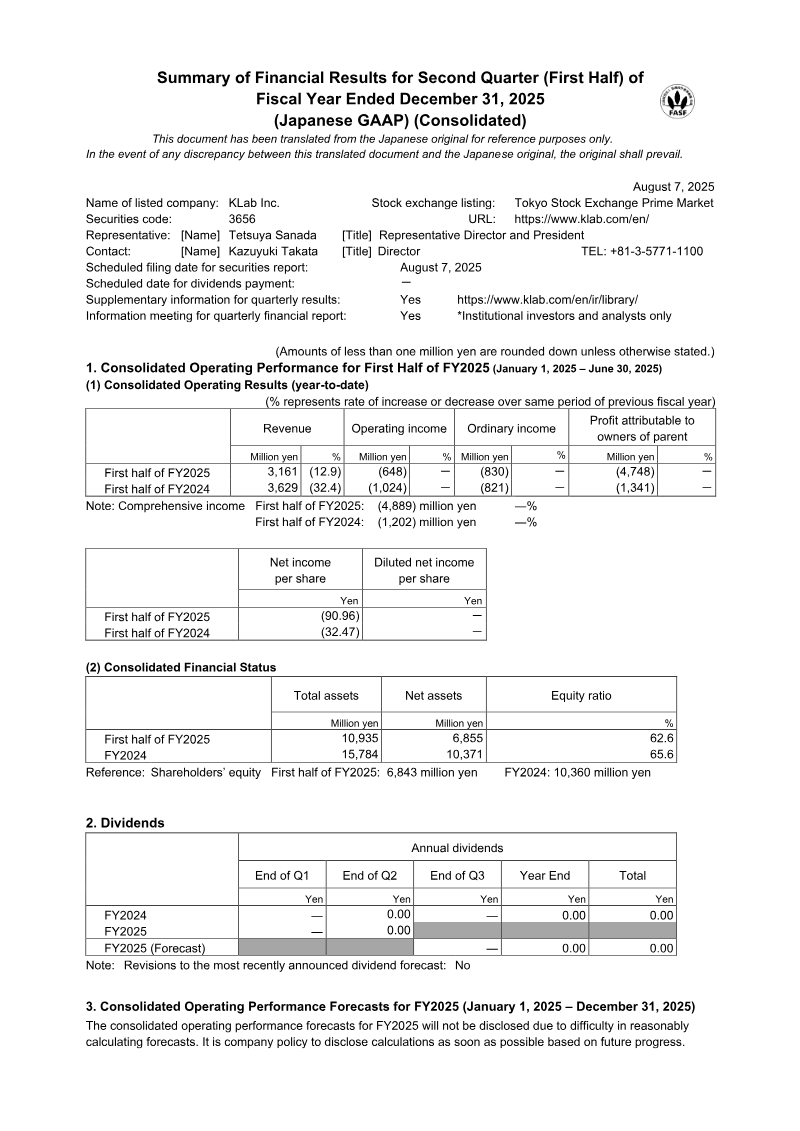
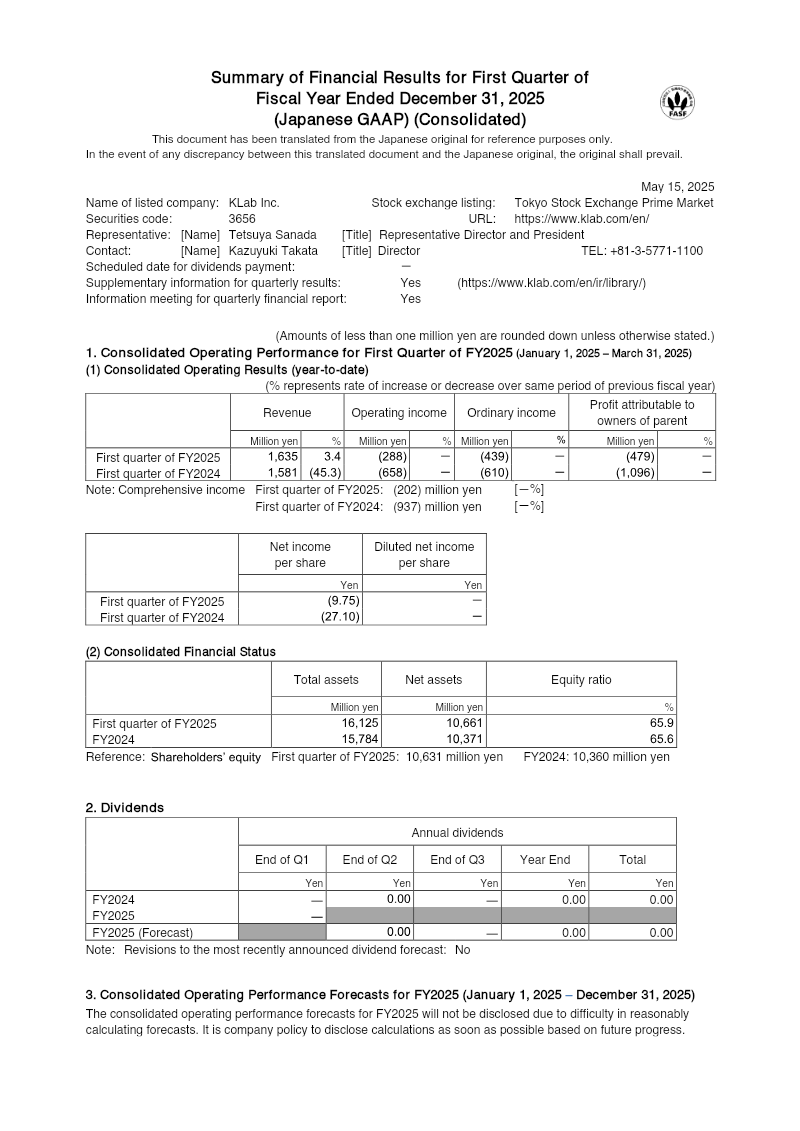
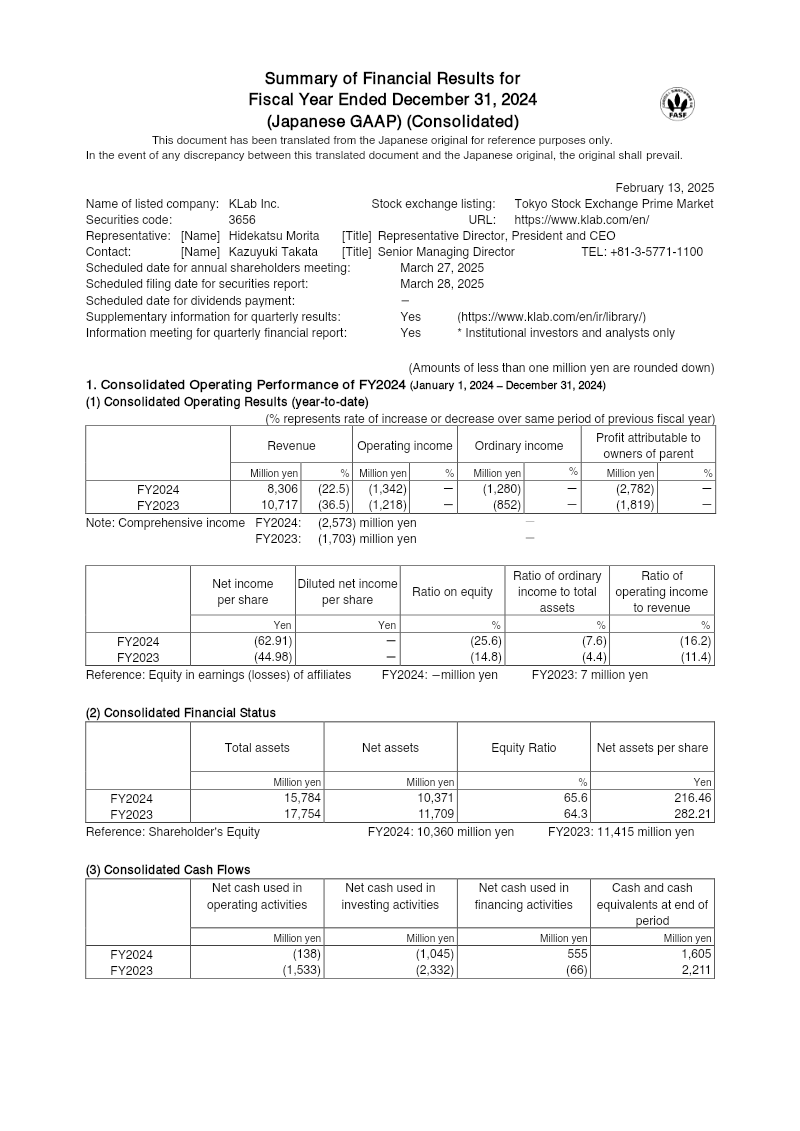
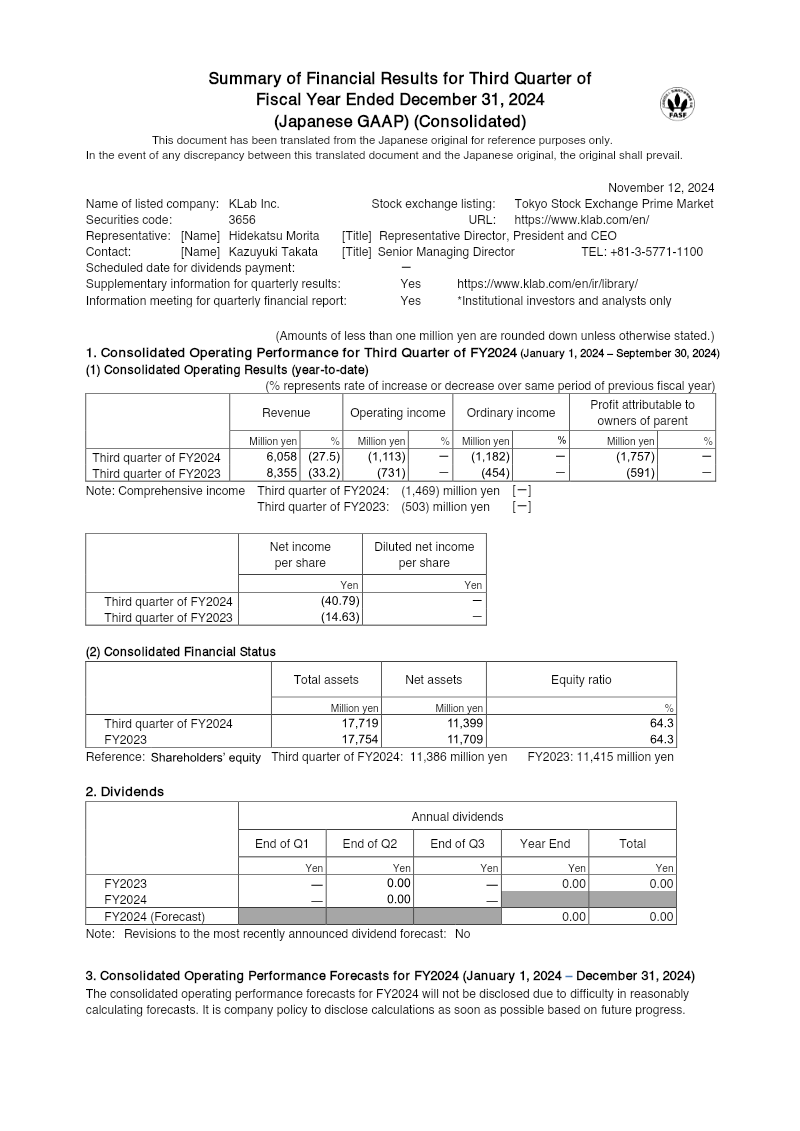
Summary of Financial Results for Fiscal Year Ended December 31, 2023 (Japanese GAAP) (Consolidated) evail. This document has been translated from the Japanese original for reference purposes only. In the event of any discrepancy between this translated document and the Japanese original, the original shall prevail. Name of listed company: KLab Inc.
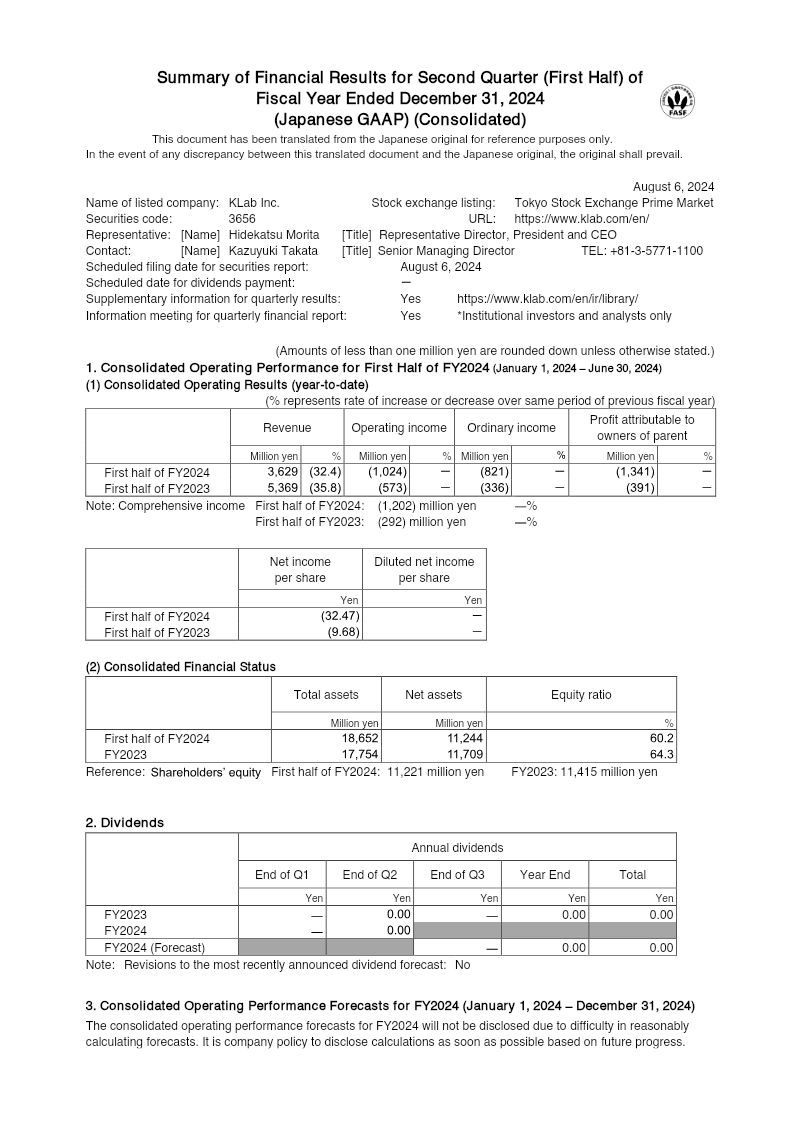
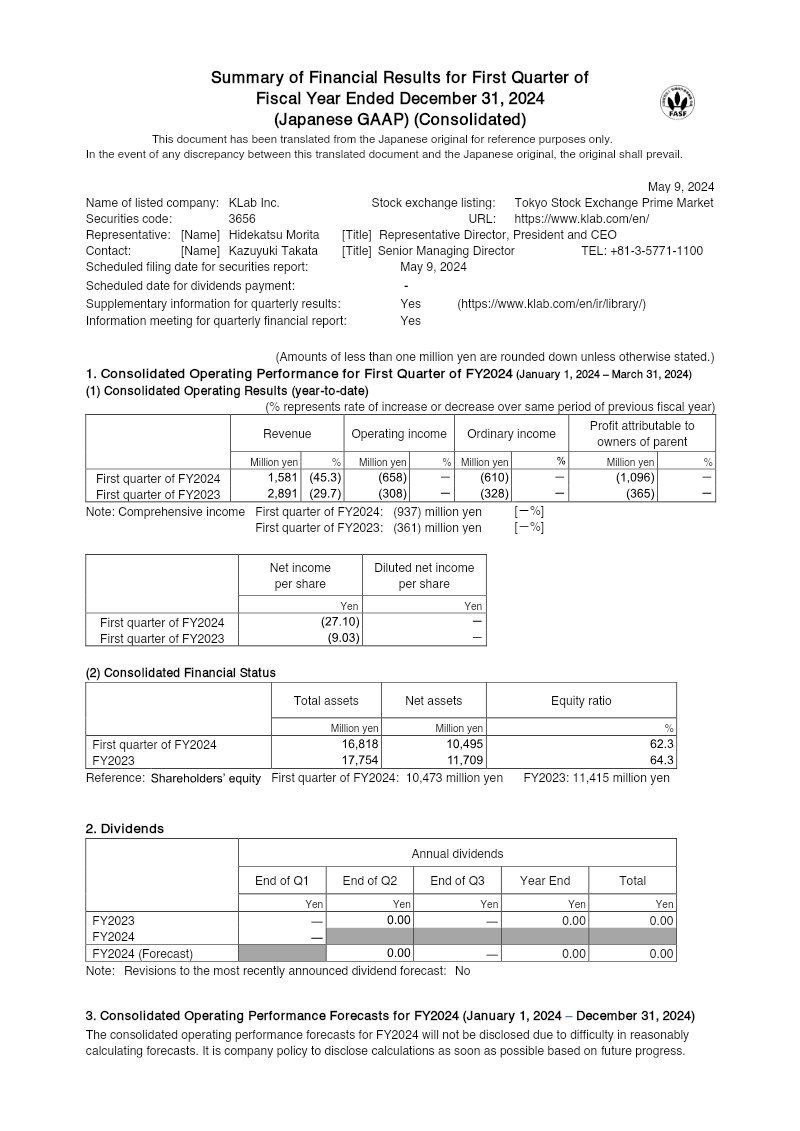
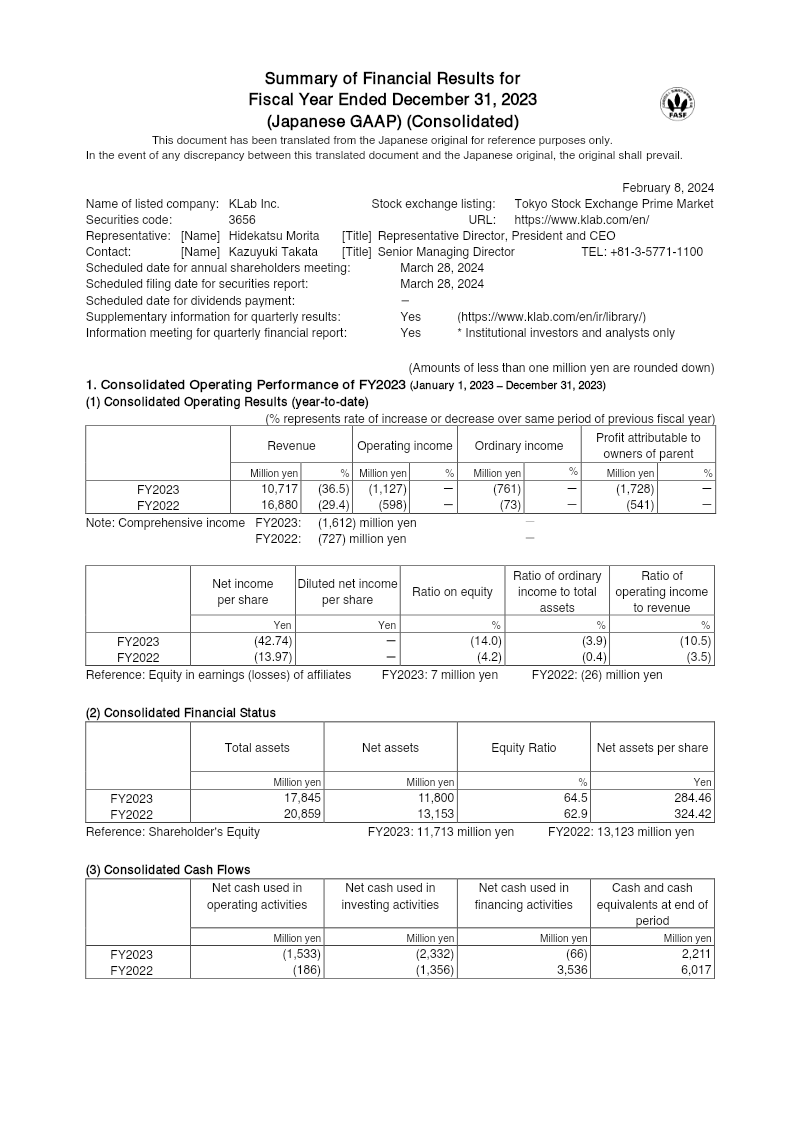
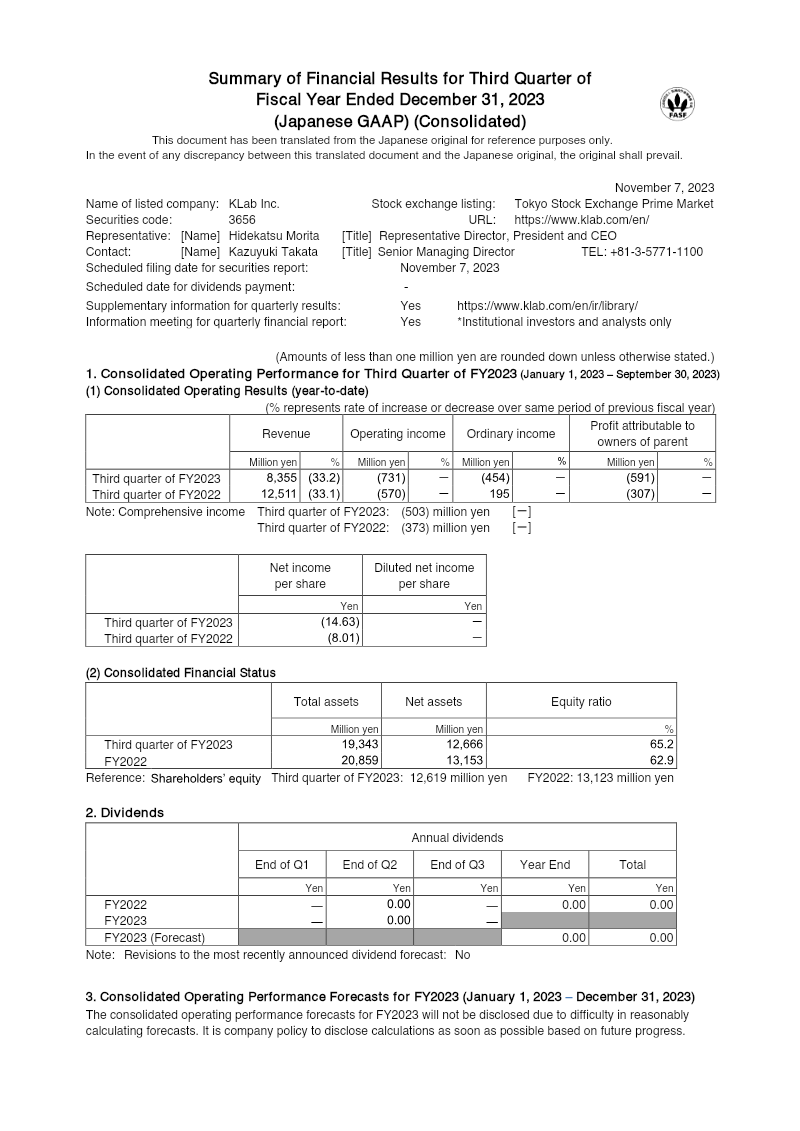
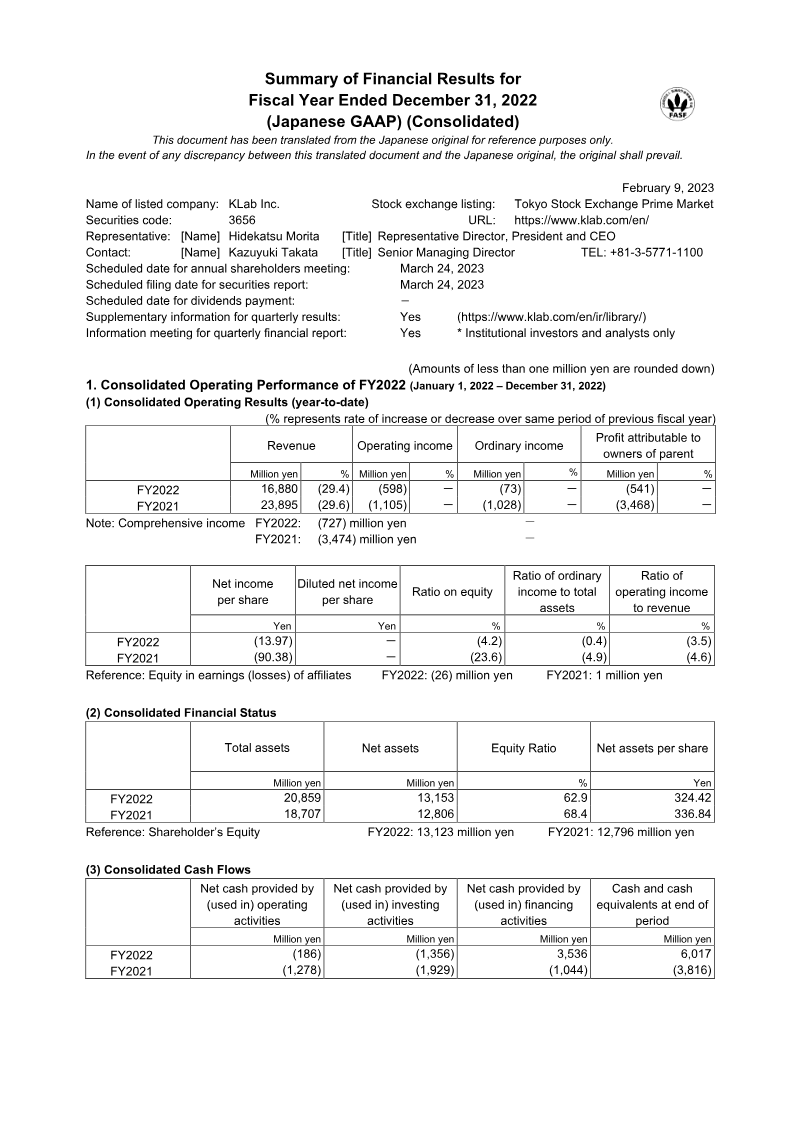
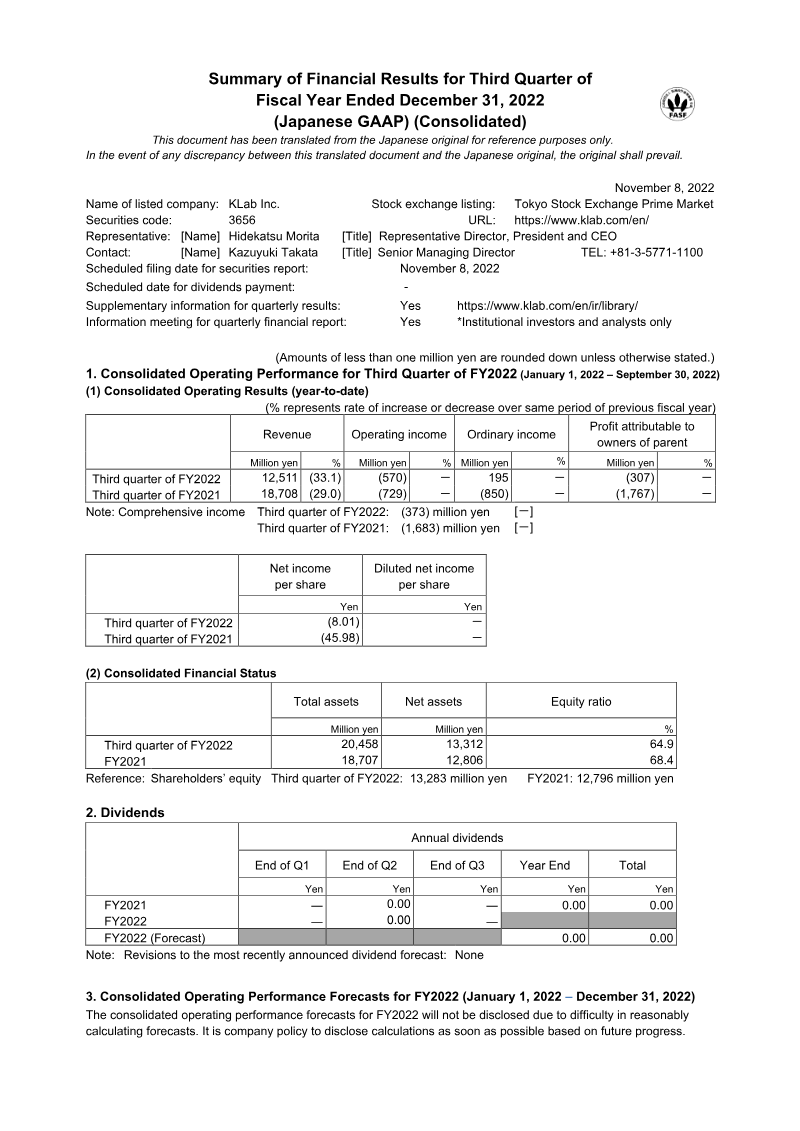
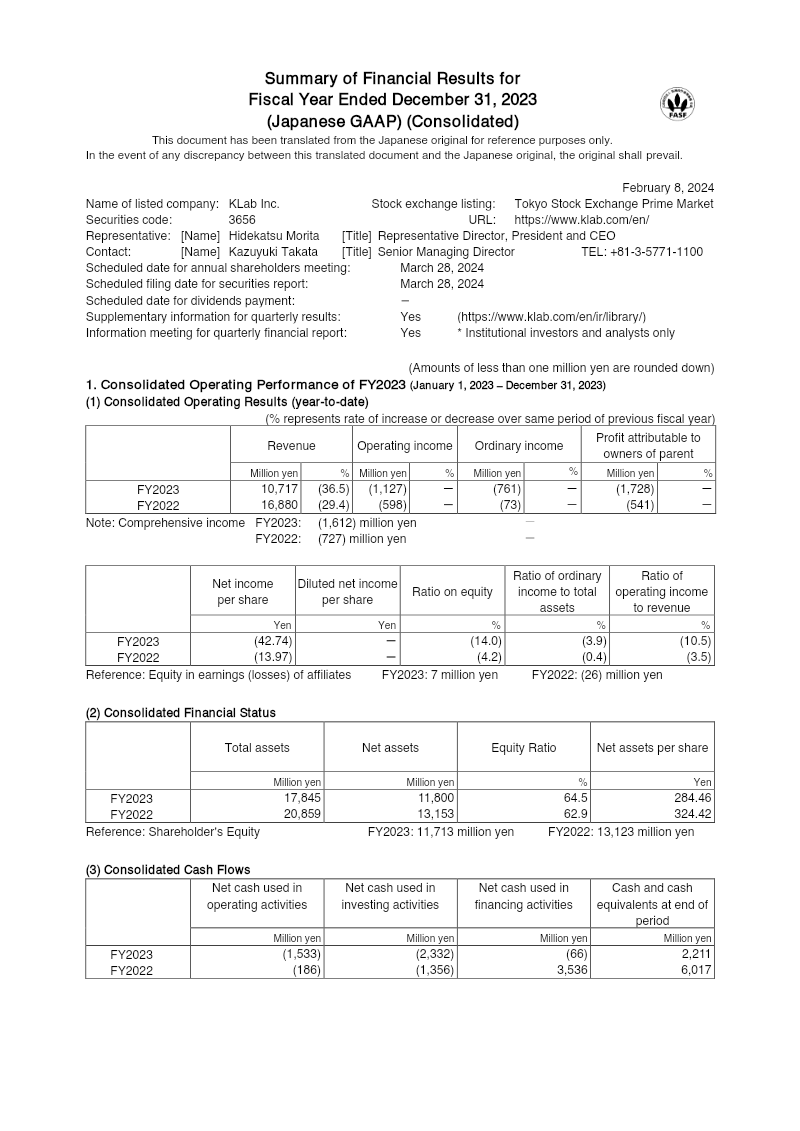
Summary of Financial Results for Fiscal Year Ended December 31, 2023 (Japanese GAAP) (Consolidated) evail. This document has been translated from the Japanese original for reference purposes only. In the event of any discrepancy between this translated document and the Japanese original, the original shall prevail. February 8, 2024 Name of listed company: KLab Inc. Stock exchange listing: Tokyo Stock Exchange Prime Market Securities code: 3656 URL: https://www.klab.com/en/ Representative: [Name] Hidekatsu Morita [Title] Representative Director, President and CEO Contact: [Name] Kazuyuki Takata [Title] Senior Managing Director TEL: +81-3-5771-1100 Scheduled date for annual shareholders meeting: March 28, 2024 Scheduled filing date for securities report: March 28, 2024 Scheduled date for dividends payment: - Supplementary information for quarterly results: Yes (https://www.klab.com/en/ir/library/) Information meeting for quarterly financial report: Yes * Institutional investors and analysts only (Amounts of less than one million yen are rounded down) 1. Consolidated Operating Performance of FY2023 (January 1, 2023 – December 31, 2023) (1) Consolidated Operating Results (year-to-date) (% represents rate of increase or decrease over same period of previous fiscal year) Revenue Operating income Ordinary income Profit attributable to owners of parent Million yen % Million yen % Million yen % Million yen % FY2023 10,717 (36.5) (1,127) - (761) - (1,728) - FY2022 16,880 (29.4) (598) - (73) - (541) - Note: Comprehensive income FY2023: (1,612) million yen - FY2022: (727) million yen -
g income Ordinary income Profit attributable to owners of parent Million yen % Million yen % Million yen % Million yen % FY2023 10,717 (36.5) (1,127) - (761) - (1,728) - FY2022 16,880 (29.4) (598) - (73) - (541) - Note: Comprehensive income FY2023: (1,612) million yen - FY2022: (727) million yen - Net income Diluted net income Ratio on equity Ratio of ordinary Ratio of per share per share income to total operating income assets to revenue Yen Yen % % % FY2023 (42.74) - (14.0) (3.9) (10.5) FY2022 (13.97) - (4.2) (0.4) (3.5) Reference: Equity in earnings (losses) of affiliates FY2023: 7 million yen FY2022: (26) million yen (2) Consolidated Financial Status Total assets Net assets Equity Ratio Net assets per share Million yen Million yen % Yen FY2023 17,845 11,800 64.5 284.46 FY2022 20,859 13,153 62.9 324.42 Reference: Shareholder’s Equity FY2023: 11,713 million yen FY2022: 13,123 million yen (3) Consolidated Cash Flows Net cash used in Net cash used in Net cash used in Cash and cash operating activities investing activities financing activities equivalents at end of period Million yen Million yen Million yen Million yen FY2023 (1,533) (2,332) (66) 2,211 FY2022 (186) (1,356) 3,536 6,017
2. Dividends Annual dividends Total Dividend Ratio of amount of payout dividends to End of Q1 End of Q2 End of Q3 Year end Total dividends ratio net assets (Total) (Consolidated) (Consolidated) Yen Yen Yen Yen Yen Million Yen % % FY2022 - 0.00 - 0.00 0.00 - - - FY2023 - 0.00 - 0.00 0.00 - - - FY2024 - 0.00 - 0.00 0.00 - (Forecast) 3. Consolidated Operating Performance Forecasts for FY2024 (January 1, 2024 – December 31, 2024) The consolidated operating performance forecasts for FY2024 will not be disclosed. For more information, please refer to “1. Overview of Operating Results, Financial Status, Cash Flows, etc.; (4) Forecasts and Various Factors in the Future” on page 4 of Supporting Information. ■ Explanatory Notes (1) Changes to major subsidiaries during FY2023: No (Changes to specified subsidiaries accompanying changes in scope of consolidation) (2) Changes to accounting policies, estimates, and restatements ① Changes to accounting policies due to revision of accounting standards: Yes ② Changes other than ①: No ③ Changes to accounting estimates: No ④ Restatements: No (3) Number of outstanding shares (common shares) ① Period end outstanding shares FY2023 41,092,200 shares FY2022 41,092,200 shares (including treasury shares) ② Period end treasury shares FY2023 641,531 shares FY2022 641,531 shares ③ Average outstanding shares FY2023 40,450,669 shares FY2022 38,784,005 shares during the period
s (common shares) ① Period end outstanding shares FY2023 41,092,200 shares FY2022 41,092,200 shares (including treasury shares) ② Period end treasury shares FY2023 641,531 shares FY2022 641,531 shares ③ Average outstanding shares FY2023 40,450,669 shares FY2022 38,784,005 shares during the period [Reference] Summary of Non-Consolidated Operating Performance 1. Non-Consolidated Operating Performance for FY2023 (January 1, 2023 – December 31, 2023) (1) Non-Consolidated Operating Results (% represents rate of increase or decrease over same period of previous fiscal year) Revenue Operating Income Ordinary income Net income Million yen % Million yen % Million yen % Million yen % FY2023 10,028 (38.9) (1,309) - (762) - (1,602) - FY2022 16,426 (29.6) (696) - (388) - (774) - Net income Diluted net income per share per share Yen Yen FY2023 (39.61) - FY2022 (19.96) -
(2) Non-Consolidated Financial Status Total assets Net assets Equity ratio Net assets per share Million yen Million yen % Yen FY2023 17,634 11,449 64.8 282.43 FY2022 20,413 12,850 62.8 317.01 Reference: Shareholder’s Equity FY2023: 11,424 million yen FY2022: 12,823 million yen ■ Financial statements are not subject to audits by certified public accountants or audit firms. ■ Other special instructions (Method of obtaining supplementary materials on quarterly financial results) For an overview of the financial results, please refer to the quarterly financial results presentation slides posted on the Company website. https://www.klab.com/en/ir/library/presentations/
Supporting Information INDEX 1. Overview of Operating Results, Financial Status, Cash Flows, etc. 2 (1) Overview of Operating Results for the Period 2 (2) Overview of Financial Status for the Period 2 (3) Overview of Cash Flows for the Period 3 (4) Forecasts and Various Factors in the Future 4 2. Rationale Behind the Choice of Accounting Standards 4 3. Consolidated Financial Statements and Related Notes 5 (1) Consolidated Balance Sheets 5 (2) Consolidated Statements of Income and Comprehensive Income 7 Consolidated Statements of Income 7 Consolidated Statements of Comprehensive Income 8 (3) Consolidated Statements of Changes in Equity 9 (4) Consolidated Statements of Cash Flows 11 (5) Notes Related to Consolidated Financial Statements 12 (Notes Related to Ongoing Concern Assumptions) 12 (Change in Accounting Policy) 12 (Segment Information and Other Information) 12 (Per Share Data) 14 (Significant Subsequent Events) 15
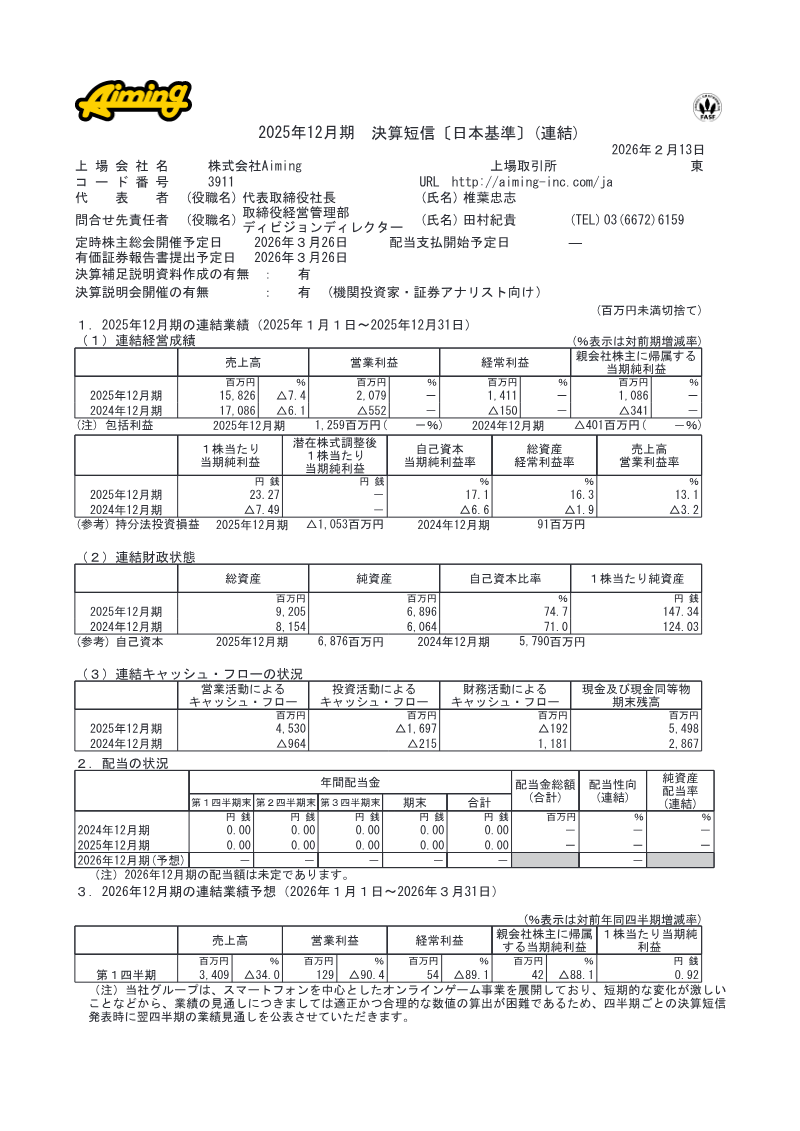
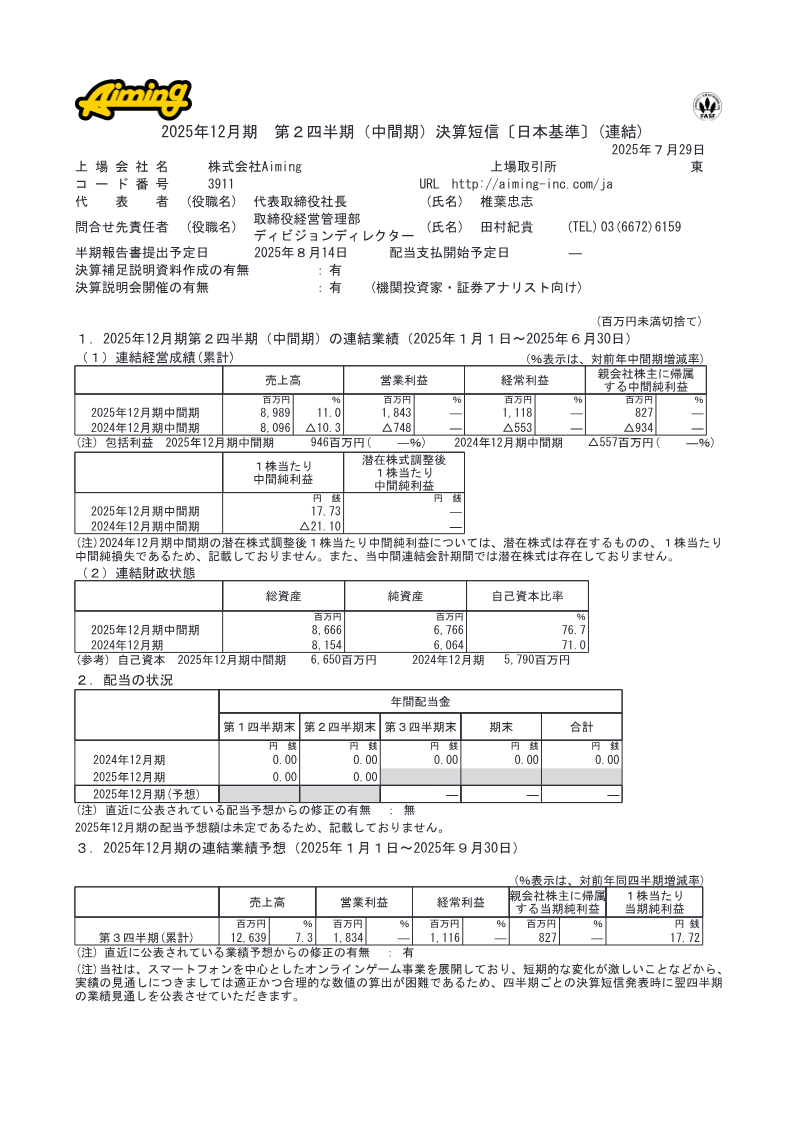
Aiming Inc. reported its consolidated financial results for the fiscal year ended December 31, 2025, revealing a significant turnaround in profitability despite a decline in top-line revenue. The company operates within a single segment, the online game business, primarily targeting the Japanese smartphone market. While total revenue fell 7.4% year-over-year to 15,826 million yen, the company achieved an operating profit of 2,079 million yen and a net profit attributable to owners of the parent of 1,086 million yen, recovering from substantial losses in the previous fiscal year. The return to profitability was driven by the sustained performance of core titles and effective cost management. Key revenue contributors included Dragon Quest Tact, developed with Square Enix, and The Eminence in Shadow: Master of Garden, which saw high engagement through its third-anniversary events. Newer titles such as 2.5 Dimensional Seduction: Angels' Stage and Legend of the Galactic Heroes: Die Neue Saga also provided steady income. Conversely, the company faced a non-operating hit from an investment loss of 1,056 million yen under the equity method. Financially, the company strengthened its balance sheet, with total assets increasing to 9,205 million yen and the equity ratio rising to 74.7%. Cash and cash equivalents nearly doubled to 5,498 million yen, bolstered by 4,530 million yen in cash flow from operating activities, primarily due to the collection of accounts receivable. Investment activities included a 1,100 million yen capital contribution to affiliates, notably Betimo, which launched a bicycle race betting service in late 2025 to diversify revenue streams. Looking ahead to the first quarter of fiscal year 2026, Aiming forecasts a 34% decline in revenue to 3,409 million yen and a sharp drop in profits compared to the previous year's period. The company cites the high volatility of the mobile gaming market and intensifying competition from high-quality overseas titles and major IP-based games as primary challenges. Future growth strategies focus on upcoming releases, including a live-action romance simulation game co-produced with TV Asahi scheduled for March 2026.
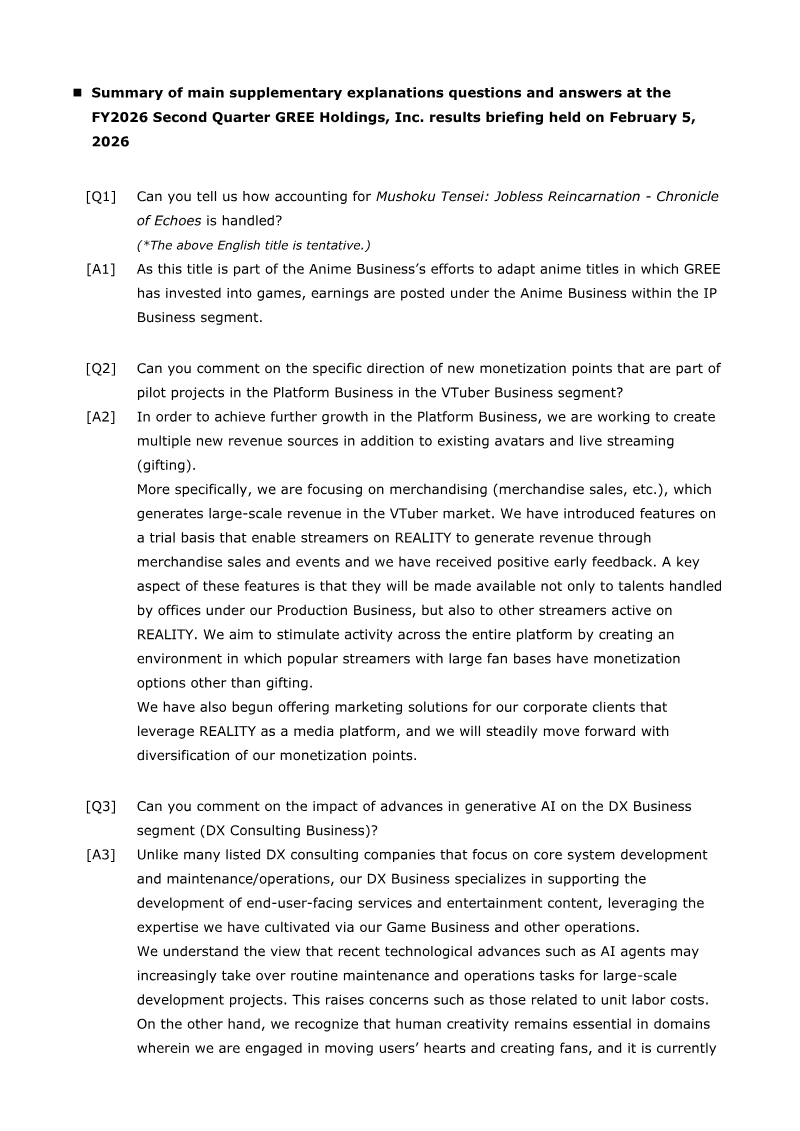
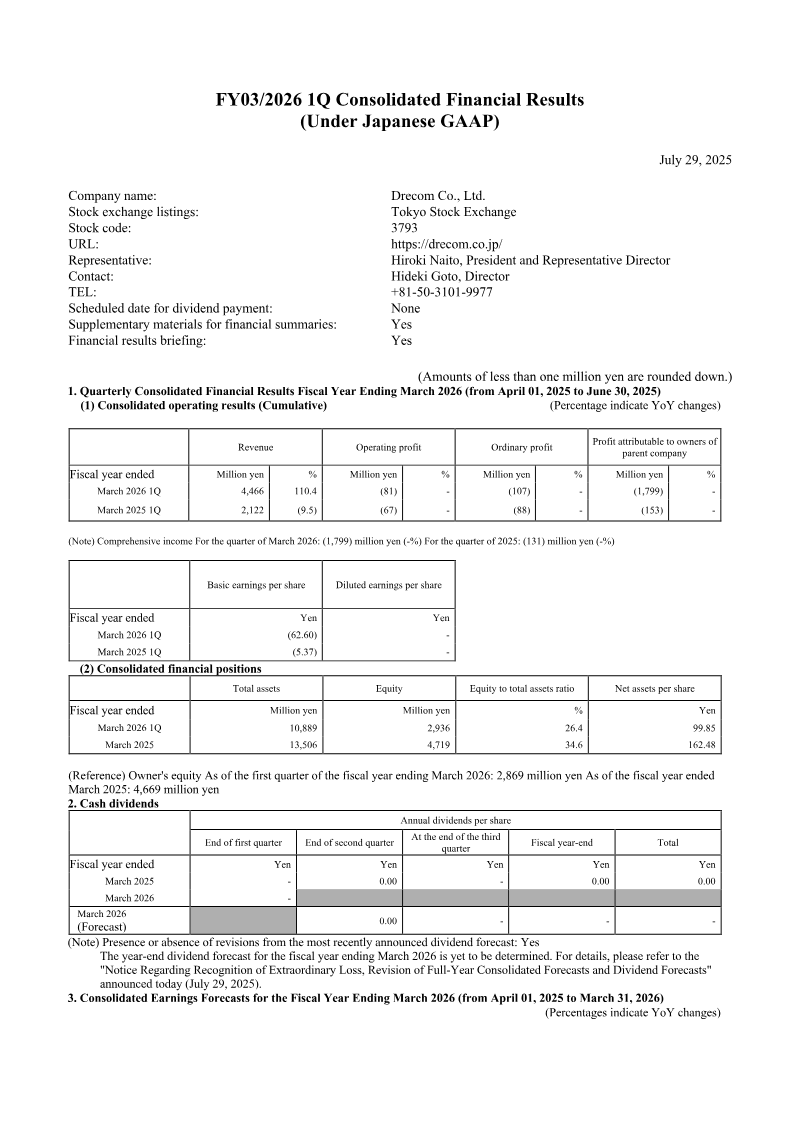
GREE Holdings, Inc. outlines its strategic direction and financial outlook following the second quarter of fiscal year 2026, focusing on a structural shift away from the volatile Game Business toward more stable, continuous growth segments. Despite a downward revision to the full-year earnings outlook for FY2026 due to the softening performance of existing game titles, the long-term medium-term targets for FY2028 remain unchanged. This stability is supported by the steady expansion of the IP, VTuber, and DX Business segments, which are intended to reduce the company's reliance on hit-driven gaming revenue. The IP Business is diversifying through the Anime Business, specifically by adapting invested anime titles into games. To strengthen this pipeline, there is a strategic goal to acquire in-house anime production capabilities or pursue M&A within the next two to three years. This move aims to provide greater control over production quality and timing, which are viewed as essential for creating popular intellectual property. Simultaneously, the VTuber Business is expanding its monetization beyond traditional gifting. Pilot projects on the REALITY platform are testing merchandise sales and event-based revenue for both in-house talent and independent streamers, alongside new marketing solutions for corporate clients. In the DX Business segment, the focus remains on high-value consulting for end-user-facing services and entertainment. While generative AI and automated agents are expected to impact routine maintenance and labor costs in the broader industry, the specialized nature of creating fan-driven content is seen as resilient to automation. Consequently, technological advances in AI are not expected to negatively impact the DX segment in the near term. Overall, the strategy emphasizes leveraging human creativity and platform diversification to ensure stable, long-term earnings growth across the global entertainment and digital transformation markets.
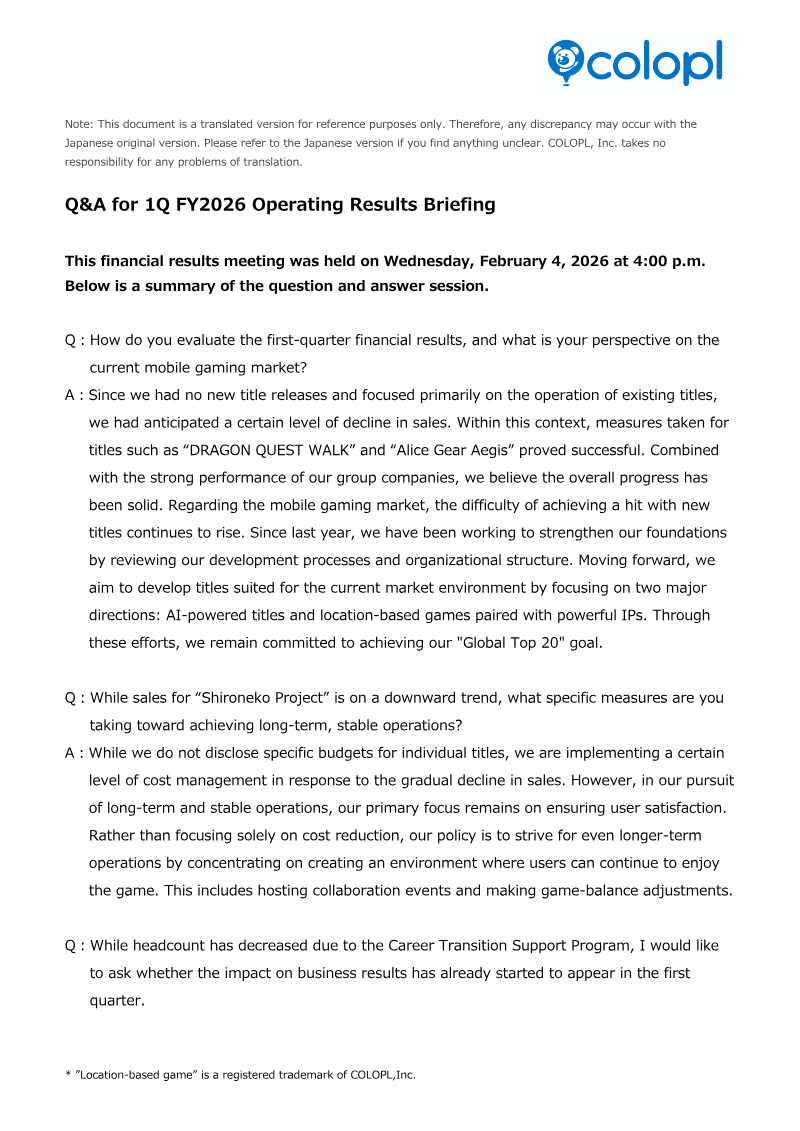
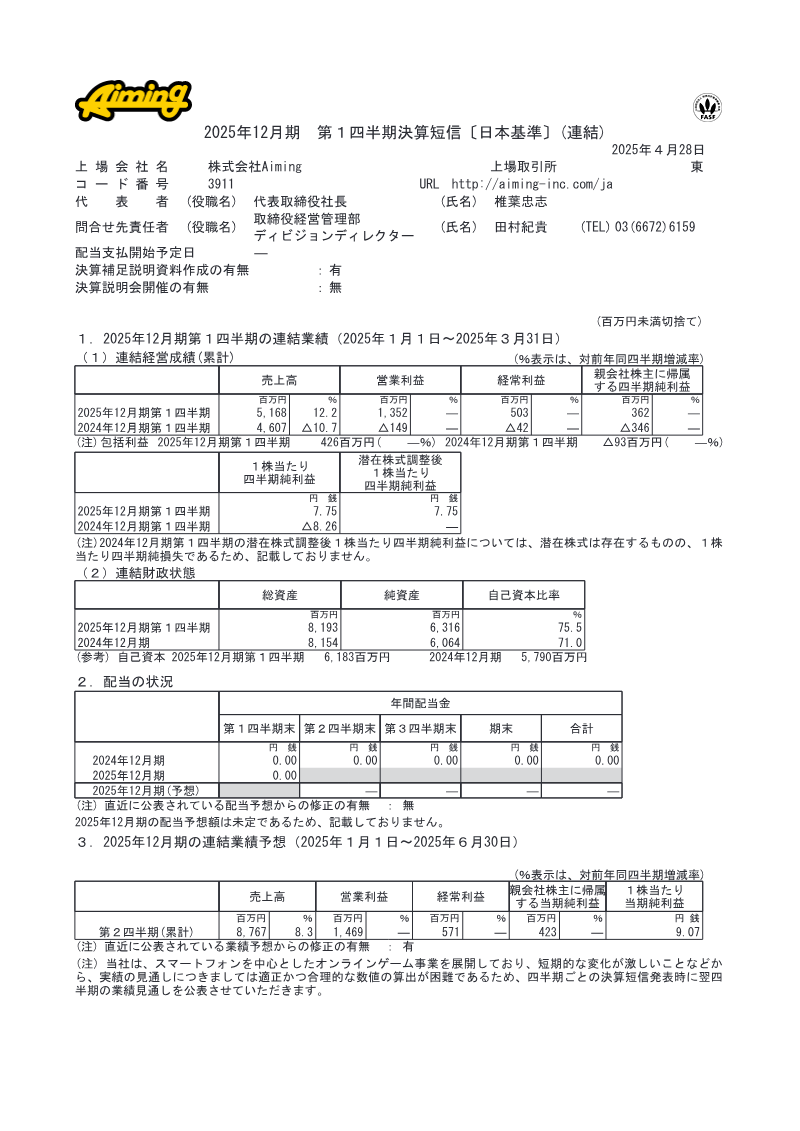
The first-quarter financial results for the fiscal year ending in 2026 reflect a strategic transition period for COLOPL, characterized by a lack of new releases and a focus on stabilizing existing mobile operations. Despite an anticipated decline in sales, the performance of established titles like Dragon Quest Walk and Alice Gear Aegis, alongside contributions from group companies, resulted in what leadership describes as solid progress. The company is currently navigating a challenging mobile market where the barrier to entry for new hits is rising, prompting a shift toward two primary development pillars: AI-powered titles and location-based games paired with globally recognized intellectual properties. Financial performance in the first quarter was impacted by extraordinary losses related to special severance payments from a Career Transition Support Program. While headcount has decreased, the resulting reduction in personnel expenses is not expected to materialize until the second quarter of 2026. Regarding long-term operations for legacy titles such as Shironeko Project, the strategy emphasizes user satisfaction and game-balance adjustments over aggressive cost-cutting to ensure longevity. The company is also diversifying its platform strategy beyond its core mobile business to include PC and console gaming. This is exemplified by the release of Kazuma Kaneko’s Tsukuyomi on Nintendo Switch, a title that originated as an exploration of generative AI in gaming. By establishing a new genre termed "Generative Games," the company aims to leverage AI-generated assets and systems across multiple hardware formats. Moving forward, the overarching goal remains achieving a "Global Top 20" position by integrating advanced technology with high-profile IPs and expanding the reach of its proprietary location-based gaming expertise.
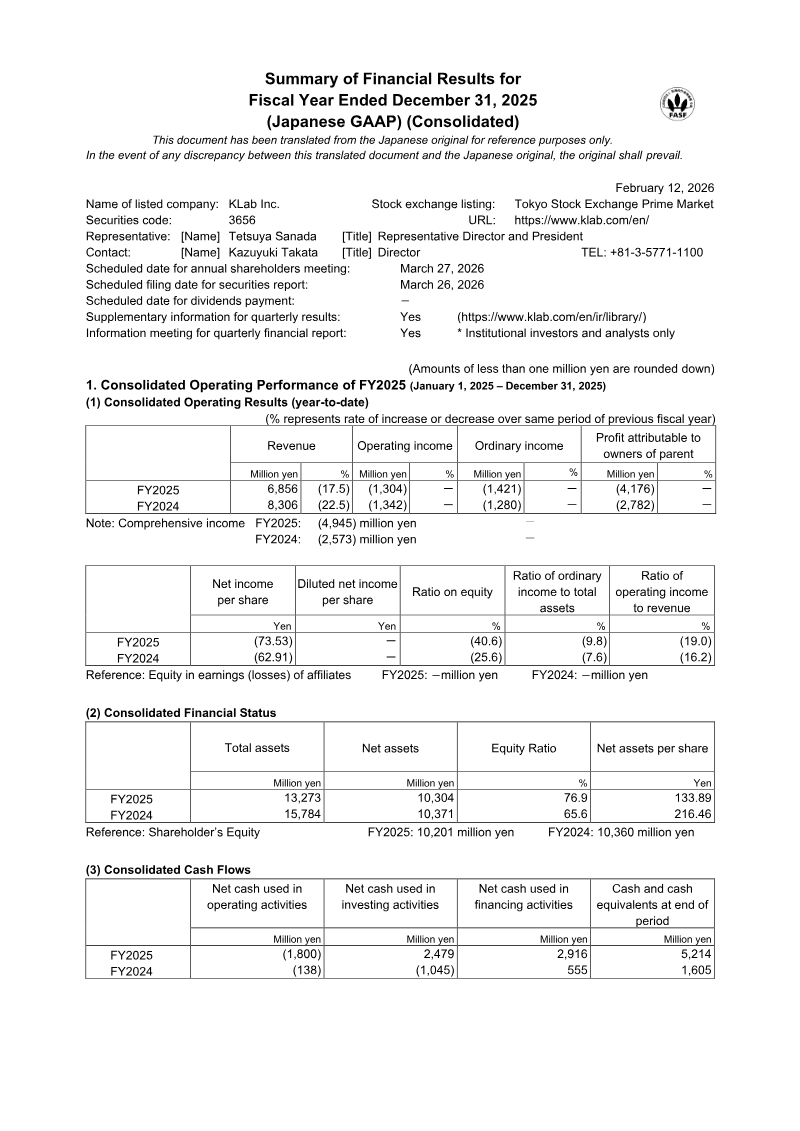
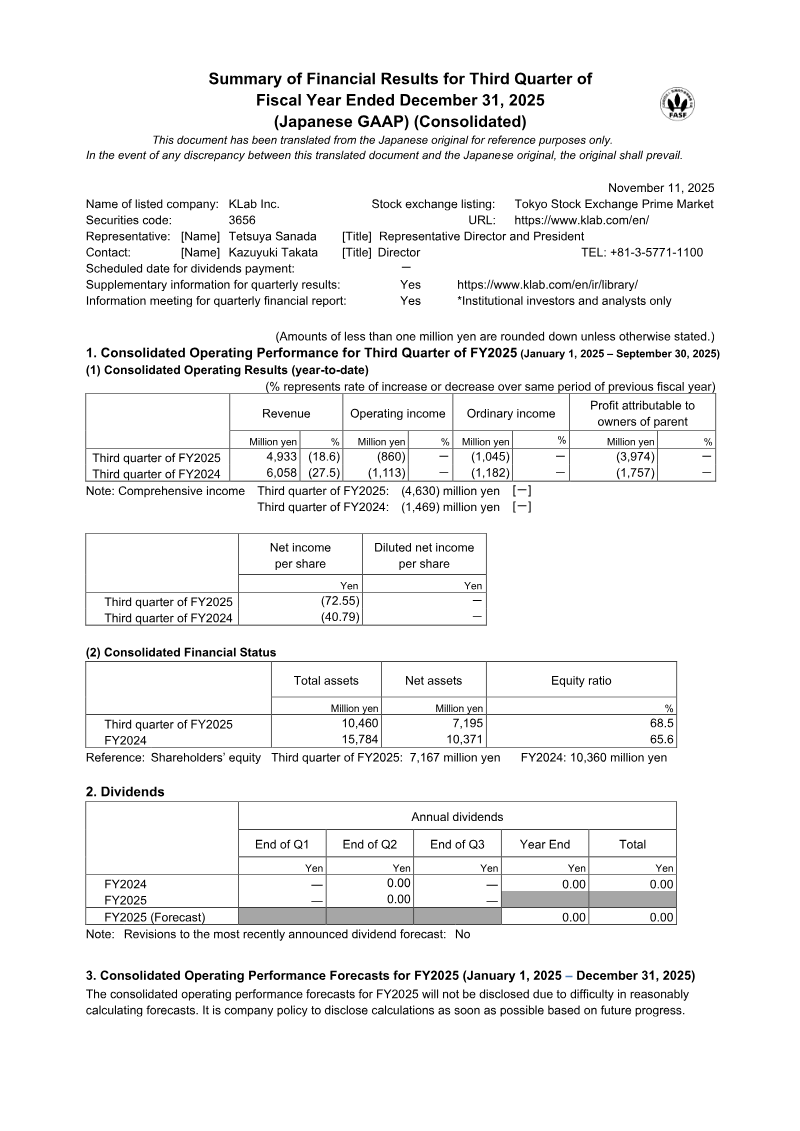
Fiscal performance for the year ended December 31, 2025, reflects a period of significant structural transition as the organization grapples with a 17.5% year-on-year revenue decline to ¥6.86 billion. This downturn was primarily driven by the weakening performance of core mobile titles such as BLEACH Brave Souls and Captain Tsubasa: Dream Team, alongside a substantial ¥4.43 billion impairment loss on software assets related to EA SPORTS FC™ TACTICAL. These factors culminated in an operating loss of ¥1.30 billion and a net loss of ¥4.18 billion, a marked increase from the previous year’s deficit. Despite these operational challenges, the financial position remains stabilized through aggressive capital management and strategic divestment. Total net assets held steady at ¥10.30 billion, supported by ¥4.79 billion in proceeds from new share issuances and the sale of investment securities. Cash and cash equivalents rose to ¥5.21 billion, providing a necessary buffer as the company implements cost-cutting measures, including workforce reductions, office relocations, and the divestment of GlobalGear Co. Ltd. These actions aim to mitigate the volatility of the traditional mobile gaming segment, which saw profits drop from ¥1.13 billion to ¥830.5 million over the fiscal year. The strategic focus is now shifting toward the emerging GPU AI Cloud and AI Entertainment sectors to diversify revenue streams. The new GPU AI Cloud Business demonstrated promising initial growth, contributing ¥490.7 million in sales and signaling a pivot away from total reliance on the game business. While the adoption of revised accounting standards for income taxes had no material impact on the results, the massive impairment losses and subsequent net loss of ¥73.53 per share underscore the urgency of this pivot toward high-growth technology infrastructure and AI-driven entertainment.