1 free read left. Create a free account for unlimited reading + AI research.
Create free account
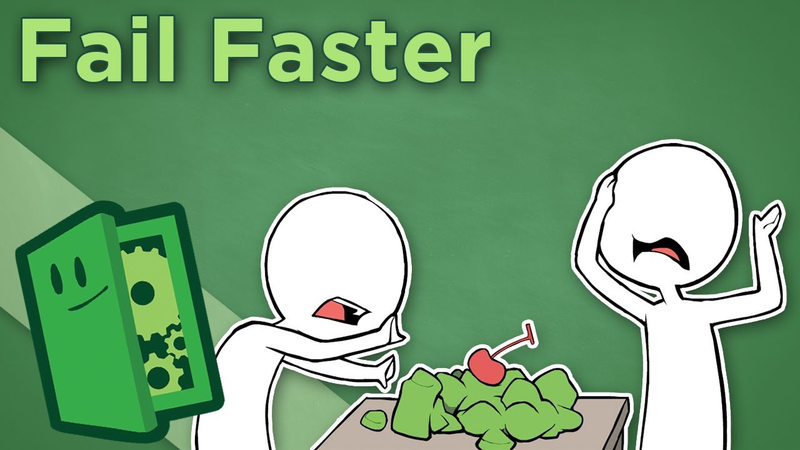
Fail Faster - A Mantra for Creative Thinkers - Extra Credits
Key insights
6 takeaways- 01Teams should avoid excessive time spent debating high-level concepts, as even successful games often begin as simple or absurd premises that only reach greatness through refinement.
- 02Exposing raw ideas to external critique is essential for identifying blind spots that creators are often too close to see.
- 03Ego and personal attachment to initial concepts act as significant barriers to quality and must be set aside to allow for necessary, productive failure.
- 04The core of successful game design is 'failing faster,' which prioritizes rapid iteration and course correction over the pursuit of a flawless initial concept.
- 05Designers must move beyond abstract planning by creating prototypes, paper mockups, or simple concepts as early as possible to test the viability of an idea.
- 06Failing early—even before writing a single line of code—is the most efficient way to resolve fundamental issues before they become prohibitively expensive to fix.
Ask AI about this video
Transcript
Before we begin, let me give another warm welcome to returning guest artist Mac Co, who is just the best guy. We love having him. Anyway, for a long time James just assumed this was the first lesson all designers learned, and that it would be kind of redundant to do a whole show about it. Not so apparently. He's recently observed professional designers waste millions of dollars, seen students cheated out of the education they should have and graduating with no hope of getting a job in this industry, and watched people trying to make games for the greatest good falter, all because they didn't learn the one most basic lesson of design: fail faster. This is the designer's credo. It is our mantra. It is our goal with every waking second of every day. Fail faster. No idea is made fully formed. No game you design will ever be right on the first pass. The art of what we do is simply spiraling towards a better center, course correcting along the way. Fail faster because without testing, and without
exposing your thoughts to others and embracing how many horrible mistakes and egregious failures you made in your last pass, you will never create a good game. Fail faster by understanding that no idea is good. By understanding that the high-level idea for Mario is a plumber on drugs. That the concept behind Sonic is an indigo hedgehog in sneakers that can run really fast. And that the pitch line for Gears of War is linebackers with chainsaw guns. These ideas are all terrible, and they're all great. As mere ideas, they're meaningless. Choose something, anything, begin to iterate, and fail faster. Any plan is better than no plan because even though your plan is inevitably full of miserable misconceptions that will lead you headlong into problems as you go, to and from there you can start to correct your course towards what's really right. Too many times James has seen teams spin their wheels debating concepts and high-level ideas, and starting to work only once they felt they had the best possible idea. But that perfect idea of theirs was as human and as flawed and as fundamentally broken as all of our ideas. And now they'd spent so much time dreaming up that perfect idea that they had no time left to iterate on it. Now those perfect ideas are relegated to bargain bins or lingering on one of
those unseen projects that never shipped because they were unable to mill out all the flaws. Meanwhile, ideas like, "Hey, let's throw birds at pigs." makes a billion dollars. And, "Let's put a child into a zombie apocalypse." moves us to tears. So, fail faster. You don't even need to have something playable to fail. It doesn't have to be fully baked. You don't even need more than words on a page. Start with that first broad pass on what this game will be, then hand it off. Tell people, "Hey, I'm very new to this from a friend of mine and I don't think it's very good, but I was hoping to get a second opinion." Just so no one's afraid to be brutally honest with you. Let them redline that thing and mark it all up. Let them just tear it apart bit by bit. Accept the truths that you might be too close to see. This is how a game goes from sucking to sucking less to being kind of okay, I guess, to being pretty good to finally becoming great. Fail before you even have a line of code. Mock up the mechanics on paper. Try to play it with others as quickly as you can. Get your concept art in front of a dozen eyes. Try 20 different styles and themes. Close your eyes and put yourself in the shoes of the player. Imagine yourself playing the game down
to the button presses you'll make and watch where it goes wrong. Fail faster. Get a prototype up as soon as is humanly possible. It doesn't need art. It doesn't need to impress. It needs to be as raw and as open as it can be so you can understand it without being distracted by all the bells and whistles. Play it. Just play it into the ground. Let everyone else play it. You will learn and you will correct and you'll do so before it costs you greatly. Because the later you fail, the more expensive your failures will be to correct and so the less likely you'll be to correct them. So, fail faster. Your ideas can't be precious. Your ego can't need protecting. You have to understand that the only thing that matters is the game you ship, not any of the steps along the way. Every failure is an opportunity for betterment. Every failure is another chance to get it right. Don't give these away out of fear or shyness. Fail faster because failing is how we get it right. I'm a mess.
I'm a mess.
Summary
The core philosophy of successful game design centers on the mantra of failing faster. Rather than striving for a perfect initial concept, designers must recognize that all ideas are inherently flawed and meaningless in their raw state. The creative process is not about executing a flawless vision from the outset, but rather about spiraling toward a better product through constant iteration and course correction. By embracing early failure, developers can identify and resolve fundamental issues before they become prohibitively expensive or time-consuming to fix.
Many projects fail because teams spend excessive time debating high-level concepts, mistakenly believing that a perfect idea will prevent future problems. In reality, even the most successful games often originate from simple, seemingly absurd premises that only achieve greatness through rigorous testing and refinement. Designers are encouraged to move beyond abstract planning by creating prototypes, paper mockups, or simple concepts as early as possible. Exposing these raw ideas to external critique allows for the identification of blind spots that the creator may be too close to see.
The methodology emphasizes that ego and attachment to initial concepts are significant barriers to quality. By inviting brutal honesty and actively seeking out flaws, developers can transform a project from a poor concept into a polished, successful experience. Failing early—even before writing a single line of code—is the most efficient way to learn. Ultimately, the value of a project lies in the final shipped product, not the individual steps taken to reach it. Every failure serves as a necessary, productive opportunity to refine mechanics and improve the overall design.
























Comments